For far too long, South Sudan’s transitional government has ignored its responsibility to reduce the costs and risks faced by those seeking to help South Sudanese people in need. Instead, officials at national, state, and local levels have obstructed humanitarian assistance and treated it as a source of revenue. This tragic disregard for human suffering must end.
The United States has, and continues to be, the largest provider of humanitarian assistance to the people of South Sudan. For far too long South Sudan’s transitional government has taken advantage of the generosity of U.S. taxpayers. South Sudan’s leaders must address the man-made main drivers of the humanitarian crisis that afflicts millions of South Sudanese people, including political violence and failure to use public revenue appropriately to provide basic services, help address humanitarian needs, and pay public sector salaries.
South Sudan’s transitional government’s unwillingness to act like a partner to those trying to help their people will continue to factor heavily into the United States’ decision making about where to devote valuable foreign assistance resources around the world. We will use all the tools available to us, including sanctions and visa restrictions, to end the impunity that has contributed to making South Sudan one of the most dangerous places in the world to deliver humanitarian assistance.
Dr. Matthew Benson : The underlying issues in South Sudan are not being adequately addressed. The biggest challenge is the lack of investment in peace building. We need to reimagine peace as something worth investing in if we are to build a well governed state #CitizenWeekend
Julius Minyori: The initial agreement was meant to lay the foundation for a new South Sudan, but its implementation was undermined by sabotage. The question remains how can you anchor the roof when the structure itself has not been properly built? #CitizenWeekend
Daniel Aketch, Senior Analyst: In the past, elections were largely about the powerful elite manipulating votes. Today, the dynamics have changed and the likely outcomes are often known in advance. The country is undergoing an elite transition, and what we need is a peaceful process with better political solutions not violence #CitizenWeekend
Daniel Aketch, Senior Analyst: We are marking a historic liberation movement as South Sudan celebrates 15 years of independence, reflecting on the journey the country has made #CitizenWeekend
Today we remember Nelson Mandela, a leader who opposed apartheid and became a symbol of courage, forgiveness, and hope.
Mandela was South Africa's first black president. 'Madiba', as he was affectionately known, is among the great heroes of history. He was born on this day in 1918.
#MandelaDay
I have always been inspired by Nelson Mandela’s life & belief that when people stand together, nothing is impossible.
The future is in our hands
On #MandelaDay, let's carry forward Mandela’s vision of a just, inclusive, equal and peaceful world.
Secretary of State Marco Rubio's Statement on South Sudan National Day:
On behalf of the United States of America, I extend congratulations to the people of South Sudan as you commemorate the 15th anniversary of your independence. The United States’ support for the South Sudanese people began decades before independence in 2011. In partnership with religious organizations, civil society groups, and other grass roots movements, the United States has sought to promote a peaceful and prosperous future for the South Sudanese people. The United States looks forward to continuing our work with the people of South Sudan to build a future that benefits both our nations.
https://t.co/kMbhK4HjVu
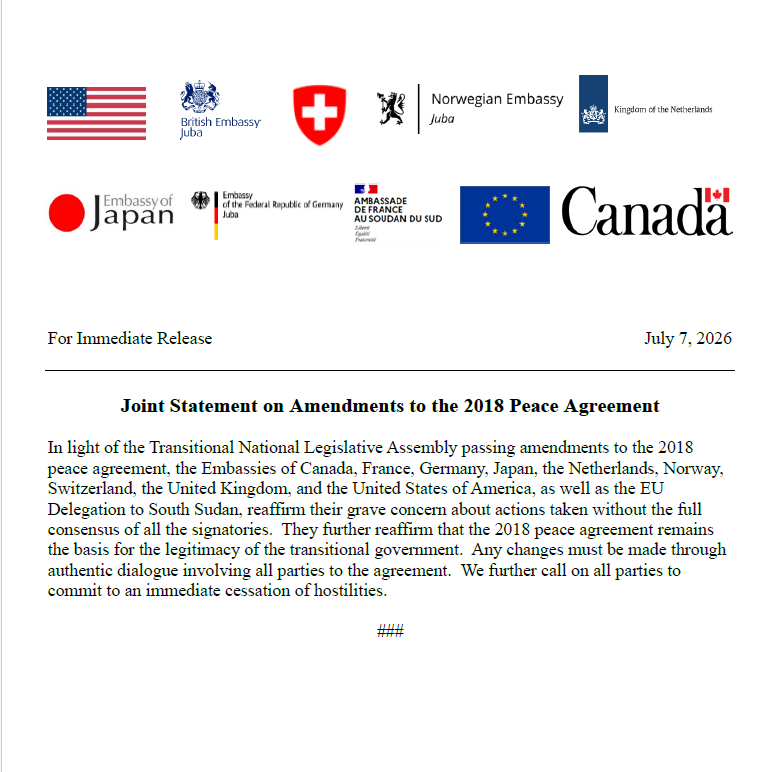
Joint Statement on Amendments to the 2018 Peace Agreement
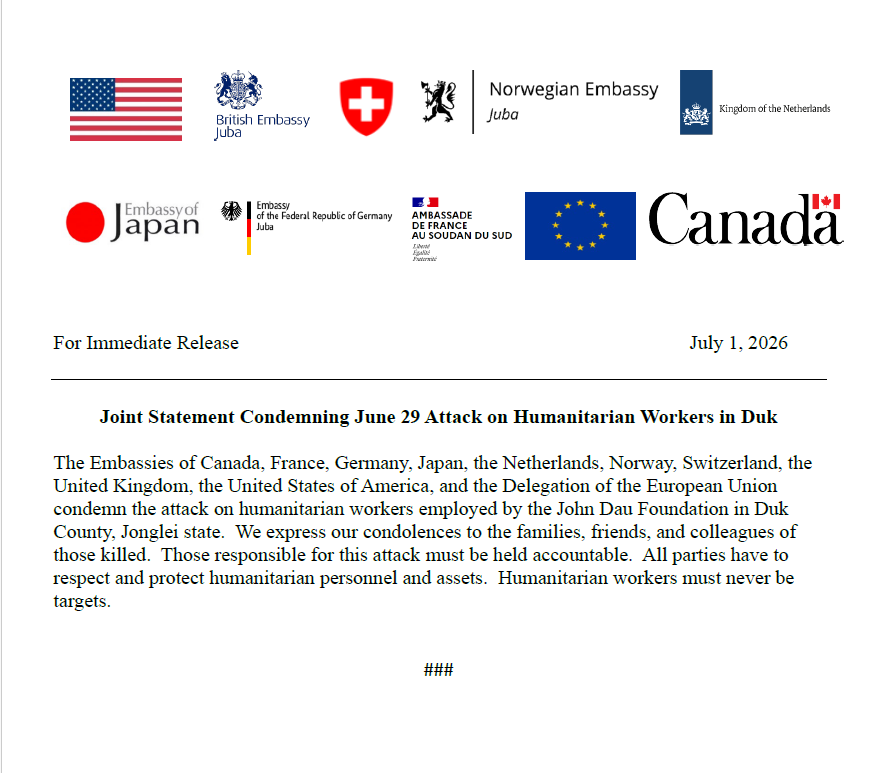
In light of the Transitional National Legislative Assembly passing amendments to the 2018 peace agreement, the Embassies of Canada, France, Germany, Japan, the Netherlands, Norway, Switzerland, the United Kingdom, and the United States of America, as well as the EU Delegation to South Sudan, reaffirm their grave concern about actions taken without the full consensus of all the signatories. They further reaffirm that the 2018 peace agreement remains the basis for the legitimacy of the transitional government. Any changes must be made through authentic dialogue involving all parties to the agreement. We further call on all parties to commit to an immediate cessation of hostilities.
https://t.co/vncYkjwviD
Peace is our priority in South Sudan. Peace requires a return to genuine interparty dialogue. Read Ambassador Adler's statement at the RJMEC briefing: https://t.co/srsPmxER46
South Sudan is sliding back into civil war. The EU should shift its posture away from state building – which is routinely exploited by predatory elites – toward a strategy of containing conflict and preventing wider collapse. https://t.co/BtaszU72Gn
The SPLM/A-IO under detained First Vice President Dr Riek Machar has distanced itself from the newly registered IO Party, saying the party is not affiliated with the movement. #SSOX#SouthSudan
https://t.co/NKG41nbzJ0
President Salva Kiir says the government has removed the census and permanent constitution-making process to allow the country to proceed with elections. #SSOX#SouthSudan
https://t.co/vairvdOkfo
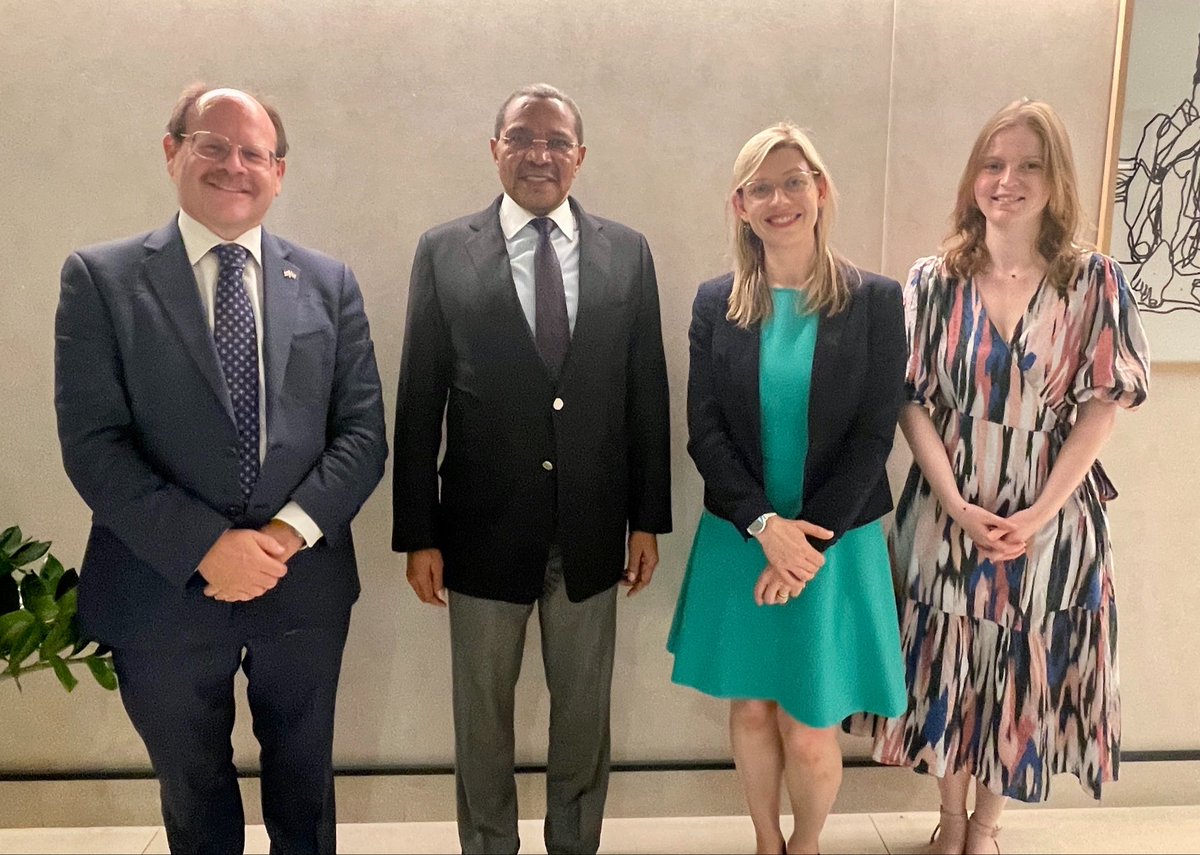
Former President of Tanzania, Jakaya Kikwete and I had the opportunity to meet the President of South Sudan, Salva Kiir Mayardit to discuss peace and the stability of South Sudan. Moreover, the discussion is focused on the upcoming elections in South Sudan in December 2026. The
The UK strongly supports the @_AfricanUnion’s efforts to achieve lasting peace in #SouthSudan through inclusive dialogue.
Delighted, while in London, to discuss 🇸🇸 with the AU High Representative, former President @jmkikwete, alongside my @FCDOGovUK colleagues.