Strange enough that Republic is misspelt in the citation seal, but Seychelles being misspelt is a really unusual lapse for a country to make on its own national honour document
It’s weird times for Indians in America. But pull out the world’s smallest violin for the lobby group that seemed to welcome Trump’s bigotry in other directions, but is now crying foul when he turns, as was always going to happen, against them
India’s ties with Israel are deep and in our policy circles, there is obviously entrenched gratitude for the support provided by Israel in past crises or more recent contingencies, thus providing strategic comfort. We cannot forget those who stand by us in critical moments, and this is how partnerships are built. But should this become the basis for uncritical alignment? Foreign policy cannot be an exercise in gratitude. Judgement should distinguish between bilateral cooperation, which may run very deep, and regional conduct, which is expansionist and escalatory. Conflating the two narrows India’s strategic space.
The capacity for calibrated engagement has historically been a key determinant in Indian foreign policy. We should value our strategic relationship with Israel, but that does not entail an abandonment of a strategic assessment of its actions. Strategic partnership cannot morph into strategic indulgence , which is not in our country’s long-term interest . Partnerships must deepen trust, not constrain judgement.
The #ceasefire (US-Iran) announcement marks a pause, but more importantly, it reveals where each actor now stands.
The United States has stepped back from the brink it created. A deadline backed by threats of overwhelming force has given way to a conditional pause built around negotiations. That signals not strength alone, but recognition of limits: military objectives may have been met, but political end states remain elusive.
Israel, for its part, finds itself in a more ambiguous position. Having driven escalation, it is now tethered to a process it does not fully control. Its objectives, particularly around regime change or long-term degradation of Iran, sit uneasily with a negotiation track shaped elsewhere.
Iran emerges with a measure of strategic resilience. It has absorbed strikes, retaliated, and then shifted the frame from ceasefire to conditions for a broader settlement: sanctions relief, security guarantees, and regional de-escalation.
In doing so, it has moved from target to negotiating actor without conceding core positions.
Pakistan’s role has unfolded not as architect, but as conduit and catalyst. It has provided the channel through which messages travelled, deadlines were softened, and a narrow diplomatic opening created. That is not mediation in the classic sense, but it cannot be dismissed with stray witticisms either.
What we are witnessing is not resolution of conflict , but repositioning.
The war has not ended. It has entered a different phase, where coercion and negotiation now proceed together.
For India, the implication is clear.
Do not read this as de-escalation alone. Read it as a system under strain, where outcomes are still fluid.
India should state its position with clarity:
support de-escalation, safeguard maritime flows, and resist alignment with any one narrative of this conflict.
This is not a moment for silence.
It is a moment for calibrated voice.
#WestAsia
#IranUSConflict
#MiddleEastCrisis
#StrategicAutonomy
#IndiaForeignPolicy
#Hormuz
#MaritimeSecurity
A little Ali Larijani Story
I have a little Ali Larijani story. In 2005, Iran signed a deal to export five million tonnes of liquefied natural gas, or LNG, for 25 years to India, with deliveries scheduled to start in 2009. Ali Larijani, as secretary of Iran’s Supreme National Security Council (a job he had till his assassination by the devilish Israelis), negotiated directly with Prime Minister Manmohan Singh about the price of gas to be paid by India.
During a visit to New Delhi, Larijani was told by Dr. Singh that the price of gas needed to be adjusted. The Iranian official said let me connect you to President Mahmoud Ahmedinejad and the matter can be resolved. The call was made from the PMO and Mr. Ahmedinejad and Dr. Singh spoke and arrived at an agreement on the call.
However, towards the end of September 2005, India voted with the United States and key European nations to refer the Iranian “nuclear question” to the UN Security Council. Almost immediately, Iran informed India’s IAEA envoy, Sheel Khant Sharma, that the LNG deal was off. Though the Manmohan Singh government “denied” my report in The Hindu, the fact is that not a single ship delivered any LNG from Iran to India.
The Iranians were shocked. An Iranian diplomat asked me at the time: “What happened?” The answer remains: “American pressure”.
https://t.co/mvp0PHV1K5
India must also recognise that its position as “net security provider” in the region has been challenged by the U.S.’s sinking of the IRIS Dena, which cuts more deeply given their joint membership of the Quad (the strategic forum comprising the U.S., Japan, India, and Australia).
Indians are asking why their country is negotiating from a position of weakness, when all they have heard for years is stories of its strength, writes @mihirssharma (via @opinion) https://t.co/AplUhfMJMq
Residents of Chewa, Narbal, Budgam, request immediate attention to construct road connecting to Magam-Wadwan road.
https://t.co/e4qCmf6gQx
@RuhullahMehdi@OmarAbdullah@DC_Budgam@jkrddpr@tarigami
Logon ki narazgi jayaz hai. Please look into it urgently .
#FixOurRoads
#UNMISS SRSG paid tribute to the great courage of the crew of a UN helicopter attacked during an evacuation mission in Nasir, #SouthSudan, on their return to Juba. He expressed condolences for the loss of their much-respected colleague, killed in action.
@ICICIBank_Care@ICICIBank How does a new customer’s cheque disappear for a week before being found. And no convincing explanation given about why @ICICIBank staff didn’t deposit the cheque a week earlier when the account was activated.
My message to the @g20org members meeting in Brazil this week: Use your political leadership and influence to help end this war and save the people of #Gaza.
In @folha:
https://t.co/n6nn2FK5m2
In @AJEnglish:
https://t.co/lE0vTDroCb
In @AJArabic:
https://t.co/dHaAOWKvez
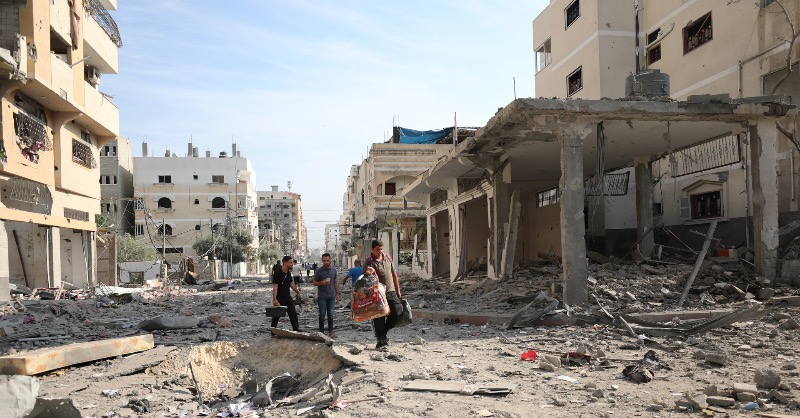
Civilians in #Gaza are in extreme peril.
We are calling on Israel to fulfil its legal obligation to provide food and medical supplies and facilitate aid operations.
And we are calling on the world’s leaders to prevent an even worse catastrophe.
#IASC 👉https://t.co/7V5oU8Vz11
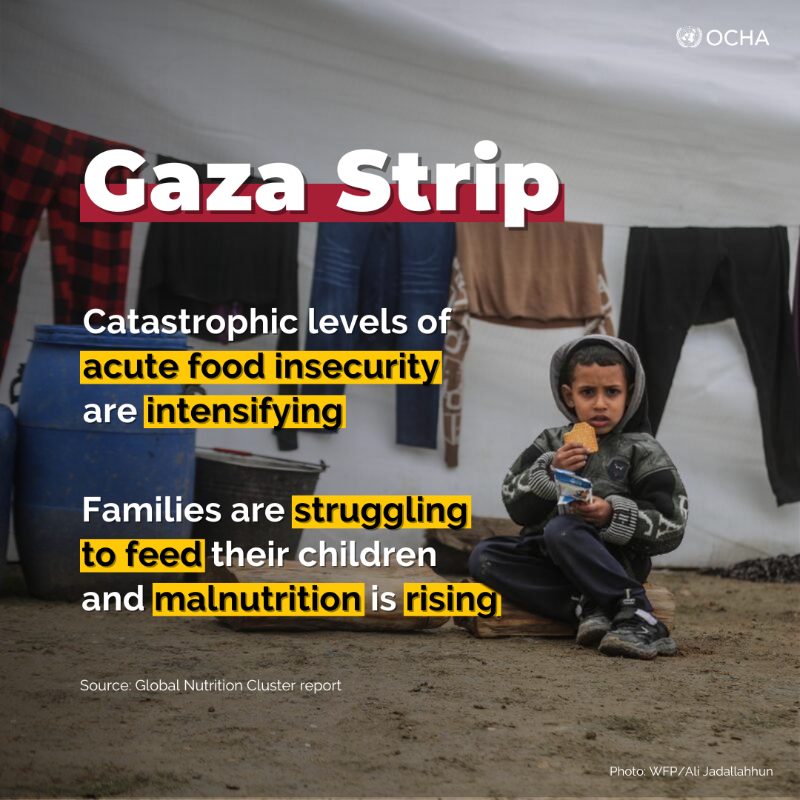
Access to food, clean water and health services across #Gaza is becoming increasingly scarce and diseases are proliferating amid ongoing hostilities.
A steep rise in malnutrition is being reported notably among children, as well as pregnant and breastfeeding women. Learn more 👇
In north Gaza, 1 in 6 children under 2 years old is acutely malnourished.
An immediate humanitarian ceasefire is the only way to scale up the delivery of aid to those who need it most.
https://t.co/rjX0NoKwSK