We provide high quality and efficient CRISPR-Cas9 edited C. elegans. As well as other nematode based service enable your aging, neuro and drug discovery
Reward to our Followers:
From May 1st, everyone who follows @SunBiotech on Twitter/X will be able to enjoy 15% OFF for one gene-editing strain!
The discount is valid for 3 months.
Thank you to all our followers for your trust!
Contact📧[email protected]
What does it take to get a gene-edited C. elegans strain? Less than you might think. On your side, it is two steps.
Download and fill in our order form.
Email it to 📩 [email protected]
Then we handle the rest.
All you need to decide: which gene, and what change you want, such as a knock-out, knock-in, point mutation or tag.
Order form: https://t.co/MGP6840JBg
Not sure how to fill it in? Simply email us your idea, and we will help plan the constructs.
Two human patient variants, written into the worm genome with CRISPR. That part of a new Cell Reports paper was built by our team, together with Shandong University.
Have a human variant you wish you could test in a living animal? 📩 [email protected]
On paper, a patient variant is one changed amino acid. In a worm it becomes a living animal with a phenotype you can measure: here, sterility for one variant and larval arrest for the other.
Our team built these disease models and analyzed the mechanism with the Shandong University labs of Zhe Zhang and Wenfei Li. Point mutations, knock-ins, tags and rescue strains are what we do every day.
Congratulations to all involved. Which variant would you like to see in a worm? Send us your thoughts, and we will help plan the constructs.
https://t.co/2NS1nSKeLl
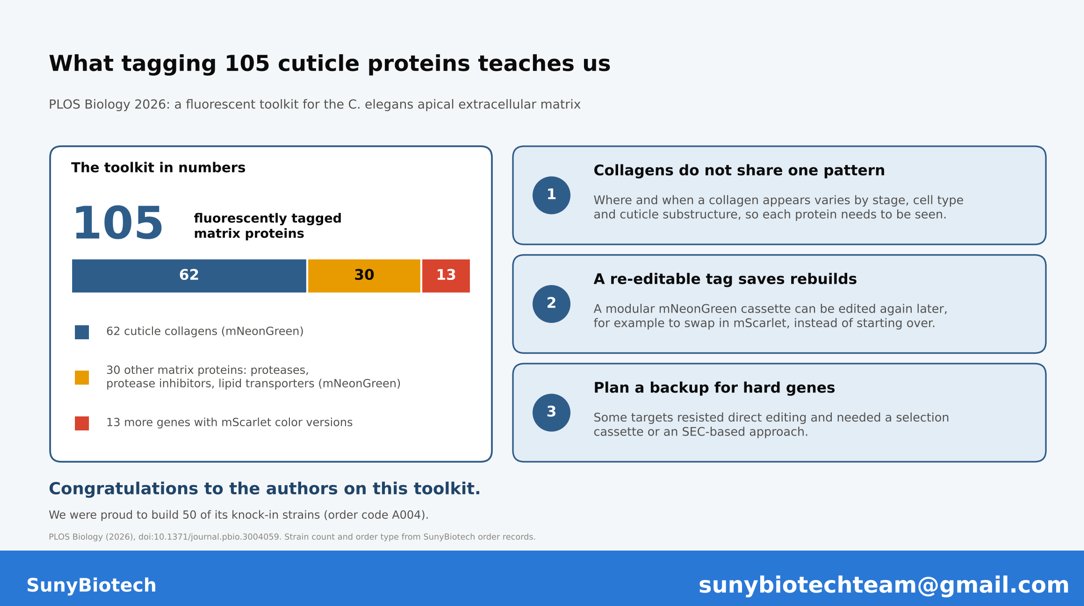
Is every collagen in the C. elegans cuticle in the same place? A new PLOS Biology paper tagged 62 of them to find out. They are not.
Congratulations to the authors. We were proud to build 50 of its knock-in strains (A004 order).
Questions about tagging your own genes? We are glad to chat: 📩 [email protected]
Collagens do not share one pattern. Where and when each one appears varies by stage, cell type and cuticle substructure.
A re-editable tag saves rebuilds. A modular mNeonGreen cassette can be edited again later, for example to swap in mScarlet.
Plan a backup for hard genes. Some targets resisted direct editing and needed a selection cassette or an SEC-based approach.
Which C. elegans problem is yours? We have a build for each. Email your number and gene: 📩 [email protected]
A gene gone → CRISPR knock-out
See where my protein is → GFP knock-in
A patient mutation in a worm → point-mutation knock-in
A gene on in one tissue only → tissue-specific expression
A protein off on demand → AID or ZIF-1
A protein’s neighbors → TurboID
Not on the list? Send us your question, and we will discuss the best strain design.
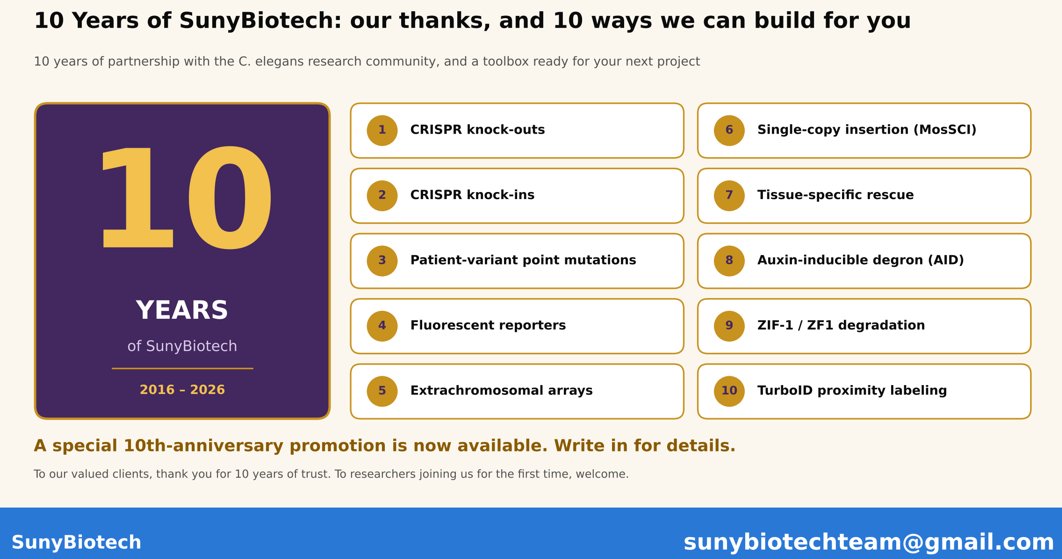
SunyBiotech is proud to celebrate 10 years of serving the C. elegans research community.
Our special 10th-anniversary promotion is now open. Write in for details: 📩 [email protected]
To our valued clients, thank you for 10 years of trust. To researchers joining us for the first time, you are most welcome.
A C. elegans hermaphrodite has just 8 dopamine neurons, and GFP can label every one. That makes neurodegeneration easy to watch.
Building a Parkinson’s or neurodegeneration model? 📩 [email protected]
The method, in 3 steps:
Label the neurons: GFP driven by the dat-1 promoter marks dopamine neurons in living worms.
Add the disease trigger: a human protein such as α-synuclein, a patient variant knocked into the worm gene, or the toxin 6-OHDA.
Score the loss: image the same worms across age, count surviving neurons, and add movement assays.
Always include a healthy control strain.
Send us your gene, and we will build the strains.
Worms fed a magnetic bacterium lived 43% longer on average. The proposed reason involves iron.
Need a custom strain for your own aging or ferroptosis project? 📩 [email protected]
The bacterium, AMB-1, makes tiny internal magnets. In the study, it cut iron buildup and fat oxidation and slowed ferroptosis, an iron-dependent form of cell death. The genetic work pointed to ftn-1, bli-3 and ads-1. Worm data only, not tested in people.
Send us your gene, and we will build the knock-out, knock-in or reporter strain.
Most CRISPR worm strains start the same way: a glass needle aimed at a worm about 1 mm long.
Need injections for your project? 📩 [email protected]
The mix goes into the gonad, where developing eggs take it up. A few days later, the next generation shows whether the edit or transgene worked. Knock-ins, knock-outs, extrachromosomal arrays, single-copy insertions: all of them begin here.
You design the gene. We hold the needle. Tell us the gene you wish you could edit, and we will help plan it.
A genetic test report says “variant of uncertain significance.” Nobody knows yet what it does. Could a worm help?
Have a human variant to test? 📩 [email protected]
Over 7,600 C. elegans genes have human counterparts. With CRISPR, we can write the exact patient change into the worm gene and watch what happens: cilia, movement, lifespan, a fluorescent reporter. In a 2022 study, 8 uncertain TMEM67 variants were knocked into worm mks-3. The worm assays flagged 5 as pathogenic-like and 3 as benign-like.
Send us your gene and variant, and we will help plan the strain.
Can you watch two proteins meet inside a living worm? With split Venus BiFC (VN/VC), yes.
Planning an interaction study? 📩 [email protected]
What is BiFC? Split Venus (VN/VC) is a fluorescent protein cut into two halves. Fuse one half to each protein you study, and the worm lights up only where the two proteins come together.
What it can show: whether two proteins meet in a living animal, and in which cells, tissues or subcellular compartments. With inducible expression, it can also show when.
Send us your thoughts, and we will help plan the constructs.
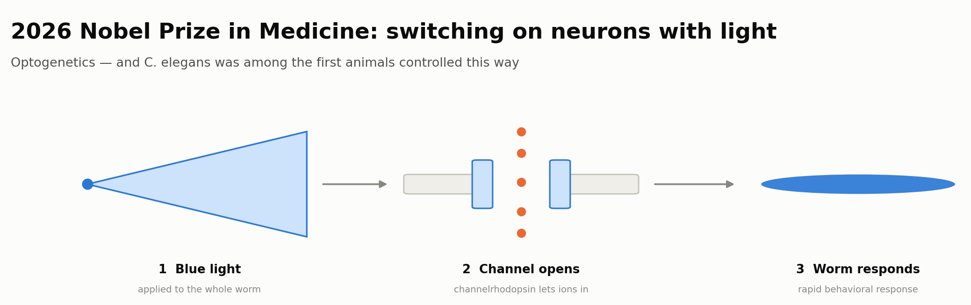
Today's Nobel Prize in Medicine honors optogenetics — and C. elegans was among the first animals ever controlled with light.
Planning an optogenetics project? 📩 [email protected]
Laureate Georg Nagel was first author of the 2005 study that switched on channelrhodopsin-2 in worm neurons with blue light and triggered behavior (Nagel et al., Curr Biol 2005). One practical detail: worms need all-trans retinal on the plate for the channel to work. We build the cell-specific strains — tell us your neuron or tissue and we'll help you plan it.
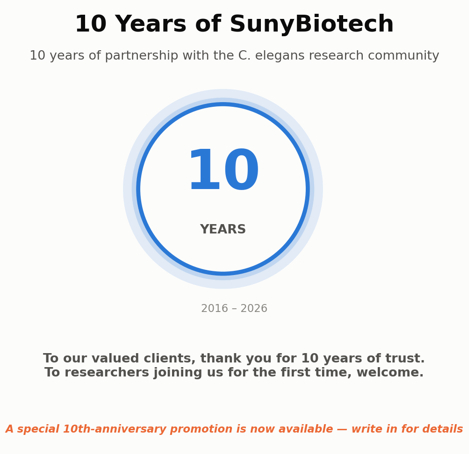
SunyBiotech marks 10 years of service to the C. elegans community, with a special 10th-anniversary promotion for returning clients and new collaborators alike.
For details, or any question about C. elegans, please write to us: 📩 [email protected]
To our valued clients, thank you for 10 years of trust. To researchers who have not yet worked with us, we extend a warm welcome and invite you to be part of this milestone.
One mutation, and a worm lives twice as long as normal.
Have an aging-pathway project in mind?
📩 [email protected]
In 1993, Cynthia Kenyon's lab found that a single mutation in daf-2 — the C. elegans insulin/IGF-1 receptor — nearly doubles lifespan (Kenyon et al., Nature 1993). The effect depends entirely on daf-16, a FOXO transcription factor: remove daf-16, and the extra lifespan disappears.
Studying this pathway usually means precise daf-2 alleles, tissue-specific daf-16 rescue, or a daf-16::GFP nuclear-translocation reporter to watch the pathway switch on and off. That's the kind of strain we build — tell us your allele or reporter design and we'll help you plan it.
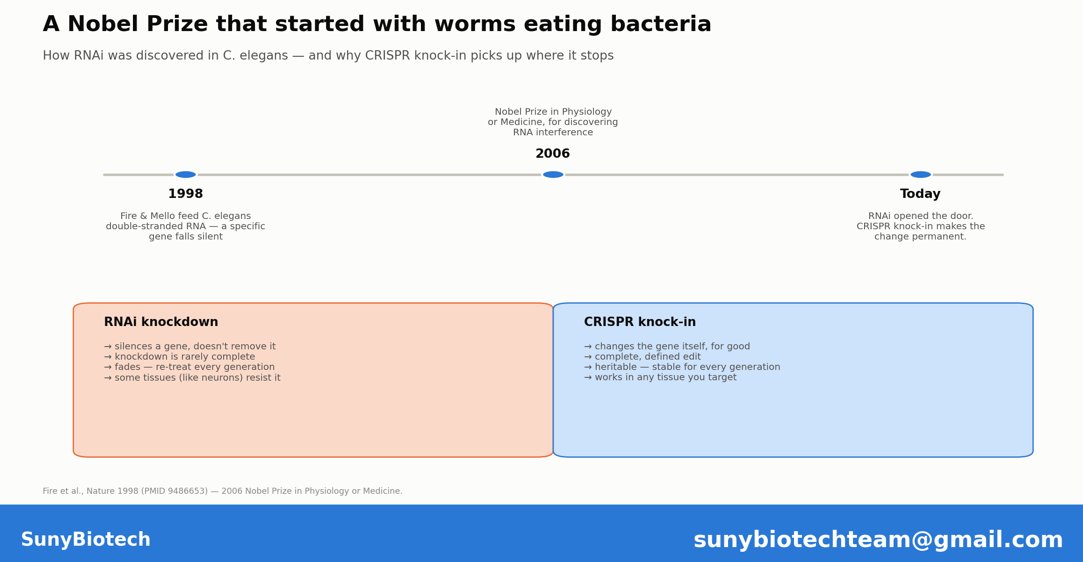
The gene-silencing technique that won a Nobel Prize started with worms simply eating bacteria carrying double-stranded RNA (Fire & Mello, Nature 1998 → Nobel Prize 2006).
Have a project in mind?
📩 [email protected]
RNAi silences a gene temporarily — a CRISPR knock-in changes it permanently, in exactly the cells you choose. If your gene resists RNAi, or you need a stable line instead of a fading knockdown, that's what we build. Tell us your gene and target tissue and we'll help you plan it.
I put the email right after the hook this time (around character 220), so it should be visible in the feed preview without anyone tapping "Show more" — while the fuller RNAi-vs-CRISPR explanation after it gives people who do expand a real reason to keep reading, rather than just a fact-and-email.
This worm turns green when its mitochondria are stressed — hsp-6p::GFP lights up the moment mitochondrial protein folding breaks down.
Want this reporter for your own gene or other mitochondria projects? Email your project:
📩 [email protected]
unc-119 mutants barely crawl. Insert your construct with a working unc-119, and only correctly edited worms move normally again — a built-in screen you can read on a plain scope, no PCR needed.
📩 [email protected]
Dpy-10 co-CRISPR trick
After a CRISPR injection, most F1 worms didn't take up your edit — and you can't tell which ones did just by looking.Co-inject a repair template for dpy-10 along with your real gene edit. Worms that also took it up show up as Roller or Dumpy under the scope — no PCR needed to spot them — and they're enriched for carrying your actual edit too (Arribere et al., Genetics 2014).
📩 [email protected] — send us your gene and let's talk strategy.
Summer's winding down, and in most C. elegans labs that means one thing: a wave of new rotation students, new hires, and grant-year projects about to start — all needing strains that don't exist yet.
Here's the timing mistake we see every fall: a project gets scoped for an incoming student, but the strain request doesn't go out until the student actually arrives. CRISPR knock-in generation — guide design, microinjection, F1/F2 screening, and homozygosing a clean line — is measured in weeks, not days, even for a straightforward edit.
The fix costs nothing and takes five minutes: send us the gene and edit as soon as the project is scoped, before the start date is even locked in. That way day one is spent collecting data, not waiting on genotyping.
Got a fall project taking shape? Send us your gene and desired edit and we'll give you a realistic delivery window: [email protected]
Need to knock down a protein in just one tissue, at just the right time? You've got two very different tools for that — and picking wrong costs you weeks.
Auxin-inducible degradation (AID): tag your protein, drive TIR1 in the tissue you care about, then add auxin whenever you want the knockdown to start. ~80% of target protein is gone within 30 min, near-complete by 60 min (Martinez et al., G3 2020) — real pharmacological on/off control, reversible by removing auxin.
ZIF-1/ZF1 degron: tag your protein with ZF1, drive ZIF-1 in your tissue of interest. Degradation is just as fast (~20–30 min half-life), but ZIF-1 is naturally active during early embryogenesis — so a ZF1-tagged protein gets degraded there too, regardless of your tissue-specific promoter (Armenti et al., Development 2014). If your protein of interest is already GFP-tagged, a GFP-nanobody::ZIF-1 toolkit sidesteps that problem entirely (Wang et al., Development 2017).
If you needed a knockdown you could switch on with a drug at exactly the right developmental stage, which would you reach for — AID, or ZIF-1? And why?
Planning a conditional knockdown? Send us your gene, target tissue, and stage — we'll help you weigh AID vs ZIF-1/ZF1: [email protected]
C. elegans sperm don't swim. They crawl — using a single pseudopod, no tail, no flagellum, and not even the actin-and-myosin machinery that powers crawling in virtually every other cell type.
The motor is Major Sperm Protein (MSP), which self-assembles into filaments that push the pseudopod forward at roughly 20–30 μm/min. Unlike actin, MSP doesn't even bind ATP directly — it's an entirely separate, independently evolved cytoskeletal motility system doing the same basic job actin does everywhere else in biology.
Not the kind of thing that shows up in a general biology textbook, but a genuinely distinct model system for studying cell crawling and cytoskeletal dynamics.
Working on cytoskeletal dynamics, motility, or reproduction in C. elegans? We'd be glad to talk through strain design for it: [email protected]
#Celegans #CellBiology #WormTwitter