Are you a 夜猫子? 😴🌙
夜猫子 (yè māo zi) literally means “night cat,” but in daily Chinese, it means night owl — someone who stays up late or feels more active at night.
Example:
我是夜猫子,晚上才有精神。
(Wǒ shì yè māo zi, wǎnshang cái yǒu jīngshén.)
I’m a night owl. I only feel energetic at night.
So… are you a 夜猫子? 🌙
Hanzi Made Easy
人 (rén)
The character for “person” 🧍
Some Chinese characters started as simple drawings.
And 人 is one of the easiest examples 👀
If you look closely,
it almost looks like a person walking.
💬 The character 人
人 (rén) means:
👉 person
👉 people
It’s one of the most common characters in Chinese.
🧠 When 人 becomes a radical
When used inside other characters,
人 often changes shape into:
👉 亻 (rén) — the “person radical”
Characters with 亻 are usually connected to:
🧍 people
🗣️ actions
🤝 relationships or human behavior
📖 Common characters with 亻
👤 你 (nǐ) — you
👉 亻 (rén) “person” + 尔 (ěr)
👨 他 (tā) — he
👉 亻 (rén) “person” + 也 (yě)
🛌 休 (xiū) — rest
👉 亻 (rén) “person” + 木 (mù) “tree”
💡 A person leaning against a tree = resting
💬 信 (xìn) — trust / letter
👉 亻 (rén) “person” + 言 (yán) “speech”
💡 Words from a person = trust/message
🏋️ 体 (tǐ) — body
👉 亻 (rén) “person” + 本 (běn) “root/origin”
🧑🤝🧑 伙 (huǒ) — partner / group
👉 亻 (rén) “person” + 火 (huǒ) “fire”
💼 做 (zuò) — do / make
👉 亻 (rén) “person” + 故 (gù)
✨ Why this matters
Once you learn radicals like 亻,
Chinese characters start feeling much more logical 👀
Instead of memorizing random shapes,
you start recognizing meaning patterns.
💬 Your turn
How many characters with 亻 have you seen before? 👀
儿童节 (Értóng Jié)
Children’s Day 🎈
Since it’s 儿童节, let’s learn some common Chinese words and phrases related to kids 👀
👶 小朋友 (xiǎo péngyou)
→ little kid / child
One of the most common ways to refer to children in Chinese.
🗣️ 这个小朋友很可爱。
(Zhège xiǎo péngyou hěn kě’ài.)
→ This child is very cute.
💡 Chinese people often call children 小朋友 instead of 儿童 in daily life.
🍼 宝宝 (bǎobao)
→ baby / darling
Used for babies — but also very commonly used affectionately 😆
🗣️ 宝宝睡着了。
(Bǎobao shuìzháo le.)
→ The baby fell asleep.
💡 Many adults jokingly call themselves 宝宝 online 👀
🧒 熊孩子 (xióng háizi)
→ naughty kid
A playful phrase for children who are wild, noisy, or mischievous.
🗣️ 那个熊孩子又在乱跑。
(Nàge xióng háizi yòu zài luàn pǎo.)
→ That naughty kid is running around again.
🍭 长大 (zhǎng dà)
→ to grow up
🗣️ 你长大以后想做什么?
(Nǐ zhǎng dà yǐhòu xiǎng zuò shénme?)
→ What do you want to do when you grow up?
🎒 幼儿园 (yòu’éryuán)
→ kindergarten
🗣️ 她在幼儿园工作。
(Tā zài yòu’éryuán gōngzuò.)
→ She works at a kindergarten.
✨ Wrap-up
From 小朋友 to 熊孩子,
Chinese has lots of fun and expressive ways to talk about kids 👀
辛苦了
xīn kǔ le
💬 Thanks for your hard work.
辛苦了 is a warm and natural way to acknowledge someone’s effort.
It can mean:
Thanks for your hard work.
You’ve worked hard.
I appreciate your effort.
⏰ When to use it
Use 辛苦了 after someone has worked hard, helped you, or done something that took time and effort.
It’s commonly used with coworkers, teachers, friends, family members, or service workers.
✨ Examples
今天加班到这么晚,辛苦了。
Jīntiān jiābān dào zhème wǎn, xīnkǔ le.
You worked overtime so late today. Thanks for your hard work.
老师,辛苦了!
Lǎoshī, xīnkǔ le!
Teacher, thank you for your hard work!
谢谢你帮我搬东西,辛苦了。
Xièxie nǐ bāng wǒ bān dōngxi, xīnkǔ le.
Thank you for helping me move things. I appreciate your help.
🙋 Your Turn
Who would you say 辛苦了 to today?
呢
ne
💬 What does 呢 mean?
呢 is a common particle used at the end of a sentence.
It can be used to ask “what about…?” or to show that an action is happening right now.
🧩 How to use it
1. Asking “What about…?”
你呢?
Nǐ ne?
What about you?
我喜欢喝咖啡,你呢?
Wǒ xǐhuan hē kāfēi, nǐ ne?
I like drinking coffee. What about you?
2. Saying something is happening right now
Subject + 在 + Verb + 呢
我在学习中文呢。
Wǒ zài xuéxí Zhōngwén ne.
I’m studying Chinese right now.
他在做饭呢。
Tā zài zuòfàn ne.
He’s cooking right now.
✨ Examples
我很好,你呢?
Wǒ hěn hǎo, nǐ ne?
I’m good. How about you?
我的书呢?
Wǒ de shū ne?
Where is my book? / What about my book?
别打扰她,她在睡觉呢。
Bié dǎrǎo tā, tā zài shuìjiào ne.
Don’t disturb her. She’s sleeping right now.
🙋 Your Turn
What are you doing right now?
Try answering in Chinese:
我在 ______ 呢。
Wǒ zài ______ ne.
I’m ______ right now.
学无止境
xué wú zhǐ jìng
💬 Learning never ends.
There is always more to learn, no matter how much you already know.
🧩 Break it down
学 (xué) — to learn
无 (wú) — without / no
止境 (zhǐjìng) — limit / end
学无止境 = Learning has no limit.
⏰ When to use it
Use 学无止境 to encourage someone to keep learning and improving, or to express that knowledge is endless.
It can be used for studying, work, skills, or life experience.
✨ Examples
即使你已经很优秀了,也要记住:学无止境。
Jíshǐ nǐ yǐjīng hěn yōuxiù le, yě yào jìzhù: xué wú zhǐjìng.
Even if you are already excellent, remember: learning never ends.
学习中文让我明白了什么叫学无止境。
Xuéxí Zhōngwén ràng wǒ míngbai le shénme jiào xué wú zhǐjìng.
Learning Chinese has taught me what it means that learning never ends.
🙋 Your Turn
What is something you never want to stop learning?
❤️ 520快乐!
(Wǔ èr líng kuàilè!)
→ Happy 520 Day!
In Chinese:
🗣️ 520 (wǔ èr líng)
sounds similar to
👉 我爱你 (wǒ ài nǐ)
→ “I love you”
That’s why May 20th became an unofficial internet Valentine’s Day in China 💕
✨ Fun fact
Chinese internet culture loves number wordplay.
520 (wǔ èr líng) → 我爱你 (wǒ ài nǐ) (I love you)
1314 (yī sān yī sì) → 一生一世 (yì shēng yí shì) (forever / for a lifetime)
So you’ll often see:
❤️ 5201314
→ “I’ll love you forever.”
Who would you say 520 to today? 👀❤️
Did someone go easy on you…
and pretend it was a fair win? 👀
In Chinese, that’s called 放水.
💬 Meaning
放水 (fàng shuǐ)
Literally: “release water.”
But in daily Chinese, it means:
👉 to go easy on someone
👉 to not use your full strength
👉 to let someone win on purpose
📖 Examples
🏀 他打篮球的时候故意放水。
(Tā dǎ lánqiú de shíhou gùyì fàng shuǐ.)
→ He went easy on purpose when playing basketball.
🎮 你别放水,我想认真玩。
(Nǐ bié fàng shuǐ, wǒ xiǎng rènzhēn wán.)
→ Don’t go easy on me, I want to play seriously.
😅 这次考试老师是不是放水了?
(Zhè cì kǎoshì lǎoshī shì bú shì fàng shuǐ le?)
→ Did the teacher go easy on this exam?
💡 When to use it
✅ Games, sports, competitions
✅ Exams or evaluations
✅ Casual conversations
Tone: informal, sometimes joking
⚠️ Cultural note
放水 can be:
😄 friendly (letting someone win)
😏 or slightly negative (unfair advantage)
So the tone depends on context.
✨ Wrap-up
Next time someone goes easy on you…
you’ll know exactly what to say 😏
The character for “water” 💧
Many Chinese characters are built from smaller parts called radicals.
And one of the most common radicals is:
👉 水 (shuǐ) — water
Once you recognize it,
you’ll start seeing it everywhere 👀
💬 The character 水
水 (shuǐ) means:
💧 water
It can be used as:
👉 a standalone character
👉 or a radical inside other characters
🧠 When 水 becomes a radical
When used on the left side of a character,
水 usually changes shape into:
👉 氵 (called the “three-dot water radical”)
Characters with 氵 are often related to:
💧 water
🌊 liquid
☔ flow
🫧 washing or moisture
📖 Common characters with 氵
🌊 河 (hé) — river
👉 氵 + 可
🧼 洗 (xǐ) — wash
👉 氵 + 先
🍹 酒 (jiǔ) — alcohol
👉 氵 + 酉
🌧️ 海 (hǎi) — sea
👉 氵 + 每
💡 Notice how all of them connect to liquids or water-related ideas.
✨ Why radicals matter
Learning radicals helps you:
👉 guess meanings more easily
👉 remember characters faster
👉 see patterns in Chinese writing
Instead of memorizing random symbols,
you start seeing logic 👀
💬 Your turn
Can you think of any other Chinese characters with the 氵 radical? 💧
The Five Elements: 金 木 水 火 土
In Chinese culture, everything in the world can be connected to five elements 👀
They’re not just materials — they’re a way to understand nature, balance, and change.
💬 What are 五行?
五行 (wǔxíng) = Five Elements
👉 金 (jīn) — metal
👉 木 (mù) — wood
👉 水 (shuǐ) — water
👉 火 (huǒ) — fire
👉 土 (tǔ) — earth
These elements are used to explain how things interact and influence each other.
🔥 In daily conversations
Chinese people still use Five Elements ideas in everyday speech.
For example, if someone:
😡 gets angry easily
🌶️ eats too much spicy food
😴 stays up too late
People might say:
🗣️ 你上火了。
(Nǐ shànghuǒ le.)
→ “You have too much internal fire.”
🏠 In home decoration
Some people use 五行 ideas in feng shui.
Examples:
🌳 plants → 木 (wood)
💧 aquariums → 水 (water)
🕯️ candles / red colors → 火 (fire)
The goal is to create a more balanced and comfortable space.
👶 In names and luck
Some parents even think about 五行 when naming children.
For example:
If someone is believed to “lack water,”
their name might include a character connected to 💧水.
❤️ In festivals and colors
Colors are also connected to the Five Elements.
During Spring Festival, you’ll see lots of:
🔴 red → 火 (fire)
Because fire symbolizes:
✨ energy
✨ luck
✨ driving away bad things
✨ Wrap-up
The Five Elements aren’t just ancient philosophy —
they still influence language, health, design, and daily life in China today.
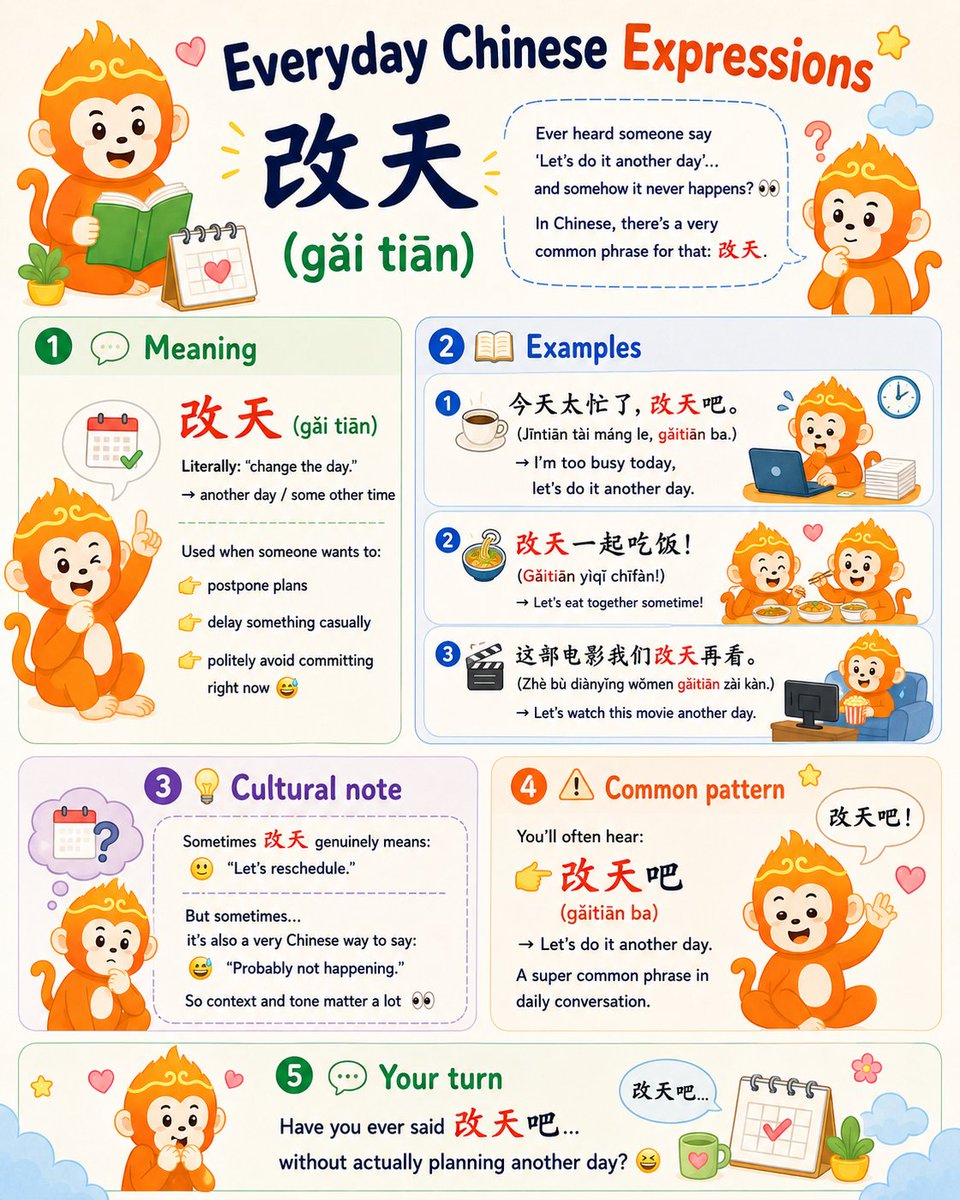
Ever heard someone say
“Let’s do it another day”...
and somehow it never happens? 👀
In Chinese, there’s a very common phrase for that: 改天.
💬 Meaning
改天 (gǎi tiān)
Literally: “change the day.”
→ another day / some other time
Used when someone wants to:
👉 postpone plans
👉 delay something casually
👉 politely avoid committing right now 😅
📖 Examples
☕ 今天太忙了,改天吧。
(Jīntiān tài máng le, gǎitiān ba.)
→ I’m too busy today, let’s do it another day.
🍜 改天一起吃饭!
(Gǎitiān yìqǐ chīfàn!)
→ Let’s eat together sometime!
🎬 这部电影我们改天再看。
(Zhè bù diànyǐng wǒmen gǎitiān zài kàn.)
→ Let’s watch this movie another day.
💡 Cultural note
Sometimes 改天 genuinely means:
🙂 “Let’s reschedule.”
But sometimes…
it’s also a very Chinese way to say:
😅 “Probably not happening.”
So context and tone matter a lot 👀
⚠️ Common pattern
You’ll often hear:
👉 改天吧
(gǎitiān ba)
→ Let’s do it another day.
A super common phrase in daily conversation.
💬 Your turn
Have you ever said 改天吧…
without actually planning another day? 😆
Why does Chinese say:
📕 一本书
👤 一个人
🏠 一家公司
What are those words in the middle? 👀
They’re called 量词 (liàngcí) — measure words.
In Chinese, you usually need a measure word between:
👉 a number
👉 and a noun
📖 个 (gè)
The most common measure word.
Used for:
👤 people
🍎 many everyday things
🗣️ 一个人
(yí ge rén)
→ one person
🗣️ 三个苹果
(sān ge píngguǒ)
→ three apples
📖 本 (běn)
Used for:
📚 books, magazines, notebooks
🗣️ 一本书
(yì běn shū)
→ one book
🗣️ 两本杂志
(liǎng běn zázhì)
→ two magazines
📖 家 (jiā)
Used for:
🏢 companies
🏪 shops/restaurants
🗣️ 一家公司
(yì jiā gōngsī)
→ a company
🗣️ 这家餐厅很好吃。
(Zhè jiā cāntīng hěn hǎochī.)
→ This restaurant is delicious.
📖 口 (kǒu)
Used for:
👨👩👧 family members
🗣️ 我们家有四口人。
(Wǒmen jiā yǒu sì kǒu rén.)
→ There are four people in my family.
📖 件 (jiàn)
Used for:
👕 clothing
📦 certain matters/things
🗣️ 一件衣服
(yí jiàn yīfu)
→ a piece of clothing
🗣️ 这件事很重要。
(Zhè jiàn shì hěn zhòngyào.)
→ This matter is important.
📖 只 (zhī)
Used for:
🐱 animals
✋ one of a pair
🗣️ 一只猫
(yì zhī māo)
→ a cat
🗣️ 一只鞋
(yì zhī xié)
→ one shoe
📖 元 (yuán)
The basic unit of Chinese currency.
🗣️ 五十元
(wǔshí yuán)
→ 50 yuan
💡 In daily conversation, people often say 块 (kuài) instead.
📖 块 (kuài)
Used for:
🧱 pieces/chunks
💰 also used for money in spoken Chinese
🗣️ 一块蛋糕
(yí kuài dàngāo)
→ a piece of cake
🗣️ 十块钱
(shí kuài qián)
→ 10 yuan / 10 bucks
✨ Wrap-up
Measure words are everywhere in Chinese 👀
Start with these common ones first:
👉 本、个、家、口、件、只、元、块
The more you hear them, the more natural they’ll feel 💛
Useful Chinese Idiom
心有灵犀 (xīn yǒu líng xī)
Ever thought of something…
and the other person said it at the same time? 👀
Chinese has a beautiful idiom for that moment.
💬 Meaning
✨ 心有灵犀 describes two people who
understand each other without needing words.
It’s used when there’s a strong sense of:
👉 mutual understanding
👉 emotional connection
👉 unspoken communication
🧠 Break it down
心 (xīn) — heart
有 (yǒu) — have
灵犀 (líng xī) — a legendary “telepathic connection”
👉 Hearts connected, minds aligned.
📖 Examples
💬 我们俩真是心有灵犀。
(Wǒmen liǎ zhēn shì xīn yǒu língxī.)
→ We really understand each other without words.
👯 她刚想说,我就说出来了,太心有灵犀了!
(Tā gāng xiǎng shuō, wǒ jiù shuō chūlái le, tài xīn yǒu língxī le!)
→ She was about to say it and I said it first — we’re so in sync!
💛 好的搭档需要心有灵犀。
(Hǎo de dādàng xūyào xīn yǒu língxī.)
→ Good partners need that unspoken understanding.
💡 When to use it
✅ Close friends
✅ Couples
✅ Teammates or partners
Tone: warm, positive, sometimes a little romantic
💬 Your turn
Who’s someone you feel 心有灵犀 with? 👀
Try writing a sentence using this idiom!
Asked for something… and the answer is a hard no? 😅
In Chinese, people often say: 没门 (méi mén)
💬 Meaning
没门 (méi mén)
Literally: “no door.”
→ No way / Not happening / Absolutely not
It’s a strong, direct refusal.
📖 Examples
🙅 你想让我加班?没门!
(Nǐ xiǎng ràng wǒ jiābān? Méi mén!)
→ You want me to work overtime? No way!
🎮 想让我让你赢?没门。
(Xiǎng ràng wǒ ràng nǐ yíng? Méi mén.)
→ Want me to let you win? Not happening.
🍰 你想吃我的蛋糕?没门!
(Nǐ xiǎng chī wǒ de dàngāo? Méi mén!)
→ You want my cake? No chance!
💡 When to use it
✅ With friends or in casual situations
✅ When you want to sound firm or playful
🚫 Not suitable for formal situations
🚫 Can sound rude if used with strangers or superiors
⚠️ Tone matters
没门 can be:
😆 joking and playful
😠 or seriously refusing
👉 It depends on how you say it.
💬 Your turn
What’s something you would say 没门 to? 👀
Useful Chinese Idiom
礼尚往来 (lǐ shàng wǎng lái)
→ "One good turn deserves another."
This idiom expresses the idea that when someone does something kind for you, it’s only right to return the favor. It emphasizes the importance of mutual respect and kindness in relationships.
Break It Down
礼 (lǐ) — courtesy, manners
尚 (shàng) — to value, to respect
往来 (wǎng lái) — interactions, exchanges
👉 It literally means "respect for manners demands reciprocal actions."
Examples
他送了我礼物,礼尚往来,我也给了他一个。
(Tā sòng le wǒ lǐwù, lǐ shàng wǎng lái, wǒ yě gěi le tā yīgè.)
→ He gave me a gift, and in return, I gave him one, as courtesy demands.
我们之间的关系一直很好,礼尚往来,互相帮助。
(Wǒmen zhī jiān de guānxì yīzhí hěn hǎo, lǐ shàng wǎng lái, hùxiāng bāngzhù.)
→ Our relationship has always been great, we help each other as courtesy demands.
💡 Fun Fact:
This idiom is often used in situations involving mutual exchange, like gifting, helping friends, or showing appreciation.
💬 Have you used this idiom before? How do you show courtesy to others? Let us know in the comments! 👇
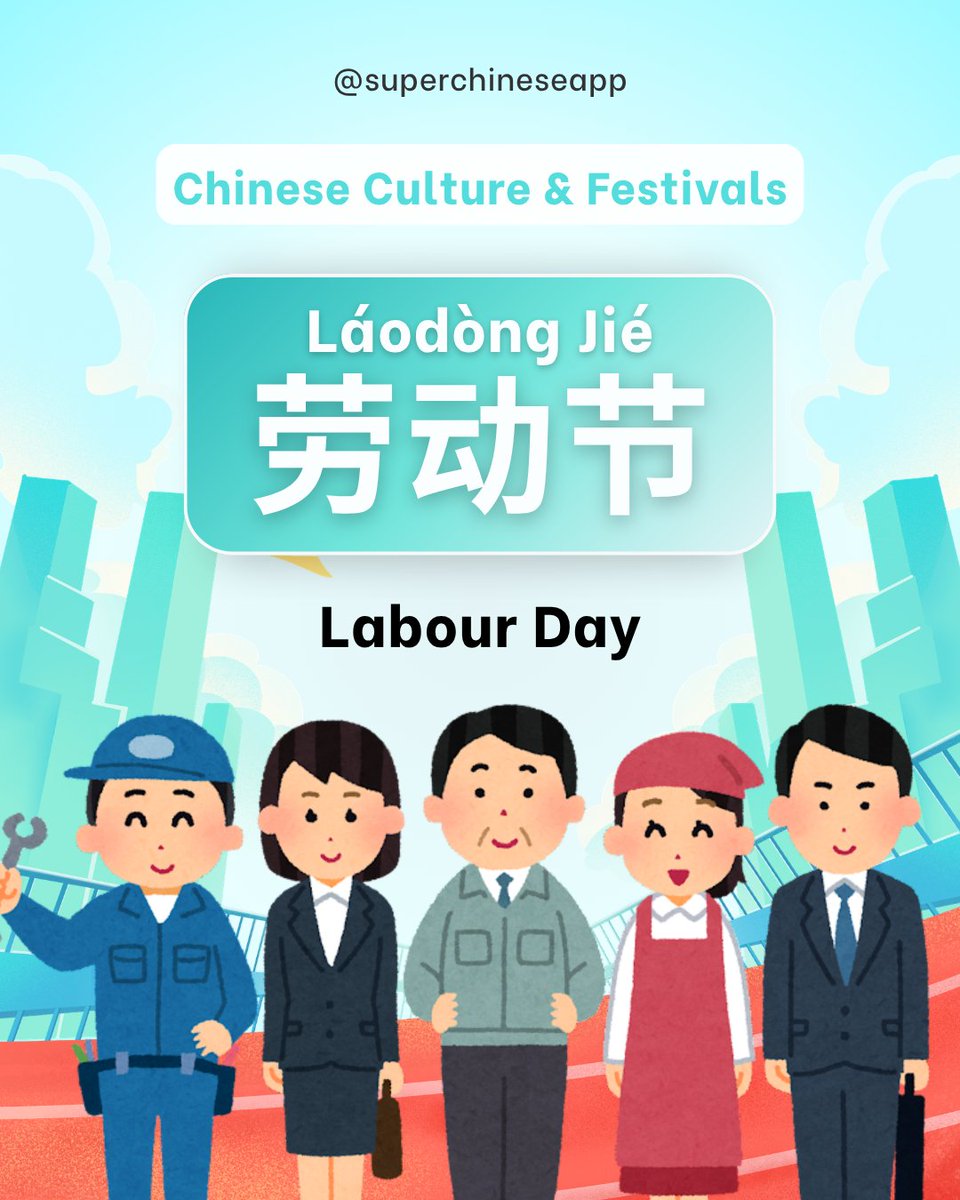
Chinese Culture & Festivals
劳动节 (Láodòng Jié)
Labour Day
May 1st is 劳动节 in China — a holiday to celebrate workers and their contributions.
But for many people, it also means something else 👀
💬 What is 劳动节?
劳动 (láodòng) = labor / work
节 (jié) = holiday
👉 A day to recognize the value of work and workers.
💡 调休 (tiáoxiū)
→ adjusted workdays
In 2026, Labour Day holiday is:
📅 May 1 → May 5 (5 days off)
But to make this long break possible…
👉 May 9 (Saturday) becomes a working day 😅
💡 Cultural note
You’ll often hear:
🚗 五一假期 (Wǔyī jiàqī)
→ “May 1 holiday”
📌 It’s one of the busiest travel seasons of the year —
crowds, traffic, and fully booked trains 😅
✨ Wrap-up
In China, 劳动节 is both:
💼 a celebration of work
✈️ and a chance to take a break from it