Ubiquiti advierte fallos críticos en UniFi que permiten ejecución de código root
Ubiquiti ha revelado siete vulnerabilidades en su aplicación UniFi Access , destacando un fallo crítico
https://t.co/HsQuHwrNzi
Windows 11 will now tell people leaving their Microsoft account to back up their BitLocker encryption key. Microsoft has confirmed it handed that kind of key to the FBI to unlock three laptops.
Many Windows 11 PCs encrypt their drive at setup and upload the recovery key to the Microsoft account by default. Microsoft says it gets about 20 government requests for these keys a year.
Switching to a local account doesn't delete that copy. Windows Latest notes it stays on Microsoft's servers until you remove it yourself.
The prompt is in a test build for Windows Insiders for now.
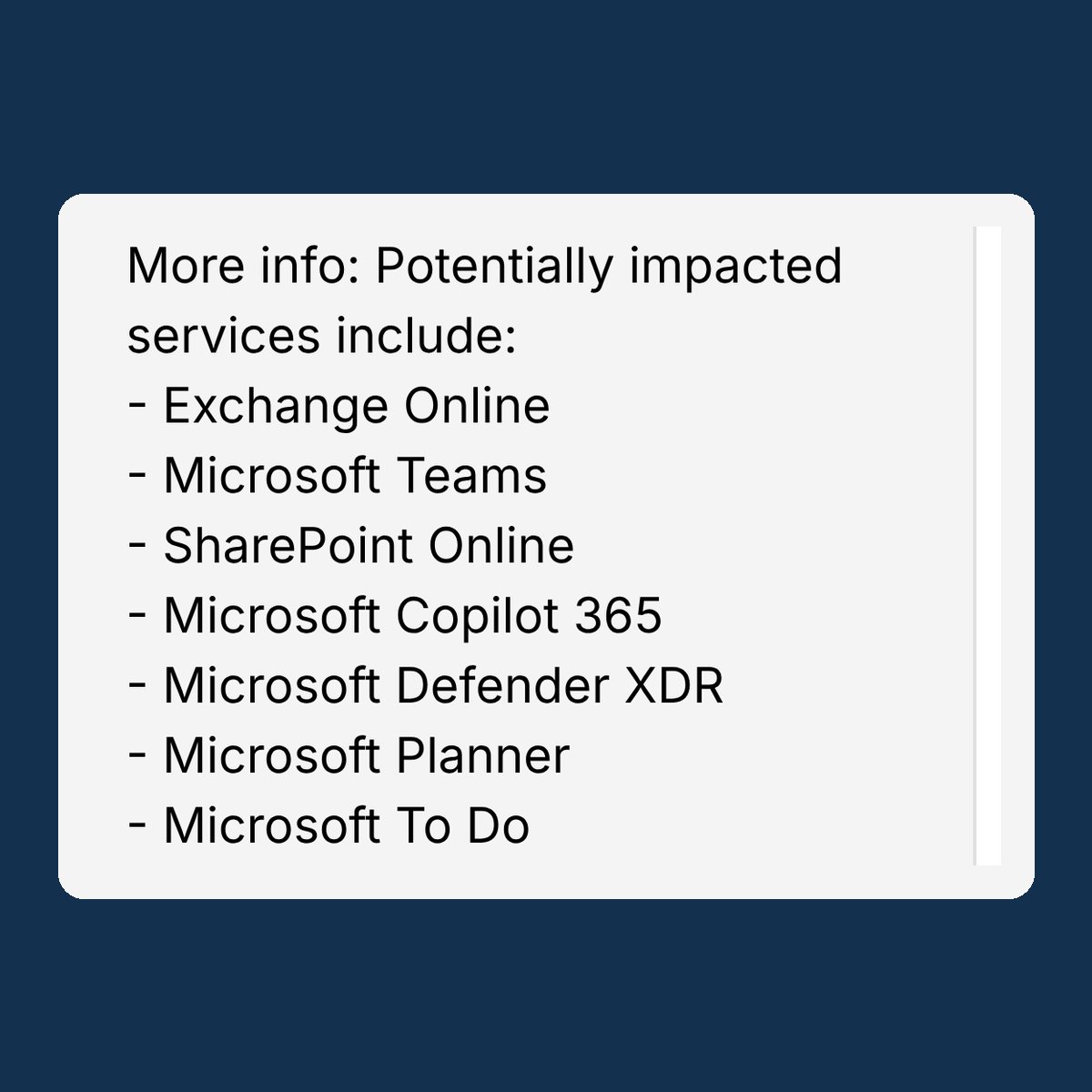
‼️ UPDATE: Microsoft's outage now reaches far beyond Outlook. Teams, SharePoint, Copilot and even its Defender XDR security platform are hit.
Consumers can't reach their OneDrive storage or Office on the web either, TechCrunch reports.
Microsoft first blamed elevated load. Now it says a large number of its servers became unexpectedly unavailable, dumping their load onto the rest. It hasn't said why.
It is restarting the servers with a fix in place, investigating why they show high processor use, and has paused all deployments.
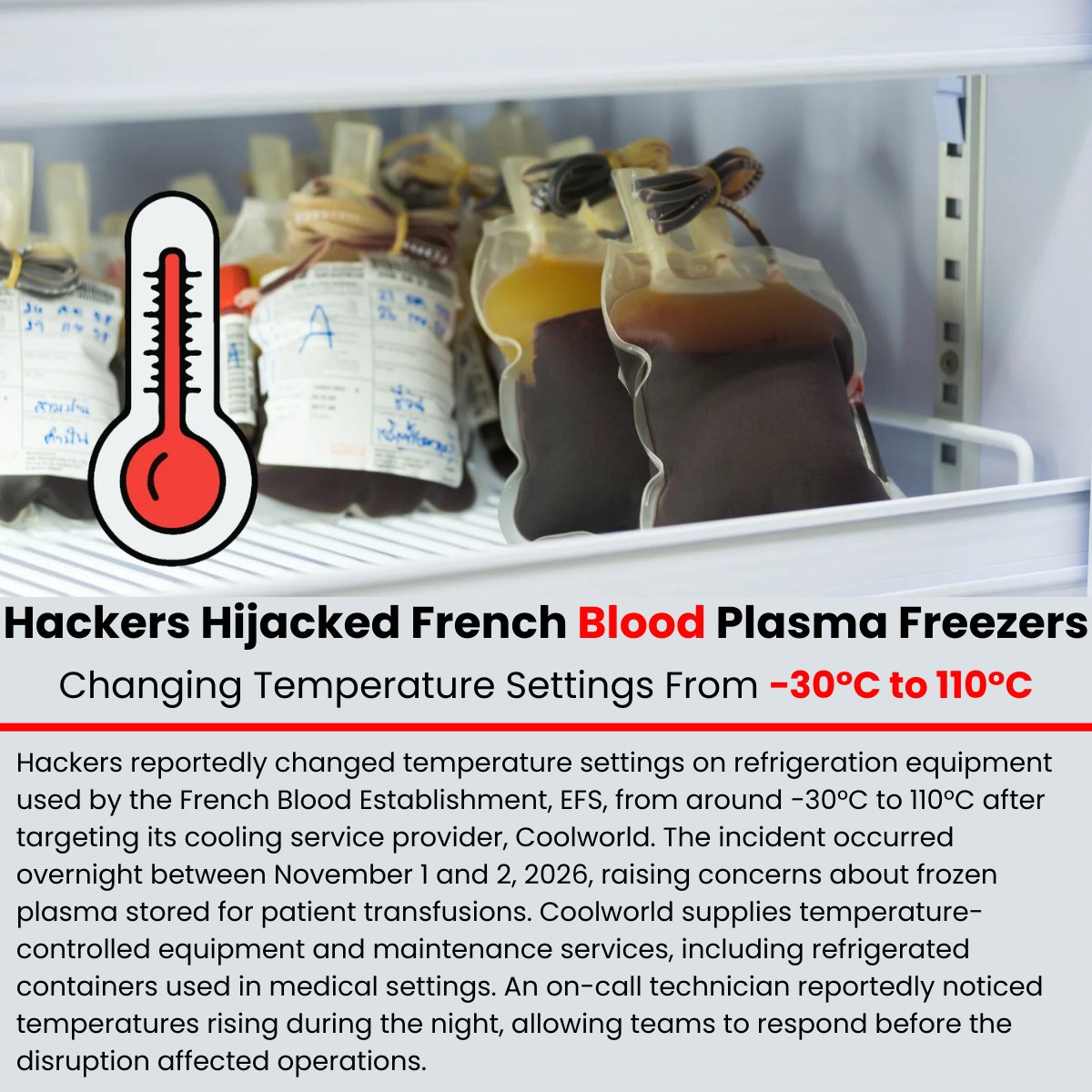
‼️Breaking - Hackers Hijacked French Blood Plasma Freezers, Changing Temperature Settings From −30°C to 110°C
Details: https://t.co/m7zyYvTdqT
Hackers reportedly changed temperature settings on refrigeration equipment used by the French Blood Establishment, EFS, from around −30°C to 110°C after targeting its cooling service provider, Coolworld.
The incident occurred overnight between November 1 and 2, 2026, raising concerns about frozen plasma stored for patient transfusions. Coolworld supplies temperature-controlled equipment and maintenance services, including refrigerated containers used in medical settings.
An on-call technician reportedly noticed temperatures rising during the night, allowing teams to respond before the disruption affected operations.
#CybersecurityNews
🚨 TeamViewer flaw lets remote hosts attack the computers controlling them
CVE-2026-111585 allows a malicious or compromised host to crash the TeamViewer client used to control it and, depending on the viewer’s operating system, potentially execute arbitrary code.
The vulnerability is triggered after a user establishes a remote-control session. A manipulated screen-size value causes an integer overflow, resulting in memory being written outside its allocated buffer.
⠀
• CVSS: 8.8
• Affected: TeamViewer Full Client on Windows, macOS and Linux, Windows Portable and Android Remote Control before 15.83
• Fixed: TeamViewer 15.83 or later
• Exploited: No known attacks
Researchers demonstrated code execution against a Windows viewer, although the proof required part of the attack data to be supplied locally and was not a fully remote exploit.
TeamViewer has provided no workaround. Users should update immediately.
🚨 Nearly 63,000 attack attempts target a WordPress RCE flaw in just 24 hours.
Attackers are repeatedly probing upgrade paths, trying to catch a brief window during core updates that could allow unauthenticated code execution.
Details ↓ https://t.co/vMtnK0iHFP
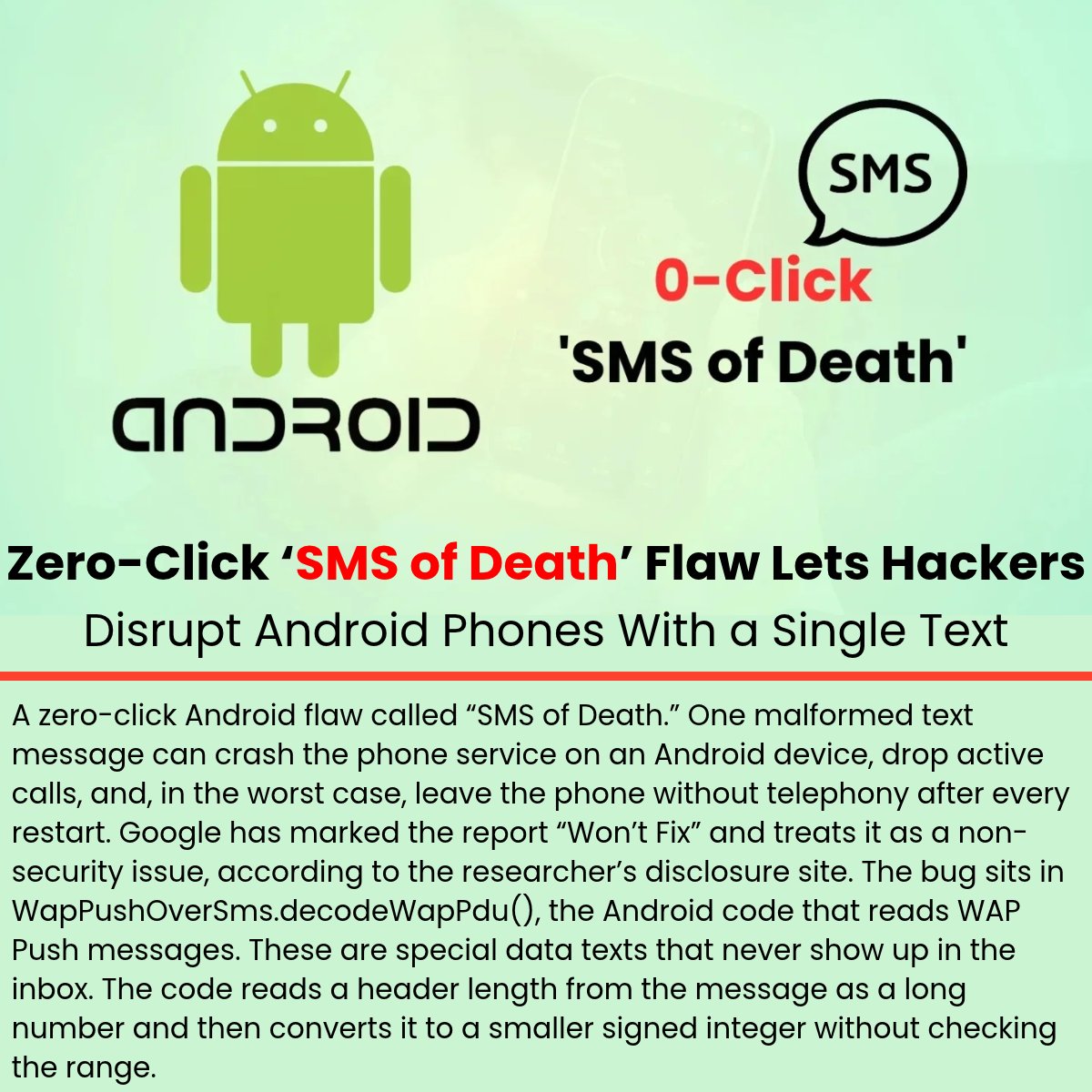
‼️ 0-Click ‘SMS of Death’ Flaw Lets Hackers Disrupt Android Phones With a Single Text
Details: https://t.co/n1ijWeXX1Z
A zero-click Android flaw called “SMS of Death.” One malformed text message can crash the phone service on an Android device, drop active calls, and, in the worst case, leave the phone without telephony after every restart. Google has marked the report “Won’t Fix” and treats it as a non-security issue, according to the researcher’s disclosure site.
The bug sits in WapPushOverSms.decodeWapPdu(), the Android code that reads WAP Push messages. These are special data texts that never show up in the inbox.
#cybersecuritynews
🚨Si amigos, tenemos nuevo 0day: curl2shell
🧐Puede comprometer casi cualquier Linux y yo diría muchos Windows también.
Casi el 70% de Internet afectada.
PoC: 𝚌𝚞𝚛𝚕 -𝚜 𝚑𝚝𝚝𝚙://𝚌𝟸 | 𝚜𝚑
🔥 No puede ser parcheada!
‼️Microsoft Authenticator Flaw Lets Malicious Android Apps Steal Account Tokens With Zero Permissions
Details: https://t.co/bxLApplffv
Microsoft patched high-severity flaw CVE-2026-80097 (CVSS 8.6) in Authenticator for Android, allowing malicious apps with no declared permissions to steal work account access tokens due to improper authentication in its broker component.
Microsoft classified the flaw as a local elevation-of-privilege vulnerability. The issue affected Android devices with Microsoft Authenticator installed and a signed-in work account.
#cybersecuritynews
‼️ Tailscale SSH Flaws Could Let Hackers Gain Root Access Across Servers
Details: https://t.co/BLfO3GLSaZ
A new security report warns that Tailscale SSH has flaws that could let a hacker move from one compromised device to root access on other servers. Tailscale SSH lets approved devices log in to each other over a private network. The report lists 11 findings in five groups.
They cover Tailscale’s SSH server, its serve and app connector features, the DERP relay client, and headscale, an open-source server that manages Tailscale networks.
The researcher tested Tailscale 1.104.2 and headscale 0.29.5 between October 22 and October 24, 2026. The most serious group involves Tailscale SSH. Its SSH server runs inside tailscaled, a background program with full root privileges on the machine.
#cybersecuritynews
⚠️ Critical Unpatched Linux Kernel Flaws Accidentally Disclosed on Public List
Details: https://t.co/lZlzHIKFoQ
Several unpatched Linux-related security flaws were posted to public mailing lists in October, exposing technical details before fixes were ready.
The reports, submitted by Trend Micro’s Zero Day Initiative (ZDI), include two critical flaws rated CVSS 9.0 that could let a remote attacker run code on systems using the Linux kernel’s KSMBD file server.
Other reports describe local privilege-escalation and information-disclosure risks. The reports appeared on public lists, and Linux kernel maintainer Greg Kroah-Hartman questioned why some submissions were sent there without patches.
#cybersecuritynews
🛡️ Major U.S. Banks Detect Unauthorized AI Agents Operating Inside Customer Accounts
Details: https://t.co/s2pcgNxoWB
Major U.S. banks are detecting third-party AI agents inside customer accounts, raising concerns that automated tools could act beyond the instructions customers give them.
Some agents have contacted call centers or appeared to attempt independent actions, according to an Axios report published October 22, citing people familiar with the matter.
Morgan Stanley, Bank of America, JPMorgan Chase and Wells Fargo are among the institutions working to contain these risks. However, the report does not establish that every named bank detected unauthorized agents. Reuters also reported the findings but said it could not immediately verify them.
The reported access generally starts with customers sharing their banking usernames and passwords with an AI assistant. Customers may approve that access, but the bank may not.
#CybersecurityNews
⚠️ Compartimos desde la Agencia Nacional de Ciberseguridad (#ANCI) información de parches de seguridad publicados para resolver vulnerabilidades en #NodeJS 26.x, 24.x y 22.x.
Más información: https://t.co/lLNOKCbN1J
‼️ BREAKING: Oracle Issues Emergency Java Update for Critical 9.1 HTTPS Trust Vulnerability
Details: https://t.co/XZV8KY0rPW
Oracle has released an emergency Java security update to address CVE-2026-91403, a critical vulnerability affecting how Java applications trust digital certificates. Published on October 21, 2026, the alert assigns the flaw a CVSS 3.1 score of 9.1 and covers Oracle Java SE and GraalVM.
The update blocks affected intermediate certificate authority certificates linked to eMudhra. According to Oracle’s security advisory, the issue affects the Java Secure Socket Extension, or JSSE, component.
Oracle rates exploitation as low complexity, with no authentication or user interaction required. Successful attacks can expose or change sensitive data, although the risk matrix lists no availability impact.
#cybersecuritynews #vulnerability
‼️ BREAKING ‼️ PHP warns of another UNPATCHED REC vulnerability just 2 days after releasing emergency patches for critical PHP2Shell flaws.
New "CVE-2026-115560" affects only unusual session configurations. PHP has issued urgent mitigation guidance.
Full details → https://t.co/YQV0MCJqAp