Independent Legal Opinion: SAL Eligible for Listing on MiCAR-Authorised Exchanges
We commissioned an independent legal analysis from Gunnercooke GmbH, a German law firm, to assess SAL’s regulatory positioning under the EU’s Markets in Crypto-Assets Regulation (MiCAR).
The opinion concludes:
"The admission of the SAL Token to trading on MiCAR-authorised CEXs is legally permissible, provided that the relevant trading platform complies with its own MiCAR obligations, in particular those relating to AML/CTF compliance, customer identification, transaction monitoring, and the maintenance of appropriate operating rules under Article 76 MiCAR."
In addition, the analysis confirms:
→ SAL is classified as an “Other Crypto-Asset” under MiCAR (the same category as BTC)
→ SAL’s privacy features do not violate MiCAR
→ SAL’s protocol design — including CARROT, SPARC, and view keys — enables exchange-level compliance
→ Admission to trading on MiCAR-authorised exchanges is legally permissible
With MiCAR now in force across the European Union, this opinion provides clear regulatory guidance regarding SAL’s position within the framework.
This is an important step in the legal foundation we have been building deliberately and thoughtfully.
The blog post breaking down the full legal opinion is now live: https://t.co/OyMgIzTm1Y
Thank you to the community for your continued support.
The Salvium Team
$SAL
Milestone 1: Stage Two Development Update
Following our initial high-level announcement of Milestone 1, we are now sharing a more detailed development update as meaningful progress has been made. This update focuses on functional implementation and current system capabilities. As previously outlined, deeper technical documentation and public repositories will follow at the appropriate stage of development.
Salvium Assets: Functional Prototype
A working prototype of user-generated Salvium Assets is now operational.
At the protocol level, asset creation and transfer mechanics are functioning, and the CLI wallet implementation is nearing completion.
Development Status:
- CLI C++ implementation: ~95% complete.
- Milestone 1 C++ implementation overall: ~75% complete.
- RPC and API code: Nearing completion.
- Salvium Asset functionality at the protocol level: Operational.
This represents a substantial step toward bringing asset functionality to Testnet.
GUI & Wallet Integration
Work is underway to integrate Salvium Asset functionality into the GUI wallet.
Our upgraded GUI will include the following features:
- An asset dropdown listing all Salvium Assets owned.
- The ability to switch between assets.
- Standard wallet operations per selected asset.
- A cleaner, more user-friendly interface.
A specification is also being prepared for potential Stack Wallet integration. While third-party integration is not guaranteed, we will pursue it where feasible.
Asset Structure & Rules
- Asset tickers may contain up to 4 alphanumeric characters.
- All Salvium Assets are automatically prefixed with “sal”.
- Salvium Asset creation is one-way; assets cannot be converted back into SAL1.
- The creation fee is currently 1000 SAL1 and may be adjusted over time.
This structure maintains a clear separation between the base-layer currency and issued assets while discouraging spam and preserving predictable system behavior.
Metadata Framework
Salvium Assets support metadata fields at the time of creation.
- Metadata will use structured JSON fields.
- We are currently confirming whether certain fields will be mandatory (e.g., URL, copyright, size, checksum/signature, name).
- A verification mechanism will be included once the metadata specification is finalized.
This framework lays the groundwork for structured and verifiable asset information. It establishes a consistent foundation for how Salvium Assets can be defined and validated going forward.
CLI Wallet Functionality
The following commands are currently implemented:
- CREATE_TOKEN <ticker> <supply> <decimals> <metadata>
Creates a new Salvium Asset on-chain with the prefix “sal” (e.g., salABCD).
- GET_TOKENS <ticker>
Searches for existing Salvium Assets matching the specified ticker.
- TRANSFER <addr> <amount> salABCD
Transfers a specified amount of a Salvium Asset to a Salvium address.
- [SWEEP_ALL | SWEEP_BELOW <amount>] <addr> salABCD
Sweeps Salvium Asset balances to a given address.
- RETURN_PAYMENT <txid>
Returns a transaction, whether it is SAL1 or a Salvium Asset.
The STAKE and BURN commands are intentionally restricted from interacting with Salvium Assets.
Additional Components Under Milestone 1
In addition to Salvium Assets and the new upgraded GUI, Milestone 1 may include:
- A new mining algorithm aimed at reducing botnet incentives.
- Anonymous one-way payment channels (under evaluation; not yet confirmed).
We are also developing potential applications to test and validate Salvium Asset functionality in practical scenarios. These efforts are intended to ensure usability, robustness, and real-world readiness prior to broader release.
Further updates on these components will be provided as development progresses.
Milestone 1 continues to progress steadily, and this Stage Two update reflects meaningful forward movement across both protocol and user-facing components. Salvium Assets represent more than a feature addition; they are foundational infrastructure for broader functionality ahead. Testnet is the next milestone gate, and it’s not as far off as it may seem (soon). We will share further updates as we move through the final steps leading up to it.
The Salvium Team
$SAL
An Introduction to Salvium Milestones
As Salvium continues to evolve, we want to clarify how future announcements will be shared and what the community should expect moving forward.
Rather than publishing a long-term roadmap with fixed timelines, we will be discussing milestones as they approach meaningful completion. Each announcement will focus on high-level functionality and intent, shared only after tangible progress has been made. This approach allows us to remain flexible, execution-focused, and honest about where things stand, without anchoring expectations to dates that may shift as development deepens.
It’s also important to understand that these milestones are not isolated features. Many of the systems being introduced are foundational components required for future Layer 2 functionality and smart-contract-like capabilities. In other words, what’s being announced now is part of a deliberate technical progression toward scalability, composability, and programmable privacy.
With that context in mind, here is the first milestone we’re ready to discuss publicly.
Milestone 1: Salvium Assets
We’re expanding Salvium’s functionality by introducing asset issuance, moving the project into a powerful Web3-native asset framework. This system unlocks meaningful, privacy-preserving use cases directly on Salvium while remaining aligned with its core design principles.
Private Ownership Proofs & Voting Rights
- Wallets can generate zero-knowledge proofs showing ownership of a specific amount, or percentage, of a token.
- Proofs can be shared anonymously with third-party applications.
- Enables private voting, gated access, DAO participation, and Web3 authentication without revealing balances or identities.
Real-World Assets (RWA)
This milestone also marks Salvium’s entry into the Real-World Asset (RWA) sector, using privacy as a core design principle rather than an afterthought. By combining asset issuance with zero-knowledge ownership proofs, Salvium enables powerful RWA use cases, including:
- Tokenized representations of real-world assets such as commodities, collectibles, equipment, art, property interests, and more.
- Private cap tables and fractional ownership without publicly exposing participants or allocations.
- Private transfers of asset-backed tokens, shielding counterparties, transaction history, and asset distribution.
This positions Salvium as infrastructure for private, verifiable, and composable real-world assets, suitable for individuals, DAOs, and institutional use cases alike.
As a final note, it’s important to address how much of this work is being developed. A significant portion of Salvium’s ongoing development, including systems related to these milestones, is being built in private repositories. This approach is intentional. As privacy-focused infrastructure moves closer to real-world utility, it has become clear that there are others watching closely, and in some cases looking to replicate work in an effort to rush similar ideas to market. Developing behind the cloak allows us to protect both our developers and the integrity of the work, ensuring that Salvium can deliver these capabilities correctly and on its own terms.
At the same time, while implementation may be private, direction is not. We actively welcome thoughtful discussion from the community around how these features could be applied in real-world scenarios — whether that’s governance, asset ownership, access control, or entirely new use cases we haven’t yet considered. Community insight will continue to play an important role as these milestones evolve from foundational systems into practical tools.
We’re very excited for what’s to come, and as always, we thank you for your continued support.
The Salvium Team
$SAL
We’ve been whispering about Salvium Two for some time, and the possibilities it can bring to the space, but what many don’t know is that the foundational piece of code to enable truly private smart contracts has already been inserted into Salvium’s code.
In fact, it’s been there for some time. You just haven’t looked hard enough.
It’s disabled, sitting patiently, waiting to be built upon. And its time is coming.
Are you ready, Anon?
$SAL
So what truly sets Salvium apart from many traditional privacy coins? 🧵👇
In short: privacy and compliance. Whereas many privacy-coins prioritise anonymity but often conflict with regulatory listings, Salvium is the worlds first privacy chain built from the ground up to provide both.☑️
On the privacy side, Salvium uses a combination of:
▫️Ring Signatures
▫️Ring Confidential Transactions (RingCT)
▫️Stealth Addresses
All to protect the privacy of senders, receivers, and transaction amounts.🔐
Did we find the first native wallet for @nonossystems for first distro release ?
When you build an operating system from scratch, not a distro, not a sandbox but a deterministic, zero-state, cryptographically enforced microkernel, the first question for integrating a privacy asset is not “which coin is good?” but “which protocol can physically operate inside a verifiable execution environment with no persistent state, no mutable dependencies and strict capability boundaries?”
Most privacy systems break under those constraints. @salvium_io is the first one that does not and that’s why I’m evaluating it seriously at a technical level.
The reasoning is architectural.
The nønos runtime imposes harsh constraints on any wallet capsule: it must run entirely in RAM, deterministically, with constant-time cryptography, zero disk I/O, no dynamic linking, no database layer and a sealed syscall surface. Salvium protocol design aligns with those requirements in a way most people underestimate.
i) The T-CLSAG construction gives Salvium a deterministic, constant-size proof system that can be implemented directly inside our crypto-provider without introducing nondeterministic memory access, external dependencies or timing-based side channels. T-CLSAG structure especially the way it composes with CARROT addressing is compact enough to fit inside a zero-state capsule where every execution path must be validated and reproducible.
ii) CARROT addressing removes the need for a persistent wallet datastore entirely. Most privacy coins require local indexing, scanning state or database recovery to reconstruct spendable outputs; nønos cannot allow that. CARROT hierarchical one-time addressing can be regenerated deterministically from a seed at capsule start, without keeping any long-lived state in memory or disk. This alone makes Salvium structurally compatible with a zero-state OS.
iii) Salvium refundable commitment system is implemented as a cryptographic condition, not a state-tracking layer. This makes refund paths enforceable without local logs, checkpoints or stored metadata something very few privacy protocols achieve. For a system like NØNOS, this is critical: capsules start from zero and end at zero and Salvium model is one of the only designs that supports that lifecycle.
iv) The entire proof-construction path in Salvium is small enough to run inside an isolated capsule with strict capability boundaries. NØNOS will not allow a wallet to reach the filesystem, to allocate arbitrary memory, to fork processes or to call system-level networking. Salvium signing, verification and commitment logic can be implemented fully inside the kernel crypto-provider without expanding the trusted computing base or requiring OS components that don’t exist in our model.
v) Salvium approach to programmable privacy (auditor keys, extractable view paths, verifiable policy without deanonymization) fits directly into the attestation model NØNOS is building. An OS that enforces zero-state execution still needs to provide attestable behavior and Salvium design allows verifiable correctness without exposing internal private data. Very few privacy protocols achieve this clean separation.
This is the underlying reason @salvium_io stands out for me technically:
its cryptography behaves like something intentionally designed for a stateless, deterministic compute environment, even though that was not its explicit goal.
NØNOS itself is still early, we are a micro-kernel, a bootloader and a cryptographic execution layer under construction. We do not yet have full userland, full networking, or full capsule orchestration but the first asset we integrate must validate the OS model, not compromise it. A native wallet must survive inside a pure zero-state lifecycle, produce deterministic proofs, and avoid every legacy assumption inherited by traditional operating systems.
From everything I’ve studied about @salvium_io is something i definitely support in web3.
Let’s be crystal clear: Salvium is private by default.
That’s the baseline - privacy should be the norm and not a feature.
But here’s the real game-changer: Salvium has innovated the tech that lets regulated exchanges list $SAL while staying fully MiCA-compliant.
Say that again slowly: no other privacy coin in the world - NONE, has a solution that lets exchanges navigate evolving regulations while keeping the asset private by default.
We’re not just talking privacy. We’re talking privacy + compliance, a combination the crypto space has never seen before. Period.
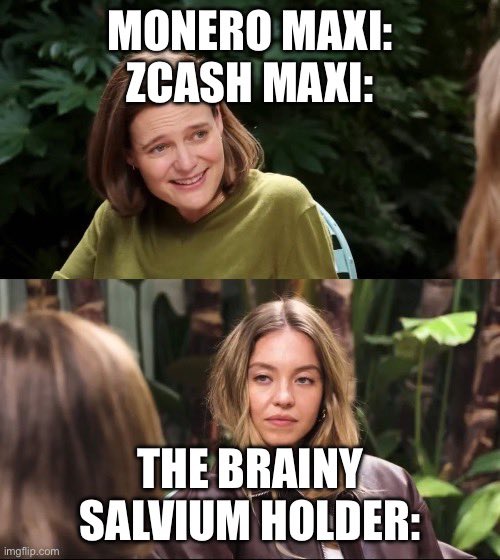
While the Monero and Zcash maxis are busy in a bunfight about whose tech is better, Salvium’s $SAL in the background, going full Sweeney mode.
$XMR $ZEC
Let���s be real. Salvium is anything but “simple.”
Through SPARC, users can be fully private or selectively visible, proving ownership or sending refunds without revealing any private data. It’s tested and Cypher Stack–audited. It’s a system designed for choice, not compromise. With DEXs coming soon, staying hidden is still completely possible.
The brilliance of $SAL is that it’s exchange-ready, something Monero will not achieve. Privacy and innovation can coexist. DYOR and stop assuming the first mover is always the best one.
Oh and let’s not even start on smart contracts coming to Salvium in 2026. DeFi on Monero 🤯
@salvium_io
@TheDesertLynx Joel, you do know Salvium $SAL exists, right? Take five minutes, grab a coffee, and read up —
in my humble (but probably correct) opinion, it’s the evolution of XMR.
Kraken’s coming and it’s bringing Monero-grade privacy.
@salvium_io
@paullinator There’s one. The real deal.
Layer 1 privacy on Monero levels, MiCA-friendly so exchanges can chill, and smart contracts coming soon.
Only a few exchanges have spotted it…MEXC being the biggest.
$SAL @salvium_io
@CryptoGodJohn $SAL @salvium_io = the love child of Monero and Ethereum that refuses to be tracked. Smart contracts coming soon, anon.
Currently small exchange life (MEXC etc.), but global domination pending.







![salvium_io's tweet photo. Milestone 1: Stage Two Development Update
Following our initial high-level announcement of Milestone 1, we are now sharing a more detailed development update as meaningful progress has been made. This update focuses on functional implementation and current system capabilities. As previously outlined, deeper technical documentation and public repositories will follow at the appropriate stage of development.
Salvium Assets: Functional Prototype
A working prototype of user-generated Salvium Assets is now operational.
At the protocol level, asset creation and transfer mechanics are functioning, and the CLI wallet implementation is nearing completion.
Development Status:
- CLI C++ implementation: ~95% complete.
- Milestone 1 C++ implementation overall: ~75% complete.
- RPC and API code: Nearing completion.
- Salvium Asset functionality at the protocol level: Operational.
This represents a substantial step toward bringing asset functionality to Testnet.
GUI & Wallet Integration
Work is underway to integrate Salvium Asset functionality into the GUI wallet.
Our upgraded GUI will include the following features:
- An asset dropdown listing all Salvium Assets owned.
- The ability to switch between assets.
- Standard wallet operations per selected asset.
- A cleaner, more user-friendly interface.
A specification is also being prepared for potential Stack Wallet integration. While third-party integration is not guaranteed, we will pursue it where feasible.
Asset Structure & Rules
- Asset tickers may contain up to 4 alphanumeric characters.
- All Salvium Assets are automatically prefixed with “sal”.
- Salvium Asset creation is one-way; assets cannot be converted back into SAL1.
- The creation fee is currently 1000 SAL1 and may be adjusted over time.
This structure maintains a clear separation between the base-layer currency and issued assets while discouraging spam and preserving predictable system behavior.
Metadata Framework
Salvium Assets support metadata fields at the time of creation.
- Metadata will use structured JSON fields.
- We are currently confirming whether certain fields will be mandatory (e.g., URL, copyright, size, checksum/signature, name).
- A verification mechanism will be included once the metadata specification is finalized.
This framework lays the groundwork for structured and verifiable asset information. It establishes a consistent foundation for how Salvium Assets can be defined and validated going forward.
CLI Wallet Functionality
The following commands are currently implemented:
- CREATE_TOKEN <ticker> <supply> <decimals> <metadata>
Creates a new Salvium Asset on-chain with the prefix “sal” (e.g., salABCD).
- GET_TOKENS <ticker>
Searches for existing Salvium Assets matching the specified ticker.
- TRANSFER <addr> <amount> salABCD
Transfers a specified amount of a Salvium Asset to a Salvium address.
- [SWEEP_ALL | SWEEP_BELOW <amount>] <addr> salABCD
Sweeps Salvium Asset balances to a given address.
- RETURN_PAYMENT <txid>
Returns a transaction, whether it is SAL1 or a Salvium Asset.
The STAKE and BURN commands are intentionally restricted from interacting with Salvium Assets.
Additional Components Under Milestone 1
In addition to Salvium Assets and the new upgraded GUI, Milestone 1 may include:
- A new mining algorithm aimed at reducing botnet incentives.
- Anonymous one-way payment channels (under evaluation; not yet confirmed).
We are also developing potential applications to test and validate Salvium Asset functionality in practical scenarios. These efforts are intended to ensure usability, robustness, and real-world readiness prior to broader release.
Further updates on these components will be provided as development progresses.
Milestone 1 continues to progress steadily, and this Stage Two update reflects meaningful forward movement across both protocol and user-facing components. Salvium Assets represent more than a feature addition; they are foundational infrastructure for broader functionality ahead. Testnet is the next milestone gate, and it’s not as far off as it may seem (soon). We will share further updates as we move through the final steps leading up to it.
The Salvium Team
$SAL](https://pbs.twimg.com/media/HBiBEnBWAAAPH3M.jpg)