Excited to share SA-FARI which will be presented as an oral at CVPR 26!
https://t.co/ypt45cmAj2
My team at Meta collaborated with ConservationX Labs to create the largest open video dataset for wildlife detection -- with @Surisdi@wrong_whp@YuanTingHu1
Happy and proud to release SAM3, our new segmentation model.
What's new? It's now a fully fledged open vocabulary detector, capable of finding any object given a simple text prompt or an example.
And we cooked hard to bring you SAM's signature "it just works" feel.
A 🧵
1/x
At #CVPR2024: we present pix2gestalt, which synthesizes whole objects from occluded ones, enabling zero-shot amodal segmentation, recognition, and 3D reconstruction!
Project Page: https://t.co/mjvjuEdfYM
Code: https://t.co/0i7sEXsg7x
arXiv: https://t.co/LxJfvtwXio
Multimodal pre-trained models, such as CLIP, are popular for zero-shot classification due to their open-vocabulary flexibility and high performance, but how would you classify images that don’t have obvious names using CLIP?
Thanks @_akhaliq for tweeting our work!
It has been shown in our prior work Zero123 that Stable Diffusion has learned powerful visual priors that can be serve as the foundation of zero-shot generalization ability for many vision tasks. In our recent work pix2gestalt, we show that Stable Diffusion, when finetuned on the task of amodal segmentation, performs incredibly well on data far outside of training distribution. We've demonstrated that this model can serves as a unified solution for occlusion reasoning, benefiting many other tasks whose performance is greatly hindered by occlusion in images such as recognition, novel view synthesis, 3D reconstruction etc.
Work led by Ege Ozguroglu who is currently applying for PhD!
This afternoon we will present our ViperGPT🐍 paper at #ICCV2023. If you’re in Paris, come talk to us! Oral presentation in room "Paris Sud" and poster 170 in room "Foyer Sud"
Project page: https://t.co/y0hGbFVWHa
(work with @SachitMenon and @cvondrick)
Excited to finally share this project!
We train a model to match music to video based on its contents and style 🎞️➡️🎵
Here are examples of matching music to video shot on mobile phones 📱
Led by @Surisdi w/ @cvondrick & Bryan Russell #CVPR2022
Let's see more results 🧵(1/n)
Do you have some home videos you’d like to add music to?
Tomorrow at #CVPR2022 we present “It’s Time for Artistic Correspondence in Music and Video”!
video: https://t.co/LNBlP1hF8U
website and paper: https://t.co/DjWymPnaen
w/ @cvondrick, Bryan Russell, @justin_salamon
@ctocevents@CVPR@Michael_J_Black Is this also expected for oral presentations? Is there a way of adding captions as a separate file, so that they can be turned on/off for virtual/oral? (e.g. *.vtt files). Thanks!
Didac Suris (@Surisdi), one of our PhD students, won a Microsoft Research Fellowship (@MSFTResearch)! Learn more about him and his PhD experience here - https://t.co/RXBgkLKSxD
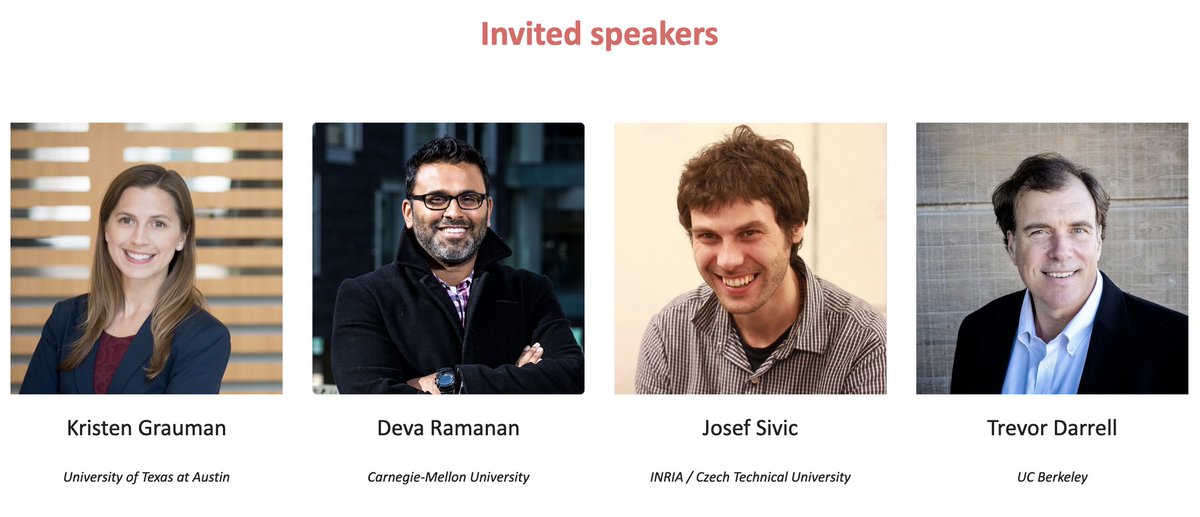
Want to know what the future of video research will be? Join us at the #ICCV2021 workshop on Structured Representations for Video Understanding.
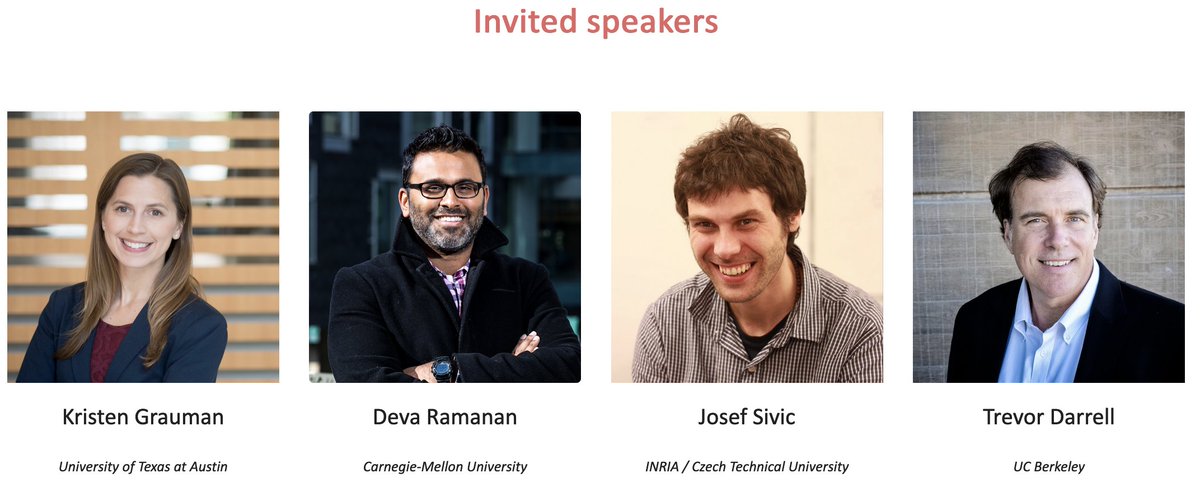
We end with a bang: a panel with Josef Sivic and Deva Ramanan. A must watch!
We start at 15:00 CEST (9:00 local), panel at 21:30 CEST
Working on how to best represent video? Still time to submit to the #ICCV2021 workshop on Structured Representations for Video Understanding. We're inviting submissions of either recently published or unpublished works.
Deadline: Aug 27th
Details: https://t.co/Q9d3Av2bys
It’s time to discuss: what is the best structure for representing videos and what is the way forward in video understanding? We are eager to hear your views at our #ICCV2021 workshop on Structured Representations for Video Understanding
Submission: Aug 27
https://t.co/NkKLumpKWM
We will have a full day with keynotes and accepted oral/poster presentations. We accept submissions for unpublished work and work published at a recent conference/journal (incl. ICCV’21)
Organized with: @cvondrick@Surisdi@doughty_hazel@MikeShou1 Shih-Fu Chang @CordeliaSchmid
@mayfer@cvondrick Thanks for you interest! No, we don't manually tag abstract predictions as closer to the center. This is learned by the model and it is a natural result of using hyperbolic geometry.
The future is hard to anticipate! In our latest #CVPR2021 paper, we introduce a framework for learning *what* is predictable in the future.
Rather than committing up front to categories to predict, our approach learns how to hedge the bet.
https://t.co/39aduV50pF