Former Executive Director, IMF for India, Bangladesh, Bhutan and Sri Lanka. Economist, cricket junkie, policy wonk, and film (all woods, old and new) enthusiast
A Typical DMG Career: The Quiet Ladder
Young Ahmed clears the CSS exam and enters the Civil Services Academy in Lahore. For two years he lives inside a pressure cooker of lectures, drills, and endless networking. His batch quickly forms tight “tribes” — lifelong alliances that will decide postings, favours and promotions for decades. This tribe or family will stay in power for the next 30+ years
After the academy he spends three hard years in the field as Assistant Commissioner: revenue courts, law-and-order crises, angry crowds and politicians. The district teaches him how Pakistan actually runs.
By his mid-thirties the system rewards the sharp ones. Eighty percent of ambitious officers secure scholarships to Harvard, Oxford, LSE or similar. Ahmed returns with a foreign degree, polished English and a valuable international contact book. He is now fully westernized and indirectly wired to take debt and follow western consultants
Back home he hunts “project” postings. Many move to donor-funded programmes — World Bank, ADB, FCDO, USAID — either on deputation or full secondment. The salary is better, the work cleaner, the reports international. No matter if more debt is required. Not his problem. Besides the consultants give him clean advice that he learnt at Harvard etc
By now he has also secured a spacious GOR house in Lahore that, with the right connections, he will not vacate for the next thirty or forty years.
A few years later he angles for an overseas slot: Commercial or Economic Counsellor in an embassy, or a position at the WTO or some other such agency.
After three to five rewarding years abroad he returns as Joint or Additional Secretary. With luck he reaches full Secretary rank, controlling large budgets and key policies.
In these golden years he quietly but aggressively cultivates donor representatives. Conferences, study tours and quiet dinners build the bridge.
When retirement arrives — or even early retirement — consulting contracts, advisory roles and well-paid door-opener positions appear. Donors need exactly these men: insiders who know every file, every approval route and every decision-maker.
What should we expect? A highly internationalised bureaucracy whose career incentives are shaped as much by foreign aid ecosystems as by national interest.
Who do they ultimately serve? The Government of Pakistan on paper; the revolving door of donors and multilateral organisations in practice.
Conflict of interest? Significant and largely unaddressed.
This is why experts like Stefan Dercon remain in high demand. For a few hundred million pounds over the years, Britain and other donors have built deep influence inside Pakistan’s elite bureaucracy. The system is not “owned,” but it is skilfully rented.
Global Times on a new "Plaza Accord": "China will not accept using exchange rates as a pretext for oppression, nor will it return to the old era of great powers coordinating the fate of a few countries."
This is a rather bizarre argument to make, although it is one you often hear in the Chinese press. It assumes that the RMB exchange rate belongs to China, and that for the EU or anyone else to intervene in the RMB exchange rate is an act of colonial oppression.
But this simply isn't true. An exchange rate "belongs" to both countries involved. If China has intervened to devalue the RMB by 20-30% against the currency of its trade partners, this is exactly the same as if it had engineered a "stealth" Plaza Accord in which it forced its trade partners to revalue their currencies by 25-43%. There is no difference between the two, and so if one way isn't an act of colonial oppression, the other way isn't either.
The Global Times also argues that China's trade surplus and its manufacturing competitiveness have nothing to do with an undervalued RMB. If the PBoC actually believed this, it is pretty obvious what it should do – it should revalue the RMB as quickly as it can. There would be no cost to doing so as, presumably, Chinese manufacturers would be as globally competitive as ever, and it would immediately benefit Chinese households by raising the real value of their domestic income. Of course the reason the PBoC isn't doing this is because it knows (as most analysts know, including, I suspect, the editors of the Global Times) that this just isn't true. The claim that currency values don't affect trade imbalances is just silly.
But to the extent that these kind of editorials reflect actual positions among policymakers, we should expect a difficult and probably painful outcome. Joan Robinson warned in the 1930s that mercantilist regimes that ran large, persistent trade surpluses would inevitably drive their trade partners to retaliate with their own forms of trade intervention once the costs of beggar-thy-neighbor trade surpluses were perceived as too high. We are clearly in Joan Robinson's world, and denying the problem is an extremely ineffective way of resolving it.
We know this from the rather lengthy history. There have been many large trade imbalances – especially ones associated with large increases in debt – in the past 100 years, and they have usually ended very badly. The interesting question in retrospect has been why, and under what conditions, the brunt of the adjustment costs were ultimately borne by either the surplus countries or the deficit countries.
I worry that because there is clearly no appetite among surplus and deficit economies to reduce the imbalances in the least painful way possible for both sides, and because the imbalances may have already gone too far for any compromise, we may be moving inexorably towards an adjustment process in which the costs are magnified, as each side tries to force the other to bear the brunt.
https://t.co/dlvL5MQYND
@prempanicker@ZEE5India Mine is now working on both laptop and mobile - separately - the trick is to not use Google but Edge - also you have to download the zee5 mobile app for the mobile
are others also having problems with @ZEE5India subscriptions for FIFA? - I have paid but cannot access matches on my laptop - been unsuccessful with [email protected] - What do I do
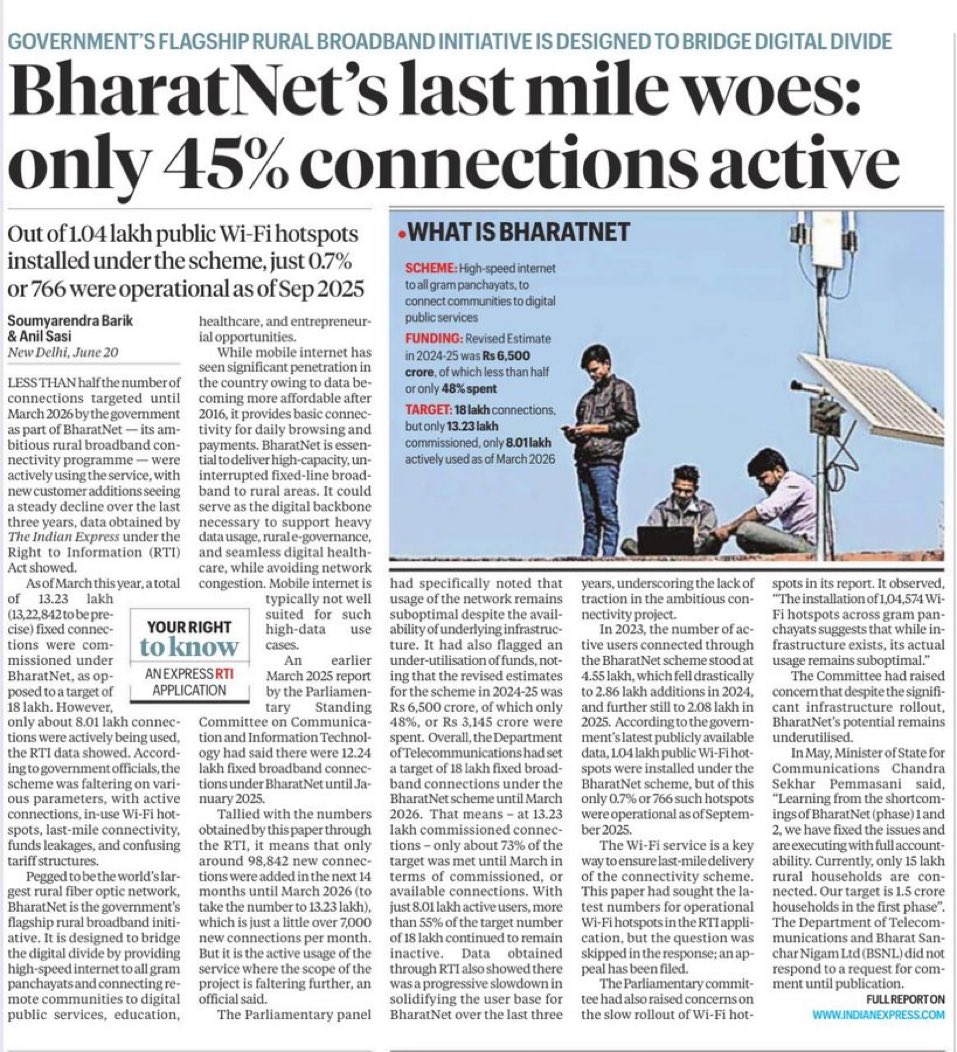
Excited about this new initiative by the Government of India to bring intellectual talent back to the country, something Raghuram Rajan and I emphasized in our book (Breaking the Mould) and have since kept reiterating.
But like several ambitious initiatives of the recent past [think Make in India, the Production-Linked Incentive (PLI) schemes] it will live or die on follow-through. The familiar arc: a well-intentioned design, an early flourish, then a slow fade as eyes come off the ball and course-correction stops.
Perhaps most importantly: because of entrenched interests, existing institutions may be hard to reform from within. And since this scheme routes returning talent largely through incumbent public institutions, that tension will be structural. Which is exactly why we also need new research universities (public and private) that can offer a conducive research atmosphere, real interaction with industry, and the training of the next generation of talent... from across the global south.
A great start nonetheless...
@PMOIndia@PrinSciAdvGoI@AjaySoodIISc@karandi65@EduMinOfIndia@NITIAayog
In such cut throat geopolitics, one cannot entirely rule out international conspiracies and interferences. However, attributing every single failure in our country to some "deep state" is superficial.
In my view, many of our failures are of our own making. And as a sovereign nation, do we not have the ability to counter such international conspiracies?
US attack kills 3 Indians
Iranian attacks kill at least 6 Indians, possibly more
Russia kills 49 Indians who were lured and used as cannon-fodder in Ukraine
But guess where all the SM outrage is focused on?
Again, thankfully, GoI is being a lot more sensible and strategic.
Morning thought: Every time I watch a World Cup football match, I ask myself: will I live to see the day when India is part of the spectacle, not just a spectator? Seventy-nine years after Independence, we are yet to play in a single World Cup in the ultimate global team sport (we almost did once in 1950). A billion dreams. One unanswered sporting question. (Not to forget a football association in this country that is trapped in politics and a fandom that is obsessed with just one sport). 🙏
Be brutally honest: Are you deeply outraged that, while hundreds of millions of Americans and I are struggling financially, @elonmusk has just now become the world's first trillionaire, with more wealth than he could spend in 1,000 lifetimes? Yes or no?
@sardesairajdeep No Rajdeep no one is claiming that Nehru was not PM till the 1952 election - but everyone is claiming that Nehru’s ELECTED tenure starts after the 1952 election
INTERESTING: If Nehru became PM only after the 1952 election as is now being claimed , then was Sardar Patel never really Deputy PM and India’s first Home Minister since he died in 1950?
The trouble with cherry-picking history is that it eventually contradicts itself.🙏
This is not to detract from sooryavanshi brilliance - I have been asking everyone to watch him saying this is how the world must have felt when bradman came on in the scene @IMSahilBhalla
'This lopsided environment threatens to reduce T20 cricket to a repetitive, mechanical loop of boundaries that will ultimately alienate the sporting public.' 6/6
A must-read Greg Chappel piece. https://t.co/dZ0SPPnOgZ
Disagree - it should be 1952 onwards - everyone counts from election onwards - many freedom fighters around the world derived legitimate legitimacy but are not counted as part of democratic reign
INTERESTING: So @narendramodi ji completes 12 years in power today, a rare feat in today's uncertain times. Tomorrow he completes 4399 days in power consecutively which is the longest unbroken tenure of an elected Indian PM if you discount Nehru's 1947-52 period as an 'interim' government. Since this govt is obsessed with Jawaharlal's legacy, this is one record they will be especially proud of. NOTE: it is wrong to say that Nehru lacked an electoral mandate before 1952 because his government derived its legitimacy from the Constituent Assembly that was constituted in 1946. So maybe to settle the debate conclusively Mr Modi will have to stay on as PM till 2031 at least!🙏🏻😉
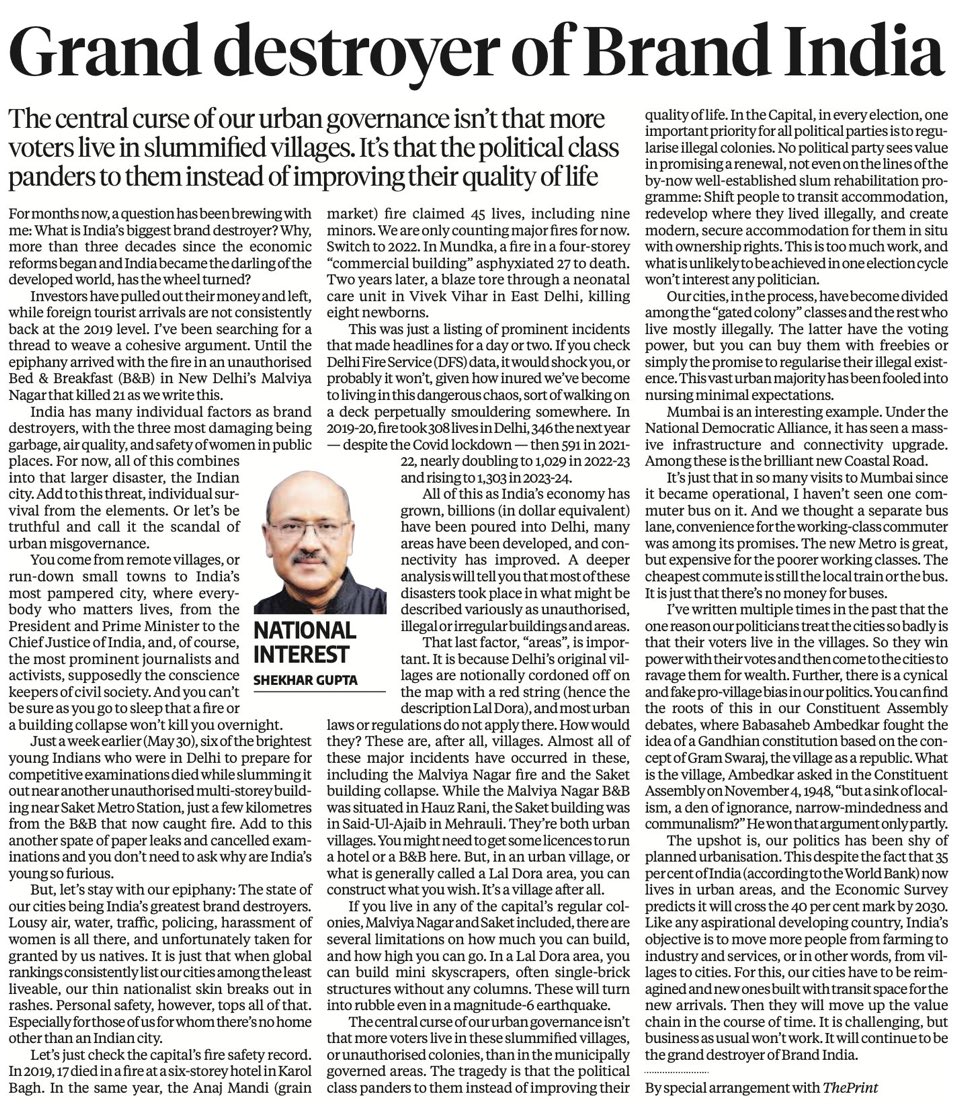
I agree with every word @ShekharGupta has written - Indian cities are unliveable and they are greatest destroyers of the Indian brand. They are badly managed, ironically against the poor, the middle class and the rich (who don’t get the quality they deserve for taxes they pay).
Maybe put in a word with the BCCI, and IPL commentators, to also say that IPL pitches make batting a chore, and for some of us, slam-bang-thank you a bit of a bore -
Cricket Gyaan: (revised tweet) Next time anyone tells you about terrible Indian pitches that turn square before lunch, ask them to see the Lords pitch in the #EngvNZ game. A seaming wicket with uneven bounce from day 1 and where a 3 day finish with no Sunday cricket looms. Am now told that @nassercricket and @Athersmike have strongly criticised the pitch. Good 👍. Indian commentators need to be just as blunt: pitches like these make batting a lottery just as flat wickets make bowling a chore. Challenge is to find the right balance. Else test cricket with an eye on WTC points will see more and more 3 day games.
𝗚𝘂𝗲𝘀𝘀 𝗪𝗵𝗼 𝗖𝗮𝗺𝗲 𝘁𝗼 𝗗𝗶𝗻𝗻𝗲𝗿?
On May 27, the anniversary of Jawaharlal Nehru’s passing, I found myself wondering what India’s first Prime Minister would make of the world today.
Imagine Nehru appearing unexpectedly at the dinner table.
He would surely marvel at India’s transformation: a major economy, a nuclear and space power, a digital innovator, and an increasingly influential voice on the world stage.
But after listening patiently to our account of India’s rise, he might ask a simple question:
“During the ongoing Iran crisis, where exactly is India?”
This question is worthy of thought.
The conflict is not some distant regional war. It touches directly upon India’s interests: energy security, shipping through Hormuz, inflation, supply chains, connectivity through Iran, and the welfare of millions of Indians in the Gulf.
Yet India has appeared more observer than participant in the diplomatic conversation surrounding the crisis.
This is not a call for reckless activism or nostalgia for another era. The world of 2026 is vastly more complex than the world Nehru inhabited. Strategic autonomy requires prudence and restraint. But there is a difference between restraint and reticence.
Nehru understood something that remains relevant today: influence derives not only from power, but also from presence.
India of the 1950s possessed far less economic and military power than India does today. Yet it sought to shape international conversations on Korea, Suez, Indochina and Congo. It did not always determine outcomes. But it was rarely absent.
The Iran crisis also reveals another reality. We often speak of a “multipolar world”, but what we increasingly see is a world of intermediaries.
Countries such as Qatar, Oman, Saudi Arabia and others have acquired diplomatic relevance because they possess channels of communication that others lack. Influence flows not merely from military strength, but from connectivity.
This is where India should excel.
We engage the United States and Europe, maintain ties with Russia, have deep interests in West Asia, participate in BRICS and the Quad, and retain credibility across much of the Global South.
Strategic autonomy should not become strategic silence.
The challenge before India is not whether it should mediate every conflict. It is whether a country of India’s scale and aspirations can afford to be absent from conversations that directly affect its interests.
Nehru would not have asked us to return to the diplomacy of the 1950s.
But as he leaves the dinner. he might ask whether a stronger India has become too cautious about using its voice.
Today we possess
unprecedented weight.
The question is whether we’re prepared to exercise an equally confident voice.
The future will not be shaped by great powers alone. It will also be shaped by those capable of connecting worlds that no longer trust one another. We have the power to be one of those.
Good night, Mr. Nehru.
#India #Nehru #Iran #Diplomacy #ForeignPolicy #StrategicAutonomy #GlobalSouth #WestAsia #Geopolitics #InternationalRelations





![rohlamba's tweet photo. Excited about this new initiative by the Government of India to bring intellectual talent back to the country, something Raghuram Rajan and I emphasized in our book (Breaking the Mould) and have since kept reiterating.
But like several ambitious initiatives of the recent past [think Make in India, the Production-Linked Incentive (PLI) schemes] it will live or die on follow-through. The familiar arc: a well-intentioned design, an early flourish, then a slow fade as eyes come off the ball and course-correction stops.
Perhaps most importantly: because of entrenched interests, existing institutions may be hard to reform from within. And since this scheme routes returning talent largely through incumbent public institutions, that tension will be structural. Which is exactly why we also need new research universities (public and private) that can offer a conducive research atmosphere, real interaction with industry, and the training of the next generation of talent... from across the global south.
A great start nonetheless...
@PMOIndia @PrinSciAdvGoI @AjaySoodIISc @karandi65 @EduMinOfIndia @NITIAayog](https://pbs.twimg.com/media/HLV5cmgXUAAK9y5.jpg)