Chazz Palminteri was offered up to $1 million for the rights to A Bronx Tale, which he turned down.
He refused to sell unless he could write the screenplay and play Sonny himself. Plenty of studios wanted the story, but none wanted to give him that level of creative control.
Then Robert De Niro came along with a simple proposal: they would make the film together. Palminteri would write the script and play Sonny, while De Niro would direct and play Lorenzo.
They didn’t need lawyers or lengthy negotiations. The entire deal was sealed with a handshake.
In Casino, the Japanese “billionaire cheapskate” K.K. Ichikawa - who wins $2 million at the Tangiers before Sam Rothstein sabotages his flight home and lures him back to the casino - was based on real Tokyo real-estate mogul and legendary high roller Akio Kashiwagi.
Known as “The Warrior,” Kashiwagi was one of the most notorious baccarat whales of the late twentieth century, reputedly playing over “$30,000 a hand” and nearly bankrupting several casinos. And like Ichikawa, he was also infamously cheap, reportedly taking “free soap, shampoo and towels” from luxury hotel suites.
However, the real-life Sam Rothstein, Frank “Lefty” Rosenthal, never crossed paths with Kashiwagi. Their stories belong to different eras: Kashiwagi’s gambling spree peaked in the late 80s and early 90s, long after Rosenthal had been barred from the casino industry.
The showdown between Ichikawa and Rothstein in Casino was instead loosely inspired by Kashiwagi’s infamous high-stakes clash with real-estate mogul and future U.S. president Donald Trump.
In February 1990, Donald Trump flew Akio Kashiwagi to Trump Plaza in Atlantic City, put him up in an ocean-view penthouse, and reserved a private baccarat table just for him. Kashiwagi arrived with $6 million and received another $6 million in credit, but after two days he left up $6.2 million.
Unwilling to accept the loss, Trump lured Kashiwagi back on terms that made it almost impossible for him to win again. He offered an informal “freeze-out” agreement: Kashiwagi would bring $12 million to the table and play until he had either doubled it or lost everything.
Knowing the odds would eventually swing back in the house’s favor over a long enough session, Trump counted on Kashiwagi being unable to resist the challenge. He took the bait. And after a brutal weeklong marathon of high-stakes baccarat, Kashiwagi went from being up millions to facing a staggering $10 million loss.
However, Kashiwagi’s real troubles were only just beginning.
After the Japanese asset-price bubble exploded, Kashiwagi’s company, Kashiwagi Shoji, buckled under the strain of its highly leveraged real-estate loans and collapsed as land values cratered. It’s also widely believed that he defaulted on high-interest debts connected to yakuza groups.
On January 3, 1992, the 54‑year‑old developer was found dead in the kitchen of his home, stabbed repeatedly with what investigators believed to be a samurai sword. To this day, his murder remains unsolved.
July 7, 1996
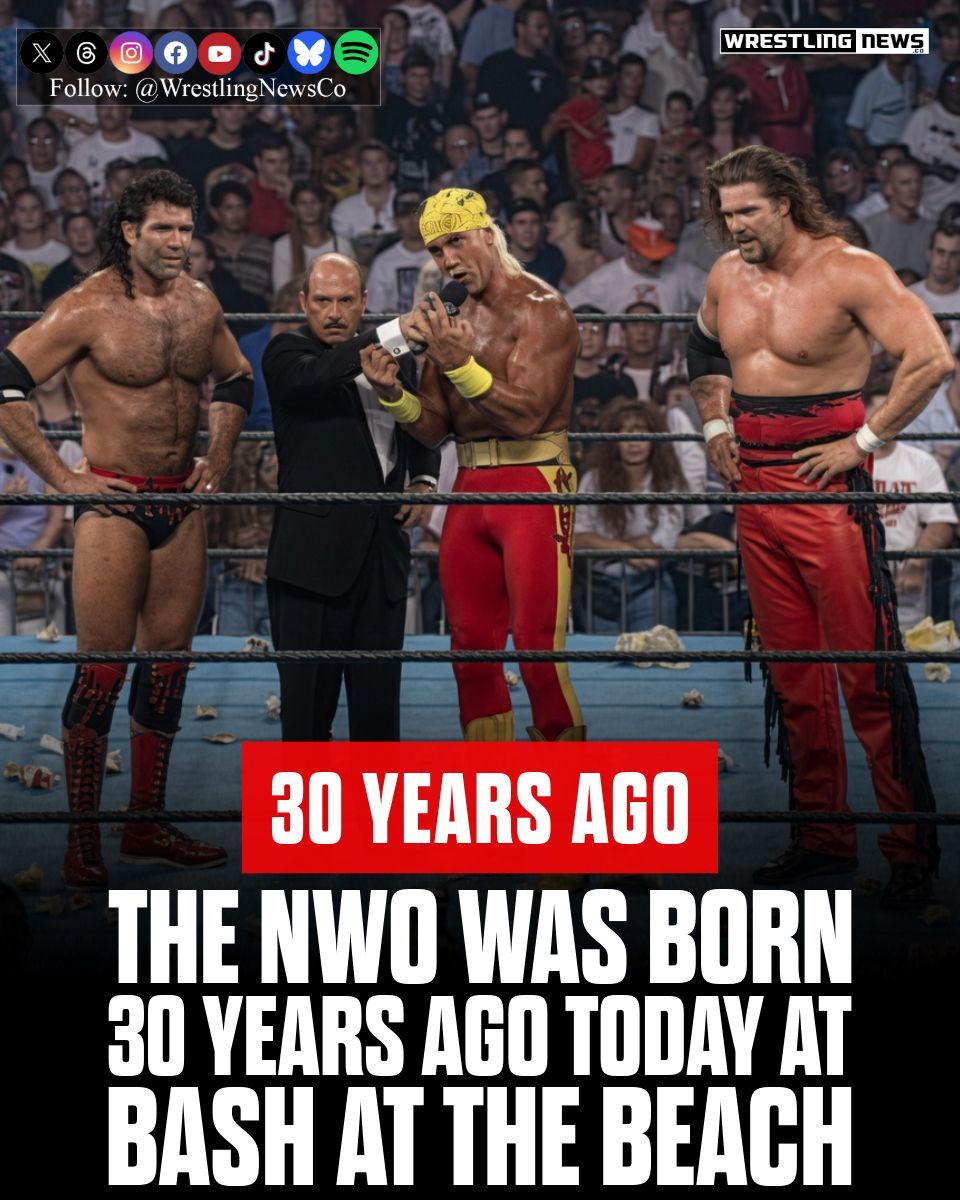
On this date in 1996, Hulk Hogan turned heel and the New World Order was born at WCW Bash at the Beach in Daytona Beach, Florida.
The Outsiders, Scott Hall and Kevin Nash, had promised a mystery partner for their six-man tag team match against Sting, Randy Savage, and Lex Luger. Hogan walked out late in the match, dropped his leg across Savage, and revealed himself as the third man.
Fans flooded the ring with garbage as Hogan told Gene Okerlund that he, Hall, and Nash were “the new world order of wrestling.” The turn transformed Hogan into Hollywood Hogan, launched the most influential faction in wrestling history, and powered WCW to 83 consecutive weeks of ratings wins over the WWF in the Monday Night Wars.
#HulkHogan #nWo #WCW #WrestlingHistory #OnThisDay