The company behind Claude goes public this week.
Anthropic plans to price its IPO on Wednesday and start trading Thursday on Nasdaq under the ticker ANT. By day 4 of its roadshow, orders reached about 6x the shares on offer.
THE DEAL
825 million shares at $70 to $78 each
Up to about $64.4 billion raised at the top of the range
About $1.3 trillion to $1.4 trillion fully diluted value
Up to 20% of shares set aside for individual investors
A separate $26 billion private placement, with Google and Nvidia at about $10 billion each
THE BUSINESS
$33.2 billion of revenue in the first 9 months of 2026, up about 1,206% from a year earlier
Still a GAAP operating loss in Q3, about $567 million
WHY IT MATTERS
A listing this size gets loud fast. When SpaceX listed in June, it closed day one up 19%, then fell to a low 49% below its record by August.
Systematic investors decide before the opening bell: how big a new position can get, and what would make them add or trim.
Would you buy a hot IPO on day one, or wait for its first earnings report?
The company behind much of the internet's networking gear just had its fastest growth in more than 15 years. Its stock was down about 2% before Friday's open.
That company is Cisco ($CSCO). And this is the stock that once took 25 years to get back to its old high.
THE QUARTER
Cisco reported its August to October quarter on Thursday night.
Revenue: $18.5B, up 24%
Adjusted earnings per share: $1.40, up 40%
Full-year revenue forecast raised to $74.8B to $75.8B
AI infrastructure sales to the biggest cloud companies: now expected at $9B this fiscal year, more than double last year
CEO Chuck Robbins called it Cisco's strongest revenue and earnings growth in over 15 years.
SO WHY THE DIP?
Investors focused on pressure on its hardware profit margins. After a big run, the bar gets higher.
THE 25-YEAR LESSON
Cisco closed at $80.06 in March 2000, at the top of the dot-com bubble. It did not close above that level again until Dec 10, 2025.
It hit $130.00 on Jun 4 this year. It closed at $102.01 on Thursday.
A great company and a great stock price are two different things. What you pay matters.
WHAT SYSTEMATIC INVESTORS DO
They use rules for when to add and when to trim, so one exciting quarter doesn't set their position size. Rules can still lose money, but they keep you consistent.
Would you have held Cisco for 25 years?
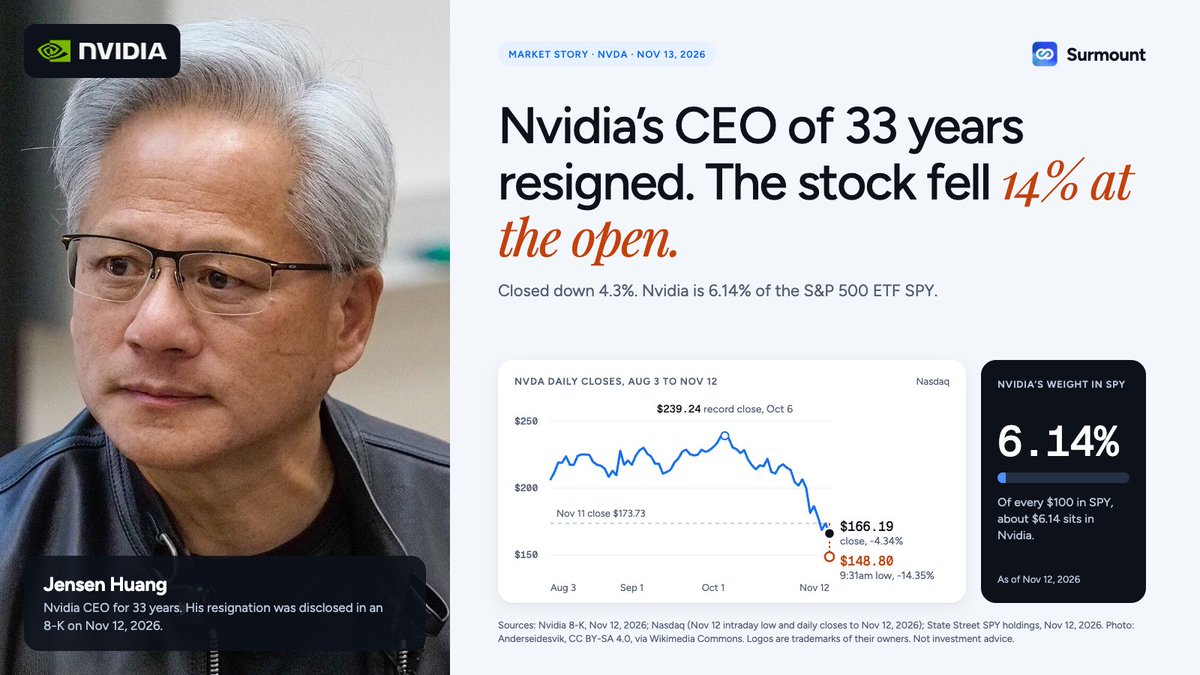
Nvidia's CEO of 33 years resigned on Thursday. The stock fell 14% at the open, then closed down 4.3%.
If you own an S&P 500 index fund, you felt it. Here's why.
Jensen Huang co-founded Nvidia in 1993 and ran it ever since. At 8:48am ET Thursday, Nvidia said he had resigned as CEO and from the board, effective immediately. CFO Colette Kress is interim CEO. The board is searching inside and outside the company for a permanent one.
THE NUMBERS
$173.73: Wednesday's close
$148.80: Thursday's low, 9:31am (-14.35%)
$166.19: Thursday's close (-4.34%)
$239.24: the record close on Oct 6, about 31% higher
+5.9% and +5.5%: AMD and Broadcom the same day
WHY IT MATTERS TO YOU
Nvidia is 6.14% of SPY, the biggest S&P 500 ETF. That's about $61 of every $1,000. When one company carries that much weight, news about one person can move your whole portfolio.
This is called key-person risk. Investors pay for a leader, and when the leader leaves, the price resets.
WHAT SYSTEMATIC INVESTORS DO
They decide limits before the news: how big any one stock can get, when to rebalance, and what would make them sell. Rules can still lose money. They just keep a headline from making the call.
Nvidia reports earnings Tuesday, Nov 17, its first without Huang as CEO.
Would you hold through a founder leaving?
The company making GTA 6 just reported sales down 18%.
Its stock closed up 8.3% the next day.
That company is Take-Two Interactive ($TTWO), the owner of Rockstar Games. GTA 6 launches Nov 19.
Take-Two reported its July to September quarter on Nov 9. Net bookings, its main sales number, fell to $1.60B from $1.96B a year ago. Revenue of $1.50B came in below the roughly $1.66B Wall Street expected.
WHY THE STOCK WENT UP
Investors looked at the next 3 months. Take-Two expects $3.35B to $3.50B of net bookings for October to December, more than double the quarter it just reported. It kept its full-year forecast of $8.0B to $8.2B.
CEO Strauss Zelnick said GTA VI pre-orders are "continuing to reach unprecedented levels." The company gave no pre-order numbers.
THE NUMBERS
Nov 9 close: $207.40
Nov 10 close: $224.64 (+8.3%)
Since Oct 30: +18.1%
Past year: -4.0%
GTA V copies sold: 215M+
THE CATCH
One game now carries the whole year. GTA VI was already delayed once, from May to November. In-game spending fell 9% this quarter.
Prices move on what investors expect next. That is why systematic investors set their rules before launch day: how big one stock can get, which numbers count, and when to rebalance.
Would you buy a stock before a launch like this, or wait for the first sales numbers?
Anthropic, the company behind Claude, just put a price on its IPO: $70 to $78 a share.
At the top of the range, that values it at up to $1.4 trillion.
825 million shares, raising $57.75B to $64.35B. Ticker ANT on the Nasdaq. Trading is expected to start on or near Nov 19. Up to 20% of the shares are set aside for retail investors.
In May, private investors valued Anthropic at $965B. Some outlets had reported a $2T target only weeks ago. The range landed in between, during a week when AI stocks were selling off.
THE BUSINESS
Run-rate revenue: $81B at the end of October
Q3 revenue: $17B
Net loss, first 9 months: $104B
Cash and short-term investments: nearly $132B
WHO IS ALREADY IN
AMD, Broadcom, Google, Micron, Microsoft, Nvidia and TSMC agreed to buy $26B of stock at the IPO price. Google and Nvidia are putting in $10B each.
THE CATCH
New listings can swing hard in their first weeks. A $104B loss in 9 months is real money, even with $132B in the bank.
If you plan to buy a hot IPO, decide your position size before the first trade.
Would you buy ANT on day one, or wait a few weeks?
Rules-based investors decide ahead of time how big any one stock can get in their portfolio. Browse automated investing strategies on Surmount:
https://t.co/GS0WGiWxik
Not investment advice.
Airbnb stock ($ABNB) is up about 9% today after a Q3 earnings beat and a new $12 billion buyback, the morning after the Nasdaq-100's worst day since April 2025.
Airbnb reported its July to September quarter Thursday night. Sales and profit both beat Wall Street, it raised its 2026 outlook, and it announced a $12B share buyback.
THE NUMBERS
Revenue: $4.87B, up 19% (expected $4.75B)
Earnings per share: $3.16 (expected $2.85)
Q4 sales forecast: $3.22B to $3.28B (expected $3.16B)
New buyback: $12B
Cash and short-term investments: $12.6B
Stock: about $185, up 8.7% at 10:40am ET
A buyback is a company using its cash to buy its own shares, which leaves fewer shares for everyone else. Airbnb's highest close of the past year was $190.50 on Aug 25. One earnings report put it close to that level again, in a week when most tech stocks were sliding.
Buybacks are spread over years and can be slowed. Travel demand can turn quickly. And one good day after a selloff can fade.
Does a big buyback make you more or less interested in a stock?
#AirbnbEarnings #StockMarket
Fast growth and a falling stock can happen in the same week. Rules-based investors decide ahead of time what they will pay for growth and how much of one stock they will hold.
Browse automated, rules-based strategies on Surmount: https://t.co/gfmEAWqjhd
Not investment advice.
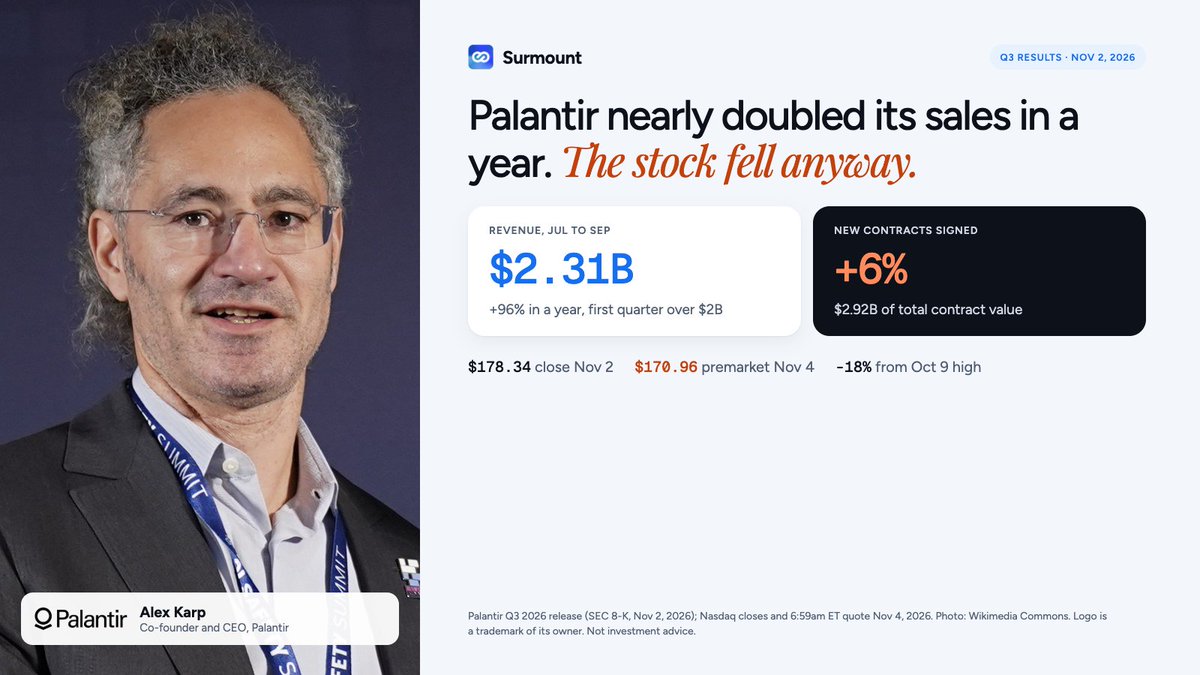
Palantir ($PLTR) nearly doubled its sales in a year. The stock is down about 4% since the report.
Here's why 96% growth wasn't enough.
Palantir reported July to September results on Monday night. Revenue hit $2.31 billion, up 96% from a year ago, and its first quarter above $2 billion. Sales to US companies grew 148% and passed US government sales for the first time.
New contracts signed (Palantir calls it total contract value) grew only 6%, to $2.92 billion. Revenue comes from deals already signed, so investors watch new signings to guess what next year looks like.
After the report, analysts put Palantir at roughly 230 times forecast profits. When a stock is priced for perfection, a great quarter can still disappoint.
THE NUMBERS
Revenue: $2.31B (+96%)
US commercial: $984M (+148%)
New contracts signed: $2.92B (+6%)
Close Nov 2: $178.34
Premarket Nov 4: $170.96 (-4.1%)
From the Oct 9 high of $209.05: -18%
Do you judge a company by how fast it grows, or by what you pay for that growth?
Apple ($AAPL) just posted a record September quarter, the first under new CEO John Ternus.
Revenue and earnings both beat Wall Street. The stock still fell 1.9% today, after trading down about 4% before the open.
Apple reported its fiscal fourth quarter (July to September) after the close on Nov 2. Ternus took over from Tim Cook on Sept 1, and called it the end of Apple's best fiscal year ever.
💰 Revenue: $114.5B, up 12% (about $113.4B expected)
📈 Earnings per share: $2.10, up 14% ($1.99 expected; includes $0.05 from tariff refunds)
📱 iPhone: $57.6B, up 17%
💻 Mac: $10.8B, up 24%
🛠️ Services: $31.6B, up 10%
Apple expects December-quarter revenue to grow 7% to 10% and gross margin of 45% to 46%, down from 47.9% this quarter. Gross margin is the share of each sales dollar left after the cost of making the product. Last quarter Apple pointed to rising memory chip costs, as AI data centers soak up supply.
THE STOCK
📉 $331.90 at today's close, -1.9%
🌅 About $323.72 before the open, roughly -4.3%
🎯 UBS raised its target to $340 from $296; Barclays to $261 from $245
Stock prices tend to move on the outlook, and the outlook is where Apple's squeeze shows. Systematic investors set their rules before earnings night: how big one stock can get in a portfolio, when to rebalance, which numbers count. Then a record quarter and a red day don't have to force a decision.
What worries you more: a thinner margin, or slower holiday growth?
Record quarters and falling stocks can happen at the same time. See how rules-based strategies handle cycles like this: https://t.co/hSBO9TjZsa
Not investment advice.
SK hynix ($SKHY) just turned 80% of its sales into operating profit.
Revenue: 104.6 trillion won, up 328% in a year. And the US-listed shares are still 27% below their September high.
The Korean memory chipmaker reported Q3 results on Oct 28 (Seoul time). Its HBM chips (high-bandwidth memory) sit next to AI processors and feed them data. It is the first quarter in company history with revenue above 100 trillion won.
💰 Revenue: 104.6T won (about $78B), up 328% vs Q3 2025
📈 Operating profit: 83.3T won, up 632%
🎯 Operating margin: 80%, up from 47% a year ago and 76% last quarter
🔁 2026 payouts: about 100T won in dividends and buybacks
📉 $SKHY: $145.36 on Oct 27, down 26.8% from $198.63 on Sep 9
Out of every 100 won of chips sold, 80 won was left after paying for factories, staff and research. The company expects its newest chip, HBM4, to outsell the older HBM3E in Q4.
Net income fell 58% from Q2 even as operating profit rose. And memory has always been a cycle: prices rise when supply is tight and fall when new factories come online.
A great quarter and a great stock are two different things. Rules-based investors decide in advance what they act on, like profits, price trend or valuation, so one headline does not make the call.
Does an 80% margin make you more or less nervous about memory chips?
Big AI bills, bigger questions. If you would rather invest by rules than react to headlines, browse automated strategies on Surmount: https://t.co/qHgAiIleUN
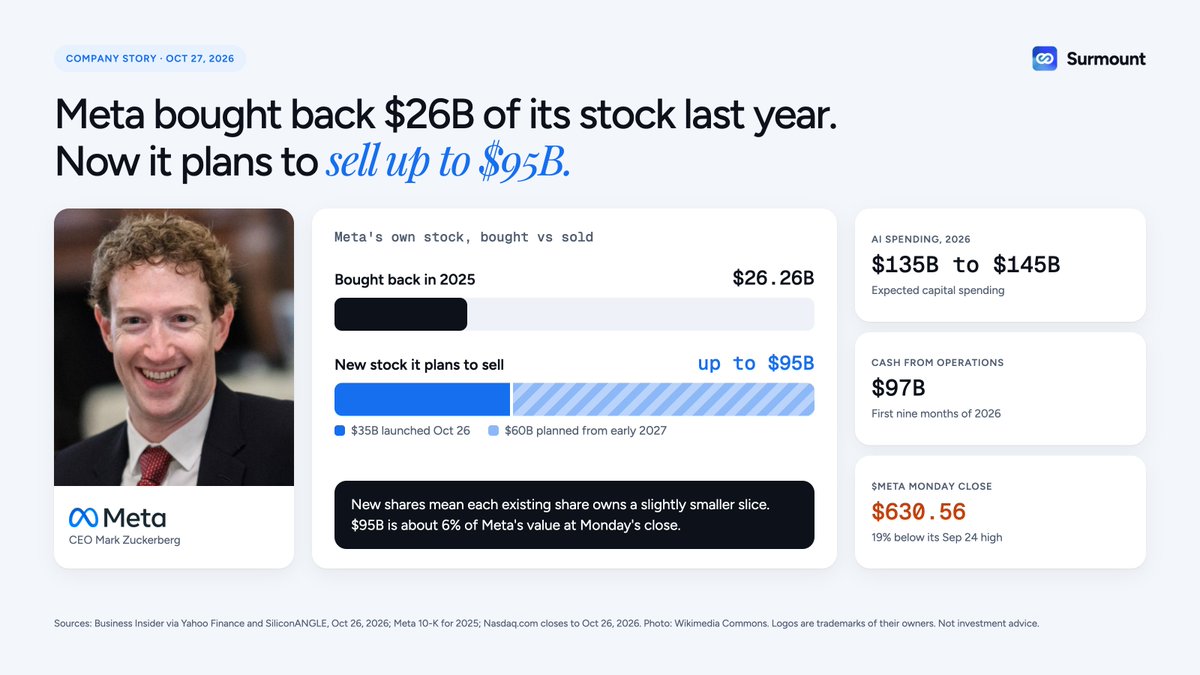
$META spent $26.26 billion buying back its own stock last year.
Now it plans to sell up to $95 billion of new stock.
On Monday, Meta launched about $35B of stock sales: roughly $22.5B of common shares plus $12.5B of preferred shares that turn into common stock in August 2029. Another $60B is planned as an "at the market" sale, meaning shares sold bit by bit at market prices, starting in early 2027.
Meta expects to spend $135B to $145B on buildings, chips and power this year. Its operating cash flow was $97B in the first nine months. The gap has to come from somewhere.
• $95B: the most new stock Meta plans to sell
• $26.26B: stock Meta bought back in 2025
• About 6%: $95B compared with Meta's total value at Monday's close
• 37%: drop in Q3 operating income, to $13B
• $630.56: Monday close, down 1.9% on the day and 19% below its Sep 24 high
When a company sells new shares, each existing share owns a slightly smaller slice. Buybacks did the reverse. Meta is betting the AI payoff is worth more than the slice it gives up.
Is this the moment Big Tech's AI bill lands on shareholders?
Like the idea of setting your rules before the headlines hit? Browse automated, rules-based strategies on Surmount: https://t.co/bqP9exyeJA
Not investment advice.
Elon Musk says more than 200 AI cloud companies face "guppy-level death."
Their stocks were already falling. CoreWeave ($CRWV) is down 60% in a year.
WHAT HE SAID
On X on Sunday, Musk wrote that debt markets have "almost entirely shut off" money for companies whose revenue depends on AI data centers. He said SpaceX closed $40B of debt for GPUs because it has Starlink and launch revenue behind it.
WHAT IS A NEOCLOUD
A company that rents out AI computing power (GPUs) to other businesses, often funded with debt and using the chips as collateral.
BY THE NUMBERS (1 year to Friday's close)
📉 CoreWeave $CRWV: -60.1%, at a 1-year low of $54.24
📉 IREN $IREN: -61.7%, at a 1-year low of $24.91
📈 Nebius $NBIS: +26.6%
Monday premarket: CRWV -4.3%, NBIS -3.4%, IREN -3.1%
THE CAVEAT
Musk's SpaceX is itself a big buyer of AI chips, so he is not a neutral observer. And balance sheets differ: Nebius is still up over the year.
THE TAKEAWAY
When a whole industry leans on the same source of money, its stocks tend to fall together. A rule that caps how much you hold in any one theme does its work before the headline arrives.
Would you still hold a neocloud stock after this?