“Not by might nor by power, but by my spirit,” says the Lord of Hosts. Zech 4:6
One of the most life-altering practices the Lord taught me along the way is that empowerment is not about achieving but about receiving.
This mindset has made dramatic difference in my home, marriage, family, relationships, writing, teaching, leading, serving, preparing and resting. “What I need, Lord, only you can supply. I look to you.”
We don’t have to clamor for it or stress and sweat and panic over it. With humility and faith we hold out empty hands before the Lord, bring our need and thank him in advance that he’s going to give us everything required for us to abound. We posture ourselves to receive.
The challenge for us in this age is that posturing ourselves to receive takes some daily stillness and focus and continual openness to the Lord. It takes meditating on his words, watching and waiting upon the Lord.
But then, after he’s supplied what we need, we come to the marvelous realization we not only received what we sought. We received something far surpassing. We received him.
When @TimKellerNYC was 24 years old, he was a new pastor in rural Virginia. Alice was an elderly Christian who had suffered enormously in her life.
More than four decades later, Keller still remembered her perspective.
I still believe.
I’ve had countless prayers that weren’t answered the way I hoped. Things withheld that I wanted in life so badly. Seen brokenness that never fixed. But I’ll tell you what I have seen. I’ve seen the goodness of the Lord in the land of the living.
And I’ll tell you what I did get. I got Jesus. I realize again and again that the reason the scriptures still jump from the page with the life of the Holy Spirit so often when I read is because God saw to it that I’d need them. Require them. That they’d be my food and the living water of the Holy Spirit, my drink.
This was to his good pleasure. I still believe. I believe his nearness is my good and his presence is my ecstatic joy. I have many regrets. Entrusting my life into the scarred hands of Jesus is not one of them.
You can trust him.
You need to get to church every Lord's day for worship, including the Lord's supper, and remember that one day we'll serve the Lord and our dross will be gone.
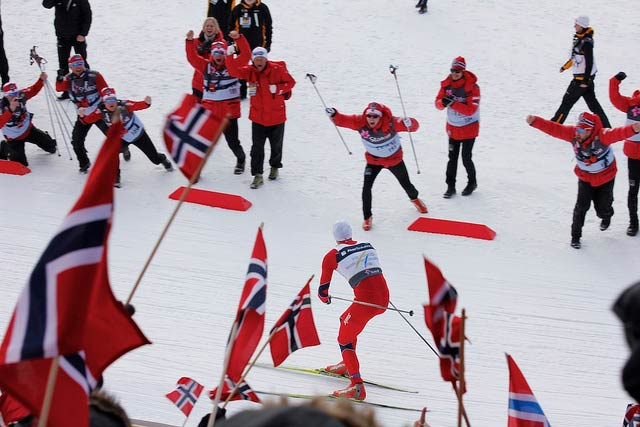
Norway consistently wins the most medals at the Winter Olympic Games, with a population of just 5.6 million people.
A big part of their success is how they treat youth sports—and it’s the opposite of what we do in the US. Here’s what we can learn from Norway:
1. Scorekeeping:
In the US: Youth sports tend to be hyper competitive even at early ages. Leagues almost always keep score.
In Norway: Scorekeeping isn’t even allowed until age 13.
Removing winners and losers keeps the focus on the process not outcomes. It keeps kids engaged longer because it minimizes pressure (and tears) and maximizes fun, learning, and growth. The goal isn’t to win a third grade championship. It’s to love sport and keep playing.
2. Trophies:
In the US: If you give everyone a trophy, you’re creating snowflakes who will never gain a competitive edge.
In Norway: Whenever trophies are awarded, they are handed out to everyone.
If getting a trophy makes young kids feel good, we should give them trophies. Maybe they’ll come back and play again next year!!
As for the creation of snowflakes with no competitive edge—Norway’s athletes are tough as nails and all they do is win.
3. Prioritizing Fun:
In the US: Far too often, the goal is to win.
In Norway: The national philosophy is “joy of sport.”
Youth sports in the US are driven by adults, ego, and money. Youth sports in Norway are driven by fun.
Only half of kids in the US participate in sports. The number one reason they drop out: because they aren’t having fun anymore. In Norway, 93% of kids participate in youth sports. Fun is the foremost goal.
4. Playing Multiple Sports:
In the US: There’s pressure to specialize early and play your best sport year round.
In Norway: Try as many sports as you can before specializing as late as college.
Norway encourages kids to try all types of sport. This reduces injury and burnout and increases all-around athleticism. It also helps promotes match quality, or finding the sport you are best suited for as your body develops, which is impossible if you commit to a single sport too early.
5. Affordability
In the US: There is increasingly a pay-to-play model with high fees for leagues, equipment, and travel. This excludes many kids from playing.
In Norway: It’s a national priority to keep youth sports affordable and therefore accessible for all.
Kids aren’t priced out, which creates opportunities for everyone to participate (and develop into athletes), regardless of their parents’ income level.
We could learn a lot from Norway:
In the US, 70% of kids drop out of youth sports by age 13. This not only diminishes an elite-athlete pipeline, but it also destroys an opportunity for healthy habits and all the character lessons kids can learn from sport.
In Norway, lifelong participation in sport is the norm. The goal isn’t to have the best 9U team. It’s to develop the best athletes. Those are two very different things. And Norway has the gold medals to prove it.