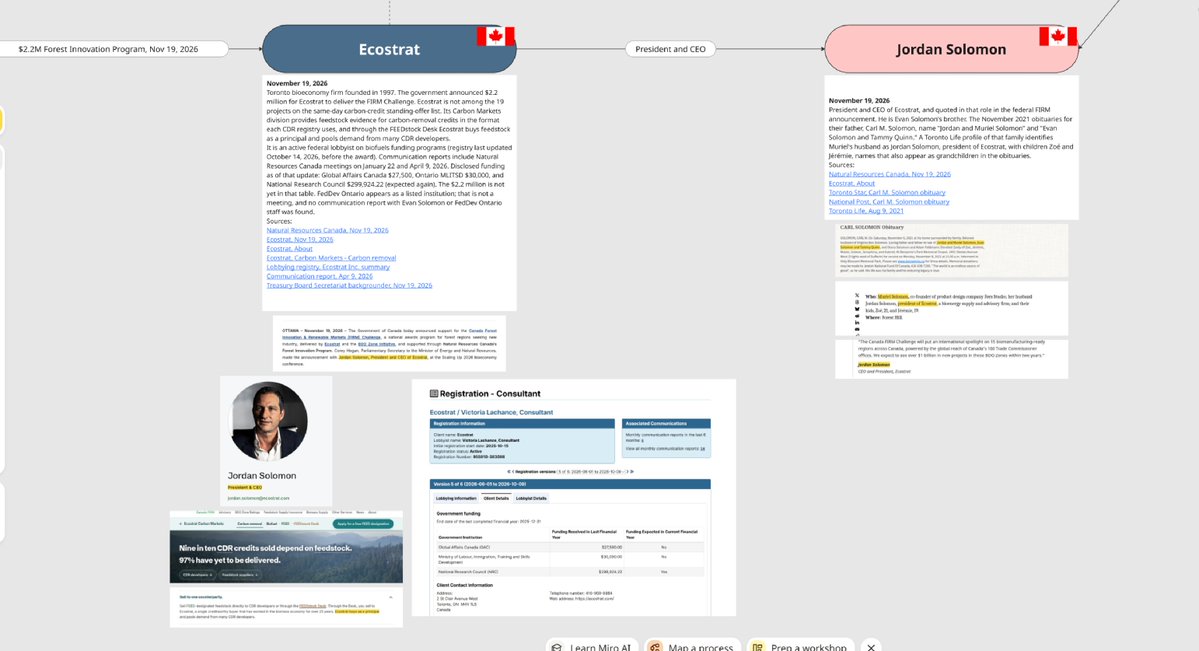
Hey @MarkJCarney were you planning on telling Canadians you are shoveling over millions to Evan Solomon's brother's Carbon Credit company? The same day you committed to buy credits for 19 projects.
@GemdariW@brivael No. Robots will carry them. Then those people are free to enjoy what they love too, and it's a mistake to think they don't love something. And some people take joy and find meaning in caring for others less capable as well.
@brivael Will those who want one be able to buy or develop an Optimus who will support and strengthen their adherence to cult-like beliefs and behaviours? My hope is that Optimus (or similar) will do the exact opposite by dispensing reality and "truth."
Wes Jones and ShaniaKwe are both Indigenous, and they’ve created this powerful song from their own experiences living on reservations.
They describe it as showing what failed socialism looks like when you’ve lived it, speaking of dependency, deteriorating housing, and communities still without safe drinking water.
A beautifully produced, deeply moving song that tells their story while offering a sobering warning to their fellow Canadians about the dangers of government dependency.
People ask why I'm so obsessed with alpacas. I've looked into it, and the mystery is how the rest of you stay so calm.
The alpaca was bred out of the wild vicuña about 6,000 years ago, at 4,000 metres in the Andes, where the air is thin, it freezes every month of the year and the grass is mostly a rumour. It thrives there. Its blood grabs oxygen better than almost any mammal's, and its stomach wrings a living out of forage a sheep would write to its MP about.
It is polite to the ground. It walks on soft pads, so it never cuts the turf. It nips the grass off instead of tearing out the root. And the whole herd uses one agreed dung pile, like a village with a by-law. Herders above the treeline have burned that pile as fuel for thousands of years, because there is nothing else up there to burn.
Then the fleece. Finer than wool, warmer for its weight, 22 natural colours and no grease. The Inca ran an empire on it. Their best cloth was worth more than gold, soldiers were paid in it, the state kept warehouses of it stacked to the rafters, and they burned it as an offering because nothing more valuable was to hand. The Spanish walked straight past the cloth to get to the metal.
In the 1990s an archaeologist in Peru examined alpacas that had been buried under house floors a thousand years earlier and dried by the desert down to the eyelashes. She put the fleece under a microscope. It was finer and more even than anything alive today. The herders of the year 1000 had better animals than we do.
Because within a century of the conquest about nine in ten were dead, along with the people who knew how to breed them, whose records were kept on knotted strings nobody can now read. The survivors were driven up to the highest, worst pasture with the families who refused to give them up. Every alpaca alive descends from the ones those people hid in the sky.
In 1836 a Bradford wool man called Titus Salt found bales of it lying unwanted in a Liverpool warehouse, worked out how to spin it, and made enough to build an entire town.
They hum, constantly, mothers to young and each to each. They give birth in the morning, so the newborn is dry and standing before the night freezes. Put two in a field of lambs and they will see off a fox. They do spit, but almost entirely at each other, over food, which is more than most families can claim.
The word jerky is theirs. It comes from ch'arki, the dried alpaca and llama meat of the high Andes. And their blood makes a kind of antibody a tenth the size of ours, which drug companies now raise them for.
Meanwhile "fleece" in a British shop means a jacket knitted out of oil.
Six thousand years of turning frozen grass into cloth, fuel, meat and medicine, and we know it as the one with the haircut at the petting farm.
So no. If anything I've been underdoing it.
REPORT: Canada permitted 42% more landed immigrants last year than claimed. New figures released by @CitImmCanada show PM @MarkJCarney concealed true numbers following widespread opposition to high quotas.
https://t.co/IM2PELvFOq
#cdnpoli#immigration
A lot of people have real trouble thinking about the aggregate behavior of groups. They can only think about individuals.
So they think about Elon Musk as an individual. Maybe they think that he must be retarded, because they need that for emotional reasons. Or maybe they think he is a talented rocket designer.
But even if they realize he understands rockets, they can only think about him as an individual doing tasks. Not about his impact on what the whole company does.
If Elon Musk is just a talented rocket designer, then he can spend all day, every day, improving rocket designs.
But he is just one of 7000 engineers. So even if did a perfect job, he would only improve progress by about .014%
So, when a midwit looks at SpaceX, he sees 7000 engineers, and says to himself "Elon Musk cannot possibly be designing the whole damn rocket himself. These people are giving him too much credit."
This would be absolutely true if Musk were just a some random SpaceX engineer. But he isn't. He's the absolute dictator of the whole damn company.
He decides, with absolute and unquestionable authority, which behaviors are punished and which are rewarded.
Why is this important?
When I worked at Boeing, on various classified projects, I naively came in with the assumption that I was a software engineer, employed to design and build functional software as quickly and cheaply as possible.
Because of this, I focused on functionality and efficiency, for example suggesting changes that would obviate the need for entire projects and software components.
And I very rapidly became persona non grata.
At first, this caused me to adopt an air of aggrieved innocence. I was just trying to do my job well, and I was being punished for it.
Then I gradually came to realize that I hadn't properly understood what my job was, or what the actual mission of Boeing Defense, Space, and Security was.
Boeing DSS was not an aerospace company. Boeing DSS was a fraud company.
Its goal was twofold. First, to maximize transfer of public tax dollars to stockholder pockets. Second, to maintain the appearance of being an aerospace company, to prevent the fraud from being exposed.
Which meant that my real job was twofold. First, to generate billable hours. Second, to look busy.
This is why Space Launch System sucks. Why it is always late when it doesn't fail outright. Why it is at 300% of its target budget. Why it leaves American astronauts stranded and needing a lift from SpaceX.
That's because, for Boeing, building rockets is a side quest. Something they have to do to look busy. Yes, a rocket does occasionally fly, but that's just happening so programs don't get shut down.
For Boeing, coming in early and under budget would actually be failure. The system is functioning exactly as designed.
The cost, not the rocket, is the goal.
Musk and SpaceX don't work like that.
Unlike Boeing executives, Musk is not a useless grifter asshole. He is an entirely different kind of asshole... a rocket obsessed sperg.
So, at SpaceX, engineers do not get rewarded for generating billable hours. They get rewarded for making rockets fly. And for all the subtasks of this, like figuring out how to make rockets lighter, figuring out how to make engines reignite better, figuring out how to make rocket exhaust not destroy launch pads, etc.
And this attracts engineers who care about rockets. You've seen them on broadcasts, crying on open microphones because they dedicated their lives to something and it just flew.
As a rocket engineer, who designs rockets, Musk is probably replaceable. As a rocket company engineer, who designs rocket companies, he is not.
For over 50 years, the US space industry stagnated precisely for the lack of a Musk-like figure, who could not only create an effective aerospace company, but who could thereby demonstrate what an effective aerospace company looks like.
Which makes it much more difficult for fraudsters to get away with fraud.
I'm envious. I wish I could have worked for an aerospace company instead of a fraud company.
But what's more important is that some of us now no longer have to play "who gets the most cheese?".
They get to play "What can we build today?".
The only issue with nuclear fission is that it’s good. And that’s why climate zealots oppose it. It delivers dense, reliable, near-zero-emission power 24/7 with a tiny land footprint. If we cut the bureaucratic red tape to lower costs and standardized reactor designs like China has, it would solve the climate change “issue” overnight. But climate alarmists only want solar and wind, which need endless overbuilding, backup power, and rolling blackouts to keep the electric grid going. Intermittency justifies rationing and state control over how much energy you are allowed to use. If you control energy, you control human behavior. And that's what the climate debate is about. It's not about science. It's not about energy. It's about power, control, and wealth redistribution.
Gerald is nine hundred kilos of Hereford bull, the most muscular representative of the Ruminati by a distance, and he built every ounce of it on salad, which is exactly why you cannot.
He has a neck you could not get your arms round. A back like a kitchen table. Shoulders that move under the coat like something being towed. He has never lifted a weight, never seen a protein shake, never touched a steak, and he would put a strongman in the shade standing still. People look at him and draw a conclusion, and the conclusion is that leaves build muscle, and the conclusion is wrong, because they are looking at the result and not at the plant.
What it took to build that out of greens:
- Four stomachs. You have one.
- A rumen holding 150 litres. Your whole gut holds about 7.
- 10 billion microbes in every millilitre of it. You keep yours in the last metre.
- Sixty kilos of leaves a day. Wet. Your big salad is about 300 grams.
- Eight hours chewing. Eight more chewing it again.
- 150 litres of spit a day to keep the vat running.
- Bacteria that turn leaf into fat, and feed him the fat.
- Bacteria that build his B12 for him, from cobalt in the soil.
- A gut that rebuilds every fragile fat it meets into a stable one before it reaches his muscle.
- A tongue like a rasp and no top front teeth.
- Four years of doing nothing else.
He is not strong because he eats plants. He is strong because he is a nine hundred kilo fermentation plant that happens to have a bull on the outside of it, and the leaves are the feedstock, and the fat and the protein that built those shoulders were made in the vat by things that do not live in you.
You have a single stomach, a colon the length of your arm, and about 5% of your calories available from fermenting greens, with wind as the by-product. Eat what he eats and you will get what the field gets, which is salad back.
He is not an argument for eating plants. He is the argument for letting something with four stomachs eat them first.
He is in the south corner. He has eaten about forty kilos since breakfast and has done nothing with it but stand there and be enormous. He has not applied to be anybody's role model, and the last man who tried to follow him was sick behind the trough by half nine.
I LOVE CANADA. I DON’T HAVE TO LOVE ITS GOVERNMENT.
I’m getting damn tired of people confusing patriotism with political obedience.
Apparently, if you criticize the Liberals, question government policy, or demand accountability, you’re suddenly labelled a traitor, un-Canadian, or worse.
What a load of political bullshit.
I’ve spent much of my life working, building businesses, farming, raising a family, and serving my community. I’ve watched ordinary Canadians work their asses off to build better lives for themselves and their children.
And I’ll be damned if someone is going to question my loyalty to Canada because I refuse to applaud a government I believe is taking this country in the wrong direction.
Canada existed long before Justin Trudeau, Mark Carney and the Liberal Party. It will exist long after they’re gone.
Our country is bigger than any prime minister, political party, or ideology.
Patriotism means defending the principles that made Canada worth building: individual liberty, personal responsibility, freedom of expression, equality before the law, and the opportunity to succeed through hard work.
It means expecting governments to live within their means, respect taxpayers, protect our sovereignty, and answer to the people who elected them.
And when they fail, it means having the backbone to say so.
I remember when conservatives fought to reform Ottawa, make government accountable, and give Western Canadians a stronger voice. We weren’t trying to destroy Canada. We were trying to make it better.
Some of us have been fighting that battle for decades.
Now we’re supposed to sit quietly while governments pile on debt, weaken economic opportunity, expand bureaucracy, and leave future generations paying for today’s political decisions?
Not a chance.
The government works for Canadians. Canadians do not work for the government.
Disagreement is not disloyalty. Opposition is not treason. And political criticism is not hatred of your country.
In a democracy, it’s our right and sometimes our responsibility.
Nobody gets to dictate how much I love Canada based on which political party I support.
I don’t owe Mark Carney my loyalty. I don’t owe the Liberal Party my silence. And I certainly don’t need a lecture on patriotism from people who mistake obedience for citizenship.
My loyalty is to Canada, its people, its freedoms, and the generations who will inherit what we leave behind.
I love this country enough to challenge its leadership, demand accountability, and fight for a better future.
And if that makes me a traitor in someone’s twisted political vocabulary, the problem isn’t my patriotism.
It’s their understanding of democracy.
Haiti just ran the cleanest A/B test of the century.
Option A: the international system. Thirteen years of UN peacekeeping, billions in aid, an army of NGOs. Result: a president assassinated in his own bedroom, a capital run by gangs, more than a million people displaced. The peacekeepers themselves brought cholera to the island and killed nearly 10,000 Haitians. After the 2010 earthquake, the Red Cross raised half a billion dollars and built six permanent homes. Six. Oxfam staff were caught paying for sex workers in the ruins.
Option B: Bukele. A few weeks, 2,000 soldiers, armored vehicles, one clear objective. Result: the gangs are now writing letters to the UN asking for "mediation."
Read that again. The gangs are asking the UN to protect them. They know exactly who is a threat to them and who isn't.
This isn't about Haiti. It's about the operating system the West has been running since the 60s, and it is dying in front of us. Its axioms were wrong.
Axiom one: everyone can be reinserted, the criminal is a victim of the system, punishment is oppression. El Salvador tried truces and soft approaches and became the murder capital of the world. Then it stopped believing it.
Axiom two: force is always illegitimate. But order isn't natural. It's built and maintained, sometimes by force. A state that refuses to use legitimate violence doesn't abolish violence. It hands the monopoly to whoever is willing to use it. In Haiti, that's the gangs.
Axiom three: everything can be steered from the top. Central banks, planners, aid agencies, "development" programs. Decades of money pushed down from above, and the result is always the same: a class that lives off the problem and has zero incentive to solve it. An NGO that fixes Haiti loses its budget. Think about that.
Axiom four: morality is relative and the old norms were just oppression. This one was built by a very specific elite in the 60s and 70s. In 1977, Sartre, Beauvoir, Barthes, Deleuze and others signed a petition in Le Monde defending sex between adults and minors. Those people are the intellectual grandparents of today's ruling class. Epstein isn't an anomaly. He's the tail of that comet: a network of untouchables who believed rules were for other people.
Now the system is cornered, and it has two exits.
Exit one: lock everything down. Digital IDs, programmable money, censorship sold as safety, a technological control state more total than anything Orwell imagined. Keep the bureaucracy, add the surveillance.
Exit two: let it collapse and rebuild on what actually works. Individual responsibility. Freedom. Consent. Clear rules, actually enforced. Decentralized systems that emerge from the bottom instead of central planners who are never accountable for their failures.
Haiti just showed us which one delivers.
The 20th century bet on the bureaucrat. The 21st belongs to builders, and to states that do what they say.
As a clinical hypnotherapist, I’ve long been fascinated by how much of what we believe was never consciously chosen in the first place.
Some of the opinions we defend most fiercely may be the very ones we’ve never thought to question.
We inherited them. Absorbed them. Heard them repeated so often that eventually they felt like our own conclusions.
I’ve caught myself doing it, and the realization was rather uncomfortable.
We’re entering an age where even the appearance of public agreement can be manufactured. Where thousands of voices may not represent thousands of people.
And where genuine human beings can be persuaded by a consensus that never existed.
We’ve always been susceptible to following the crowd. What happens when the crowd itself is an illusion?
A seemingly insignificant experience years ago made me question the origins of my own convictions.
I’ve written about that experience and why the questions it raised have become more unsettling with time.
How Much of What You Believe Is Actually Yours?
My latest Substack essay:
https://t.co/UUkL1abFjP
I come here with observations, questions, and a sense of humour—not a claim to have all the answers.
I enjoy the conversations, especially when someone offers a perspective I hadn’t considered.
I’m willing to change my mind. I often do.
Always, Angela
". . . he put the whole of politics in another, noting that it is hard to imagine a more dangerous way of making decisions than putting them in the hands of people who pay no price for being wrong."
Thomas Sowell – The Man Who Asked for the Evidence 📚
He was born in 1930 in North Carolina, in a house without running water. His father died before he was born. He grew up in Harlem, left school at sixteen, delivered telegrams, worked in a machine shop and served in the Marines. Then he went to Harvard, Columbia and Chicago.
He started as a Marxist. Books did not cure him. A summer job did.
In 1960, at the U.S. Department of Labor, he studied the minimum wage in Puerto Rico's sugar industry. Each time the wage was raised, employment fell. He proposed a simple test to find out why. Nobody in the building wanted it run. The department's budget depended on the law being good; whether the law was good was not its business. That summer, he understood that an institution has interests of its own, and that the truth is rarely among them.
Everything else followed from there. For sixty years, he has asked the three questions that no ideology survives: compared to what, at what cost, and what hard evidence do you have?
He put the whole of economics in one line, observing that there are no solutions, only trade-offs. And he put the whole of politics in another, noting that it is hard to imagine a more dangerous way of making decisions than putting them in the hands of people who pay no price for being wrong.
He gave the planners their true name: the anointed. People who judge themselves by their intentions and everyone else by results, and for whom every failure of their policy is proof that it was not tried hard enough.
He was a black man from Harlem who said that culture matters more than grievance, and that the policies made to help the poor had hurt them most. For that, the people who claim to speak for the poor never forgave him. He kept writing anyway – more than forty books, without a single slogan in them.
He is ninety-six. He has never held power, never led a movement, never raised his voice.
He only asked for the evidence. In the age of the Lie, that turned out to be the most radical thing a man could do.
—
America has one honor that fits: the Presidential Medal of Freedom, its highest civilian award. 🏅🇺🇸
He should receive it now, while he can still walk up and collect it. 🗽
The dog exists because Ice Age hunters could not live on lean meat.
Wolves and people wanted the same animals, and for a long time nobody could explain why a band of hunters would feed a rival through a winter. In 2021 a team of Finnish researchers did the sums for the coldest stretch of the last Ice Age and found the answer in the human liver.
By late winter a reindeer or a horse has burned through its fat and is nearly all muscle. A person can only clear so much protein. Push it much past a third of what you eat and you get sick, then weak, then worse, however full your stomach is. So a hunting band took what it needed, the marrow, the brain, the tongue, every scrap of fat, and was left sitting on a heap of lean meat it could not safely finish.
A wolf can live on lean meat for months.
The surplus went to the pups by the fire. Nobody was competing for it. A few thousand winters of that and you have a dog.
So the oldest friendship on earth rests on one fact about your metabolism: you are the fat-eater in the partnership. Your ancestors dealt with the skinless chicken breast twenty thousand years ago by throwing it to the wolf.
Today the lean cut is on your plate with a health sticker on it, and his descendant gets a brown biscuit made of maize.
He was better fed in the Ice Age. So were you.
@Martyupnorth Random lottery. But you have to be over 40, have children, and have a net worth in the top quartile of the province. You serve for four years and that's it.