Harvards Business School
Founder Indus Capital ,USA ,
Founder Texas Capital ,TX,USA
Founder Eskeyn Ventures ,UK
Tanushree Foundation
Ted Speaker ,Author
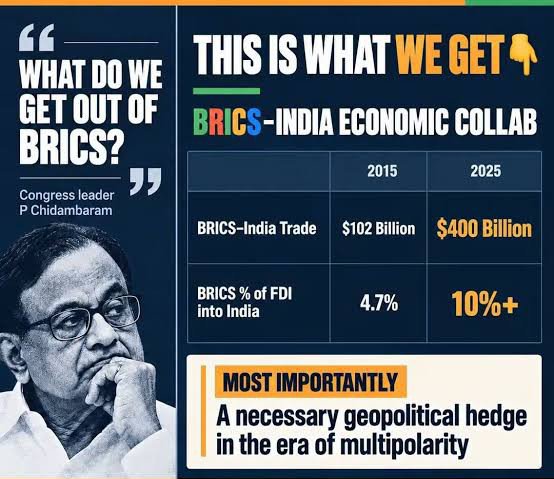
India BRICS Advanatage
India gains strategic autonomy, expanded trade markets, and alternative development finance through its membership in the BRICS Alliance
Brics-and-indias-strategic-opportunity)Strategic & Diplomatic AdvantagesStrategic Autonomy: BRICS allows India to partner with non-Western emerging powers without joining a formal military or
Global South Leadership: The bloc positions India as a primary voice for developing nations and the wider Global South.
Global Governance Reform: Membership gives India a collective platform to push for reforms in the UN Security Council, IMF, World
Diplomatic Leverage:
India uses the platform as a balancing mechanism, maintaining strategic ties with Western nations while engaging
Economic & Financial AdvantagesAlternative Finance: The New Development Bank provides long-term funding for infrastructure projects like roads, ports, and transit networks in India.
Expanded Export Markets: The expanded 21-country market (including 11 full members and 10 partners) opens new trade avenues for Indian pharma, agriculture, Energy Security:
The grouping includes major global energy and critical mineral producers, ensuring resource stability for India's
Local Currency Trade:
Promoting bilateral trade settlements in national currencies helps lower transaction costs and reduces vulnerability to external financial shocks.
Advancing India's Strategic Interests
Platform for Strategic Autonomy and Multi-Alignment: BRICS enables India to cooperate with.Innovation. New opportunities. India's trade with BRICS partners has surged past $417 billion in 2025–26, more than doubling in five years. With $96 billio...Institute for Security & Development
That distinction is critical for New Delhi. India can support greater use of national currencies, payment interoperability
Central Bank Assests and GDP
The largest central bank balance sheets belong to the European Central Bank (Eurosystem), the People’s Bank of China (PBOC), and the U.S. Federal Reserve. Together, the world’s major central banks control tens of trillions of dollars in assets—primarily composed of gold, foreign currency reserves, and government securities. Because central banks operate in different currencies and scale with the size of their domestic economies, economists track them using two primary metrics: Absolute Asset Value (converted to USD) and Assets as a Percentage of GDP (which measures the central bank's footprint .
The GDP Disconnect: A massive economy does not automatically mean an outsized central bank balance sheet. For example, while the U.S. Fed has trillions in assets, it represents only 21.2% of U.S. GDP. Conversely, Hong Kong boasts a ratio of 130.1%, meaning its central bank holds assets worth more than the territory's entire annual economic output. Safe Havens and Interventions: Economies like Switzerland (107%) and Japan (94.7%) maintain massive balance sheets relative to their sizes due to aggressive currency interventions. The Swiss National Bank routinely purchases foreign assets to suppress the value of the Swiss Franc, a heavily sought-after "safe-haven" currency. Emerging Market Buffers: Central banks like the Reserve Bank of India (RBI) have intentionally grown their asset pools—primarily through accumulating foreign exchange reserves—to guard domestic currencies against global market volatility and sudden capital outflows
On this auspicious occasion of #GaneshChaturthi, as homes and hearts across our country and around the world light up with devotion, we welcome the beloved Lord of New Beginnings, Wisdom, and Harmony into our lives.
Vighnaharta, the remover of obstacles, reminds us that no hurdle is insurmountable when approached with intelligence, patience, and a steadfast spirit. #Ganesha teaches us to navigate life’s complexities with balance, to cherish intellect, and to seek unity across our diverse tapestry of culture and tradition.
In talks with media
India importance to BRICS
'India As a founding member of the bloc—which has now expanded to 11 members representing nearly half of the world's population and roughly 40% of global GDP—India places immense value on the forum. This significance is highlighted as New Delhi hosts the 18th BRICS Summit in September 2026 under the theme "Building for Resilience, Innovation, Cooperation and Sustainabilit"
"Reforming Global Governance: The bloc acts as a unified pressure group demanding systematic reforms to Western-dominated bodies such as the UN Security Council, IMF, World Bank, and WTO to reflect current geopolitical realities."
Thanks maam Arundhati Bhattacharyaji for Hindi version of book launch "Aparajita".
Great learning allways looks upto you ma'am
Arundhati Bhattacharya's memoir Indomitable: A Working Woman's Notes on Work, Life, and Leadership
The Tech Startup Funding Race and India
The global startup funding landscape remains heavily concentrated in the United States. However, India is strengthening its position as a major technology and innovation hub.
The plot highlights the scale of the U.S. market while showing how India compares with other major technology ecosystems around the world.
India Ranks Third for Startup Funding
The U.S. dominates the ranking with $244 billion in startup funding. That total is more than 16 times the $15.2 billion recorded by the UK, which ranks second.
India follows in third place with $10.5 billion in funding. This puts the country ahead of several large economies and established technology hubs. China attracted $7.3 billion, while Germany received $7.0 billion. Canada and France followed with $6.3 billion and $6.2 billion, respectively.
That was the second-highest total globally. Only the U.S., with 60 listings, recorded more. India finished ahead of China, which had 38 listings, and Europe, which had 20.
The strong IPO count points to a growing pipeline of Indian technology companies reaching public markets. It also gives investors another measure of the country’s expanding startup ecosystem beyond private funding totals.
Turning Investment Data Into Insights
Funding and IPO activity show India becoming an increasingly important part of the global technology landscap
India also attracted more than twice the funding recorded by Singapore, at $4.5 billion. Israel and Switzerland round out the ranking with $4.2 billion and $3.5 billion.
India’s IPO Market Shows Momentum
India’s position becomes even more notable when looking at public listings. The country recorded 42 tech IPOs in 2025, according to Tracxn’s India Tech Annual Funding Report
GST 2.0 Reforms In India Sectoral Impact, Changes, and Roadmap To Viksit Bharat,JNU Campus 8 September.
Thisbring together policymakers, industry leaders, academicians, and students to discuss the latest developments in the Goods and Services Tax (GST) framework and its implications for various sectors of the Indian economy. Participants will explore the transformative changes brought about by GST 2.
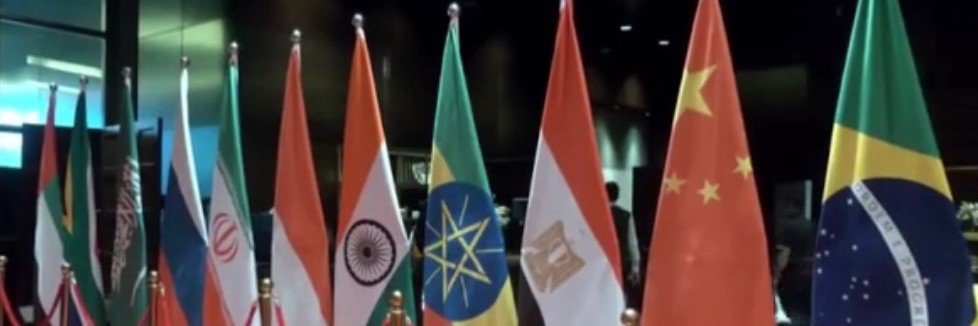
India is officially hosting the 18th BRICS Summit in New Delhi from September 12–13, 2026, at the premier Bharat Mandapam convention centre. This mega-diplomatic event marks India’s fourth time holding the rotating BRICS presidency, coinciding perfectly with the 20th anniversary of the bloc's establishment. Pic prelude to events
Go Gone. Indian Unicorns
Who moved the Cheese No more SoftBank
Nomore Ant capital
No more Alibaba .No more fancy Cyber hub office No more Banglore..
All these poster boys bitting the nails
OYO ROOMS are no more adult couple's paradise.
Sugar cosmetic have no more sweet takers of Multi color lipsticks where likes of Reliance booming
Lens Cart doesn't have fancy membership
Boat is sinking they fooled "made in India jargon" where entire thing is made in China
Just have screws in India.
So does Payym
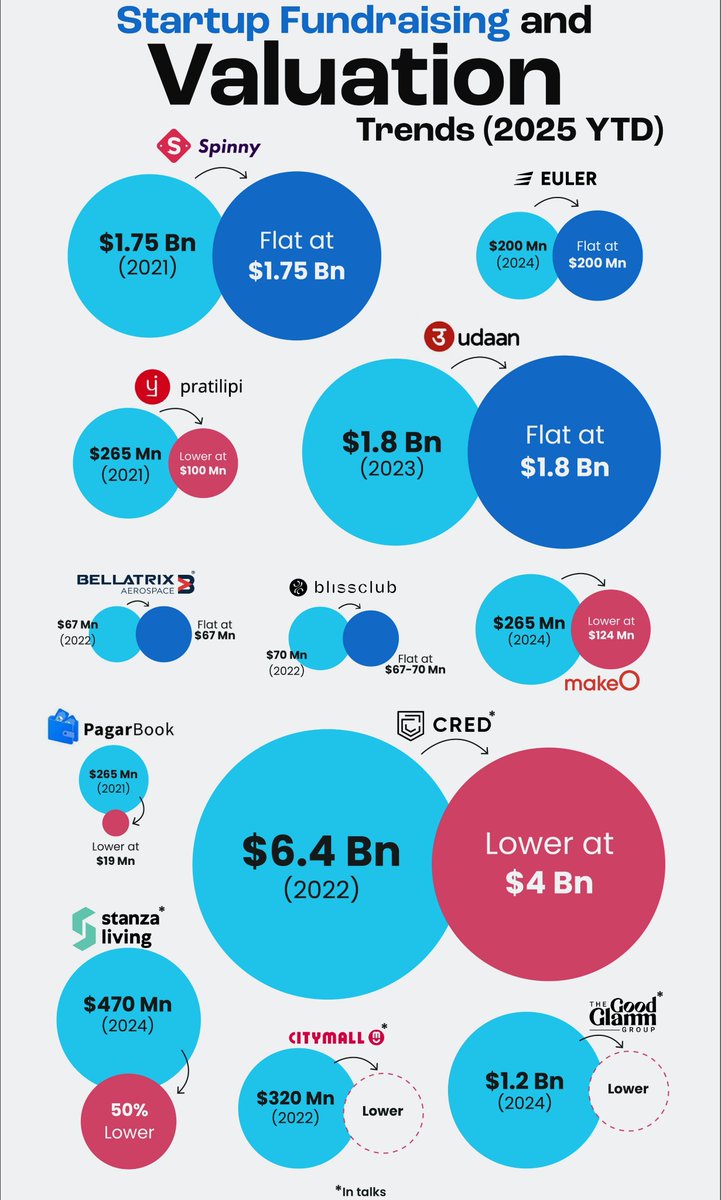
Indian startup valuations are down because a severe funding crunch, tighter global liquidity, and a major shift by investors toward profitability over raw growth have corrected inflated pandemic-era prices.Key Reasons for the Valuation Drop
The Funding Crunch
Global investors have pulled back due to macroeconomic pressures and geopolitical tensions. Money has become much harder to secure, especially for late-stage companies. "Late-stage startup funding fell 38% year-on-year to $5.6 billion in 2025-26...", according to the Economic Times.Shift from Growth to ProfitabilityDuring the boom years, investors rewarded rapid user growth even if the company lost money.
Now, public and private markets demand strict financial health. "Private investors are now using the same standards.
Growth that doesn't boost LTV, margins, or payback doesn't support high multiples anymore.".The Overvaluation CorrectionMany startups raised money at unrealistic values during past market highs.
When these companies failed to meet extreme growth expectations, investors marked down their values or faced painful down rounds.Corporate Governance and Compliance Concerns
High-profile issues, regulatory penalties, and a lack of financial transparency at major firms have made venture capitalists much more cautious. Many startups suffered from an execution crisis, “chasing valuation over value, building for investors instead of customers.”,
IS HDFC BANK. GOING THE LEHMAN BROTHERS WAY..
Underperformance and stock price decline of HDFC Bank—which has seen its shares plunge roughly 27% to 28.5% year-to-date in 2026—is primarily driven by serious governance controversies, leadership exits, and post-merger structural pressures rather than a failure in its core banking operations. The bank's market capitalisation has eroded by nearly ₹4 lakh crore in 2026, hitting a two-year low of ₹707 on August 28, 2026
1. The Leadership Crisis and CEO ExitSashidhar Jagdishan's Departure: On August 29, 2026, MD & CEO Sashidhar Jagdishan made a surprise announcement that he will not seek reappointment and will retire when his term ends on October Preceding Resignations: This followed the abrupt resignation of Part-Time Chairman Atanu Chakraborty in March 2026 over ethical differences with management, which initially triggered severe market volatility.
Succession Uncertainty: Leaving the transition until the final months created a massive sentiment overhang, fueling foreign
Governance Issues and Legal BattlesThe MSRDC Disciplinary Action: The board issued warning letters and a ₹1 lakh fine to top executives, including the CEO and CFO, for "business overreach" involving a past ₹45 crore deposit deal with the Maharashtra State Road Development Corporation (MSRDC). Core banking funds were allegedly disguised as marketing expenses.
US Class Action Lawsuits: Following the MSRDC revelations, three US-based law firms initiated securities violation lawsuits against HDFC Bank, damaging global investor trust.
3. Post-Merger Financial StrainMargin Squeeze (NIM): Following the massive July 2023 merger with HDFC Ltd, the bank has battled persistent compression in its Net Interest Margins (NIM).
CASA Ratio Pressure: Low-cost Current Account Savings Account (CASA) deposits have declined.
The bank has been forced to rely on more expensive fixed deposits to sustain credit growth, driving up its overall cost of funds.Institutional Capital Shift: Active mutual fund managers and FIIs systematically trimmed their weightage, allowing competitors like ICICI Bank to overtake HDFC Bank as the top holding in domestic active mutual fund portfolios.
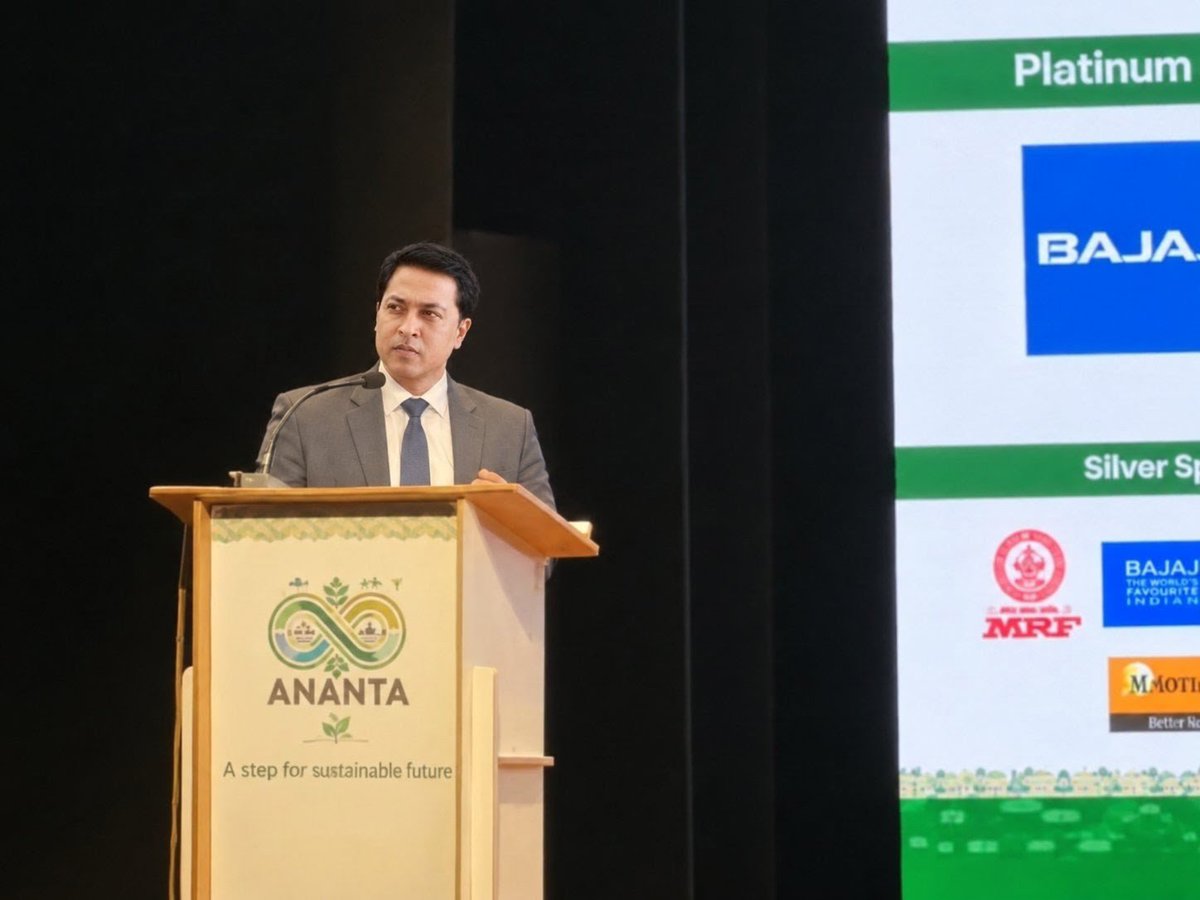
Pure green energy and support of sustainable growth with self driven eco system. True flagship and innovative disruptions Ananta .Proud for the association
My best wishes Shri Shyam Sunder Agrawal,GAIL india .
Shri Shyam Sunder Agrawal retired as the Executive Director (Operations & Maintenance – Corporate Office) of GAIL (India) Limited on August 31, 2026, capping off a distinguished career that spanned over 35 years at the company.Throughout his tenure, he played a vital role in expanding and securing India's natural gas infrastructure
A historic milestone for India’s Nari Shakti and our Armed Forces. 🇮🇳
Heartiest congratulations to Air Vice Marshal Shakti Sharma on becoming the first woman non-medical officer in the Indian Defence Services to attain the two-star rank, as she assumes charge as Assistant Chief of the Air Staff (Education).
This is not merely a glass ceiling broken; it is a national milestone. It reflects an India where women are increasingly taking their rightful place at the highest levels of leadership, responsibility and service to the nation.
Her achievement strengthens the aspirations of a generation of young Indian women who know that no rank is beyond their reach and no frontier beyond their ambition.
May she continue to lead with distinction and inspire many more women to serve India with pride.
Jai Hind!
At Rhodes Memphis, Tennessee.
Key takeaways Lynne and Henry Turley Memphis Center for Community social Entrepreneurship engagements in multi country multi culture background
IndusInd Bank Ltd appoint three new directors strengthening leadership
Ganesh Sankaran and Jagdeep Mallareddy have been appointed as Executive Directors (Whole-Time Directors) of IndusInd Bank Limited with effect from August 4, 2026
Subhash Chandra Zee Fake it till you make it
how he did and how media knew it.
Zee Network founder Subhash Chandra managed to settle a massive ₹22,006.57 crore liability for just ₹6.25 crore through a personal insolvency resolution process approved by India's National Company Law Tribunal (NCLT).
The media found out about it immediately because the landmark decision was passed as an official, public legal order by the NCLT on August 25, 2026, sparking an instant news wave and a subsequent public war of words between corporate giants.The mechanics of how he achieved this resolution, and the exact reasons the media caught wind of it, are detailed below.
How Subhash Chandra Did It
The settlement represents a 99.97% haircut for the lenders on paper, but it was executed strictly through legal pathways under the Insolvency and Bankruptcy Code (IBC):
Personal Guarantees vs. Corporate Debt:
The ₹22,006.57 crore figure was not direct cash that Chandra pocketed; rather, it stemmed from personal guarantees he signed to back corporate loans taken by his parent conglomerate, the Essel Group
.Prior Liquidations: Before the insolvency process reached its final stage, Chandra had already liquidated major personal assets and sold off his family's core promoter stakes in Zee Entertainment Enterprises to pay back over ₹43,000 crore in group debts.
Commercial Wisdom of Creditors:
Under IBC laws, a personal repayment plan requires the approval of creditors holding at least 75% of the voting share. Chandra's plan secured a 80.814% majority vote from the lenders. The majority of banks accepted the ₹6.25 crore contribution because it reflected the actual remaining value of his heavily depleted personal estate.NCLT Judicial Stamp: NCLT Judge Nilesh Sharma approved the plan and dismissed objections from dissenting lenders, ruling that the "commercial wisdom" of the financial majority must be upheld
.Borrower Liability Remains:
Critically, this haircut only frees Chandra personally. The original borrowing corporate entities and their underlying assets remain fully liable for the remaining multi-billion dollar debt.
How the Media Knew ItThe public exposure of the case did not happen through a leak, but rather through standard legal tracking and corporate rivalry:
Public Court Orders: Decisions by the NCLT are matters of public record. Financial journalists regularly track high-profile personal insolvency cases, ensuring the verdict was published hours after the judge signed it
.Corporate Media Rivalry: The news went viral and exploded across platforms after TV18 Group—a media entity owned by Mukesh Ambani's Reliance Industries Ltd.—heavily broadcasted the sensationalist headline that a billionaire had escaped a ₹22,000 crore debt for a pocket-change sum.
Students suicide in #IIT, #IITDELHI
This has to stop.....
Repeated hostel accommodation denials, academic pressure, and administrative humiliation.Mental Health Struggles: Current student actively undergoing medical treatment for mental health issues.
Despite receiving medical clearance to continue his studies,
the family was forced to rent a separate flat outside because the institute did not provide accommodation.
eighth student suicide at IIT Delhi since 2023, severely amplifying deep-seated frustrations regarding intense academic pressure, isolation, and student welfare management