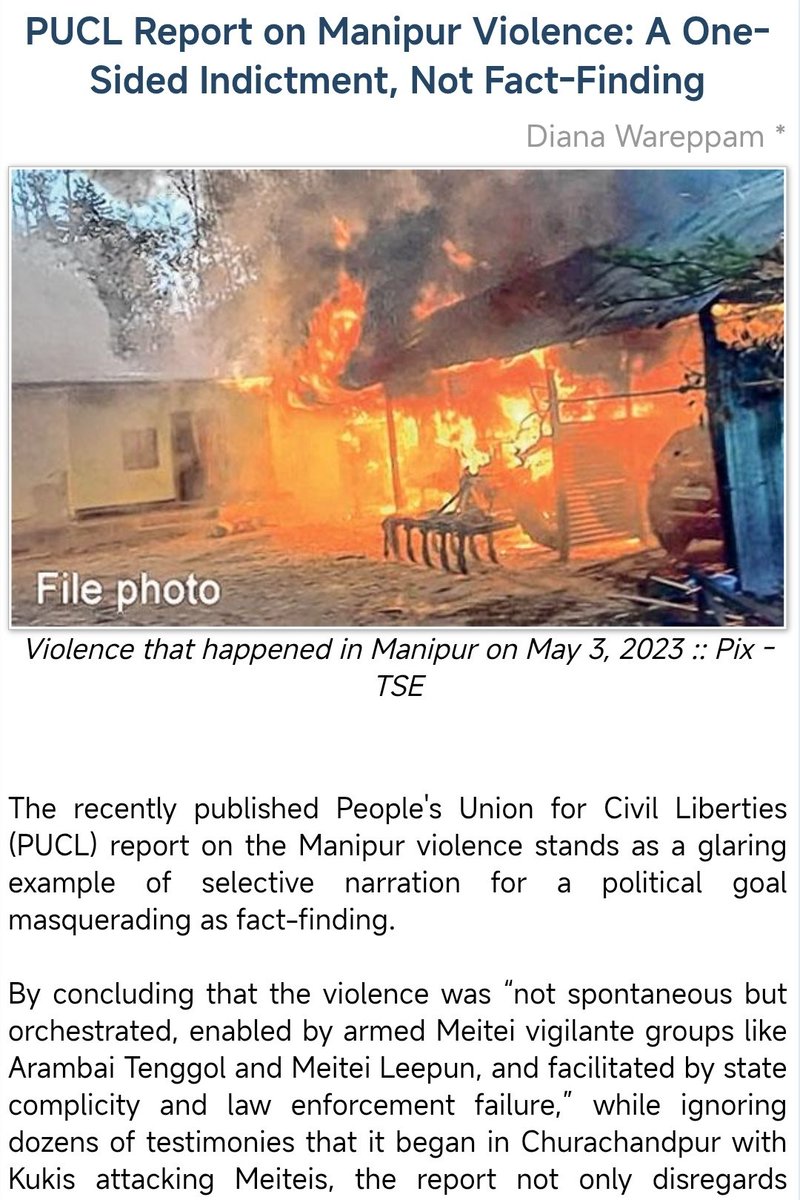
I wrote at @epaomanipur -
"PUCL (@PUCLindia) Report on Manipur Violence: A One-Sided Indictment, Not Fact-Finding"
'By reducing the crisis to a simplistic binary and vilifying one community, PUCL ignores the complex realities on the ground. Its selective lens betrays a prejudiced ideological position that risks fuelling division rather than aiding reconciliation. Anything less than honest, balanced inquiry will only write the next chapter of conflict, not reconciliation. Manipur deserves truth, not manufactured narratives.'
Link- https://t.co/DmlPG5U2UL
Your contemptuous way of NOT acknowledging, and correspondingly dismissing, months long pain and suffering of the people of Manipur as insignificant to your "Rastra Chetna", shall not go unanswered ... History shall bear testimony!
Let’s remember this 13 Martyrs on this #RepublicDay of India 🇮🇳 and let every Indian 🇮🇳 know, how they defended Manipur from the series of attacks by #KukiTerrorists and gave up their lives so that India 🇮🇳 can have a better future.
Let’s remember this 13 Martyrs on this #RepublicDay of India 🇮🇳 and let every Indian 🇮🇳 know, how they defended Manipur from the series of attacks by #KukiTerrorists and gave up their lives so that India 🇮🇳 can have a better future.
@PrinceArihan 4/ The Islamic and KNF terror alliance can be vividly seen in the pattern of violence against predominantly the Hindu Meiteis, particularly women and children. Many times, Meiteis who follow other religions have been spared. A glimpse of their brutality can be seen here:
@PrinceArihan 4/ The Islamic and KNF terror alliance can be vividly seen in the pattern of violence against predominantly the Hindu Meiteis, particularly women and children. Many times, Meiteis who follow other religions have been spared. A glimpse of their brutality can be seen here:
3/The success of this alliance could have far-reaching consequences beyond the immediate region. A destabilized Northeast India, coupled with unrest in neighbouring Bangladesh and Myanmar, could create a volatile environment ripe for external intervention. Western nations, particularly the United States, have a history of strategic interest in the region, often under the pretext of promoting democracy or protecting human rights. The potential for external involvement by Western nations adds another layer of complexity. Any missteps in handling this alliance could be exploited by these powers to justify their intervention, further destabilizing the region and undermining local sovereignty.
The alliance between the KNF and JAFHS is a dangerous development in the already volatile region of Northeast India, Bangladesh, and Myanmar. While the partnership may seem ideologically contradictory on the surface, it is, in reality, a calculated move by both groups to further their own agendas. The implications of this alliance are far-reaching, with the potential to destabilize the region and invite external intervention under the guise of counterterrorism or humanitarian assistance.
3/The success of this alliance could have far-reaching consequences beyond the immediate region. A destabilized Northeast India, coupled with unrest in neighbouring Bangladesh and Myanmar, could create a volatile environment ripe for external intervention. Western nations, particularly the United States, have a history of strategic interest in the region, often under the pretext of promoting democracy or protecting human rights. The potential for external involvement by Western nations adds another layer of complexity. Any missteps in handling this alliance could be exploited by these powers to justify their intervention, further destabilizing the region and undermining local sovereignty.
The alliance between the KNF and JAFHS is a dangerous development in the already volatile region of Northeast India, Bangladesh, and Myanmar. While the partnership may seem ideologically contradictory on the surface, it is, in reality, a calculated move by both groups to further their own agendas. The implications of this alliance are far-reaching, with the potential to destabilize the region and invite external intervention under the guise of counterterrorism or humanitarian assistance.
2/By aligning with JAFHS, the KNF aimed to amplify its operational capabilities, using JAFHS’s established networks and resources to spread terror across Bangladesh, India, and Myanmar. This partnership allows the KNF to target a broader range of adversaries and destabilize key areas in these countries, thereby weakening state control and creating a power vacuum that could eventually support their goal of an independent Christian state.
JAFHS, known for its Islamist militant activities, brings a different but complementary set of skills to the alliance. Their expertise in guerrilla warfare, bomb-making, and radicalization is invaluable to the KNF’s objectives. While JAFHS’s primary agenda is to spread Islamist ideology, their collaboration with KNF allows them to extend their influence into new territories, furthering their own goals under the guise of supporting KNF’s insurgency.
This symbiotic relationship benefits both groups: the KNF gains the militant expertise and operational reach needed to challenge state forces, while JAFHS finds new opportunities to spread its ideology and establish footholds in regions where Islamist influence has traditionally been weak.
2/By aligning with JAFHS, the KNF aimed to amplify its operational capabilities, using JAFHS’s established networks and resources to spread terror across Bangladesh, India, and Myanmar. This partnership allows the KNF to target a broader range of adversaries and destabilize key areas in these countries, thereby weakening state control and creating a power vacuum that could eventually support their goal of an independent Christian state.
JAFHS, known for its Islamist militant activities, brings a different but complementary set of skills to the alliance. Their expertise in guerrilla warfare, bomb-making, and radicalization is invaluable to the KNF’s objectives. While JAFHS’s primary agenda is to spread Islamist ideology, their collaboration with KNF allows them to extend their influence into new territories, furthering their own goals under the guise of supporting KNF’s insurgency.
This symbiotic relationship benefits both groups: the KNF gains the militant expertise and operational reach needed to challenge state forces, while JAFHS finds new opportunities to spread its ideology and establish footholds in regions where Islamist influence has traditionally been weak.
1/The emergence of Jamaatul Ansar Fil Hindal Sharqiya, a militant organization with ties to pro-Al-Qaeda extremist groups, sparked concern following the circulation of a video some years back showing its members receiving training from the Kuki-Chin National Front (KNF) in the Chittagong Hill Tracts (CHT).
The foundation of this alliance was laid in 2021 when JAFHS and the KNF signed a written agreement. The details of this agreement reveal a carefully calculated partnership, where Jamaatul Ansar sought not only to secure a safe haven but also to gain the military expertise and local knowledge of the KNF.
The KNF, traditionally a Christian insurgent group operating in Northeast India, has long sought to establish an independent Christian state in the region. However, their alliance with JAFHS, an Islamist militant group with a history of religious extremism, signalled a shift in their strategy. From a counterterrorism perspective, the KNF’s collaboration with JAFHS is less about religious ideology and more about leveraging militancy as a tool to achieve their political objectives.