A small correction.
Active funds are UW India and passive funds have to catch up on the weight increase!
The catch up continues - FII inflow in the month of November - A staggering INR 65,000 Crores (USD 7 Bn).
Guess who sold! DIIs - INR 40,000 Crores
Why did FIIs suddenly come surging back into India?
IMHO
All the passive funds who were UW India had to catch up. India's weight in MSCI EM went up from ~10.5% in September to 12.5% in October (Mostly owing to fall in weights of Korea and Taiwan)
As Mike Green (@profplum99) has written, passive flows are entirely price-agnostic. They operate on the world's simplest algorithm: "Did I receive cash? If so, buy." They don't care about valuations or fundamentals, which creates massive, unthinking momentum when index weights shift.
Summarising what @neelkanthmishra wrote
These are approximate costs and an indicative measure, not exact
A Month ago - Per Barrel Cost (In USD)
Price of Brent Crude - 117
Refining Margins - 75
Transport Cost - 35
Total - 227
Approximate cost per litre in India at USD/INR 97 -> 138
While the above cost lasted only for a few weeks, some narrative led to significant extrapolation.
Current - Per Barrel Cost (In USD)
Price of Brent Crude - 100
Refining Margins - 50
Transport Cost - 20
Total - 170
Approximate cost per litre in India at USD/INR 93.5 -> 100
A decline of ~40%!
Most of us got to a certain wealth threshold because of concentration.
But the dichotomy is as we get older, concentration needs to reduce.
Loss from extreme concentration shows up in times like these.
Head over to https://t.co/EKgy7Ub3nE if concentration is bothering you
@DezervHQ
A tough few months, then a massive bullish turn in just one week.
Everyone is asking:
Have markets turned for good?
Or is this a "dead-cat bounce"?
Get your answers this Saturday from India’s top investing minds
🎙️ Navneet Munot (HDFC MF) - The Macro Call
🎙️ Anish Tawakley (DSP MF) - Market Cycles
🎙️ Kenneth Andrade (Old Bridge) - Mid & Small Caps
🎙️ Atul Suri (Marathon Trends) - Fundamentals & Momentum
🎙️ Vaibhav Porwal (CIO of Dezerv) - Selecting the Best
Hosted by @sandeepjethwani.
🗓 NAV-Varsh Summit | Sat, 7 Nov, 11 AM 🔗 Register: https://t.co/0EnVJE0fiV
@DezervHQ@hdfcmf@oldbridgecap@dspmf@marathontrends
A blue wave or a green wave :)
If the war(s) really end, a major overhang of geo-politics uncertainty goes away.
Most risk asset "prices" should do well.
The performance of these assets have been on a tear themselves. Look at mid-season earnings of
Nifty 50 - 25% YoY
BSE500 - 28% YoY
And P/E of 18x - 20x
Peter Lynch made billions with this rule - Buy when
P/E = growth
We are 50 Webinars old with over a 100k participants. But most excited about the one on the 14th!
Lets see what our kids spin up! Please help spread the word. A special #67 prize as well :)
Most of us learned how money works late, and often the hard way.
Our children don’t have to.
A few months ago, I wrote about how our money habits are shaped more by our parents than by any MBA, book or finfluencer. Since then, I’ve been thinking about the other half of that idea. Children learn money best not when we explain it to them, but when they get to work it out for themselves.
So this Children’s Day, we’re trying something new.
We’re hosting the Dezerv Children’s Day Hackathon 2026, a finance hackathon for children aged 8 to 18.
The challenge is simple: build a web app that helps children manage money.
To do that, they’ll have to answer the questions every family deals with:
- Where did my pocket money go?
- How do I save for something I really want?
- Should I buy it now, or wait a little longer?
No coding experience is needed, and no real money is involved. Just curiosity, creativity and a willingness to learn by building.
With everyone home for Diwali, it could be a fun thing to sit down and build with your kids this weekend.
What the Dezerving kids can win:
1) Prizes worth up to ₹1 lakh
2) The top 3 present their apps live to an audience of 2,000+ on Children’s Day, 14 November
3) The top 10 win a mystery swag box
4) Every child who submits gets a certificate
It’s free, fully online, and registrations close on 8 November.
If you have a child at home, or know one who loves building things, please share this with them.
I can’t wait to see what they build.
Link below.
Kitne Soan Papdi!
Getting 5 boxes of Soan Papdi this Diwali is annoying.
But having multiple mutual funds that own the exact same stocks is expensive.
Most portfolios suffer from duplicate clutter without the owner even knowing. It’s time for Portfolio ki Safai.
In this webinar, we’ll cover:
What duplicates to clear out?
What do you really need?
Now that there’s room, what should you actually buy?
Clean house here
https://t.co/dCN6CEPA7n
The Core Question
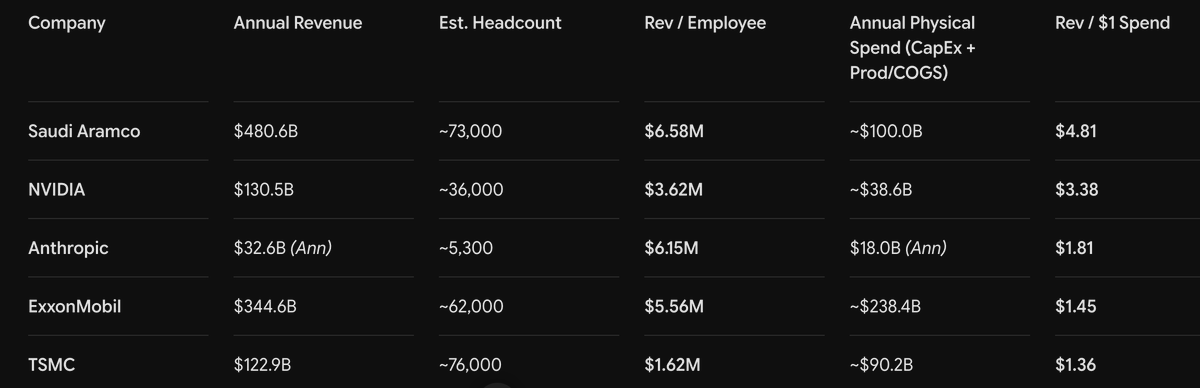
With a 900% NDR, the demand curve is proven. But the structural question remains: is there a physical and economic ceiling to this model?
Unlike traditional software, where distributing an extra copy costs virtually zero, serving this massive AI demand requires scaling physical supply chains (GPU clusters, power contracts, cooling infrastructure). Anthropic is already operating at a capital efficiency comparable to ExxonMobil and TSMC.
Anthropic’s leaked S-1 reveals two staggering things: top-line growth that is breaking historical records and a mind-numbing Net Dollar Retention (NDR) of 900%. Enterprise demand for frontier models is essentially vertical.
But valuing AI labs through a traditional tech lens ($6.15M revenue per employee) obscures the actual economics. Frontier AI is heavy industry. When we look at the total physical spend required to produce that revenue (CapEx + Cost of Production/COGS), AI aligns structurally with energy and semiconductors.
Look at the Capital Efficiency (Rev per $1 of Physical Spend)
🚀 Happening Tomorrow at SamvAAd 2026!
Fit for Purpose: Reimagining Income & Suitability Assessment for Responsible Finance
How can trusted financial data enable more accurate income assessments and responsible financial decisions?
Join industry leaders as they explore how Account Aggregator-enabled data sharing can help financial institutions better understand customers, assess affordability and suitability, and deliver financial solutions tailored to their needs.
📅 15 October 2026
📍 Grand Hyatt, Mumbai
⏳ Just 1 day to go! Be part of the conversations shaping a more inclusive and responsible financial ecosystem.
🎟️ Register Now: https://t.co/oiFsNDMhnh
@AnumatiForData | @SusmitPat | @Bajaj_Finance | @ICICILombard
#SamvAAd2026 #OpenFinance #ResponsibleFinance #AccountAggregator #Sahamati
If it’s “easier” to make money, then will we make “lesser” of it?
Indian markets are the least volatile among all EMs.
This makes it easier to stay the course for most investors.
But would this mean lower reward?
Getting rich and staying rich are two extremely different skills.
If you look at the course of history, a lot of people who are very good at getting rich do not have the ability to stay rich.
They are people taking outsized risks, underestimating the value of advice and overestimating their ability to manage their jobs, their family, their life and their money.
There is no better representation of this than people who hold RSUs or ESOPs of their companies.
Through unparalleled execution and hard work, they’ve created value for their company and have been rewarded with equity. Now it makes up a significant portion of their net worth and consequently a concentrated bet.
That’s why we’re doing a live session on RSUs, ESOPs, ESPPs and SARs, and how to manage them alongside your portfolio. This is for you if:
- Your company stock has become your biggest holding
- Your shares keep vesting and you don’t have a plan
- You’re thinking about a liquidity event, changing jobs, or moving abroad
You'll walk out knowing:
- Exactly how concentrated you are in your own company's stock
- Where your personal limit should be, based on your goals, not someone else's rule of thumb
- How to bring that stock into the rest of your portfolio instead of managing it on the side
Saturday, 29 August · 11:00 AM IST · 60 minutes, plus live Q&A
Link to register: https://t.co/0lSISygzTc