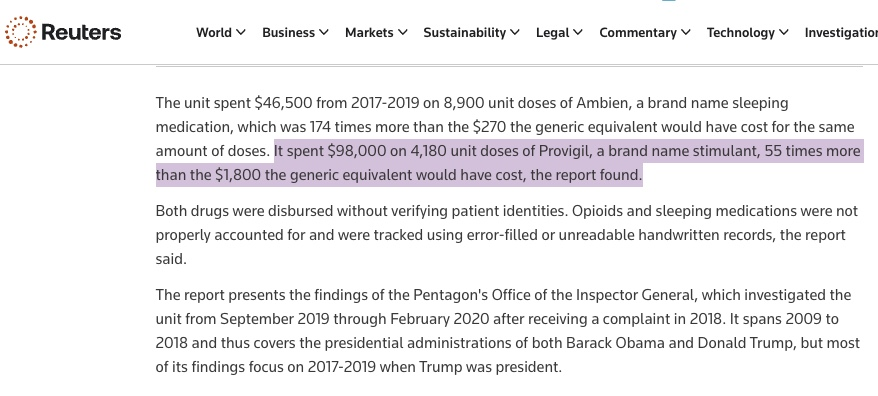
weekly reminder that the white house spent $98k on modafinil to keep the world leaders focused and performing
i wonder if they prefer citicoline or alpha-GPC to offset the headaches from choline depletion
the elite is enhanced. always has been, always will be.
2.5mg tadalafil
3 drops vitamin E
500mg magnesium
150mg sublingual modafinil
coffee with coconut oil
more orange juice than an exploding sun
as the odyssey soundtrack plays
good afternoon.
I took 2400x the RDA of b1 and it changed my life.
No crashes. Impeccable mood. Clear mind.
Keep in mind I was already taking 300-500mg of b1, but in the form of thiamine mononitrate (or hydrochloride).
Ill start off with the most jarring benefits: zero crashes. Sometimes throughout the day i would feel my blood sugar getting low a few hours after meals, and I would need some carbs to keep energised. With benfotiamine, that was gone, and I felt like I could easily skip meals without energy issues or hunger. 8/10 on this point
This also resulted in a much more stable mood. I had an even and happy mood all day, without any sort of crankiness. Prevously I would feel random bursts where I would thing negative thoughts, or say a swear word if I dropped something. With benfotiamine, that was gone completely, and I felt much more calm under stress. Reduced cortisol I presume. 7/10
In terms of thinking, I could think clearer without negative thoughts. My mind did feel a bit less muddy for sure, but it wasnt super drastic. I've used nooyropics before and this still beats them, let's go with a 6/10
In terms of memory, I didn't notice anything. Not to say it doesn't help, I suppose I wasn't really trying to remember anything in particular 😅
NEGATIVES: No physical negatives in the week long experiment. I did use almost the whole bottle in a week, so this would be relatively costly in the long run. I also split my dose 4x through the day, it felt kinda awkward smuggling a handful of pills into work and quickly scarfing them down when nobody was looking. I imagine if I dod this high of a dose perpetually I would run into some sort of nutrient deficiency, maybe b3 or magnesium?
The verdict is that megadosing Benfotiamine is pretty frickin cool! I felt good and jolly on it and plan on doing it in the future. I would want to buy a bulk form of b1 though, perhaps a 1kg powder sack of it at a cheap price. If someone was scared of such a crazy dose, I would say that the majority of people would benefit massively from "smaller megadoses" like the aforementioned 300mg, which is "safer".
I specifically switched to benfotiamine for this experiment. One of the benefits of b1 is that it has higher bioavailability and can better get into the cells where it is needed, as well as being more potent at combating evil things in the body like AGEs (advanced glycation end products) which contributing to the aging process. You can also retain it better due to the fact that it is fat soluble.
Most high yield ETFs DECAY in price! 📉💵
But not ALL! Some grow & pay big!
Here's 8 High Income ETFs with ZERO price decay & high dividend income! 💸📈
*save for later* 🔖👇
sourcing 3rd party tested peptides with transparent CoA's in the EU has never been a smooth ride, but it just got a lot easier;
retaeu has
- retatrutide
- GHK-cu
- semax
- selank
- NA epitalon
- MOTS-c
- tesamorelin
- BPC-157
- bac water
- and more
they're where i've been buying from since december last year, shipping has always been quick and smooth within the EU, good customer service with actual humans, etc.
they're giving based readers 5% off with code BASED
linked in comments!
10 Stocks to Watch under Engineering & Construction group 🔖
These leaders build the infrastructure that powers our economy and future.
$STRL $FIX $VATE $AGX $MYRG
$PWR $IESC $ORN $ECG $DY
if doctors prescribed this pill to office workers rather than men who can’t satisfy their wives…
they could combat one of the deadliest health habits of the 21st century…
a sedentary lifestyle
if you work seated for long hours, consider taking 2.5-5mg tadalafil daily:
> increases cerebral blow & oxygen delivery to vital organs throughout the body.
> 50% of blood flow to the legs is lost after sitting just 3hrs & 3-7% to the head
> brainfog & fatigue is correlated to a sedentary lifestyle due to lack of blood flow
> may increase the effects of caffeine indirectly through reducing vascular resistance
> better endothelial function (vascular health)
> lowers all cause mortality by up to 30%, whereas a prolonged sitting lifestyle can increase it by 20-30%.
not medical advice.
𝙩𝙖𝙙𝙖𝙡𝙖𝙛𝙞𝙡 𝙞𝙣𝙩: https://t.co/qu2RP1MRju
Every hedge fund I respect is suddenly talking about the same thing, and... it is not the chips.
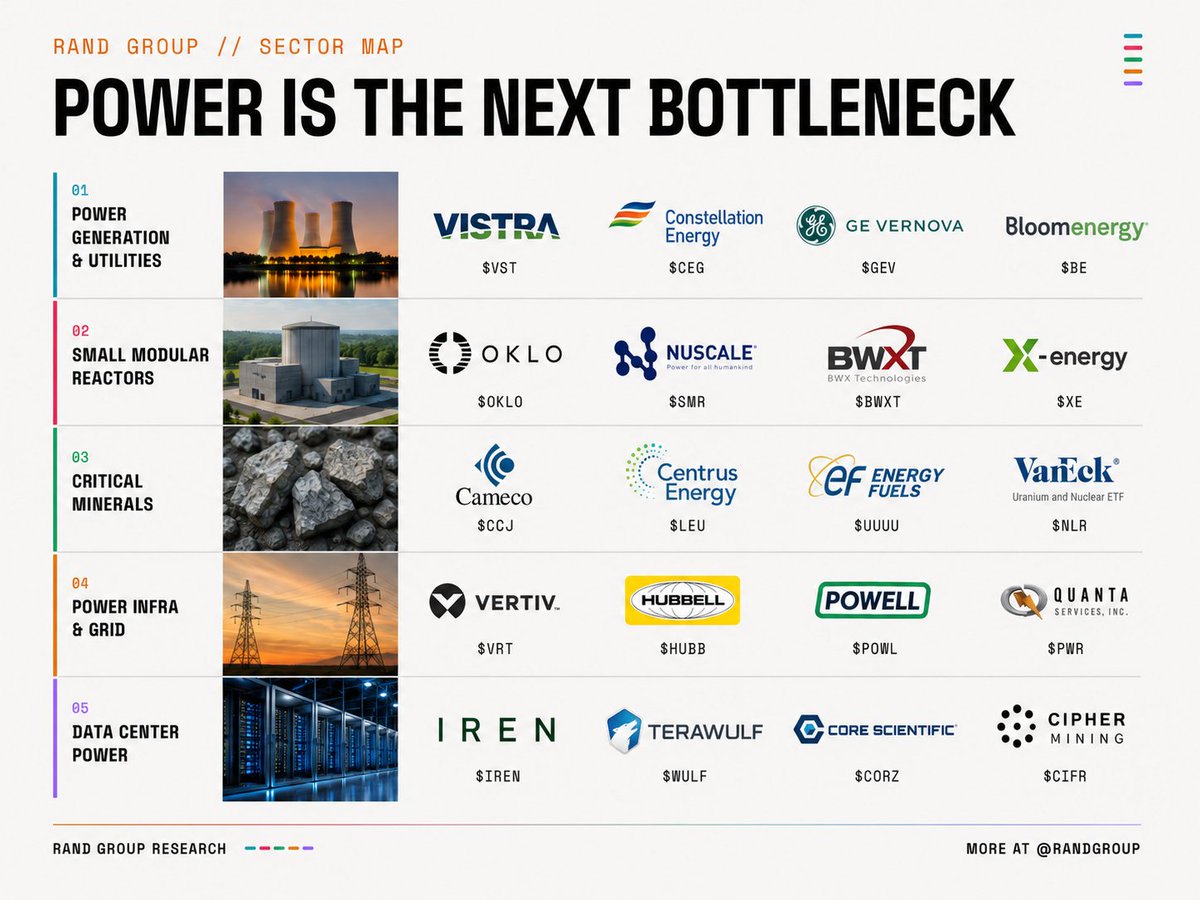
It is the one bottleneck that breaks the entire AI story if it is not solved. Around 20 public companies sit on it. I put them all in one map across 5 layers.
Let's dive into it 🧵
Here is the thing nobody priced in two years ago. We spent a decade with flat electricity demand in this country. Utilities planned around it. Then AI showed up asking for gigawatts at a time.
The Electric Power Research Institute now thinks data centers could eat 9% to 17% of all US electricity by 2030, up from roughly 4% in 2023. Former Google CEO Eric Schmidt told Congress the sector may need 67 more gigawatts by the end of the decade. That is not a tweak to the demand curve. That is a new industrial revolution landing on a grid built for a different century. Every company below sits somewhere between a power plant and a server rack. This is the map.
🔌 POWER GENERATION & UTILITIES
Start at the source. These are the companies that actually make the electrons. For years this was the most boring corner of the market: regulated returns, slow growth, dividend investors only. Then the hyperscalers started signing power contracts directly with generators, and the whole category repriced.
$VST Vistra
This is the one I watch most closely in the group. Vistra signed Meta to a power purchase agreement for roughly 2,600 megawatts at its PJM nuclear sites, which tells you everything about where this is going: tech giants are now buying nuclear output directly. Q1 2026 adjusted EBITDA hit a record for a first quarter at $1.494 billion. They have hedged almost all of their 2026 generation, and they have bought back about 30% of the company since late 2021. A generator that trades like a buyback machine with an AI tailwind bolted on.
$CEG Constellation Energy
The largest nuclear fleet in the country, and the company that put nuclear back on the front page when it agreed to restart Three Mile Island for Microsoft. In January it closed the $21.8 billion Calpine acquisition, adding around 23 gigawatts of mostly gas and renewable capacity, and Q1 2026 revenue more than doubled the year before to $11.1 billion. The thesis is simple: when an AI company wants carbon free baseload power tomorrow, there are very few phone numbers to call, and this is one of them.
$GEV GE Vernova
If you only own one name in this entire map, my honest take is that it should probably be this one. GE Vernova makes the gas turbines and the grid equipment, the literal picks and shovels of the buildout. In a single quarter its Electrification segment booked $2.4 billion in data center equipment orders, more than it booked in all of 2025. Total backlog sits around $163 billion and management pulled forward its $200 billion target to 2027. The gas turbine backlog jumped from 83 to 100 gigawatts in one quarter, and they are raising prices into that demand. This is the cleanest expression of the trade.
$BEPC Brookfield Renewable
Note the ticker: this is Brookfield Renewable, $BEPC, not the $BE on most charts (that is Bloom Energy). Brookfield operates about 47 gigawatts and is developing a pipeline north of 200. It signed a framework with Microsoft to deliver over 10 gigawatts, roughly eight times the size of the largest single corporate power deal ever signed before it, plus a multi gigawatt hydro deal with Google. It also owns about half of Westinghouse alongside Cameco. The patient, contracted, dividend paying way to play the same wave.
⚛️ SMALL MODULAR REACTORS
Now the speculative end. The promise here is clean, firm baseload power in a compact box you can site right beside a data center. The catch: almost none of these are producing commercial power at scale yet, so you are buying a timeline as much as a company. Price that carefully.
$OKLO Oklo
The most exciting and the most expensive name in the room. In May the NRC approved the principal design criteria for Oklo's Aurora powerhouse in under half the usual review time, a real regulatory step forward. The customer pipeline is around 14 gigawatts, anchored by a 12 gigawatt agreement with Switch and a 500 megawatt deal with Equinix, and it added a research partnership with NVIDIA and Los Alamos. Just remember Oklo plans to build, own and operate its reactors and has essentially no revenue yet. This is a call option on a 2028 plus story.
$SMR NuScale Power
The one with the regulatory lead. NuScale has NRC design approval for both its 50 and 77 megawatt modules, which genuinely derisks deployment. It is sitting on about $1.2 billion in liquidity and is working toward a definitive power agreement with TVA through its ENTRA1 partner, with its first project tied to RoPower in Romania. Revenue was a rounding error last quarter because the licensing work wrapped up, so this is still a story about getting the first units in the ground.
$BWXT BWX Technologies
The adult in the room, and the name I would own if I wanted nuclear exposure without buying a lottery ticket. BWXT actually makes money: Q1 2026 revenue of $860 million and net income of $91 million, and it raised full year guidance. It builds reactors for the US Navy, produces medical isotopes, and just acquired Precision Components Group to push into commercial nuclear manufacturing. While the SMR startups sell the future, this one sells into it today.
$XE X-energy
Brand new to the public market. X-energy IPO'd on April 24 at $23 a share, raised about $1.02 billion, and came out around a $12 billion valuation with Amazon as its anchor backer holding nearly a third of the company before the listing. It pairs an 80 megawatt reactor design with its own proprietary TRISO fuel, and its order book already tops 11 gigawatts including Amazon's commitment to as much as 5 gigawatts by 2039, plus Dow and Centrica. Reality check: it lost about $390 million on $109 million of revenue in 2025, and first deployments are not expected until the early 2030s.
⛏️ CRITICAL MINERALS
You can build every reactor on the list above and they are paperweights without fuel. This is the front end of the cycle: mining, enrichment, conversion, and the magnet metals the whole grid runs on. Quick note: I swapped the misfiled Northland slot for Energy Fuels here, which is a genuine US critical minerals producer.
$CCJ Cameco
The blue chip of the uranium world. Q1 2026 net earnings jumped 87% and adjusted EBITDA rose 44% to $509 million on stronger prices and volumes. The kicker is Westinghouse: Cameco owns roughly half of it alongside Brookfield, so it captures both the fuel and the reactor technology side of the renaissance. When people want uranium exposure without a science project, they buy this.
$LEU Centrus Energy
The reshoring play, and a fascinating one. Centrus is the only production ready uranium enricher in America, sitting on a $2.3 billion enrichment backlog, a $900 million HALEU award from the Department of Energy, and a notice from the NNSA that it intends to sole source enrichment work to them. It is pouring over $560 million into its Oak Ridge centrifuge factory and is even exploring a fuel joint venture with Oklo. This is a national security story wearing a stock ticker.
$UUUU Energy Fuels
This is what $UUUU actually is. Energy Fuels runs White Mesa, the only conventional uranium mill operating in the United States, and it is the rare company licensed to produce both uranium and separated rare earth oxides under one roof. Its 2026 uranium guidance implies growth of 50% to 150%, and it is now turning out the dysprosium, terbium and magnet metals that everything from EV motors to grid hardware depends on. Uranium and rare earths, the two supply chains Washington is most desperate to pull back from China, in one company.
$NLR VanEck Uranium and Nuclear ETF
If you would rather own the whole theme in one line instead of picking a winner, this is the basket. $NLR holds the nuclear value chain end to end: reactors, enrichers, miners and the utilities running the plants. A lot of this very map sits inside it, with Constellation, Cameco, Centrus, BWXT and Energy Fuels all among its largest positions. The lazy way to be right about the sector even if you pick the wrong individual stock.
🔧 POWER INFRA & GRID
Between the power plant and the server rack is the least glamorous and maybe most investable layer of all. Transformers, switchgear, cooling, and the crews who build it. The dirty secret of the AI buildout is that the grid itself is the bottleneck. Interconnection queues run years, and the equipment to connect anything is on backorder.
$VRT Vertiv
The purest grid adjacent winner so far. Q1 2026 sales rose 30% to $2.65 billion, with the Americas up 44% on data center demand, earnings per share up triple digits, and guidance raised twice in two quarters. Vertiv makes the power and thermal systems that keep a data center alive, and it just joined the S&P 500. When the chip names sneeze, this one catches it, but the order book keeps validating the story.
$HUBB Hubbell
Boring on purpose, and that is the point. Hubbell makes the electrical and utility hardware, the transformers, metering and grid components, that every new data center and every grid upgrade quietly requires. It will never 10x in a year, but it sells into both the AI buildout and the broader grid replacement cycle at the same time. This is the ballast in the basket.
$POWL Powell Industries
My favorite quiet story in this section. Powell makes custom electrical equipment for utilities, energy and now data centers, and the demand signal is screaming: orders up 97% last quarter, a record $1.8 billion backlog, and right after the quarter closed it landed a single data center order worth more than $400 million, the largest in its history. It did a three for one split this spring and carries no debt. A small cap industrial running into a structural tailwind.
$PWR Quanta Services
The labor. Quanta physically builds and upgrades the grid, the part of this problem that no software fixes. Q1 2026 revenue rose 26% to $7.87 billion and its backlog hit a record $48.5 billion. If all of the generation and transmission above actually gets built, a meaningful slice of it gets built by crews like these. The pick and shovel play on the wires themselves.
🖥️ DATA CENTER POWER
The wild card, and the highest beta corner of the map. These started as bitcoin miners, which means they already owned the one thing everyone now wants: large blocks of interconnected power and the land around it. They pivoted to hosting AI compute, signing leases with the hyperscalers and the neoclouds. Enormous growth, real execution, and serious single customer risk. Size accordingly.
$IREN IREN
The furthest along. Formerly Iris Energy, IREN has a Microsoft AI cloud partnership worth billions, a power pipeline around 4.5 gigawatts, and high performance computing on track to make up the majority of its revenue by the end of the year. It already trades like an infrastructure company rather than a miner, because increasingly that is what it is.
$WULF TeraWulf
TeraWulf describes itself as a power company that happens to build digital infrastructure, which I think is exactly the right framing for this whole row. It has locked in over $12.8 billion of contracted compute revenue through long term leases with the Google backed Fluidstack and Core42, anchored by its Lake Mariner site and scaling toward a gigawatt of power. Its leasing revenue more than doubled year over year. Controlled power, leased to AI, on a multiyear contract.
$CORZ Core Scientific
The contrarian one. CoreWeave tried to buy Core Scientific in an all stock deal, and in a rare moment of shareholder backbone, the holders voted it down in late 2025. So it stays public, and it kept the prize: roughly $10 billion or more of contracted revenue with CoreWeave across about 590 megawatts, while converting its old mining sites into AI colocation. You are betting the company creates more value alone than the buyout offered.
$CIFR Cipher Mining
The earliest stage of the pivot, rebranding toward AI as it goes. Cipher signed a hosting deal backed by Google's Fluidstack, with Google taking around a 5% stake, plus a 300 megawatt arrangement tied to AWS, building toward a contracted compute backlog around $9 billion. Highest risk, least proven, most torque if the leases convert to cash on schedule.
⚡️FINAL THOUGHTS
Step back from the tickers and a pattern jumps out. The market is paying up for the same insight at five different points on the same wire.
The stability lives at the bottom and the middle. Cameco, Hubbell, Quanta Services and BWX Technologies make money today and sell into a buildout that is contracted for years. They will not triple overnight, but they do not need a single thing to go right that has not already happened.
The growth lives at the edges. GE Vernova is the rare name that has both, scale and acceleration, which is why I keep coming back to it. The reactor startups and the former miners are where the imagination is, and also where the disappointment will be when timelines slip, because timelines always slip in nuclear and in construction.
The clearest read of all is that the AI story quietly handed the baton from the chip layer to the power layer, and most people are still watching the wrong race. You cannot run the model without the electrons, and the electrons are the scarce thing now.
I will say the obvious part out loud: this is a map, not advice. I am pointing at where the money is moving, not telling you what to buy. Do your own work on every one of these, especially the speculative names where a single contract or a single regulator can move the whole thesis.
If this saved you a week of research, do me a favor and bookmark it, then send it to the person in your group chat who only owns Nvidia. The power bottleneck is the second half of that trade.
Current mission:
Help 1 million people start writing online.
And this thread has everything you need to:
• Build a writing habit
• Generate endless ideas
• Capture and keep attention
• And most importantly, develop the Ship Daily mindset
Grab a cup of coffee and dive in:
The next wave of multi-millionaires will position themselves in every major future sector.
Those who listen to me will very likely achieve financial freedom and retire in the next 5-10 years.
Here are the top 3 stocks in every core sector for the next decade:AI Compute: $NVDA, $AMD, $AVGO
Semiconductor Manufacturing: $TSM, $ASML, $AMAT
Networking & Connectivity: $MRVL, $ANET, $CRDO
AI Infrastructure: $IREN, $VRT, $NBIS
Nuclear Energy: $OKLO, $SMR, $NNE
Robotics & Automation: $TSLA, $SYM, $OUST
Autonomous Flight: $ACHR, $JOBY, $EH
Space Economy: RKLB, $ASTS, $LUNR
Quantum Computing: $IONQ, $RGTI, $QBTS
Position early and let time do the compounding.
Are you ready to get on board?
🔥I just updated next week’s watchlist. Click the Telegram link in my profile and send “77” to unlock the latest watchlist, entry setups, and market alerts.
The deeper I dig into histamine, the more I recognize it’s probably the driver for a lot of dysfunctional behavior in people—ADHD, OCD, procrastination, insomnia, rumination.
Histamine is one of the core arousal/wakefulness neurotransmitters and gates dopamine, acetylcholine, glutamate, and the stress axis via H1/H3 receptors. Too little histamine means underaroused; too much means hypervigilant.
In cases of low-level (or even full-blown) allergies and dysregulated mast cell degranulation, chronic nighttime exposure leads to poor sleep. Downregulated H1 receptor expression from chronic agonism then causes poor activation when needed, leading to ADHD and/or procrastination—a functional histamine deficit.
Similarly, chronic excessive histamine drive leads to OCD and rumination because the mind cannot relax in its hypervigilant state, which also causes histamine-driven insomnia.
Two tools that can help:
1. Cyproheptadine is an antihistamine with antiserotonin effects that blocks histamine at the receptor and blunts the cortisol effect driven by excess serotonin (from gut microbes). It also stimulates appetite, so keep that in mind. More of a sledgehammer than...
2. Ketotifen, a mast cell stabilizer, doesn’t cause the drowsiness that cyproheptadine does. It prevents pathological mast cell degranulation and is good for low-grade allergies.
And of course, the Ray Peat Carrot Salad™️ and well-cooked white button mushrooms will bind bacterial endotoxin in the gut, which could be driving the histamine dysfunction leading to the above symptoms.
There's a company in Wyoming that will sell you a fully formed 12-year-old American business overnight for $3,500
It has an EIN, a state filing, a clean history, and a verifiable business credit profile from before you bought it
The bank treats you like you've been running this business since 2013
This is a real legitimate product. It's called an aged shelf company
A shelf company is a legal business entity (usually an LLC or corporation) that was formed years ago and "sat on the shelf" with no activity, no debt, no revenue, just a clean state filing and an active EIN. Specialized companies form these entities in bulk in business-friendly states (Wyoming, Delaware, Nevada, New Mexico) and hold them until someone buys
When you buy a shelf company, you're buying:
The business name (can be changed at registration)
The state filing (officially shows formation date 5-15 years ago)
The EIN (the IRS-issued business tax ID that's been on record since formation)
Sometimes: pre-established business credit accounts (Dun & Bradstreet listing, business credit cards in good standing, vendor accounts)
The legal continuity of being a "seasoned" entity
What this changes for funding:
Most business credit applications ask "years in business" on the application. A 5-day-old LLC scores low. A 12-year-old LLC scores high. Same human, same FICO, different perceived risk
Bank underwriting models heavily weight business age because longer-operating businesses default less. A 720 FICO with a 12-year-old LLC scores meaningfully higher on most issuers' business card underwriting than the same FICO with a 30-day-old LLC. The difference can be 20-40% higher approval limits and access to products that won't approve startups
Shelf companies with pre-existing business credit profiles (Dun & Bradstreet PayDex score, established tradeline history) score even higher. A shelf company with a 75+ PayDex and 8-10 established tradelines qualifies for business credit products that brand-new LLCs categorically can't access
The pricing market:
Basic 5-year-old shelf LLC, no credit history: $1,200-$2,500
10-year-old shelf LLC, no credit history: $2,800-$4,500
15-year-old shelf LLC with PayDex 75+ and 8+ tradelines: $7,500-$15,000
20-year-old shelf corp with full business credit profile: $15,000-$35,000
Where to buy: WholesaleShelfCorporations, Wyoming Corporate Services, Corporate Direct, Northwest Registered Agent (some of these companies, Google verifies the rest)
The play:
Step 1: buy a 10-12 year old shelf LLC for $3,500-$5,000. Get the operating agreement transferred. File a name amendment if you want a custom business name. Update the registered agent to you or your service
Step 2: open business checking under the shelf LLC name with the existing EIN. Walk into Chase, Bank of America, or US Bank. The bank sees "[Business Name] LLC, formed 2013." 12 years of legitimate operating history on paper. Deposit $500 to open
Step 3: 30 days after opening business checking, apply for business credit cards. Application asks "years in business." You truthfully type 12. The underwriter pulls public records, sees the 2013 state filing, sees the active EIN, sees an established checking relationship. Approves at the higher tier
Average approval lift versus a 30-day-old LLC: 25-60% higher limits on the same FICO
Same person. Same credit. Same income. The only thing that changed is the formation date on the paperwork
Important caveats (zero hedging on this part, just truth):
This is legal. Buying and operating a shelf company is fully legal in every state. The IRS doesn't care. State business registrars don't care. The banks don't have a problem with you buying a shelf company
What IS illegal under 18 U.S.C. § 1014: lying about the business's operating history or revenue on a credit application. If you bought a shelf company and tell the bank you've been operating it for 12 years generating $300K/yr in revenue, that's fraud. If you tell them you bought the entity recently and now operate it as a new business with [actual revenue], that's legal
Banks have also gotten smarter about shelf companies since 2018. Some issuers (notably Chase and Amex on certain products) now verify operations independently for newly-purchased shelf LLCs by requiring bank statement uploads or revenue documentation. The shelf company advantage is bigger than it was 10 years ago but smaller than it was 5 years ago
Best use case in 2026: shelf company combined with real business operations. You buy a 12-year-old LLC, transfer it to your name, start operating an actual business through it, and 60-90 days later apply for business credit. You get the formation-date advantage on the application while having real operational substance behind it
A friend in Phoenix bought a 14-year-old shelf corp last year for $4,200. Transferred ownership. Opened business checking. Used it to operate a marketing agency he was launching. 90 days later applied for Chase Ink Business Preferred. Approved for $58K at 0% APR. Same week applied for Amex Business Platinum. Approved for "no preset spending limit" (which functions as $50K-$100K usable)
The same human applying with a brand new LLC formed last month would have gotten roughly half those limits. The $4,200 paid for itself in week one of the business
The richest small business owners in America have stables of aged shelf companies sitting at their attorney's office. They activate them on demand whenever they want to look established to a new bank. The product has existed since the 1970s. It's only "obscure" because nobody talks about it
dm me "funding" and i'll show you how you can qualify for up to 250k in 0% APR funding (if you have a 700+)