You might "own" the car but you don't own the software required for it to function. Even if you did write an alternative software you won't be able to run it on the Intel / Qualcomm chips powering the car.
@manhhung_ai@wallstreetbets@qvac Your not wrong, all of the capable chips come with shady software blobs. It's possible to sandbox these machines, but not for the faint of heart. Hopefully AMD delivers on its loose promises to support open source firmware and goes further but I wouldn't hold my breath. #riscv
@almokhtar_al@wallstreetbets@qvac https://t.co/fr7AGA4QZa
Everyone needs something comparable to this in their closet. Nothing beats removal of third party trust but at the same time most people can't buy a 100k computer. If you have to use a third party I'm a fan of https://t.co/egXmS68Zpl or similar projects.
Apple restored the app store listing a few hours ago. This is yet another example of why it's better to avoid storing peoples messages and data on centralized infrastructure.
⚠️ ALERT: Telegram has been removed from the iOS App Store worldwide.
Apple has not provided a reason for the removal, and neither Apple nor Telegram has issued an official statement at the time of writing.
Existing installations appear to remain functional.
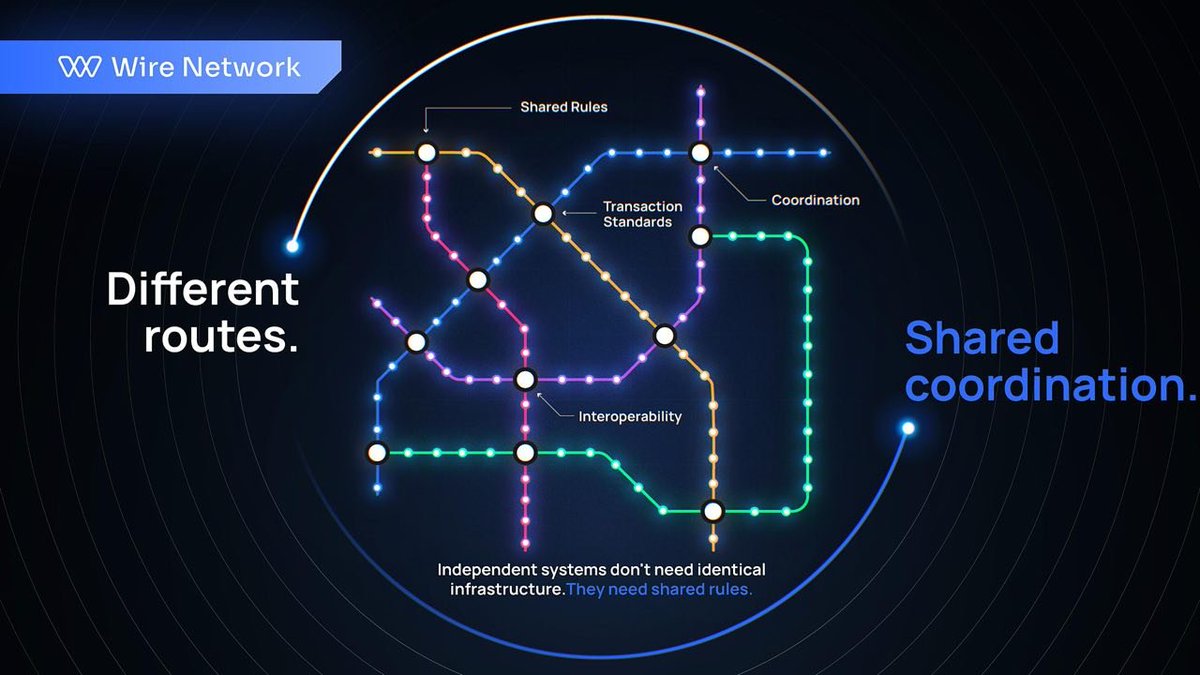
Cities don't function because every street operates independently.
They function because every street follows the same traffic rules.
Digital economies face a similar challenge.
As more chains, applications, and assets become connected, coordination becomes increasingly important.
Shared infrastructure is valuable because it gives independent ecosystems a common set of transaction rules while allowing them to remain independent.
That's the role Wire's Universal Transaction Layer is designed to play.
Crypto is in a circular death spiral at the moment.
First it was chain wars. "Everyone come live on $Eth island. That $Sol island sucks."
Then the narrative shifted to cross chain. "Sure, these bridges may get hacked for billions of dollars but thats the cost of interoperability, right?!"
Now we are back to companies like Base and Robinhood trying to convince people "Everyone just come use our chain” ….that only has 1 validator that just happens to be its own. 🤦🏻.
Wire’s Universal Transaction Layer is going to realign the entire industry and get us back on a trustless, secure, decentralized future that we never should’ve strayed from in the first place.
Another $350M+ lost.
There have been 20 bridge exploits in the past six months.
At some point, it's worth asking whether we're looking at isolated incidents or recurring architectural tradeoffs.
Every bridge is a vault with a middleman holding the keys.
Wire Network has no middleman. No vault. No keys to steal.
Wake up before you’re the next headline.
𝗪𝗵𝗮𝘁 𝗶𝘀 𝗪𝗶𝗿𝗲 𝗡𝗲𝘁𝘄𝗼𝗿𝗸?
Most blockchains were built as separate worlds.
Ethereum has its own users.
Solana has its own liquidity.
Bitcoin has its own settlement environment.
Every ecosystem grows in its own direction, with its own wallets, fees, addresses, applications, and security assumptions.
That is powerful, but it also creates a major problem.
Crypto is connected in theory, but fragmented in practice.
If a user wants to move value across ecosystems, they usually need bridges, wrapped assets, routers, or external messaging layers.
That adds friction.
It adds risk.
And it forces users to understand infrastructure they should never have to think about in the first place.
Wire Network is being built from a different starting point.
Wire is a Universal Transaction Layer.
Not a bridge.
Not a router.
Not another cross-chain messaging protocol.
A settlement layer.
The core idea is simple:
Assets stay on their native chains.
Ownership moves through Wire.
That distinction matters.
In a traditional bridge model, an asset is often locked on one chain while a wrapped version is created somewhere else.
The user is no longer just trusting the native chain.
They are also trusting the system connecting both sides.
Wire takes another path.
Instead of constantly pushing assets from one chain to another, Wire is designed to settle ownership changes on its own Layer-1 while the underlying assets remain secured on their native chains.
The asset does not need to leave home.
The ownership record changes.
That is the foundation of Wire’s Universal Transaction Layer.
And from that foundation, the rest of the system starts to make sense.
Wire Name Service handles routing and custody mapping.
UPAP, the Universal Polymorphic Address Protocol, gives users a universal address model across supported chains.
APoS separates governance from block production.
aBFT provides the finality model.
Node owners can whitelist applications, allowing specific dApps to deliver gas-free experiences for users.
Each part is designed around one larger goal:
Make blockchain feel less fragmented.
For users, Wire is about reducing cross-chain confusion.
No more asking which network an asset is on every time you want to interact.
No more manually jumping through several systems just to access liquidity somewhere else.
No more treating interoperability like an advanced skill only power users can understand.
For developers, Wire introduces the idea of Universal Deployment.
Build once.
Reach users and assets across supported chains.
Instead of rebuilding the same application across multiple ecosystems, developers can think in terms of one application layer connected to many supported environments.
That is a major shift.
But the most interesting part may be what Wire means for AI agents.
Human users can tolerate friction.
AI agents cannot.
An AI agent operating at machine speed cannot stop every few minutes to switch networks, search for gas, choose a bridge, check whether a wrapped asset is acceptable, or wait through unclear transaction states.
Agents need predictable infrastructure.
They need transactions that either complete cleanly or revert cleanly.
They need low-friction access across supported chains.
They need settlement built for speed, coordination, and scale.
That is why Wire’s architecture is especially relevant to the agentic economy.
If AI agents are going to transact with other agents, applications, marketplaces, and protocols, they will need rails that do not collapse under the weight of constant micro-transactions.
They will need infrastructure where cross-chain activity is not treated as an afterthought.
Wire is still pre-mainnet, with Testnet V2 live and mainnet timing being finalized.
So the right way to understand Wire today is not as a finished production network claiming victory over every chain.
It is better understood as a new architectural model for what cross-chain settlement could become.
A system where assets stay native.
Ownership settles through one layer.
Users get a simpler experience.
Developers get broader reach.
AI agents get infrastructure designed for machine-speed activity.
That is the introduction.
Wire Network is not trying to add another bridge to crypto.
It is building a Universal Transaction Layer for a world where value, applications, users, and AI agents need to move across supported chains without inheriting the same old cross-chain risks.
The asset stays home.
The ownership moves.
That is Wire Network.
@WireNetwork #WireNetwork