@Masterflip_ If we think about this deeper regardless of who said and if it was inferred or intended, etc. The value is not solely on baseball stats anymore as there is a dollar figure now adays on attention economics. Thus, we going to get a lot of that now in media with @BlueJays playoffs
During the dotcom bubble, 97% of America’s fiber was dark because infrastructure was built years ahead of demand.
Today’s AI buildout looks nothing like that. The comment “there are no dark GPUs” means every GPU produced is already reserved or monetized the moment it ships.
This is the difference between speculative infrastructure & fully utilized infrastructure.
The U.S. has more rare earth minerals than any nation on Earth—an estimated $12 trillion worth.
But thanks to endless permits, lawsuits, and land bans, we depend on China and Russia for critical materials.
We don’t have a mineral shortage—we have a leadership shortage.
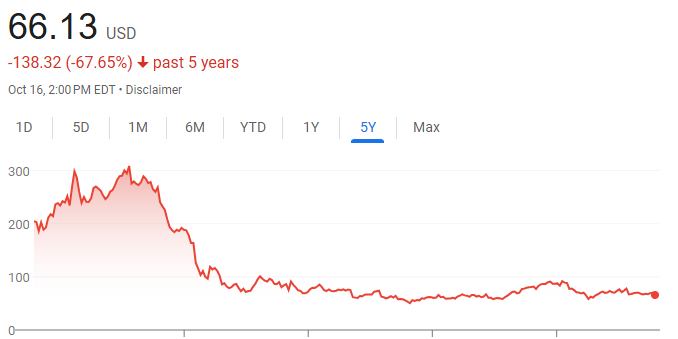
What is the definition of "dead money"?
$PYPL
4+ years of sideways while missing the biggest bull market ever.
And I'm saying this as a Paypal long term bull here. It pains me.
Critical Metals: Why I’m Not Letting The Trilogy Deal Scare Me
( $CRML Rating: Buy) | BY Talha Quraishi
When I see a small-cap miner like Critical Metals Corp. $CRML soar 70% in pre-market trading, my first instinct isn’t to chase the rally it’s to ask why. In this case, the “why” goes far beyond a headline. It’s about national strategy, resource independence, and a government quietly rewriting how it invests in American critical minerals.
While some investors panicked after Trilogy Metals (TMQ) secured a U.S. government equity stake fearing Critical Metals might miss its chance I see it differently. In my view, Trilogy’s deal confirms the playbook, not the end of it. If anything, it strengthens the likelihood that Critical Metals becomes one of the next beneficiaries of Washington’s industrial policy pivot.
Simply put, I believe Critical Metals is sitting in the crosshairs of a geopolitical and economic realignment that could significantly re-rate its valuation once federal involvement becomes official.
Background: The Government’s Resource Awakening
Let’s rewind to what happened last week. The Trump administration announced a $17.8 million investment for a 10% stake in Trilogy Metals an Alaska-based miner tied to key energy transition materials like copper, cobalt, and zinc. The market went wild; the stock tripled overnight.
That announcement followed a series of similar moves: the Department of Defense’s $400 million investment in MP Materials $MP and the Department of Energy’s 5% equity stake in Lithium Americas $LAC. The U.S. government is no longer just funding strategic projects it’s owning them. This shift from subsidies to equity reflects a deeper belief: if America wants to rebuild its industrial base and mineral independence, it needs to sit at the ownership table.
That’s where Critical Metals enters the picture.
Company Overview
Critical Metals specializes in the acquisition and development of mineral assets vital to modern technology rare earth elements, lithium, gallium, and other metals foundational to EVs, AI chips, defense systems, and clean energy.
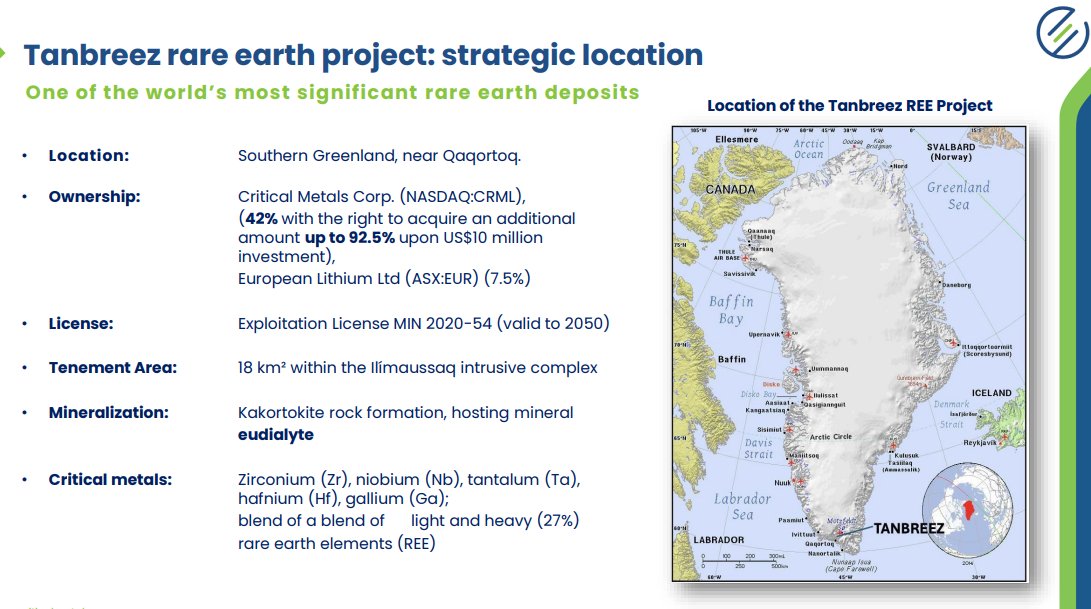
Its flagship project, Tanbreez, located in southern Greenland, is one of the world’s largest known rare earth deposits, with an estimated 45 million tonnes of resources. The company recently increased its ownership in Tanbreez to 92.5%, giving it near-total control of what could become a cornerstone of Western rare earth independence.
Geopolitically, the location couldn’t be more strategic. Greenland sits between North America and Europe both regions desperate to reduce reliance on China, which currently controls roughly 85% of global rare earth processing and 90% of refining capacity.
Financial Overview
According to company filings, Critical Metals holds around $7.3 million in cash and $5.9 million in debt, maintaining a modest balance sheet for a development-stage miner. With a market capitalization near $1.2 billion, its valuation reflects the optionality of being next in line for government involvement rather than operational revenue since the company hasn’t yet entered production.
At this stage, cash burn is primarily tied to exploration, permitting, and infrastructure not production costs. This makes Critical Metals a high-risk, high-upside investment: the type of speculative setup where sentiment, policy, and timing can drive extraordinary revaluations.
In my opinion, that optionality is what makes the stock so interesting right now.
The Government Connection: A Policy-Advantaged Trade
I’ve been following this “policy-advantaged” trade closely. We’ve already seen how the U.S. government’s direct participation has transformed select names:
▫️MP Materials (MP): surged 350% YTD after the Department of Defense became its largest shareholder.
▫️Lithium Americas (LAC): rallied over 200% after the Department of Energy confirmed a 5% equity stake.
▫️Intel $INTC: received $8.9 billion in federal investment converted into equity, a move that doubled the government’s paper value within months.
Each of these cases follows the same pattern: an initial rumor, a speculative surge, a brief selloff on uncertainty, and finally confirmation that re-rates the company overnight.
Critical Metals is now in that pre-confirmation phase. The Trilogy Metals deal may have temporarily absorbed political attention, but it validates that Washington is actively taking ownership stakes in strategic resource firms. Once the Ambler Road project in Alaska advances, I expect attention will shift to Greenland and with it, to Critical Metals.
Greenland: America’s Quiet Frontier
I’ve always believed Greenland is a geopolitical wildcard. Trump’s earlier interest in “buying” Greenland was widely mocked, but from a resource strategy standpoint, it wasn’t far-fetched. Greenland is loaded with rare earth elements, and the West’s access to those resources could shape the next decade of industrial competitiveness.
Critical Metals’ Tanbreez project positions the company directly in this narrative. The company’s recent $35 million PIPE financing and a 10-year supply deal with Ucore (whose Louisiana plant is funded by the Department of Defense) are critical signals that institutional and government-aligned capital already see the writing on the wall.
This is what gives me conviction: the company is not waiting for policy it’s aligning ahead of it.
Valuation and Trading Setup
At around $10–$11 per share, I see the current pullback as a healthy reset following the 70% pre-market surge and 45% one-day gain. Technically, CRML has broken above its 21-day, 50-day, and 200-day EMAs, with RSI levels previously peaking near 85 indicating overbought conditions. The current consolidation offers a more rational entry for long-term investors.
If the U.S. announces even a minority equity stake, I expect a reaction similar to Lithium Americas or MP Materials a potential 50–100% re-rating within weeks. Conversely, if policy momentum stalls, the stock could revisit its prior support levels around $6–$7.
This binary setup where macro policy meets speculative market behavior is precisely what makes Critical Metals both fascinating and risky.
Risks
Let’s be clear: this is not a stock for conservative investors.
The company is pre-revenue, depends heavily on favorable political developments, and operates in a geopolitically sensitive region. The Trilogy deal could delay or dilute immediate government focus on Critical Metals. Additionally, environmental and logistical hurdles in Greenland could slow project execution.
Still, I believe these risks are priced into the current range, while potential policy catalysts remain unpriced.
Conclusion
In my opinion, Critical Metals isn’t just another speculative mining stock it’s a test case for America’s evolving industrial policy. If the government continues translating strategic interest into ownership, I see this company as a likely next-in-line candidate.
Yes, the Trilogy deal took the spotlight but it also set the stage. And in markets like this, where geopolitical alignment meets resource scarcity, the second act often delivers the bigger payoff.
Oct 8, 2015: @AndrewRSorkin asks: "When you think about innovation and you think about where we are gonna be 10, 15, 20 years, and what to invest in and what to make… it would be what?"
@ElonMusk and @Sama both answer: AI
Nov 20, 2015: OpenAI was founded
In this March, I kinda perfectly predicted the market in terms of bottom price range of BTC, hope you all bought some BTC at that time. Recently, bitcoin broke through 120,000 USD🔥 , and there are a lot of friends ask me what happened in the past four months? Is it still a good time to enter the market? Here are some humble opinions:
1️⃣ What happened in the last 4 months? The Truth Under Dramatic Volatility
First and foremost is the huge global macro-political and economic uncertainty was triggered but now seems to be controlled (if not eliminated). Specifically the trade war in March/April this year knocked the price of Bitcoin to 74k and the recent ceasefire in the Middle East pushed the price to 120k. The global macro narrative has never been more direct impacting Bitcoin price.
2️⃣ What's affecting the price of Bitcoin? Two major trends are exploding
The first is the pricing power shift trend (mid to late stage)
-Wall Street is officially taking over: bitcoin ETFs are averaging $200M+ in daily inflows
-Trump wins election → big SEC regulatory relief
-Stablecoin bill passes → compliance process grinds on
Second is the liquidity easing trend (early days)
-U.S. M2 surged 6% y/y, but the market cap of stablecoin on the chain is only $160B (vs. traditional finance ≈ large growth space for onchain stable coins)
-Divergence in rate cut expectations? Doesn't matter! Europe has already cuted their interest rate from 4.5% to 4.25%, Fed will follow within the year (CME rate futures bet on 85% probability of rate cut in September)
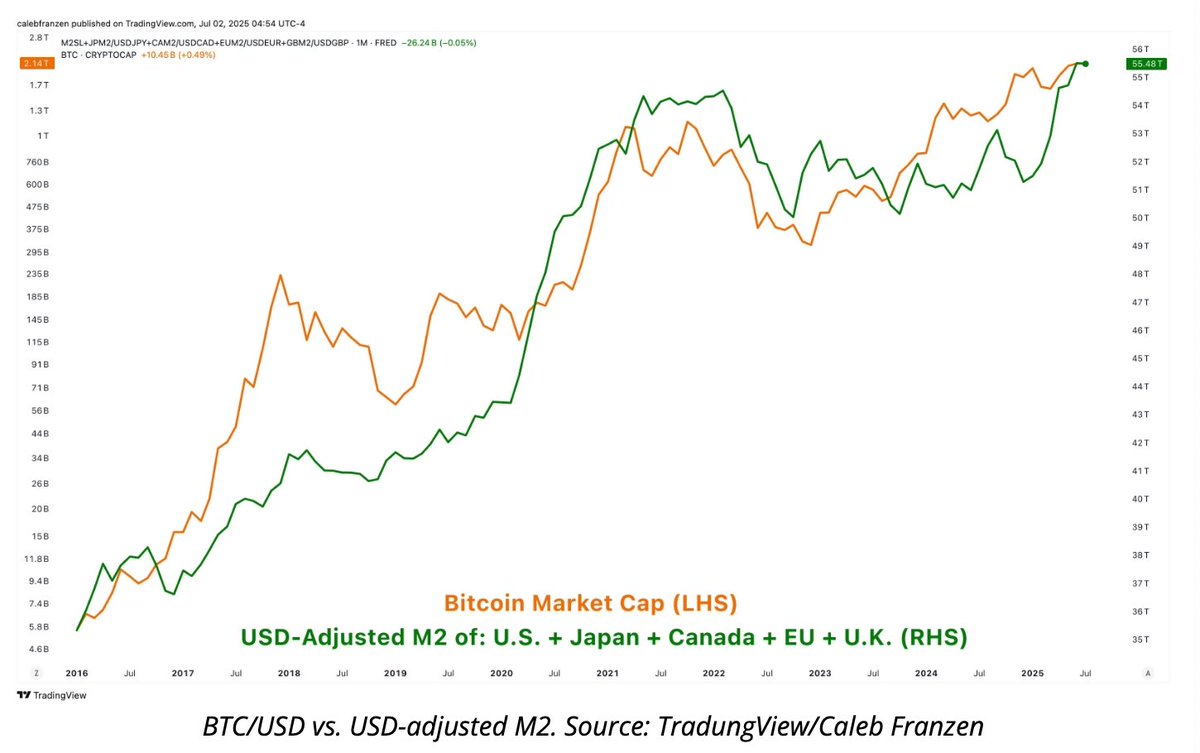
-Global M2 has been rising, and historically Bitcoin price has been strongly correlated with M2 supply (as shown in the graph).
3. CONCLUSION: Bitcoin = the best risk asset
From a financial allocation perspective, Bitcoin has become the best quality USD risk asset: highly cashable, with the high risk-adjusted return. And those huge global macro-political and economic shocks are controlled, with the US and China working together again, higher certainty of US and European rate cuts, and new highs in global M2 supply. Personally, I think Bitcoin will be a very worthwhile dollar asset to hold and allocate for the next five years, provided the US dollar system doesn't crash.
Should you get on board now? Remember - the liquidity increase is just starting and 120K of BTC price is just a starting point🚀