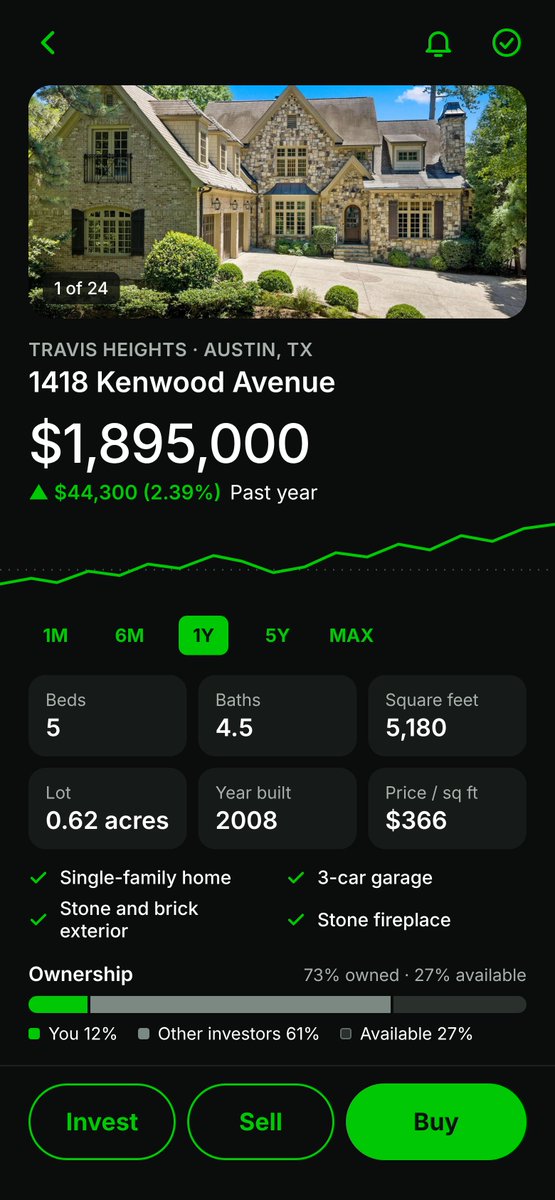
$HOOD: Buying a home in America should be as easy as buying a stock
• Buy, sell, or invest in any US home in 30 seconds
• One open marketplace for every buyer and seller
• List your own house in minutes
• Invest in any neighborhood you believe in
• No middlemen
Homeownership built the American middle class. Today the process is slow, expensive, and full of people taking a cut. The technology already exists. It's time to open up residential real estate to every American.
$HOOD: “What people really want is to invest in an individual private company as easily as they can invest in a public stock. And maybe they want an individual piece of land or a property in a neighborhood that they think is going to do well.” – @VladTenev
The whole idea of this platform is to make buying and selling a whole home easier, and to remove the barriers to entry.
It’s a two-part approach: technology and policy.
On the policy side, I believe we should:
> Eliminate property taxes
> Eliminate down payments on a first home
> Eliminate the real estate middlemen who take a fee on every purchase and sale
> We need to build new homes and new cities that are exciting, desirable places people want to live
$ANT: “We can create an age of miracles where humanity is able to solve problems that have eluded us for millennia.
We have to make sure that all the risks, all the ways that things can go wrong with this technology, we very carefully address those risks as we bring the benefits and as we have a viable business at the same time.
And I invite you to join us on the next phase of this journey.” — @DarioAmodei
.@DavidBozell: “CNBC poll that said the number one issue for young Americans was housing above all else. Above gas, above Iran, above Israel. For 18- to 35-year-olds, for both genders, male and female, it was the number one issue.
For 18- to 49-year-old men, the number one issue in America was the cost of housing. That’s 30 years of guys that are trying to own the roof over their head, and they can’t do it.
This year is the worst year for housing since 2011. The worst year for housing in 15 years. I really think it was the fact that people want to own the roof over their head.
It is the best brick-and-mortar example of pursuing the American dream. And 30 years of guys said it’s the number one issue.”
Via @NextUpHalperin
More relevant today than ever:
“People want to see the same level of urgency and mobilization that we see in foreign policy applied to domestic issues—affordability, housing, and economic opportunity.
Americans want to see action on lowering costs, tackling inflation, investing in infrastructure, securing the border, and making homeownership attainable again for younger generations who feel increasingly locked out of the American dream.”
I wanted to share a few thoughts about the situation with Iran. What’s happening geopolitically right now is an incredibly delicate balance that President Trump has to manage carefully. Americans simply do not want another long-term entanglement in the Middle East—we’ve seen how that story ends in Iraq and Afghanistan, and those conflicts ultimately failed to produce the outcomes that were promised.
For years the justification was regime change and the belief that democracy could be implemented in the region if we stayed long enough. But the reality is that those efforts cost American lives, trillions of dollars, and decades of national focus, with very little to show for it in the end. A lot of younger Americans today genuinely struggle to understand why the United States would be entering a war with Iran, because for most people it does not affect their day-to-day lives and often feels like a conflict that is more closely tied to regional dynamics involving Israel than a direct threat to Americans at home.
At the same time, it’s important to recognize that Israel is one of America’s closest allies and standing strong with the Jewish community is something the United States should always be proud of. Supporting allies matters, but even George Washington warned about the risks of becoming too closely tied to any one nation’s conflicts, cautioning against “permanent alliances” that could pull America into wars that are not directly its own. The concern many Americans have is that when alliances become too intertwined, the United States can end up absorbing the costs—militarily, financially, and politically—of conflicts that were not originally ours to fight.
That’s why President Trump has to recognize something important about the American appetite right now. People want to see the same level of urgency and mobilization that we see in foreign policy applied to domestic issues—affordability, housing, and economic opportunity. Americans want to see action on lowering costs, tackling inflation, investing in infrastructure, securing the border, and making homeownership attainable again for younger generations who feel increasingly locked out of the American dream.
Too often presidents get pulled into the gravity of Washington, where their attention becomes dominated by foreign crises and geopolitical maneuvering. Of course, the United States has global responsibilities and the president must be a steward of the most powerful nation in the world. But as we move further into the Trump administration, there has to be discipline about avoiding a deeper military involvement—especially any scenario involving boots on the ground in Iran—while keeping the primary focus on delivering for the American people at home.
To President Trump’s credit, the military actions so far have been swift and targeted toward specific objectives. But the broader strategic questions now begin to emerge: What does the end state in Iran actually look like? What does the future of military conflict in the region look like from here, and what—if any—should the long-term American footprint in Iran be? At the same time, how do we protect American interests abroad without losing sight of the promises made to Americans at home?
Americans want a safe and stable world, but they also want leadership that is prudent about when and where the United States uses its military power. We cannot allow our forces to become overstretched or spread too thin, especially at a time when rising geopolitical competition—particularly with China—demands careful strategic focus. Ultimately, the balance Americans are looking for is strength abroad while rebuilding prosperity, opportunity, and stability at home.
.@DavidBozell: “CNBC poll that said the number one issue for young Americans was housing above all else. Above gas, above Iran, above Israel. For 18- to 35-year-olds, for both genders, male and female, it was the number one issue.
For 18- to 49-year-old men, the number one issue in America was the cost of housing. That’s 30 years of guys that are trying to own the roof over their head, and they can’t do it.
This year is the worst year for housing since 2011. The worst year for housing in 15 years. I really think it was the fact that people want to own the roof over their head.
It is the best brick-and-mortar example of pursuing the American dream. And 30 years of guys said it’s the number one issue.”
Via @NextUpHalperin
$OPEN: One year ago, I wrote this article. Could not be more disappointed. What @nejatian should have done:
> Tokenize real estate: buy, sell, or invest in any residential real estate property
> Democratize homeownership
> Buy or sell a house in 30 seconds
> Develop a true marketplace for buyers and sellers where anyone can buy or sell a house anywhere in the United States
At this pace, one of the AI labs will probably disrupt residential real estate.
Gen Z and Gen Alpha are being locked out of homeownership. For younger generations, owning a home is no longer a realistic part of the American Dream. There should be a Trump Account initiative equivalent for buying and selling a house. Opendoor should have led the way.
Would love to see Robinhood take a shot at disrupting the buying and selling of residential real estate. Young people are literally being priced out of homeownership, and it’s a sad state of affairs.