To CEOs, CFOs, CIOs and Directors:
Have you read the White House Accord on Super Intelligence? What will you do to safely deploy Super Intelligence within your Enterprise?
EY and 8090 are building a new solution - KYSI (Know Your Super Intelligence) designed to create a verifiable record of AI-enabled decisions by capturing the context and evidence, and spotlighting controls, across enterprise environments. The solution helps organizations strengthen governance while keeping pace with innovation. It does this by providing:
- End-to-end traceability
- Policy-to-risk mapping
- Auditable evidence packages
Together, we are helping organizations move beyond AI experimentation toward AI they can trust, govern and scale enterprise-wide with confidence.
To learn more, reach out to your EY Partner or ping us at https://t.co/fkfTXgcI8c
“We tried to get Claude to write it, but it did a poor, sloppy job and we had to spend a lot more time editing than we expected (don’t tell him we said that, just in case…). Perhaps there’s a lesson to be learned there. Claude also didn’t like our references to specific companies – one in particular. He preferred “standalone model developer”. So, our legal team would like us to point out that any reference to companies, products or individuals is illustrative and does not describe or imply their actual conduct, financial condition or intentions. It is a work of fiction, and any remaining errors are the fault of AI. As we know, AI “just does stuff sometimes” and no human should ever be held accountable for its actions. AI moves in mysterious ways.”
THE PERKINI REPORT: THE 2028 REALITY CRISIS
What if the most obvious financial bubble in all of history turns out to be.... a bubble... and what if that is just really.... bearish?
there were signs, there are always signs 🤣
free link:
https://t.co/NB7rGw3PJP
inspired by @citrini
David Friedberg: France’s Crisis Is a Warning for America
“France is a bellwether for the West.
So take a look at this chart. This chart is a measure of public spending as a percent of GDP.
And you can see the comparison of France's public spending as a % of GDP to the peak public spending as a % of GDP of major communist nations.”
@Chamath:
“So do you think France is a communist state? They spend like it.”
@Jason:
“Well, it's certainly been a socialist state, right?”
Chamath:
“Is it working?”
@Friedberg:
“That's my point. And I think this is such a prescient lesson for the West to look at.
We all think that there's some political problem with Macron or whoever it was.
The more the government spends, the worse the conditions get for its people, not the opposite, and then the people riot and revolt.
Take a guess where the US is today. US public spending is roughly 36% of GDP. France today is operating its national government spending deficit is 5.4% of GDP. The US is actually 6.2% of GDP.
France is, I think, probably the first to go because they're only growing their economy at half a percent while the US is growing at 2.3%.
So we're still kind of hanging on because we have some degree of economic growth that's allowing us to kind of hold things together.
But I would argue that we are facing the same sort of fiscal cliff which leads to this extraordinary social unrest as France.
All the economic measures are aligned, we're at the same rate, we're at the same set of problems, and we're starting to see the cracks in the system.
There's probably a multi-year solution.”
POD UP! 🚨
-- AI Cyber Panic w/ @nikesharora
-- Ken Griffin’s Bubble Warning
-- The Fall of France?
(0:00) Bestie intros!
(0:11) Ken Griffin's AI bubble warning
(8:19) Palo Alto Networks CEO Nikesh Arora joins
(14:24) AI Cyber panic: PHP exploits and the tumultuous year ahead
(44:17) France on the brink: Riots, immigration referendum, debt crisis
(1:31:49) Trump's second half strategy, Press Secretary J-Cal?
@ces921 I think there are already a handful of IGs that consistently trade inside of USTs. I do believe SpaceX should be added to that list and believe in its long term business. It’s a tremendous business.
This SpaceX paper is money good and better than most sovereign debt. Also means that everyone else except IG-grade hypers will price at 10-12% in 2027.
SpaceX $SPCX is finalizing a $40 billion debt raise at sharply higher borrowing costs than its previous financing, according to Semafor.
The lowest-rated portion is expected to carry an interest rate of around 8.3%, while a safer portion backed by AI chips could price near 7.75%.
The safer portion is expected to price more than 1 percentage point above where SpaceX's existing bonds trade.
The deal, led by Apollo and Goldman Sachs, is expected to be finalized next week.
Founders send me pitches every day. Here’s a better way: come to our hackathon!
EVOLVE: 20 hours, overnight at 8090 in Redwood City, Nov 13–14.
Build AI agents and tools that build software. The winning team, beyond recognition and a cool trophy gets two 1:1s with me, to help you refine a pitch or idea and then a follow-up.
Use the time however you want. Ask me for advice, ask me for money or just make fun of me. All allowed if you win!
Apply: https://t.co/zvRSjRh3bW
1% of companies represent 90% of AI spending.
Of that 90%, 80% of this spend are from unprofitable VC backed companies.
So, roughly, $0.70-75 of every dollar of AI spending right now comes from AI companies spending VC investment dollars.
As a result, the revenue quality in AI is currently poor. This happened in previous cycles as well, like cloud when early users of AWS were mostly venture backed startups.
The thing, though, is that before AWS could scale and pull thru GCP and others as legitimate cash machines, there were a few clearing events to sort out these brittle revenues.
This is the extrapolation of Ken’s point. We will need to transition from speculative AI spending to consistent, reliable spend that shows up in public market earnings reports.
This hasn’t happened yet because most of the breathtaking revenue growth comes from LPs investing in VC funds who then send it to startups.
BREAKING: Citadel founder Ken Griffin says AI is "almost certainly" a bubble, noting that companies are struggling to turn AI spending into productivity gains.
However, Griffin says he is bullish on AI's long-term potential.
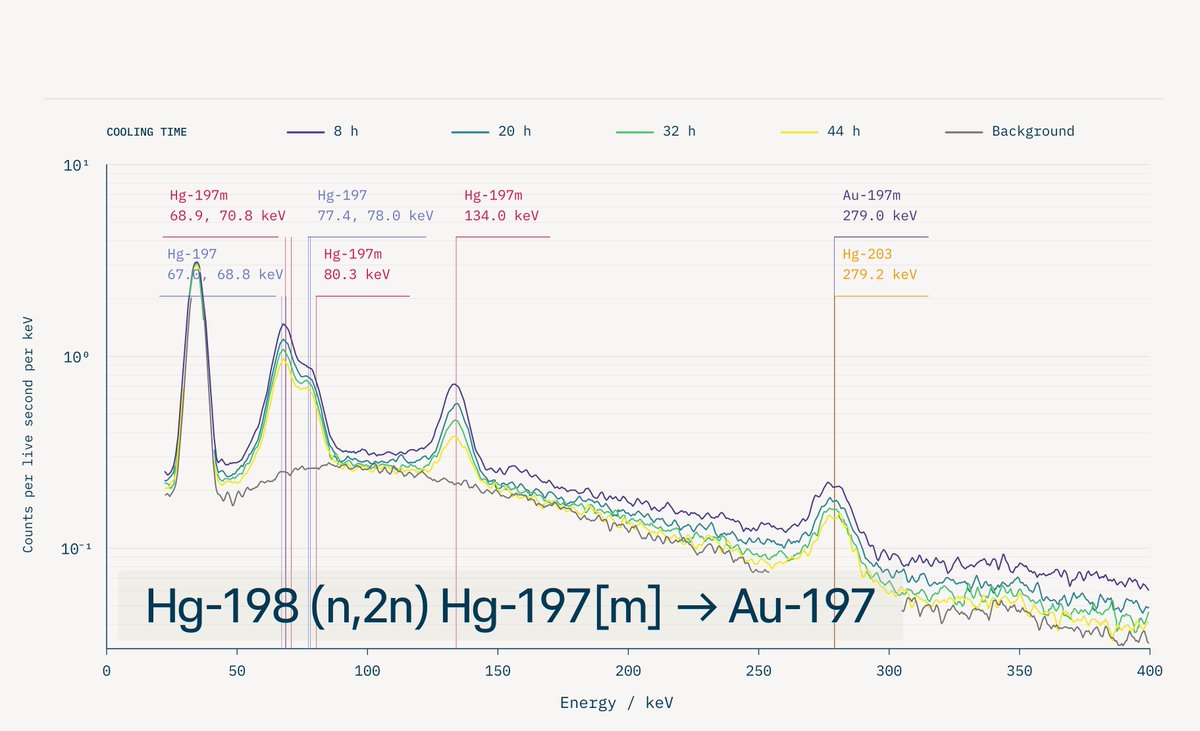
In 2025, we published a bold proposal to use fusion reactors for gold production.
And now we’ve done it: Mercury transmuted into stable gold, using fusion neutrons, at 10x the record set by CERN in 2025.
We’ve reduced alchemy to a series of difficult but tractable engineering problems.
It’s all about clips.
I see it at Beast Industries where I’m on the board. I see it with All In where I am on the show.
I think people don’t understand that content preferences will evolve around this time constraint.
It’s already come for movies. It will come for sports next.
The first thing to change will be terms of service and blocking these agents. Not because the value is low but because the risk is high. Banks will chose self preservation and risk mitigation.
Then we will need to find a security and governance architecture that will get external auditors comfortable.
These are the practical issues of human risk tolerance in AI diffusion that model capability can’t solve.
SCOOP: Major U.S. banks are detecting unauthorized third-party AI agents inside customer accounts, including some attempting to take actions that appear to be independent of user instructions, sources told Axios.
The findings have alarmed banking executives, who are racing to restrict access to their systems as AI moves at a velocity faster than financial institutions can respond, multiple industry and bank executives told Axios.
Several banks are now preparing for worst-case and even “day after” scenarios, including how to rapidly secure or restore customer accounts if things go wrong, the people said.
Several bank executives told Axios they're struggling to distinguish between human users and AI agents. One executive said banks also struggle to determine whether agents are authorized by customers or potentially operating without their permission, more akin to rogue agent behavior.
Read my latest for Axios here: https://t.co/Q3bda5In8q
.@chamath on the pricing shift he thinks will make the AI market explode:
“When Google invented and scaled AdWords and AdSense, the market exploded… because we went from buying 1,000 ads to just getting an outcome. Right now we buy a million tokens. We will eventually move to an outcome. And I think when that happens, this market will just go absolutely crazy.”
This tracks. I watch something on YouTube every day. Netflix is a dormant subscription for me.
YouTube has very low costs of content creation. Netflix has $14B of debt that has financed their content library.
Another lesson in the halls of mismatching assets and liabilities? Time will tell.