Daily Market Update – August 18, 2026
Equities
U.S. markets closed lower on Monday. Asian markets fell more sharply today, with Japan leading the declines. European indices are mostly trading slightly lower. U.S. futures point to a weaker open later today.
Interest Rates
Long-term U.S. yields continue to rise. The 30-year Treasury yield is at its highest level in nearly 20 years. Higher yields increase borrowing costs and put pressure on equity valuations.
Oil & Geopolitics
Oil prices have moved back above $91 per barrel. The temporary U.S.-Iran ceasefire has expired. Traffic through the Strait of Hormuz remains heavily restricted, keeping supply tight.
Yen
The Japanese yen has weakened further and is trading near 159.70 against the dollar. The effect of the earlier intervention continues to fade.
Quick Summary
Risk appetite is soft. Higher long-term yields and elevated oil prices are weighing on stocks across Asia and Europe, while U.S. futures also point lower.
Short narrative
Markets are in a cautious mood today. Rising long-term interest rates in the U.S. and a renewed jump in oil prices after the U.S.-Iran ceasefire expired are putting pressure on equities. Asia already closed weaker, Europe is trading slightly lower, and Wall Street looks set for a softer open. At the same time the yen continues to lose ground, showing that earlier support measures are fading. The combination of higher borrowing costs and tighter energy supply is currently the main headwind for risk assets.
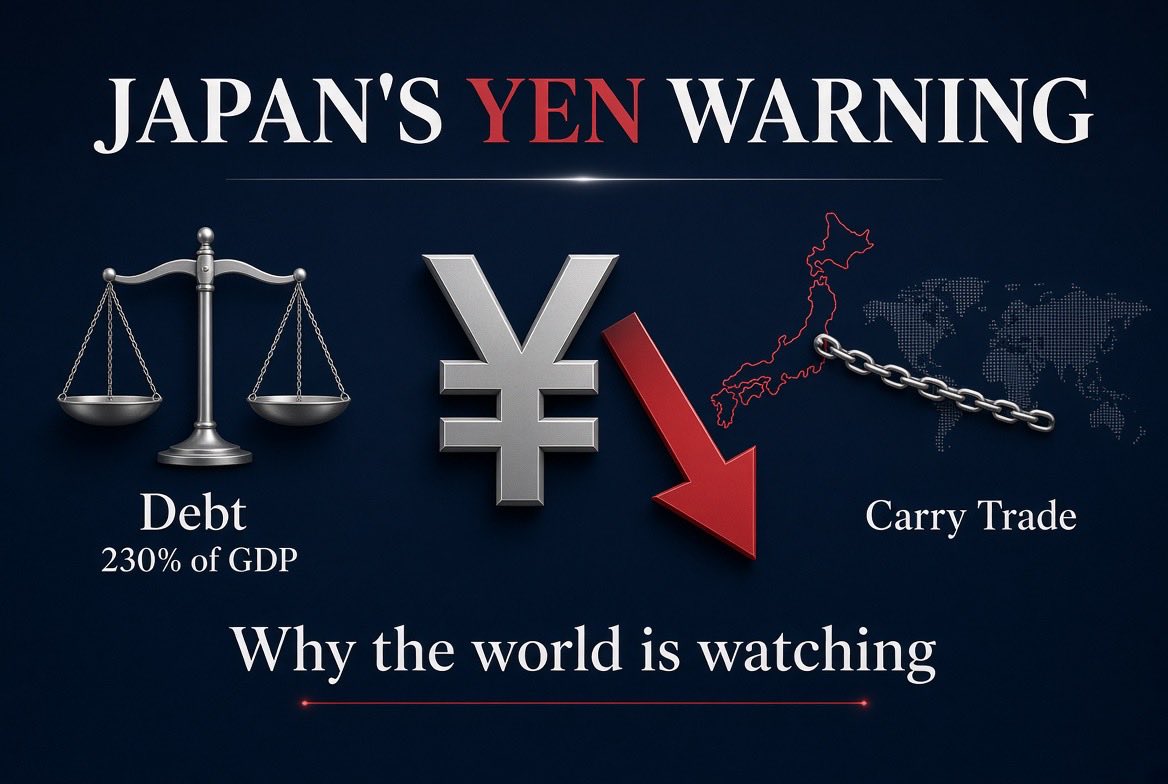
🚨 Japan’s Yen just hit multi-decade lows, and the world should be paying attention.
This is more than a currency story.
A forced unwind of the yen carry trade or pressure on Japan’s massive debt could send shockwaves through global markets.
The joint US-Japan intervention just two weeks ago has already lost half its gains. The yen is sliding back fast.
Here’s why it matters (in plain English):
1. The Carry Trade
For years investors borrowed ultra-cheap yen in Japan and invested it elsewhere for higher returns.
If the yen strengthens or rates rise, those positions get forced closed, meaning rapid selling of stocks and bonds worldwide.
2. Why the Bank of Japan can’t just hike rates hard
• Japan has the highest government debt in the developed world (~230% of GDP). Higher rates explode interest costs.
• Banks and insurers hold huge amounts of Japanese bonds. Rising rates create big losses.
• The economy is fragile and the population is aging rapidly.
3. The rollover problem
Old loans keep their low fixed rates, but Japan has to constantly refinance enormous amounts of maturing debt at the new higher rates. The total interest bill still rises fast.
The US even joined Japan in intervening to support the yen, the first time in 15 years. Yet half of that support has already evaporated.
Interventions can buy time.
They don’t fix the underlying problems.
Is this the risk markets are still underestimating?
@xkatekarsyn Nothing. I’d ignore you. My girlfriend is the most beautiful woman in the world, and when I was on my first date with her, nothing could make me take my eyes off her. ❤️
@AwedaJoshua True, Kimbo is the ultimate fighter to me. As a kid I downloaded all his raw street fight clips and watched that shit for hours. Absolute savage. Miss those days brother
Everyone is watching missiles and oil prices.
But there is another signal worth watching:
Insurance.
Ships sailing through high-risk conflict zones need war-risk insurance. As the danger increases, insurers raise premiums, restrict coverage or advise shipowners to pause voyages altogether.
And that’s where it gets interesting.
A tanker doesn’t need to be sunk to disrupt global trade.
If sailing through the Strait of Hormuz becomes too expensive or too difficult to insure, shipowners may decide the voyage is simply not worth the risk.
Fewer ships.
Delayed cargo.
Higher transport costs.
More pressure on oil and LNG supply.
The Strait can technically remain open…
while becoming commercially harder to use.
That’s why I’m watching insurance.
The first effective blockade may not be military.
It may be financial.
#Hormuz #StraitOfHormuz #Iran #Geopolitics #Oil #EnergySecurity #Shipping #Insurance #WarRisk #GlobalTrade #MiddleEast #LNG #SupplyChain
Everyone is still watching missiles.
But the real squeeze is happening in the insurance market.
War-risk premiums for tankers through the Strait of Hormuz remain extremely elevated, often 2-4% of vessel value for a single transit (versus <0.25% pre-crisis).
For a typical $250 million supertanker, that’s $5-10 million in extra insurance per voyage.
Shipowners are doing the math: is this route still worth it?
Fewer willing ships.
Higher freight rates.
Growing delays in oil & LNG deliveries.
The Strait doesn’t need to be physically closed to disrupt global energy flows.
Sometimes a financial blockade is more effective than a military one.
That’s the silent pressure I’m watching.
#Hormuz #StraitOfHormuz #WarRisk #Insurance #EnergySecurity #Oil #Geopolitics
🚨 What They’re Not Telling You About the Next Crypto Wave
While missiles dominate the headlines, quiet backroom deals and document leaks point to something bigger.
Geopolitical chaos is forcing institutions and governments to accelerate the shift to ISO 20022, the new global financial standard.
The old SWIFT system is too slow, too expensive, and too easy to weaponize.
Enter the neutral alternatives:
• XRP, Built for instant cross-border liquidity
• Stellar (XLM), Designed for compliant global flows
• XDC, Enterprise backbone for trade finance
• Bitcoin, The ultimate decentralized hedge against systemic risk
Mass adoption isn’t coming.
It’s already being quietly engineered behind the scenes.
The window is closing.
Are you positioned?
#ISO20022 #XRP #XLM #Stellar #XDC #Bitcoin #Geopolitics #Crypto #GreatReset #CryptoNews #Altcoins #DigitalAssets #FinancialReset #Blockchain #MassAdoption #Hormuz #EnergyCrisis #ripple #xinfin
🚨 What They’re Not Telling You About the Next Crypto Wave
While missiles dominate the headlines, quiet backroom deals and document leaks point to something bigger.
Geopolitical chaos is forcing institutions and governments to accelerate the shift to ISO 20022, the new global financial standard.
The old SWIFT system is too slow, too expensive, and too easy to weaponize.
Enter the neutral alternatives:
• XRP, Built for instant cross-border liquidity
• Stellar (XLM), Designed for compliant global flows
• XDC, Enterprise backbone for trade finance
• Bitcoin, The ultimate decentralized hedge against systemic risk
Mass adoption isn’t coming.
It’s already being quietly engineered behind the scenes.
The window is closing.
Are you positioned?
#ISO20022 #XRP #XLM #Stellar #XDC #Bitcoin #Geopolitics #Crypto #GreatReset #CryptoNews #Altcoins #DigitalAssets #FinancialReset #Blockchain #MassAdoption #Hormuz #EnergyCrisis #ripple #xinfin
Everyone is still watching missiles.
But the real squeeze is happening in the insurance market.
War-risk premiums for tankers through the Strait of Hormuz remain extremely elevated, often 2-4% of vessel value for a single transit (versus <0.25% pre-crisis).
For a typical $250 million supertanker, that’s $5-10 million in extra insurance per voyage.
Shipowners are doing the math: is this route still worth it?
Fewer willing ships.
Higher freight rates.
Growing delays in oil & LNG deliveries.
The Strait doesn’t need to be physically closed to disrupt global energy flows.
Sometimes a financial blockade is more effective than a military one.
That’s the silent pressure I’m watching.
#Hormuz #StraitOfHormuz #WarRisk #Insurance #EnergySecurity #Oil #Geopolitics
Everyone is watching missiles and oil prices.
But there is another signal worth watching:
Insurance.
Ships sailing through high-risk conflict zones need war-risk insurance. As the danger increases, insurers raise premiums, restrict coverage or advise shipowners to pause voyages altogether.
And that’s where it gets interesting.
A tanker doesn’t need to be sunk to disrupt global trade.
If sailing through the Strait of Hormuz becomes too expensive or too difficult to insure, shipowners may decide the voyage is simply not worth the risk.
Fewer ships.
Delayed cargo.
Higher transport costs.
More pressure on oil and LNG supply.
The Strait can technically remain open…
while becoming commercially harder to use.
That’s why I’m watching insurance.
The first effective blockade may not be military.
It may be financial.
#Hormuz #StraitOfHormuz #Iran #Geopolitics #Oil #EnergySecurity #Shipping #Insurance #WarRisk #GlobalTrade #MiddleEast #LNG #SupplyChain
AI is changing everything.
The people learning today will lead tomorrow.
Grambix
📚 eBooks & Audiobooks
🧠 AI, business & future skills
⚡ Fast microlearning
Now on the App Store & Google Play.
Start your 30-day free trial.
#AI#ChatGPT#Startup#Tech#Learning#Grambix
🚀 Knowledge is evolving.
People no longer want to spend hundreds of hours searching through endless content.
They want fast, practical and powerful information they can actually use.
That shift is exactly why platforms like Grambix are emerging.
• Short-form micro learning
• Premium eBooks & audiobooks
• Business, AI, finance, mindset and modern skills
• Designed for people who want to stay ahead without wasting time
The future of learning may not be longer.
It may simply become smarter.
More available inside Grambix.
📱 30-day free trial
Available on Apple App Store & Google Play Store
#AI #ArtificialIntelligence #MicroLearning #Business #Success #Entrepreneur #SelfImprovement #Money #Investing #Crypto #Future #Education #Mindset #Startup #Grambix