China's economy is struggling:
China’s industrial production rose +4.5% YoY in July, but posted its first monthly slowdown in 3 months.
At the same time, retail sales grew just +0.6% YoY, the 3rd-lowest reading in at least 18 months.
This comes as passenger vehicle purchases, the largest component of retail sales, dropped -21.0% YoY.
Furthermore, fixed-asset investment fell -6.7% YoY in the first 7 months of 2026, worsening from the -5.7% decline in the first half.
Over the same period, real estate investment collapsed -19.2% YoY, the largest drop on record.
China's economic slowdown is deepening across every major sector.
BREAKING: Foreign holdings of US Treasuries dropped -$72 billion in June, to $9.30 trillion, to the lowest level since January.
This marks the 3rd monthly decline over the last 4 months, totaling -$190 billion.
Japan, the largest foreign holder, reduced its holdings by -$26 billion in June, to $1.12 trillion, the lowest since January 2025.
The UK, the 2nd-largest holder, cut its holdings by -$9 billion, to $940 billion, the 2nd-largest on record.
China, the 3rd-largest holder, trimmed its holdings by -$26 billion, to $633 billion, the lowest since September 2008.
Meanwhile, foreign official holders, such as central banks and government entities, reduced their Treasury holdings by -$70 billion in June, to $3.78 trillion, the lowest since February 2024.
Foreign demand for US Treasuries is losing momentum.
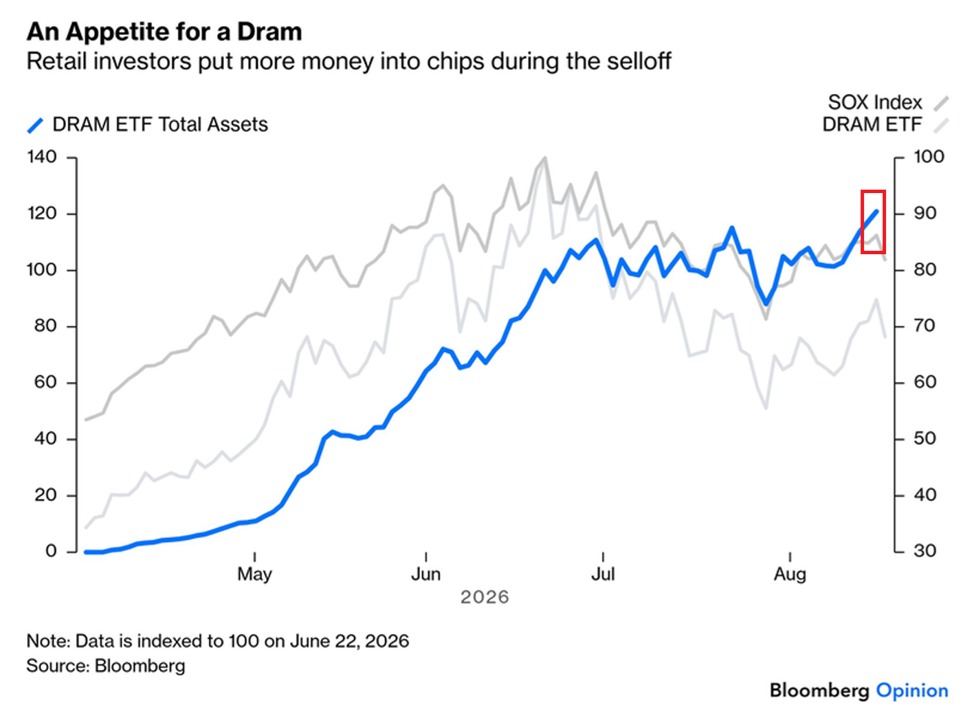
Retail investor demand for chip stocks is incredibly strong:
Total assets under management (AUM) in the US memory ETF, $DRAM, have surged +20% over the last 2 months, to a record $28 billion.
This is despite a -28% decline in the fund’s price over the same period.
This comes as the fund has attracted +$12 billion in inflows during this time, with all 8 consecutive weekly inflows.
In total, $DRAM has pulled in +$27 billion since its inception on April 2nd, and has gained +98%.
Meanwhile, the 2x leveraged long memory ETF, $RAM, has seen +$893 million in inflows since its debut on June 24th.
Investors are piling into memory stocks at an unprecedented pace.
Attacks on Russian logistics appear to be intensifying again. Footage from the R-280 highway, which connects the annexed Crimean peninsula to southern Russia's Rostov region via the partially occupied Zaporizhzhia and Donetsk regions, shows burning Russian military vehicles. #Ukraine
In April 2025, on the Kupiansk front, an M1224 MaxxPro armored vehicle used by a special unit of the Defence Intelligence of Ukraine (HUR MO) was hit by a Russian FPV drone.
After the strike, the specialist inspected the vehicle and assessed the damage. Once he confirmed that the engine was still running, he got behind the wheel — and the MaxxPro drove out of the combat zone under its own power, despite the damage and a blown tire.
So much for Trump’s “economic blockade” of Iran.
Makhachkala port, August 19, 2026.
Iranian bulk carrier Kados (IMO 9137258) calmly loading barley in a russian port.
Apparently, the blockade has an exception when russia is involved.
Ukrainian attack drones swarmed Russia’s Nizhnekamsk Oil Refinery this morning, scoring multiple hits and setting the plant on fire.
Seen here, a Ukrainian Fire Point FP-1 maneuvers and then dives into one of the already-burning Russian refinery’s process units.
💥 A drone attack in the Moscow region has completely destroyed the plant of AlmaFood, the largest manufacturer of coffee and ingredients for vending machines in Russia.
Located within the "Severnoye Domodedovo" logistics complex, the facility—along with its equipment and warehouses—burned to the ground.
"Everything burned down; no equipment is left in the workshop, literally nothing," confirmed the company's Commercial Director, Anna Abishina.
For years, local business owners pretended the war didn't concern them while quietly financing the aggression through their taxes. Now, the illusion of safety has definitively shattered. The war is inevitably returning to where it started, and every business in the Russian Federation will learn its true cost firsthand—through burning factories, broken supply chains, and millions in losses.
MOSCOW IN TOTAL CHAOS. 🌑🇷🇺
A massive explosion at a key substation has plunged the Russian capital into darkness. The impact is catastrophic: the entire Federation’s infrastructure is in a state of systemic collapse.
❌ Banking apps: DEAD.
❌ Payment terminals: OFFLINE.
❌ City services: PARALYZED.
The heart of Russia is offline and the ripple effect is tearing through the nation. 💥📉
#Moscow #Blackout #RussiaCollapse #BreakingNews
Russia's Black Sea Fleet lost two Kalibr carriers in the August 12 strike on Novorossiysk naval base. Frigates Admiral Makarov, the fleet flagship, and Admiral Essen reportedly suffered critical damage and are out of service for at least a year.
Essen's bow was hit, deforming the deck and destroying its 8-cell 3S14 launcher, Trebovaniye-M combat system, radar, EW systems and satellite communications. Makarov was hit near its launcher area, triggering an internal detonation and burning out the 3S14 launch cells.
#Ukraine
A rare Russian ISDM Zemledeliye remote mine-laying system was destroyed by the Dovbush Hornets Unmanned Systems Battalion of Ukraine’s 68th Separate Jaeger Brigade
US Treasury just blinked: after 30y yields hit levels last seen in 2007, Treasury Sec Bessent doubled long-end liquidity buybacks from $2bn to at least $4bn per operation. 30y yield fell ~9bp to 5.19%. This is not QE, debt stays outstanding. But signal is clear: 5.3% is pain point
🔴 Astronaut visits Ukraine after seeing Russian missile strike from space.
Norwegian astronaut Jannicke Mikkelsen visited Kryvyi Rih in August 2026 with NGO Fritt Ukraina to deliver aid and observe the impact of Russian missile strikes she previously spotted from orbit.
I am so glad they are sharing what is really happening
This administration is trying to LIE about the HORRIFIC conditions they are living in….we see the truth‼️
Russia has found a source of near-slave labor and “cannon fodder” in North Korea. For Pyongyang, this is a way to earn foreign currency, gain access to Russian resources and technology, while maintaining complete control over its citizens abroad.
North Korea has been making money from exporting its workers for decades. According to estimates cited by 38 North, around 100,000 North Korean citizens may be working abroad in approximately 40 countries, generating around $500 million a year for the regime. Russia has now become one of the main destinations. According to South Korean intelligence, around 15,000 North Koreans were already working in Russia by May 2025. Formally, this violates UN sanctions: Resolutions 2375 and 2397 banned the issuance of new work permits to North Korean citizens and required existing workers to be repatriated by the end of 2019. Moscow circumvented these restrictions by using other types of visas. In 2025, Russia issued more than 36,000 visas to North Korean citizens, almost all supposedly for educational purposes. In practice, these “students” go to Russia to work.
Now this flow is expanding. Organized groups of North Korean women have begun arriving in Russia to work on assembly lines, in garment factories, kitchens, and farms. Russian employers are offered ready-made groups of at least 40 workers. This marks an important shift: previously, North Korean labor in Russia was associated primarily with men working in construction and logging.
‼️ This is effectively state-sanctioned human trafficking. A major report by the UN Office of the High Commissioner for Human Rights explicitly describes North Korea’s overseas labor system as involving indicators of forced labor. Former workers told the UN that their passports were confiscated, they were forbidden from leaving workplaces and dormitories independently, and their communications and contacts with the outside world were monitored. People are supervised not only by representatives of North Korea’s Ministry of State Security, but also by group leaders and informants within the work brigades themselves. One former worker in Russia told the UN that a single North Korean intelligence officer monitored around 500 workers through a system of group leaders who reported to him daily.
The state also controls the money. Russian employers typically do not pay workers their salaries directly: the money goes to companies linked to North Korea, after which state payments and various expenses are deducted. Human Rights Watch, citing interviews conducted by Global Rights Compliance with 21 North Korean workers in three Russian cities, reports that they worked 12-16-hour days and, in some cases, up to 364 days a year. With a salary of around $800 a month, approximately $600 could be taken by the North Korean state, and after additional deductions for travel, accommodation, and other expenses, workers were sometimes left with as little as $10.
For Russia, this is particularly beneficial now. The war itself has created a labor shortage: hundreds of thousands of men have been mobilized or recruited into the military, large numbers of people have been killed or wounded, some of the population has left the country, and the defense industry is drawing workers away from other sectors. Moscow is now trying to fill part of this labor shortage with North Koreans. In July 2025, 38 North reported that North Korean workers had returned to Russia’s Far East on a scale not seen there since before the pandemic.
But Pyongyang is supplying Russia with more than just workers. In autumn 2024, North Korea began deploying regular military units to Russia. The first wave consisted of approximately 14,000-15,000 troops, whom Russia primarily used in combat in the Kursk region. These were not individual mercenaries who had independently signed Russian contracts, but soldiers of the Korean People’s Army sent at the decision of the North Korean state. Moscow and Pyongyang concealed their involvement for several months and officially acknowledged it only in spring 2025.
The casualties were extremely high.
South Korean intelligence estimated that around 600 North Korean soldiers had been killed out of approximately 15,000 deployed, while Western estimates of total casualties - killed and wounded - exceeded 6,000. In June 2025, Reuters also reported more than 6,000 casualties among the North Korean contingent. This means that a very significant portion of the initial force may have suffered casualties over a relatively short period of combat.
The North Korean state portrays these deaths as heroic sacrifices. In August 2025, Kim Jong Un publicly met with the families of those killed and promised to ensure they would have a “wonderful life.” State propaganda began referring to the fallen as martyrs and heroes.
And Russia intends to continue using this resource. On July 25, Volodymyr Zelenskyy said that Russia was preparing to receive another 30,000 North Korean troops. On August 9, he gave a range of 30,000-50,000. Reuters has not independently confirmed these figures, so for now they should be presented specifically as an assessment by the Ukrainian side. However, the preparations for a new deployment fit into the already established model of Russian-North Korean cooperation.
🇷🇺 W rosji z paliwem stabilnie: "Dzisiaj jest 13 sierpnia. Zatankowaliśmy olej napędowy do pełna na stacji benzynowej Łukoil przy trasie M5, niedaleko miejscowości Kyzył-Jar. Przejechaliśmy dosłownie 15 kilometrów i samochód po prostu stanął. Nie chce odpalić, musieliśmy wezwać lawetę. Zamierzamy stworzyć precedens i oddać auto na pełną diagnostykę. Jeśli to kwestia trefnego paliwa, sprawa skończy się w sądzie...”
In Russia's Dagestan region, where the media wage is 30,722 rubles/month ($335/month), a man is in shock as gasoline prices have hit 338 rubles/liter ($4/liter or $15/US gallon).
Gas is becoming an unnaffordable luxury with an entire month's salary only purchasing 1.5 tanks.
Russia's Orsk refinery is going to be shut down for six months now because of a Ukrainian drone strike. The local region is without reliable fuel supplies now.