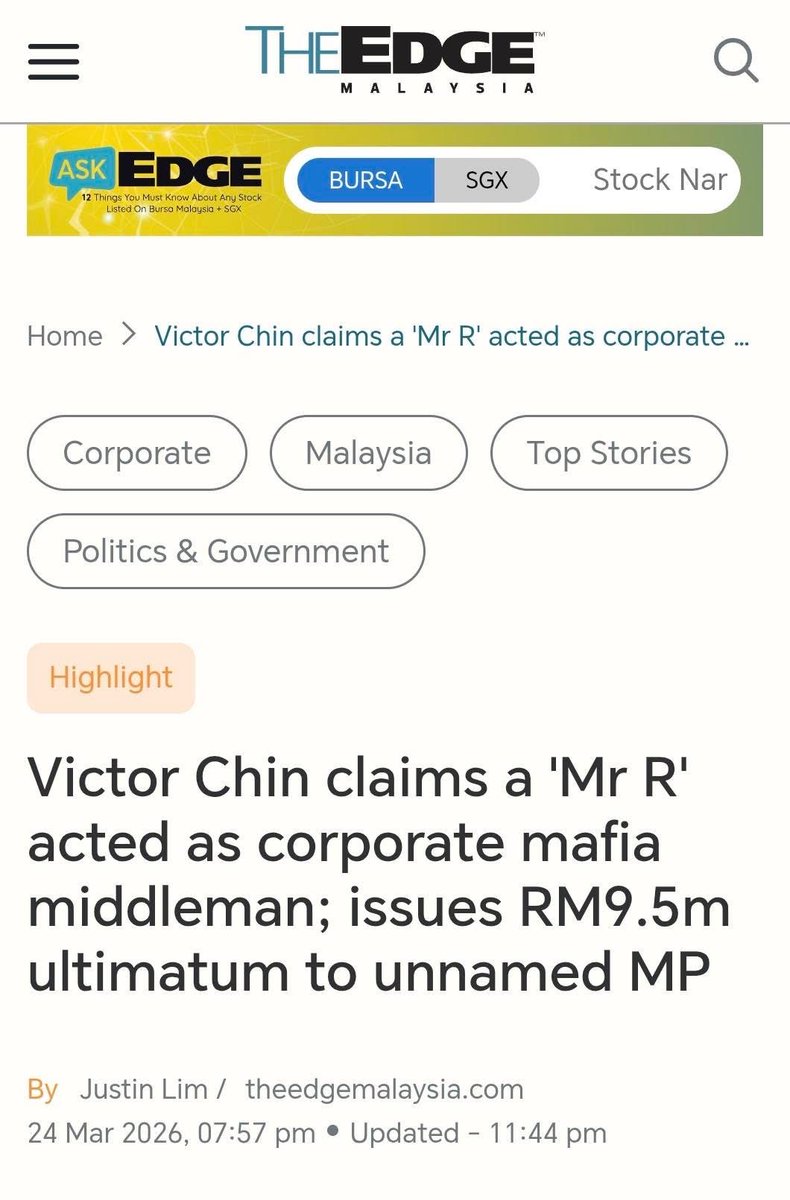
Dia ni antara punca PH kalah teruk
Dengan cakap pelat acah2 orang putih.
Menjatuh maruah orang.
Konon tanya soalan hebat.
Biadap pula dengan mak ayah datuk nenek kita..
Berapa Ceplos ni korang bayar?
Dia ni ketua Ceplos ke?
Dah tak ada orang bijak ke dalam PH?
🚨 BREAKING:
A controversial referee decision from FIFA!
FIFA formed the refereeing team for the France-Morocco quarter-final entirely from Argentine officials.
Don't bother this much, just give the trophy to Messi and don't tire anyone out...
Dua benda yang kita kena bangga dengan Petronas minggu ini
1) Petronas berjaya pastikan Malaysia dapat minyak cukup dari Rusia. Bukan setahun tapi 20 Tahun. Presiden Putin beri jaminan benda ni betul
2) Petronas berjaya dapat salah satu telaga gas terbesar dunia di Turkmenistan
Petronas tak pernah Failed to impress Malaysia Alhamdulillah
Yusri Che Lah kini muncul antara Jurulatih tempatan berstatus 'ejen bebas' & difahamkan beliau terbuka untuk berunding dengan mana-mana kelab sama ada dalam mahupun luar negara yang berminat dapatkan khidmatnya⏳✍🏼
@ASTROARENA
Masa dia jadi MB dulu, semua lantikan undang sah tapi bila masa turn org lain jadi MB semua lantikan undang & YDP Besar dah tak sah pulak. Pening mikir bila jd anak yatim ni.
Dia lupa apa yg dia dah buat dul dan dia ingat rakyat bodoh macam dia. Lagi mahu claim jadi pakar undang2 adat N9
Nasib baik ado yg simpan berita ni.
Menate punya si Rais ni..😤😤
When Germany got eliminated from the group stage in Euro 2000, they pressed a hard reset button.
Bild called them “the worst team in the history of mankind”.
Oliver Kahn said “when it comes to outstanding players, we neither have the quality nor the quantity”. That was under Erich Ribbeck, a man not many Germans fancied, but respected.
Germany simply went to work after the Euros embarrassment.
It was a rude reawakening. They'd been warned for a long time that their talent generation had stalled. They were thrashed by Croatia in the last 8 at France 98.
What did they do after their new millennium woes?
The “Extended Talent Promotion Programme”. German professional clubs and the German FA spent €48m on this programme every year. They spend more on it now. It’s expensive but very promising.
They figured their search for talent was narrow. They were not finding enough gems. Their concentration was too focused on the centre. And talented Germans were in the lower cadres.
For example, Miroslav Klose who was their star at the 2002 World Cup was playing amateur football at 21. He didn't play academy football. He played local football before joining Kaiserslautern reserves. In 2001, he made his Germany debut and became the hallmark of the revival of German football — a system that now democratises access for every talent.
Many like Klose had gone without notice. When they switched policies and went deeper in their search, Jorg Daniel, the Director of the Extended Talent Programme said;
“If the talent of the century happens to be born in a tiny village behind the mountains, from now on we will find him."
They lived that quote.
They invested in coaching education. The Extended Talent Programme also made it compulsory for every professional German football club to have and maintain a centre of excellence.
They developed two systems known as “Stützpunkte” for the regional talent centres, and the ones run by the German clubs in Bundesliga and 2. Bundesliga. These are known as “Leistungszentren”.
They built 366 Stützpunkte and hired 1,000 coaches paid by the DFB.
The best local footballers are found and sent to the Stützpunkt and if they do well, they'll be sent to the Leistungszentren which is run by the elite sides.
Germany scouts hundreds of thousands of talents as a result, and have an endless stream of football players. Today, it's hard to see a good football talent in Germany who's not on their radar.
The system spelled out a rule on the number of German talents they must have, the number of physios, coaches, and how those clubs should relate with local schools to get talent. They also bore the risk of losing their license if they didn't follow these rules.
What this did for German football is the access we see today. It's now become a very cosmopolitan football team. A team that has players of varying roots, yet one love for the country that's made them.
The man who shone in 2002, Klose had Polish roots. They also had their first African-born player. They've had players of Turkish, Nigerian, Polish, Sierra-Leonean, Togolese, Ivorian, Tunisian, etc roots play and perform well for them ever since. Fantastic talents whose parents came from different parts of the world have since represented Germany and they look good for it.
Young coaches also became more accepting of the norm. They want to succeed.
England’s hard reset after its stark failure between 2008 and 2012 led to the EPPP. It has worked for them so far.
You may have talents in a country but you must find a way to bring them together. You must find a way to find them.
My name is Rilwan, I love and write about football systems, memories and the depths behind the game. Follow me and repost if you want more of this.
Standing at 1.68m tall, Kamal is known for his combative style and is regarded as one of the league’s best man-to-man defenders, often making life difficult for opposing wingers with his pressing and tough challenges. https://t.co/CN27OUR3Im
Eduardo Sosa has quickly emerged as Immigration’s midfield maestro, proving to be the kind of playmaker any Super League side would dream of having.
For a newly promoted team, a period of adjustment was always expected. https://t.co/MGJCSzzPOO