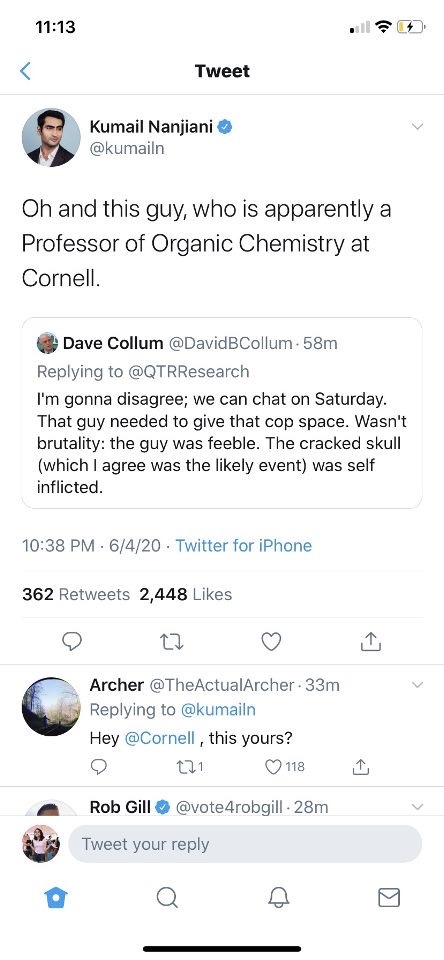
Fire @DavidBCollum. @Cornell commit to your words of “standing against racism.” These tweets are linked to his Cornell chemistry website and are a representation of the university. This man has had multiple Title IX cases against him. Don’t sweep this under the rug AGAIN.
Wong's article is just one legal conundrum that faces many different people in the digital age. IP law is starting to delve into safeguarding people online, i.e. freelance journalists. Technologies and the way we interact with them is evolving faster than the law can keep up.
Interesting that on the side of those against no Insta likes, most are SME's. For the general Insta community, likes harbor self image issues. It has by no means been the "death of Instagram" like one SME said in Padilla's piece. It's been a few months, and it's old news now.
What Oppenheimer recognizes is more nuanced than Turkle's opinions regarding media: connection is much bigger than speaking to strangers at lay moments in public spaces. Technology has afforded us connection both domestic and international, which can't be ignored. @CUComm3200
I hope most students take away from Burns' article that trans visibility isn't enough, given the lack of protections trans people face in the public sphere. Allies outside of the community should be more active in speaking out on trans issues to facilitate change. @CUComm3200
Baym's article has been my favorite of the semester. From downloading my 1st song on iTunes to being the music director of @SlopeMedia, music has defined my internet/media activity. At this point in history, music continues to drive media, as well as changes we see within it.
I once reported homophobic+transphobic videos on an account. In minutes, they 'reviewed' my report and found no issue with the posts. Despite being a huge company (owned by FB), they provide nearly "no recourse" in harassment claims. Lorenz drives this point home in her piece.
@CUComm3200 I agree w/ Jackson that Twitter has made us better. Those that disagree may be resistant to change, esp. boosting marginalized groups. A lot of the credit for hashtag activism is due to Black twitter like we discussed, with higher % on Twitter than % of blacks in U.S.
A key point from Chayka is "more that a sheer volume of viewers, what monoculture entails is a feeling." Like the chart in the article, individuals interests spread across spectrums. Today, the bounds feel limitless in finding media to enjoy. In every niche exists a monoculture.
Florini's article illuminated the power of Black twitter and black people's agency (including myself) beyond the funny memes. Looking at the big picture, black identity performance online "constitutes an important mode of resistance to marginalization and
erasure." @CUComm3200
It feels impossible to combat misinformation when it's put out by the institutions meant to serve and protect you. A trends editorial team or a new reporting tool as Meserole suggests is a good first step to minimize fake news. https://t.co/KRB3f4GO1Y
The Cook article made me frustrated. It's interesting that women-identifying sex workers' are experiencing censorship on Instagram, yet male celebrities/'influencers' are profiting from organizing virtual strip clubs. Misogyny often underlies these safeguard systems @CUComm3200
@CUComm3200 While we often focus on the insidious factors of technology, it was refreshing to read the Papacharissi and CMSI pieces. It made me hopeful to be reminded of how social media has and continues to invigorate social movements.
@CUComm3200 Swanson's article illuminated an important fact about education and socioeconomic status that many neglect: having higher education does not guarantee high returns on investment for low-income people. Traditional thought generally says the opposite