On the 23rd of September 2026, SynMax's maritime domain awareness platform, Theia, detected and tip-and-cued high-resolution satellite imagery of the NING FENG LENG 2 (IMO 1026697), a 157-meter Chinese-flagged reefer, engaged in a ship-to-ship transfer with an unidentified squid jigger just outside of the exclusive economic zones (EEZs) of Peru and Chile (-15.8541, -80.9254).
At the time of capture, AIS location data was not received from either vessel.
The interaction between the two vessels is consistent with the resupply of personnel or provisions and the transshipment of catch at sea, practices that allow distant-water fleets to remain active near fishing grounds for extended periods and complicate the traceability of fish products. Tracking support vessels such as reefers enables analysts to identify the vessels, ports, and markets through which IUU (illegal, unreported, and unregulated) fish enter the supply chain, allowing enforcement to focus on a small number of high-value nodes rather than thousands of individual fishing vessels.
Theia ingests more than 40 million km² of satellite imagery daily, fusing it with global AIS and additional datasets to automatically detect, identify, and track tens of thousands of vessels across oceans, regardless of AIS output. Atlas, SynMax's Agentic AI, extends this further, enabling analysts to interrogate Theia's pre-processed datasets, generate network charts, and explore links between vessels, such as repeated rendezvous between support vessels and fishing fleets, shared patterns of life, and changes of identity, to map the networks behind transshipment activity at scale.
We are very happy to have supported @Reuters in their latest reporting on Iranian energy exports.
SynMax’s maritime domain awareness platform, Theia, provided satellite imagery and analysis showing that a tanker carrying Iranian jet fuel reached Myanmar in September, despite the blockade of Iranian ports which was reimposed on the 14th of July.
Theia automatically analyzes more than 40 million km² of satellite imagery daily to provide the ground truth of vessel movements across oceans.
We are very proud to see SynMax’s satellite intelligence featured in @HighNorthNews’ latest reporting on two Chinese heavy-lift vessels sheltering off Norway’s Vesterålen Islands, amid a Norwegian Coast Guard operation.
The article follows the YA QING HAI YANG (IMO 1021570), a vessel sanctioned for deliveries to Russia’s Arctic LNG 2 project, and the JIAN YANG CHENG HE (IMO 9813137) on their voyage from southern China via the Northern Sea Route to the Norwegian coast. Imagery provided by SynMax shows both vessels en route with cargo on board earlier this summer.
Theia, SynMax’s maritime domain awareness platform, ingests and analyzes more than 40 million km² of satellite imagery daily, fusing it with global AIS and additional intelligence sources to detect, identify, and track tens of thousands of vessels, regardless of their AIS output.
BREAKING: Two Chinese heavy-lift vessels, including a ship sanctioned for deliveries to Russia, are sheltering off Norway’s Lofoten Islands amid a Coast Guard operation that has brought several Norwegian military and patrol vessels into the area
#sanctions
https://t.co/o8FcZJfhO6
It's fantastic to be in Troia, Portugal for Defence IQ's Maritime ISR conference!
If you're attending and would like to discuss our latest developments in maritime domain awareness, AI, and geointelligence, please don't hesitate to call in and speak to our team at Booth 8 in the North Foyer.
SynMax is delighted to be attending @DefenceIQ’s Maritime ISR conference in Troia, Portugal, next week on the 13th and 14th of October.
Visit us at Booth 8 in the North Foyer to see SynMax’s maritime domain awareness platform, Theia, which automatically analyzes more than 40 million km² of satellite imagery daily, fusing it with global AIS, synthetic aperture radar (SAR), and additional datasets to detect, identify, and track tens of thousands of vessels, regardless of spoofing attempts or dark periods.
The team will also be demonstrating Atlas, SynMax’s Agentic AI data science tool, which enables analysts to interrogate vast, pre-processed, auditable datasets with precision, extending human capacity and delivering decision-ready intelligence at pace.
If you would like to arrange a meeting with our team during the event, please send us a message. We look forward to seeing you in Troia.
The KANG KON, North Korea's second Choe Hyon-class guided-missile destroyer, has had a troubled introduction to service. On the 21st of May 2025, the 145-meter warship partially capsized during a failed launch at Chongjin Shipyard. Despite this setback, she was refloated and has now entered service with Pyongyang's fleet. SynMax's maritime domain awareness platform, Theia, has tracked her journey from repair yard to active fleet assignment.
Recently, Theia identified her alongside Rason, North Korea, on the 27th of August and the 3rd of September, and then detected her AIS dark, underway off North Korea's east coast on the 4th of September.
Two days later, KCNA state media placed the vessel alongside at Wonsan, where Kim Jong Un presided over a commissioning ceremony and described the warship as capable of delivering a "deadly retaliatory strike." The ceremony took place the day before the US, South Korea, and Japan began a five-day joint military exercise, Freedom Edge, near Jeju Island.
Theia subsequently repeatedly identified the KANG KON at the Mayang-do naval facility, a pattern consistent with a newly commissioned vessel joining the East Sea Fleet. Once the KANG KON’s pattern of life was established, high-resolution @Satellogic imagery was tasked on the 3rd of October. This showcases the value of using medium-resolution, high-frequency satellite coverage to flag a vessel of interest for tasked high-resolution follow-up, prioritizing imaging resources against validated targets rather than searching blindly.
Theia fuses more than 40 million km² of daily satellite imagery with unclassified intelligence sources to automatically detect, identify, and track vessels regardless of their AIS status, enabling rapid response to the movement of high-value targets. SynMax's Agentic AI, Atlas, can be used to track dark vessels by bringing together satellite detections and open-source reporting to accelerate identification and reduce analyst workload.
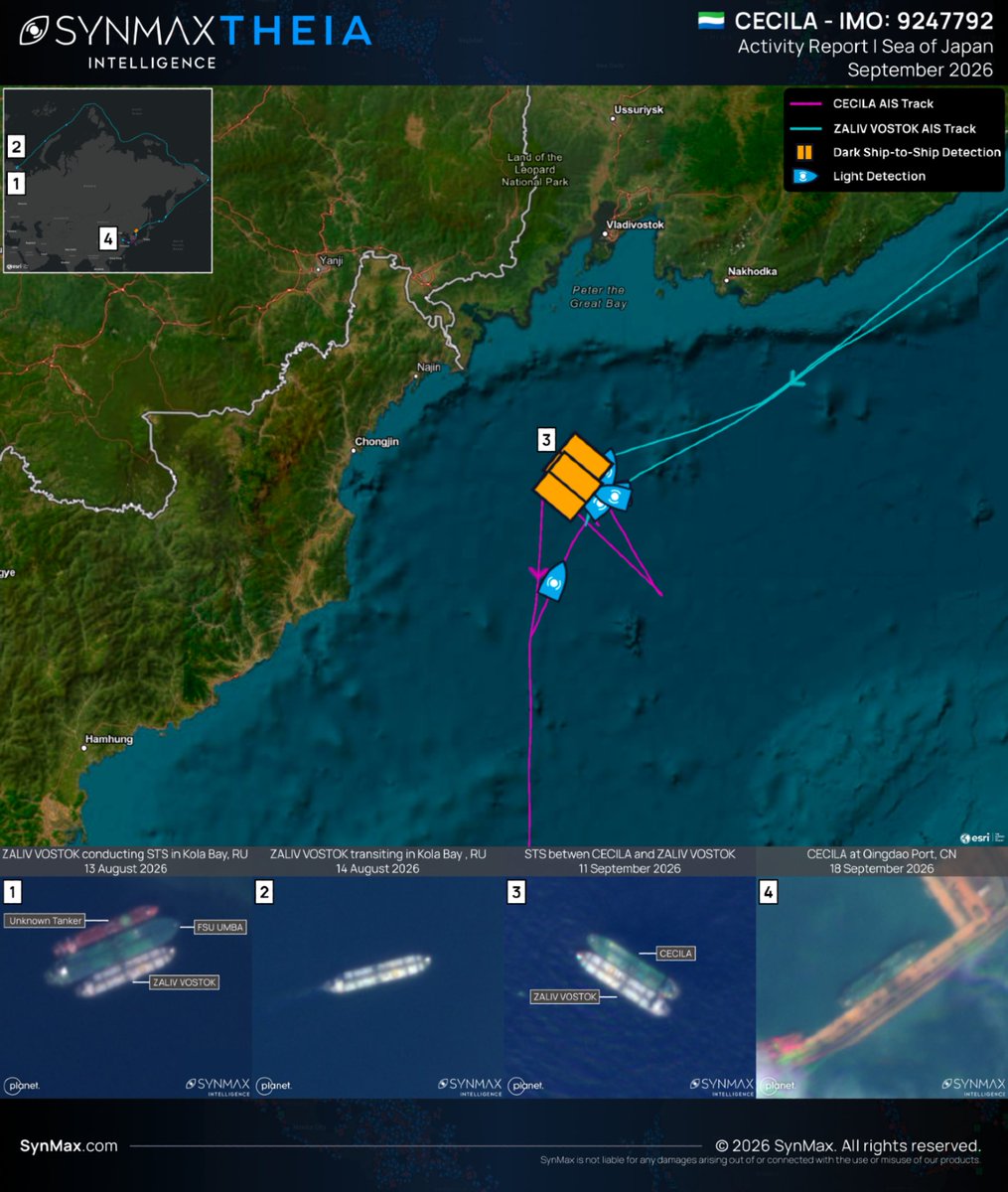
On the 13th of August 2026, SynMax's maritime domain awareness platform, Theia, detected the sanctioned tanker ZALIV VOSTOK (IMO 9360130) alongside the FSU UMBA, a sanctioned floating storage unit used for the storage and transfer of Russian crude oil, at anchor in Kola Bay, Russia. The two vessels were assessed to be conducting a ship-to-ship (STS) transfer.
The following day, the ZALIV VOSTOK was imaged departing Kola Bay. Approximately four weeks later, on the 11th of September, Theia identified her again, this time in the Sea of Japan south of Nakhodka, Russia, alongside the sanctioned Sierra Leone-flagged tanker CECILA (IMO 9247792). Again, the behavior of the two vessels was consistent with a STS transfer. AIS data was not received from either vessel during the operation. Following the interaction, the CECILA made for Qingdao Port, China, where she was imaged alongside on the 18th of September.
Theia was able to track the ZALIV VOSTOK and the CECILA by automatically fusing more than 40 million km² of daily satellite imagery with AIS and SAR data, among others, rather than relying on any single source. SynMax's Agentic AI platform, Atlas, allows analysts to surface suspicious behavior globally, alerting analysts to vessels of interest in near real time and carrying the analysis forward when the transponders go quiet.
Merlin.01 is in orbit. 🚀
Following yesterday’s successful #SpaceX Falcon 9 launch, Merlin.01 and three NewSats have made contact with our ground station network, with good health reports across all subsystems.
This launch marks another step in building the infrastructure for Persistent Global Intelligence (PGI), with Merlin designed to support daily global remapping and continuous detection at scale.
Read the full announcement for more on the mission and what’s next.
https://t.co/QJOgrX3iLq
Congratulations to @earlkman and the whole @Satellogic team on a successful Merlin launch today!
I’ve long believed that Satellogic is one of the most capable teams in commercial space and what you are doing now with Merlin is game changing.
SynMax is excited to be a part of it!
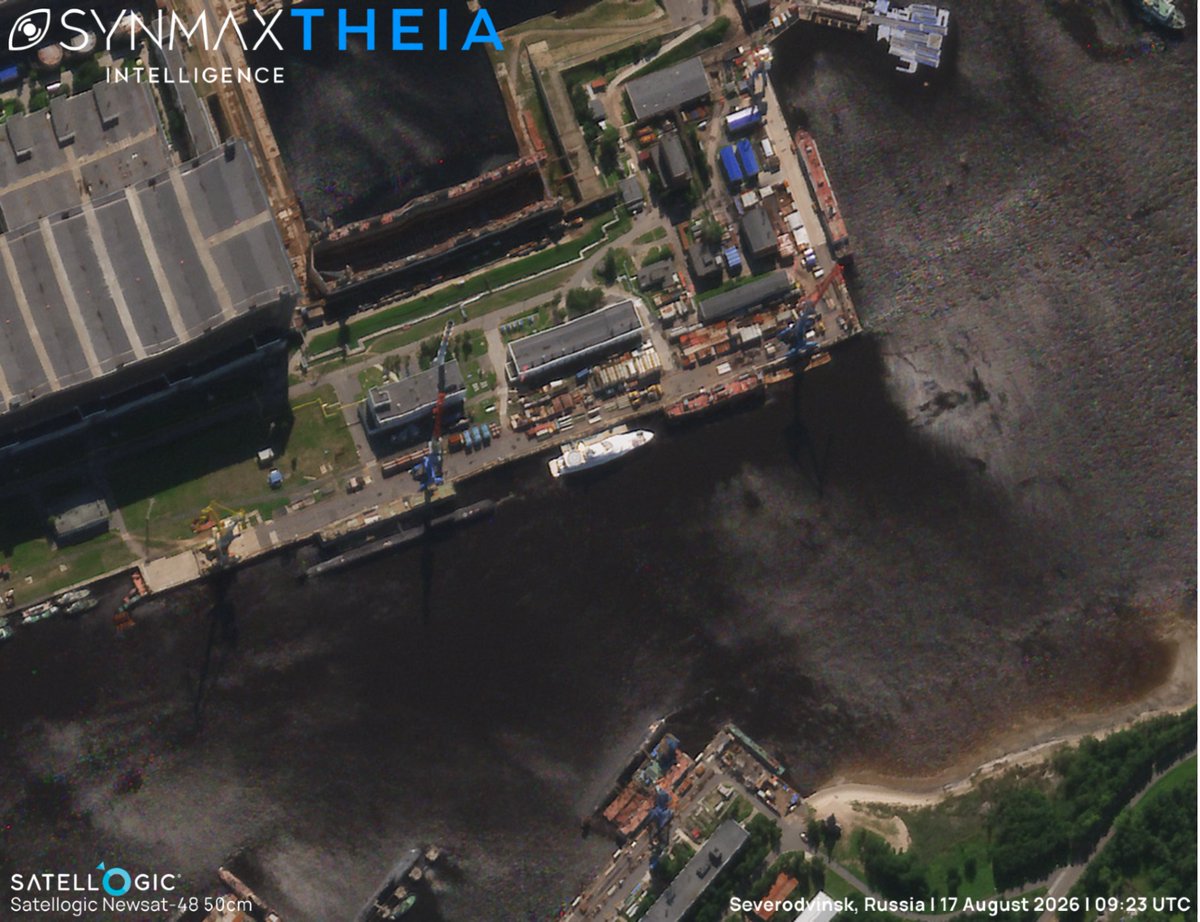
UPDATE: Following our previous post on the KOSATKA's (IMO 1011551) arrival at Severomorsk, Russia (link in comments), SynMax's maritime domain awareness platform, Theia, has identified Putin’s yacht alongside Severodvinsk.
The KOSATKA's last detection at Severomorsk was on the 7th of August. She was identified at Severodvinsk on the 17th, approximately 350km to the southwest.
The 82-meter superyacht, formerly named GRACEFUL, is widely linked to Russian President Vladimir Putin and was sanctioned by the United States in 2022, shortly after which she was renamed. She had not transmitted on AIS since 2022, before briefly reappearing last June, when she departed the Baltic Sea under naval escort, reportedly bound for the Arctic amid concerns of Ukrainian long-range drones.
Severodvinsk is home to the Sevmash shipyard, where the KOSATKA's hull was originally laid down.
Theia ingests more than 40 million km² of satellite imagery daily, fusing EO, SAR, and AIS data to automatically detect, identify, and track tens of thousands of vessels across oceans, regardless of AIS status. SynMax's Agentic AI, Atlas, provides automatic alerts on vessels of interest, delivering actionable intelligence on high-value targets.
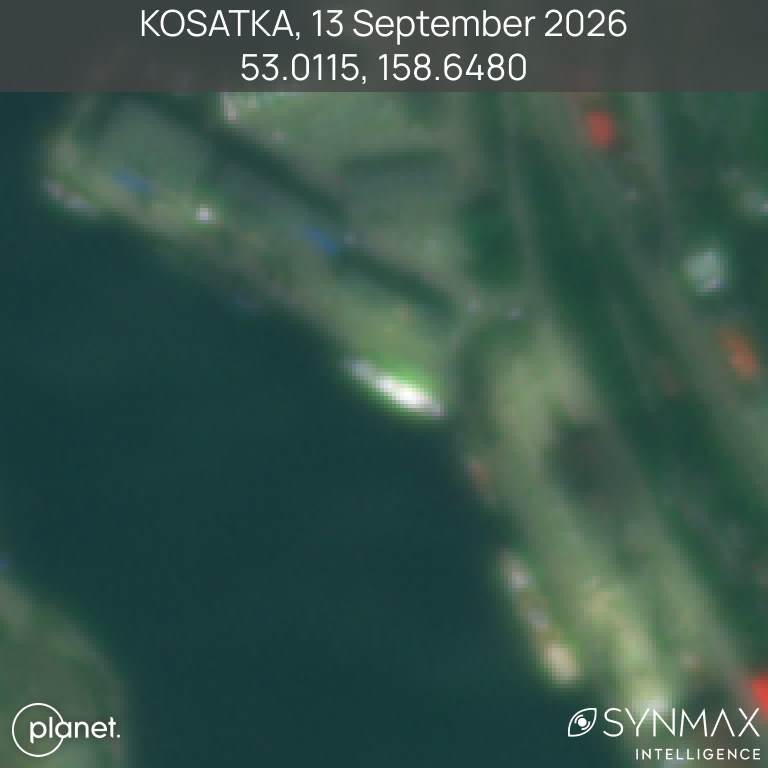
UPDATE: Following our previous coverage of the KOSATKA's (IMO 1011551) movements from Severomorsk to Severodvinsk (link in comments), SynMax's maritime domain awareness platform, Theia, has identified Vladimir Putin's superyacht more than 5,900km to the east, alongside Petropavlovsk-Kamchatsky, on Russia's Pacific coast.
The KOSATKA was last identified at Severodvinsk on the 17th of August 2026. She was next detected by Theia on the 13th of September, having transited the length of Russia's Arctic coastline via the Northern Sea Route to reach Kamchatka.
Petropavlovsk-Kamchatsky sits on Avacha Bay, home to Russia's Pacific Fleet, including the Rybachiy submarine base at Vilyuchinsk on the opposite shore. It is assessed that her arrival marks a further stage in the vessel's relocation away from European Russia, though the purpose of her presence at Kamchatka has not been confirmed.
The 82-meter superyacht, formerly named GRACEFUL, was sanctioned by the United States in 2022, shortly after which she was renamed. She departed the Baltic Sea under naval escort in late June 2026, reportedly amid concerns over the reach of Ukrainian long-range drones, before being tracked by Theia to Severomorsk and subsequently Severodvinsk.
Theia ingests more than 40 million km² of satellite imagery daily, fusing EO, SAR, and AIS data to automatically detect, identify, and track tens of thousands of vessels across oceans, regardless of AIS status. SynMax's Agentic AI, Atlas, provides automatic alerts on vessels of interest, delivering actionable intelligence on high-value targets regardless of how far, or how dark, they travel.
SynMax will be at the Potomac Officers Club 2026 Intel Summit this Thursday, September 24, at the Falls Church Marriott Fairview Park in Virginia.
Strong lineup for anyone working intelligence and national security, with keynotes across the IC and panels on GEOINT, OSINT, and agentic AI. Those are the problems we work on every day at SynMax.
If you'll be there, let's connect.
A major European defense customer has selected SynMax Theia for maritime domain awareness, under a 12-month contract covering a large European area of responsibility.
SynMax is delivering the platform with a dedicated point of contact, onboarding and training for the customer's team, and continuing analyst support.
Read more at the link. https://t.co/SONVjwDGVc
SynMax tracked two U.S.-sanctioned vessels, Glory and Bright, loading the final power modules for Train 2 of Russia's Arctic LNG 2 in China, now heading north for the Arctic.
Followed across five months of handoffs.
@gCaptain published the exclusive, reported by @malte_humpert : https://t.co/yp9d8JfiOr
Between the 21st of April and the 2nd of May 2026, three commercial vessels were hijacked off the coast of Somalia and Yemen in a significant resurgence of Somali piracy, assessed to be highly likely carried out by Somali pirate action groups (PAGs) operating from the Puntland coast.
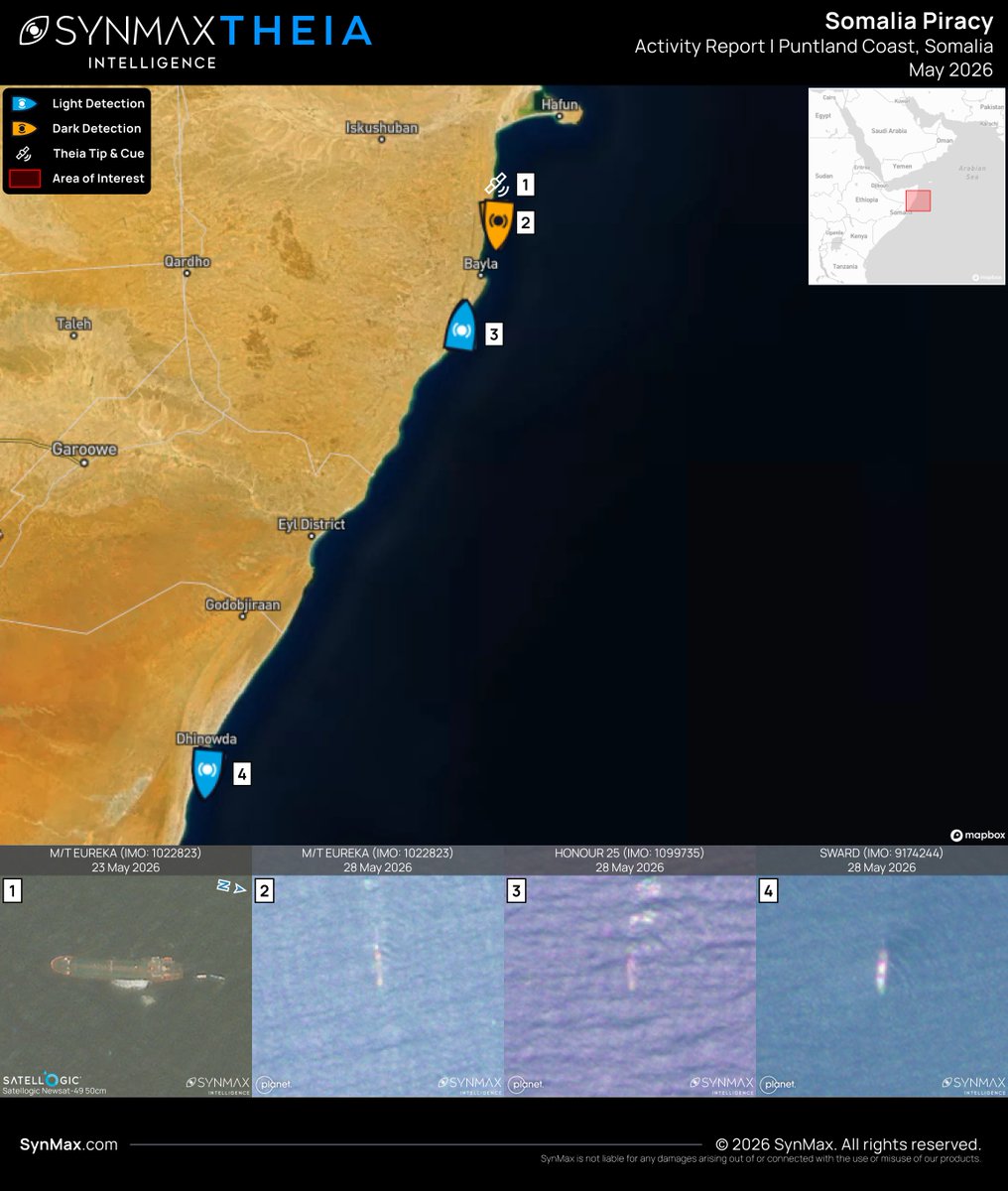
The HONOUR 25 (IMO 1099735), the SWARD (IMO 9174244), and the M/T EUREKA (IMO 1022823) remain under pirate control. SynMax's maritime domain awareness platform, Theia, has tracked the vessels throughout their ordeals, detecting each off the Puntland coast as recently as the 28th of May.
The HONOUR 25 (IMO 1099735) is a Palau-registered product tanker. She was seized on the 21st of April while en route from Berbera, Somaliland, to Mogadishu, while laden with refined oil. Theia detected her on the 28th of May, anchored off the Puntland coast south of Bayla.
On the 26th of April, the SWARD (IMO 9174244), a 100-meter general cargo ship built in 1998 and flagged in St. Kitts and Nevis, was hijacked approximately six nautical miles northeast of Garacad, Somalia. At the time, she was reportedly transiting to Mombasa with a cargo of cement. Theia imaged her on the 28th of May in the vicinity of Dhingwda, approximately 200km south of the other two vessels.
The M/T EUREKA (IMO 1022823) is an 88-meter, Togo-flagged product tanker, built in 2006. She was seized off Yemen's Shabwa coast on the 2nd of May while transporting diesel from the UAE. Continuous tracking and the ability to dynamically tip-and-cue high-resolution imagery enabled the tasking of @Satellogic imagery of the M/T EUREKA on the 23rd of May, confirming her position in the vicinity of Bayla.
The geographic spread of the three vessels along the Puntland coastline is consistent with established patterns of Somali piracy. It is believed that organized crime groups in Somalia are taking advantage of the Iran war to launch hijackings, as international naval patrols, first deployed in 2008 to counter the pirates, have been stretched thin by current events around Hormuz and the Red Sea.
Theia ingests more than 40 million km² of satellite imagery daily, fusing electro-optical and SAR imagery with real-time global AIS to automatically detect, identify, and track tens of thousands of vessels, regardless of their signal output. Tip-and-cue capabilities automatically task high-resolution imagery of vessels of interest, while SynMax's Agentic AI enables the precise interrogation of vast, preprocessed datasets, massively increasing analysts' capacity and exposing true unknown unknowns.
Following our previous report (link in comments) on the hijacking of the HONOUR 25 (IMO 1099735), the SWARD (IMO 9174244), and the M/T EUREKA (IMO 1022823), the resurgence of Somali piracy along the Puntland coast has continued to escalate, with three further vessels seized since our last update.
On the 17th of July 2026, the ASANA (IMO 9035838), a 127-meter, Tanzanian-flagged oil and chemical tanker built in 1992, was hijacked approximately 65 nautical miles southwest of Al Mukalla, Yemen, shortly after departing the port.
On the 17th of August 2026, the LUTUF (IMO 9109134), a Cameroon-flagged cargo vessel reportedly carrying equipment destined for a Turkish military training facility in Mogadishu, was boarded approximately four nautical miles off Mareeyo, in Puntland's Eyl district. Following a 10-day joint operation conducted by the Turkish Navy and the Somali National Armed Forces, during which four pirate skiffs were reportedly destroyed and 14 pirates killed, the LUTUF was freed on the 29th of August. Puntland authorities have disputed this account, alleging that an unconfirmed ransom secured her release.
On the 20th of August 2026, the SIBU 1 (IMO 9204776), an Eritrean-flagged oil products tanker previously named SEAMULL and sanctioned by OFAC for her alleged role in Iran's shadow fleet, was hijacked approximately 136 nautical miles east of Al Mukalla, Yemen, and taken toward the Puntland coast, becoming the sixth vessel seized since the 21st of April.
On the 11th of September, the SWARD and her crew, imaged on the 7th of September, were released from captivity after a ransom was reported to have been paid.
SynMax's maritime domain awareness platform, Theia, continues to maintain visual custody of the vessels still under pirate control. Between the 2nd and 7th of September 2026, Theia detected the SIBU 1, ASANA, and M/T EUREKA AIS dark, and the HONOUR 25 and SWARD AIS light, all distributed across the Puntland coastline.
Four commercial vessels and dozens of seafarers remain under pirate control. The geographic spread of these hijackings is consistent with the reconstitution of a pirate action group network capable of sustained, long-range operations.
Theia ingests more than 40 million km² of satellite imagery daily, fusing electro-optical and SAR imagery with AIS to automatically detect, identify, and track tens of thousands of vessels, regardless of their signal output. Tip-and-cue capabilities automatically task high-resolution imagery of vessels of interest, while SynMax's Agentic AI enables the precise interrogation of vast, preprocessed datasets to expose true unknown unknowns.
🚨Exclusive: China Sends Key Arctic LNG 2 Modules to Russia to Complete Train 2
🏁 2x final power modules for T2 en route
📆 Heavy load carriers departed 🇨🇳 Sep 6-10.
🇷🇺🤝🇨🇳 Arctic cooperation continues, several T3 modules awaiting pickup.
https://t.co/7wBWRtwiMZ
SynMax satellite imagery anchored a report on North Korea's naval buildup that aired this Sunday on Bankisha, one of Japan's national Sunday news programs.
It tracked the Choe Hyon destroyer at the Nampo shipyard, plus a separate submarine construction site.
https://t.co/0JggxxgnCk
When Reuters set out to establish whether Moscow was still resupplying its Syrian bases under the new agreement with Damascus, the answer sat in the traffic off the coast. SynMax tracked a four-vessel Russian convoy into the Syrian port of Tartus on September 7, the first resupply of Moscow's coastal facilities since the August 9 agreement on Russia's military presence in the country.
https://t.co/JDYMvoQjBB