@nats_io Free 30-day trial of MQ Gateway available now: https://t.co/JbtXR6D6cf
Unify all your devices and services on one @NATS_io messaging and streaming system
MQTT 5 or AMQP clients preventing you from standardizing on @NATS_io?
Good news: Synadia MQ Gateway is in public preview.
Connect those clients to the gateway, and every message becomes a NATS message. No extra broker to run.
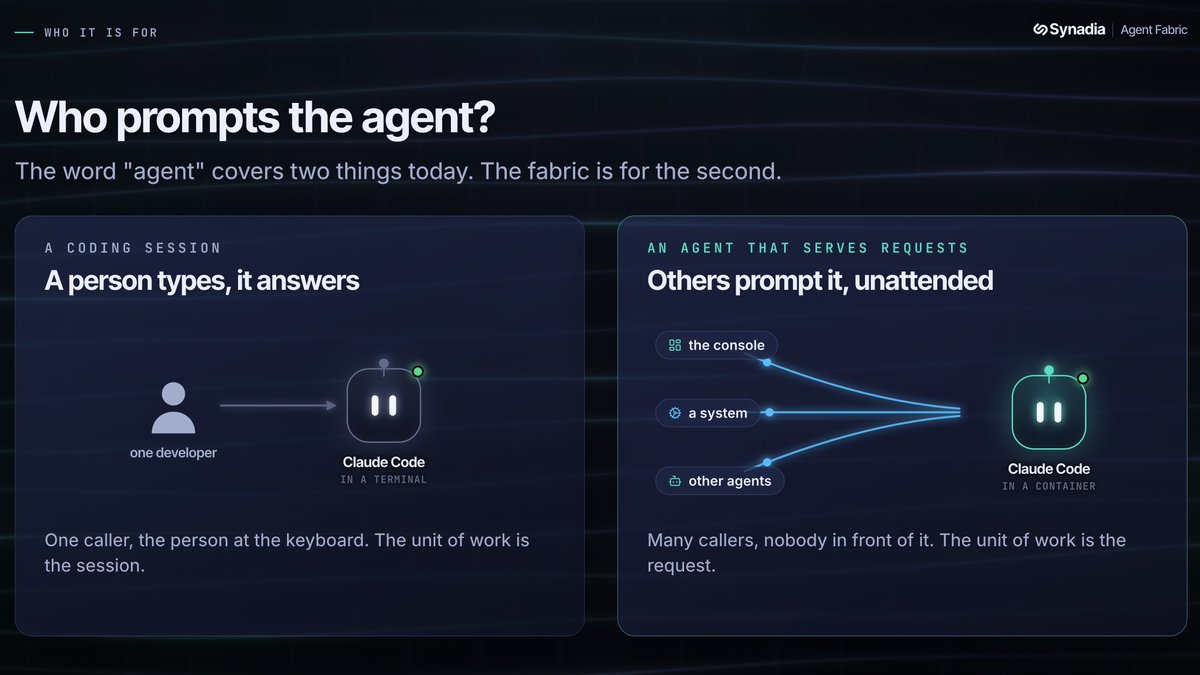
Most agents today have one caller - the person typing to them.
The next ones will take requests from pipelines, services, and other agents, and nobody will be watching.
Synadia Agent Fabric is built for that second kind of agent.
Every prompt it receives is signed, and every request lands on one record you can follow.
Public preview of Agent Fabric, all built on @NATS_io, now available
@nats_io We put the new design through more than 6,000 hours of fault-injection testing. All the details on what changed and how we tested it:
https://t.co/QkluHwiSG1
Moving a stream between @NATS_io nodes is easy when the cluster is healthy: add the new servers, copy the data, remove the old ones.
But you often move a stream because something is wrong. A node is failing, lagging, or about to be retired.
Getting those steps right on a degraded cluster took a complete redesign in NATS Server 2.15.
Before 2.15, if a node dropped out at the wrong moment, the system could keep the wrong replica and lose data. 2.15 fully closes that gap.
Now, if a server drops mid-change, the change waits. It never takes a shortcut with your data.
Soon, most of the prompts to your agents will come from software, not from people.
Synadia Agent Fabric, now in public preview, signs every prompt, gives each agent its own model key, and puts every call in a task on one timeline.
All running over @nats_io
How do AI agents coordinate across clouds without losing state? Andrew Connolly and @wallyqs talked NATS and AI workloads with @theCUBE at #KubeCon 🎥 https://t.co/PqzNvcxYwZ
@nats_io has officially graduated from CNCF!
The open source messaging and streaming fabric now provides a proven communication layer for more than 2,000 organizations running distributed systems and agentic workloads.
Read the announcement:https://t.co/WF39wtstYv
#KubeCon #CloudNativeCon
A big congrats to all the @NATS_Io maintainers, contributors, advocates, end users, and community members who have shaped the NATS ecosystem over the years.
https://t.co/2g5H6KLAyd
NATS has officially graduated from CNCF.
The open source messaging and streaming fabric now provides a proven communication layer for more than 2,000 organizations running distributed systems and agentic workloads.
Read the announcement:https://t.co/WF39wtrW8X
#KubeCon #CloudNativeCon
Such an amazing journey! @nats_io just turned 16 as well.
A huge thanks to everyone in the ecosystem for your support.
It feels like we are just getting started. At @synadia we have never seen so much interest in NATS as the central nervous system to drive modern distributed systems, cloud to edge, and of course Agentic AI.
On using @nats_io as part of broader realtime system and removing a frontend dependency on FireStore at @Lovable - really nice post from @AtaMarzban94
https://t.co/v6TX5DRTji
This is one of the most exciting projects at Lovable. Ata and the team has done AMAZING work to build Realtime and replace our existing solution on the fly without a migration window.
Crazy
.@Lovable keeps 2M+ live subscriptions fresh with @NATS_io—and the code that writes the data never has to trigger a refresh.
Every database change gets published to one specific subject in the hierarchy. Each subscription listens with wildcards, as broadly as it needs, and NATS routes each change to the subscriptions it affects.
For a Lovable dev, a live feature is a backend function written like an API endpoint, plus one hook call on the frontend.
They have ~40 of these today, and teams ship new ones independently!
Check out the full writeup from @AtaMarzban94 below👇️