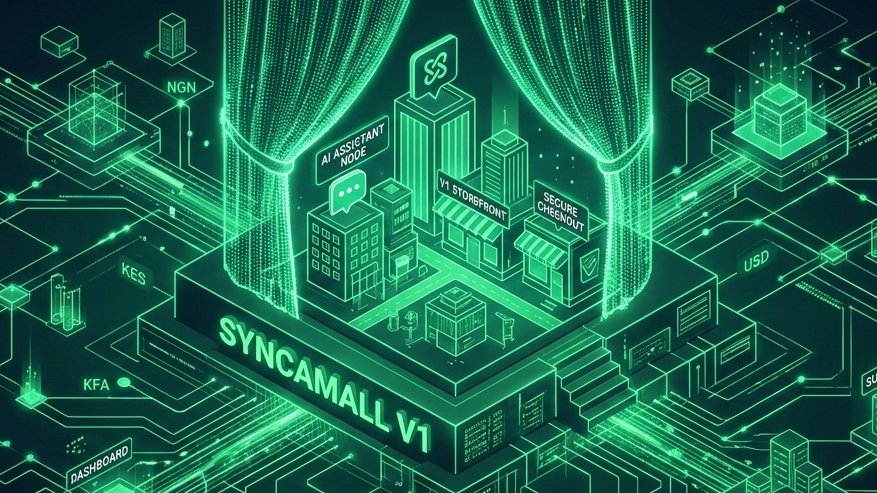
SyncaMall v1 is officially live. You are finding this at the exact right time.
Built to give early merchants a massive advantage of owning an autonomous digital storefront.
Instead of a standard website where customers click through static pages, your store gets a dedicated AI Concierge. Customers can chat directly with your store's AI, ask specific product questions, and have items added straight to their cart.
We also solved the friction of cross-border trade. Your checkout system is ready to accept direct bank transfers, crypto (USDT/USDC on the Base network), and over 40 African currencies.
You control the entire operation from a private admin dashboard. Manage your inventory, and get instant purchase alerts sent directly to your WhatsApp and email.
This is day one. Claim your store name and establish your presence before the rush.
View the marketplace or register your store here: https://t.co/psj2kTdOsy
@syncamall@RaenestApp Facts, total game-changer for African merchants, finally crypto payments that settle into local currency without the usual headaches, if I ran a shop I’d be signing up today.
Now Africans can actually buy and sell on @syncamall , accept crypto payment on the base network and convert directly to their local currency on @RaenestApp
Get on board merchants.
@Jojo3xl@Umar__Jafar@smartnakamoura You can sell and buy with crypto on @syncamall
We completely isolate web2 from traditional finance.
If you can buy in bulk using crypto and sell to customers while accepting crypto, that's the whole point of exchange.
I have been following this conversation closely because it captures exactly what we see every day at @SyncaMall. Nigeria holding the top spot in USDT and USDC ownership is not a sign of economic strength. It is the direct result of millions of people losing faith in the naira and using stablecoins as the safest way to protect their savings from constant devaluation. That part is spot on. What stands out even more in your post is the second point. These holdings stay mostly as personal stores of value because there has been no reliable way to turn them into everyday transactions. Without smooth on and off ramps and without tools that let ordinary merchants accept and spend stablecoins in their normal business, the money sits idle. Most attempts to build that infrastructure have struggled and many have failed. The risks are real. Regulatory hurdles, thin margins, and the sheer complexity of making everything work in our local environment have held back progress for years.That is precisely why we started SyncaMall. We are not building another wallet or another payment processor that layers on top of the old system. We are creating autonomous commercial nodes that run on the Base blockchain and are powered by NetmindAI. Any independent business owner in Nigeria, whether running a small shop in Lagos, an import business in Abuja, or a service provider anywhere in the country, can spin up their own node in minutes. Once it is live, the node lets them accept USDT, USDC, or any stable asset directly from customers. The AI handles the heavy lifting in the background. It automatically manages pricing to keep things fair, routes settlements for the best rates, syncs inventory so stock levels stay accurate, and even helps with customer discovery so the business reaches more people who already hold these stablecoins.The beauty of this setup is that it turns the entire flow into real commerce instead of just holding. A customer pays with USDC. The merchant receives it instantly in stable value. The node can then use those funds to restock from suppliers who also prefer stablecoins, pay bills, or send money across borders without forcing everyone to convert back to naira and lose value in the process. There are no middlemen taking large cuts, no need for expensive developers, and no months of complicated integration. The node is self managing and decentralized, which means it was designed from the ground up for the realities we face here in Africa, not copied from models that work in places with stable currencies and different rules.We built SyncaMall because we live this challenge. We know the frustration of watching stablecoin adoption grow while the actual spending power stays locked away. Our nodes close that gap. They give merchants the infrastructure they have been missing so that stablecoins move from savings accounts into the daily economy. Early business owners can already test the nodes at no cost and see how it changes their operations. If you run a business that deals with customers who hold USDT or USDC, this is the moment to move beyond protection and start building real economic activity with the money you already trust.The big banks will eventually play their part, but the independent merchants who power most of our economy cannot wait for that. SyncaMall puts the tools in their hands today so they can participate fully in the stablecoin world that Nigeria has already embraced. We are live, we are growing node by node, and we are focused on making this work at scale for the people who need it most. If you are a merchant or know one who is tired of the same old limitations, come take a look at what we have built. The infrastructure gap your post highlights is exactly what we are solving.
Nigeria is ranked #1 in global USDT and USDC ownership.
Not the US. Not the UK. Not Singapore.
Nigeria.
59% of Nigerian crypto users hold USDT. 48% hold USDC. More than any other country surveyed. India is third. Brazil close behind.
The reason is obvious once you see it: in countries where local currency loses 20–40% of value annually, stablecoins aren't a crypto product. They're a savings account. A dollar-denominated store of value that doesn't require a US bank account.
Here's what the data doesn't show: most of those stablecoin holders can't use their USDT to buy anything.
No merchant acceptance. No subscription billing. No automatic payment. No way to pay a supplier. They hold the dollars. They can't spend the dollars. They convert back to fiat every time they need to transact.
The gap between stablecoin adoption and stablecoin utility is most visible not in San Francisco or Singapore. It's in Lagos, Jakarta, São Paulo.
$308B in circulation. The people who need stablecoin commerce most have the fewest tools to access it.
That's not a distribution problem. That's an infrastructure problem. The rails exist everywhere. The billing layer doesn't exist anywhere.
That's who we're building for.
This is exactly the reality we've been laser-focused on at SyncaMall from day one. Nigeria's dominance in stablecoin holdings isn't some abstract stat. It's the direct result of people protecting their savings against naira volatility that has become impossible to ignore. Holding USDT or USDC makes perfect sense when inflation erodes purchasing power month after month, but the real bottleneck has always been turning those holdings into everyday commerce. Merchants in Lagos, Abuja, or anywhere across the country need a way to accept, settle, and reinvest in stable value without friction, without rebuilding their entire operations around new rails, and without depending on legacy systems that weren't built for this environment.That's why we built autonomous commercial nodes. Every independent business owner can spin up their own node on Base, powered by NetmindAI, and instantly participate in decentralized commerce. It is not another wallet or payment processor layered on top of the status quo. It is infrastructure that lets merchants accept USDT, USDC, or any stable asset directly, with AI handling pricing, settlement routing, inventory sync, and even customer discovery in a fully decentralized way. No middlemen taking cuts that eat into already thin margins. No complex integrations that require developers or months of setup. Just plug in, operate your node, and start transacting in the same currency your customers already trust and hold.We designed this for the African context because we live it. Africans will be able to buy and sell with cryptocurrency not as a novelty, but as the default. A shop owner in Lagos can receive payment in USDC from a customer in Abuja or the diaspora, have the node automatically optimize for the best settlement path, and immediately use those funds to restock from suppliers who also prefer stable value. The AI layer makes the entire node intelligent and self-managing, so owners focus on their business instead of wrestling with infrastructure gaps.We are already rolling this out with a free package for early business owners who want to test the nodes and see the difference firsthand. If you run a shop, import goods, or provide any service where stablecoins are already part of your reality, this is the moment to move beyond holding and start building real economic velocity with them. The infrastructure the report calls out is here. It is live, it is decentralized, and it is purpose-built for exactly this moment in Nigeria and across the continent. Come build with us. The nodes are ready.
Nigeria is ranked #1 in global USDT and USDC ownership.
Not the US. Not the UK. Not Singapore.
Nigeria.
59% of Nigerian crypto users hold USDT. 48% hold USDC. More than any other country surveyed. India is third. Brazil close behind.
The reason is obvious once you see it: in countries where local currency loses 20–40% of value annually, stablecoins aren't a crypto product. They're a savings account. A dollar-denominated store of value that doesn't require a US bank account.
Here's what the data doesn't show: most of those stablecoin holders can't use their USDT to buy anything.
No merchant acceptance. No subscription billing. No automatic payment. No way to pay a supplier. They hold the dollars. They can't spend the dollars. They convert back to fiat every time they need to transact.
The gap between stablecoin adoption and stablecoin utility is most visible not in San Francisco or Singapore. It's in Lagos, Jakarta, São Paulo.
$308B in circulation. The people who need stablecoin commerce most have the fewest tools to access it.
That's not a distribution problem. That's an infrastructure problem. The rails exist everywhere. The billing layer doesn't exist anywhere.
That's who we're building for.
SyncaMall is proudly running our v1 AI Concierges on MiniMax 2.5 via @NetMindAI Handling real-time customer queries, cart management, and cross-border trade in 40+ currencies that require serious speed and reasoning. NetMind and @MiniMaxAI_ deliver exactly what we need to scale.