🌍 Pioneering sustainable energy solutions: green hydrogen, solar, & wind projects. Committed to UN SDGs, we drive global sustainability, growth and innovation
💚🌊Podcast 68: Storage Gap: Batteries, Gas Shocks & Price of Waiting 🌊💚Europe has spent years building more wind and solar, yet the evening power price still keeps a seat warm for imported gas. That is the pressure point behind our latest GreenWave Podcast episode.
⚡ SYNI, your hostess who craves above replacement-value content, goes straight at the commercial problem. Europe has improved clean generation far faster than it has built the storage, flexibility, network strength, and market design needed to hold value after sunset. The result is familiar by now. Cheap power in the middle of the day. Painfully expensive power when demand stays high and the gas fleet steps back into the conversation.
🔋 The numbers are getting harder to ignore. Europe added 27 gigawatt hours of battery storage in 2025, taking the installed fleet to 77 gigawatt hours. The same market picture says the bloc may need around 750 gigawatt hours by 2030. ACER says renewables supplied half of EU electricity generation in 2025, yet daily wholesale price swings were around five times higher than in 2020. That tells you exactly where the system still creaks. More renewable output has arrived. Flexibility has lagged. Batteries are turning into timing infrastructure because timing is where the money, volatility, and political grief now live.
🏗️ The commercial stakes are plain enough. Weak capture rates. Curtailment. Expensive balancing. Higher bills. Fragile project assumptions. In Italy, gas still shaped electricity prices in the great majority of hours this year. In Spain, the share was far lower. That gap tells a bigger story about where storage starts behaving less like an optional technology and more like core market plumbing. Developers can see it. Utilities can see it. Lenders definitely should. A battery in the right node with the right duration is starting to look a lot less like merchant bravado and a lot more like essential infrastructure.
🎙️ In Episode 68, we unpack why batteries are becoming one of the fastest serious answers to Europe’s flexibility problem, where demand side response helps, where it hits its limits, and why the real test of energy security now sits on the grid around 7 p.m. Give it a listen if you want the market story underneath the sustainability story, without the usual policy fog.
🔗 Apple Podcast: https://t.co/nthuQE2sbF
#GreenWavePodcast #BatteryStorage #EnergySecurity #PowerMarkets #RenewableEnergy #GridFlexibility #EnergyTransition #CleanEnergy #EuropeEnergy
💚 🍇 Pod Episode 66: Pure Thirst (and Fast Growth) for Natural Wines 🍇 💚 SYNI, your hostess who loves above replacement-value content like spring flowers, this week went somewhere a little different. At the Pura Sede natural wine fair in Lisbon, around fifty winemakers from eight countries gathered around a simple idea: wine with nothing added and nothing taken away. What we found was a movement that has crossed from counterculture into commercial force in a fast growing market.
🍷 One number kept surfacing directly from the winemakers: the natural wine market is growing at ~20% a year. That lands differently when it comes from producers who have put land, savings, and years of work behind the claim. No added sulphur. No commercial yeasts. No filtering the life out of the bottle. These are production choices with real cost, real risk, and increasingly, real upside in distribution and brand value.
🌿 The people behind that shift are worth paying attention to. A British winemaker building a regenerative estate in Bordeaux. A Belgian producer choosing granite soils in the Dão. Portuguese family projects keeping things small enough for decisions to stay personal. Experimental makers in the Douro pushing past inherited rules about colour and style. Sustainable practice gets commercially interesting when the conviction is agricultural and the payoff starts showing up in the market.
🍾 The wines carried the point. Pet nat was everywhere. Orange wines showed depth and precision. Co fermentations of red and white grapes were turning up with texture, freshness, and surprise. The old middle of the wine trade should probably pay attention. Consumers are getting sharper. They want provenance, honesty, and something alive in the glass. Technically correct and instantly forgettable is becoming a dangerous place to sit.
🎙️ We unpack all of that in Episode 66, “Pure Thirst: Field Notes from the Natural Wine Frontier.” It is a conversation about sustainability that reaches the balance sheet, the shelf, and the buyer’s palate. Give it a listen if you care about where wine is heading, where value is building, and why authenticity keeps getting priced into the market.
🔗💚🌊Pod Episode 66: https://t.co/ZSRastAhFX
🔗Pura Sede 2026: https://t.co/BUGoAdO11p
#GreenWavePodcast #NaturalWine #WineIndustry #Sustainability #RegenerativeAgriculture #PuraSede #Lisbon #SynergyInternational #SustainableBusiness
💚🌊Pod Episode 64: EU's Molecule Problem in Hormuzian Terms🌊💚When the Dire Strait of Hormuz becomes a geopolitical choke point, the old fantasy of energy security through imported fossil fuels starts looking exactly as flimsy as it always was. In this our 64th pod episode, SYNI shows she can sail through troubled waters and rams into the gap between the European Union's slogan and the system, asking what would real energy security actually require?
⚡ The answer is tougher, slower, and far less glamorous than most political messaging suggests. Everyone knows more renewable generation will be a key component. The real bottleneck sits in the machinery around it: grids, storage, substations, flexible demand, digital control, industrial electrification, and the political stamina to keep building once the panic fades. Europe has improved its power story. Its wider energy system still leans heavily on imported molecules, and that leaves the bloc exposed every time global fuel routes turn hostile.
🌍 We also get into the country level reality. France, Sweden, Denmark, and increasingly Spain show what a stronger domestic low carbon base can look like. Germany, Italy, the Netherlands, and Poland reveal how much unfinished work still sits inside the system. This is where the conversation gets real. Good renewable percentages are useful. They do not magically solve congestion, flexibility gaps, gas dependence, or industrial load pressure. Copper and transformers remain unimpressed by ministerial theatre.
🎧 If you follow sustainable finance, infrastructure, energy policy, or Europe’s strategic future, this episode is worth your time. It is blunt, data driven, and focused on diagnosis over slogans. Give Episode 64 a listen, follow the pod, and share it with someone who still thinks energy security begins and ends with finding the next tanker.
🔗💚🌊Pod Episode 64: https://t.co/pHdGpuZMxY
#GreenWavePodcast #EnergySecurity #EuropeEnergy #RenewableEnergy #GridInfrastructure #EnergyTransition #SustainableFinance #Geopolitics #PodcastRelease
💚🌊Pod Episode 63: SYNI Explains EU's Industry Accelerator Act 🌊💚Europe’s clean industrial future will be shaped by permits, procurement rules, manufacturing capacity, and whether projects can get financed. Leave it to SYNI to asks the question that matters here: will it help projects get built?
⚡ We use hydrogen as the lens to view the proposed IAA because hydrogen exposes every structural weakness. Power prices, grid access, water, equipment choice, infrastructure, offtake certainty, state aid, lender confidence, and timing all land in the same model. That makes hydrogen the perfect test of whether Europe’s industrial policy is becoming commercially serious or simply more verbose.
🏗️ There is real substance in the draft. Single access points for project promoters could cut administrative drag. Industrial acceleration areas could reduce permitting friction in ports, industrial clusters, fertiliser hubs, and transport nodes. Demand side rules for low carbon steel, concrete, and aluminium show Brussels is finally trying to create markets with public purchasing power.
🔍 The hard part is sequencing. The proposal pushes Union origin requirements for electrolysers and strategic manufacturing, which fits Europe’s drive for resilience and domestic capability. The commercial risk is obvious. If supply is not ready, procurement narrows, capex rises, auctions become harder to win, and developers absorb execution risk that should sit across the value chain. That is where good policy can still fail.
📉 This episode stays focused on commercial reality. Europe needs domestic factories. It also needs financeable projects, bankable offtake, and a credible path from policy text to steel in the ground. Clean industry scales through that alignment. Weak coordination leaves capital waiting, timelines slipping, and market momentum thinning out.
🎧 If you work in hydrogen, sustainable finance, industrial strategy, infrastructure, or energy policy, this is a useful listen. Episode 63 is live now on the GreenWave Podcast. Find it on Spotify, Apple Podcasts, YouTube, and more. Share it with a colleague, leave a review, and help more people find a show focused on how clean industry actually gets built.
🔗Apple pod: https://t.co/LjaYuvGEQU
🔗 EC Q&A Sheet: https://t.co/CaApXLjUHo
#GreenWavePodcast #Hydrogen #EUIndustrialPolicy #CleanIndustry #EnergyTransition #SustainableFinance #IndustrialStrategy #Decarbonisation
💚🌊Pod Episode 62 Goes to Blue Futures at NOVA SBE for GenZ Power🌊💚SYNI, your podcast hostess with a green heart, takes you inside the Blue Futures Conference at NOVA School of Business and Economics in Carcavelos, Portugal, where Synergy International was a conference partner. This was the largest sustainability conference organised by students in Portugal, with a focus on the regenerative blue economy. The word regenerative sets a higher bar than sustainable. Sustainable asks whether we can keep going without collapse. Regenerative asks whether we can restore what we already damaged.
🌊 The ocean generates over US$ 2.5 trillion a year in global GDP and supports more than a hundred million jobs. If it were a country it would rank as the world's fifth largest economy. The share of that economy's source that is genuinely protected from destructive activity sits at roughly 3%, versus the UN's goal of 30% by 2030. This cohort of GenZ students at NOVA acutely knows we're running out of time and running short on funding.
🔎 Bottom trawlers plough roughly five million square kilometres of ocean floor a year and release an estimated 370 million metric tonnes of CO2 from disturbed seabed sediments, nearly double the emissions from fuel combustion across the global fishing fleet. Meanwhile, research published in Science shows that well managed marine protected areas increase catch in surrounding waters by 12%-to-18%. One global study across 34 countries found every dollar invested in ocean protection returns roughly twenty dollars in combined benefits. That's a compounding return that would launch any fund manager into superstar status.
📌 We also cover the talk from Emanuel Gonçalves of the Oceano Azul Foundation, plus the European Commission's new OceanEye initiative backed by €50 million, and why the blue economy is projected to double by 2050.
🎧 💚 🌊 Pod. https://t.co/jO5NtvOksa
🔗 Blue Futures Homepage. https://t.co/9KhTcx7NsP
🔗Opening speech by President von der Leyen at the European Ocean Days. https://t.co/vgPng74Za9
#GreenWavePodcast #BlueEconomy #OceanProtection #SustainableFinance #MarineProtectedAreas #BlueFutures #NOVASBE #OceanoAzul #EnergyTransition #ESG #30by30
💚🌊Big Shout Out for Blue Futures Conference on Feb 27th at NOVA 🌊💚We're excited to be engaged as a Partner in the Blue Futures Conference, taking place on Feb 27th at the NOVA School of Business and Economics (Nova SBE), located along the coast in beautiful Carcavelos, just outside of Lisbon.
🌊 Sustainable engagement with the Blue Economy is one of the most important topics for our organisation and we are determined to do our part to help promote education and engagement for the current and future generation of marine stewardship.
🐟 Blue Futures is being built by students, for students, with a clear focus on ocean stewardship and a regenerative Blue Economy in Lisbon. The basics are already a wake up call: oceans cover 71 percent of Earth, generate around half of our oxygen, support more than 3 billion livelihoods, and absorb roughly 8 million tons of plastic each year. Those numbers are the whole point of showing up.
⚓ The organisers, oikos Lisbon at NOVA SBE, sit inside a wider oikos International network that has been pushing to modernise economics and management education for sustainability since 1987. oikos has known for decades that the ocean economy is full of incentives that reward short time horizons. Student led pressure and fresh thinking is often where the serious course correction begins.
🧭 For our NOVA student collaborators, this is a hands on chance to connect ocean science, policy, finance, and business execution in one room, then leave with relationships that survive beyond conference day. For us, partnering here is practical: better questions, stronger project pipelines, and a wider bench of talent that understands Sustainable Development Goal 14, Life Underwater, as a real operating constraint.
🌍 If you are in Lisbon on Feb 27, contact the NOVA organisers and come be part of the room. Bring a friend who cares about oceans but does not know where to start. Bring a spreadsheet person and a fieldwork person. The Blue Economy needs both, and students are exactly the right people to keep the agenda honest.
🔗 https://t.co/skKgi1bzLo
🔗 https://t.co/1QwoJNccwB
#BlueFutures #BlueEconomy #OceanStewardship #SDG14 #NOVA_SBE #oikos #Lisbon #RegenerativeEconomy #MarineInnovation
💚🌊Pod Episode 59 Takes a Realistic Look at Data Centres in Space 🌊💚SYNI, your hostess who needs no introduction to those that admire above-replacement content, looks at the big idea escaping sci fi and entering boardrooms: data centres in space. The “cloud” has become old news, understood now as a physical constraint with a street address, a substation, and a cooling bill, and AI is quickly turning that receipt into a strategic constraint. So the latest question has popped up: what happens when the most power hungry part of the digital economy starts eyeing orbit as the next place to plug in?
☀️ The optimistic case, often coming off the lips of no-lesser altruist than Elon Musk, is simple to state and brutal to execute. Space solar offers stronger, steadier sunlight and potentially far higher capacity factors than terrestrial solar, with no clouds and far less day night cycling depending on orbit. Orbital platforms also dodge land fights, grid queues, and local water politics. In theory, you run compute on continuous solar, beam the data down, and leave Earth’s congested infrastructure to catch up.
🧊 Then physics walks into Elon's fever dream carrying a clipboard. Space is a vacuum, so you radiate heat instead of convecting it. At scale, orbital data centres become radiator projects as much as compute projects. Add latency constraints for some workloads, radiation exposure for electronics, maintenance realities, and the governance headache of debris in crowded orbits. This episode draws a clean line between the sustainable upside and the operational risks that do not care about anyone’s follower count.
💼 We also go where the money goes. Orbital compute looks less like software and more like aerospace infrastructure: prototypes funded with venture capital, then a longer march toward bankable contracts, credible insurance, and a supply chain that can build power, thermal, and comms systems in volume. The near term opportunity set is likely to include enabling components like high efficiency space solar, thermal management, optical links, and debris mitigation tooling, plus niche workloads where the data already lives in orbit.
🌍 If you care about energy transition strategy on Earth, this conversation is worth your 27 minutes. Orbit compute may become a pressure valve on terrestrial grids, or it may fuel more total compute demand. Either way, it forces an uncomfortable but useful question: how does the digital economy scale inside physical limits?
🔗 Apple Pod: https://t.co/w6phByYBo8
#GreenWavePodcast #Elon #Sustainability #DataCenters #SpaceTech #AIInfrastructure #CleanEnergy #EnergyTransition #ClimateTech #SustainableFinance
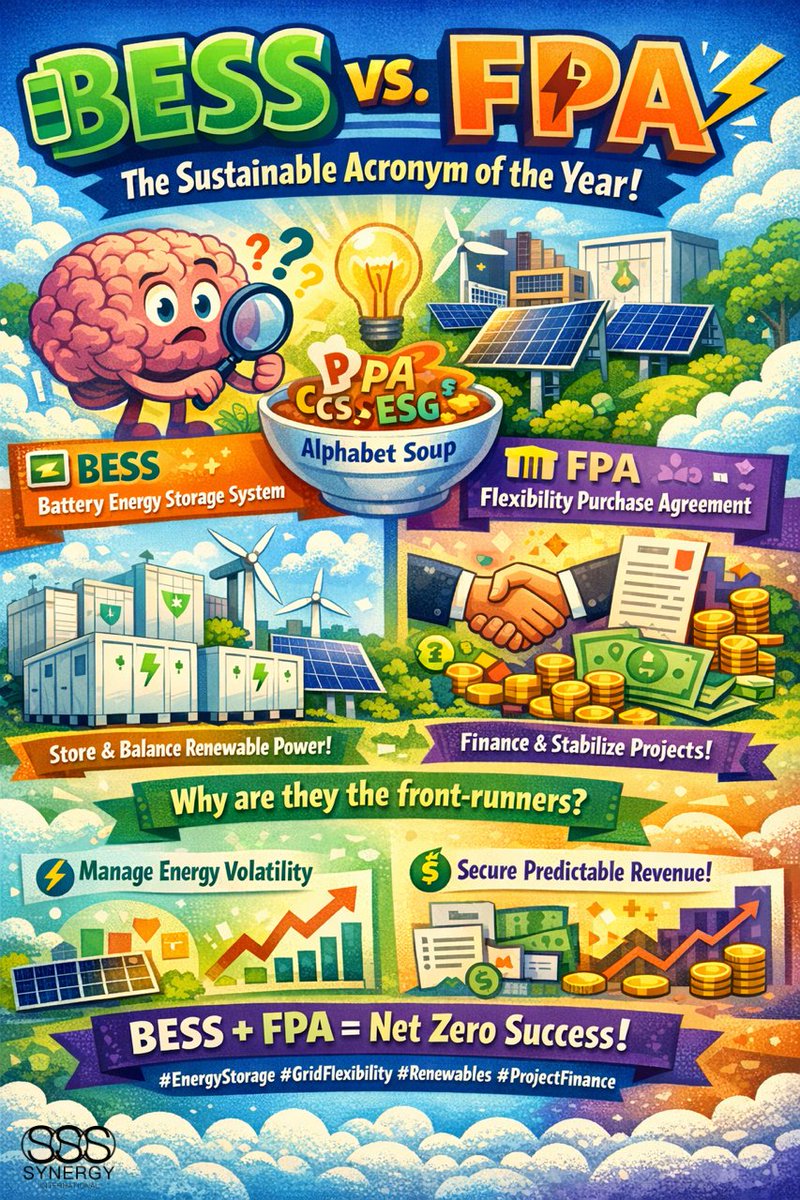
💚🌊BESS + FPA = Net Zero Success: Which Do You Think is SAY?? 🌊💚We've often highlighted the growing list of acronyms that populate sustainable energy research and news. And who hasn't had that moment when one of these catches you by surprise, stumping even the most seasoned net zero campaigners. It's often a nice exercise in humility as well as a learning opportunity to make sense of the alphabet soup.
🧠 So for all of you that already know your BESS from your FPA, give yourself the credit that you deserve. For all the rest of you, let's provide some context why BESS and FPA are the current frontrunners for the Sustainable Acronym of the Year (SAY).
🔋 BESS is the Battery Energy Storage System, the grid scale batteries plus inverters and control software that turn volatility into revenue. In 2026, that matters because the generation only trade is maturing fast. Wind and solar output increasingly lands in the same hours, which compresses prices and makes capture risk a real underwriting problem. Developers can still build great projects, yet the question investors ask has sharpened: where is the controllable cashflow when prices slump exactly when everyone else produces?
📉 That is why the Power Purchasing Agreement (PPA) story cooled and the battery story accelerated. European PPAs fell to 13.1 GW in 2025 from 15.3 GW in 2024, while about 12 GW and 24 GWh of BESS capacity was contracted via FPAs and optimisation agreements, roughly triple the prior year. The message is blunt: capital is still here, it is just buying the parts of the system that benefit from volatility.
🏦 FPA is the Flexibility Purchase Agreement, and it is the financing bridge. Merchant batteries can earn strong returns, yet lenders dislike merchant exposure. FPAs reduce uncertainty by converting multi market revenue streams into something closer to an infrastructure style contracted profile. Better predictability tends to mean better debt terms, which tends to mean more projects reach financial close.
🧩 The contract toolkit is getting sharper too. Tolling structures pay for availability or dispatch rights. Floors guarantee a minimum revenue level in exchange for some upside. Day ahead swaps hedge day ahead exposure while leaving room for optimisation. Different mechanics, same goal: make battery cashflows financeable at scale.
⚡ If you are developing projects this year, BESS plus an FPA is moving from optional add on to core strategy. It is the difference between hoping the market stays kind and designing a project that can survive the market as it is.
#BESS #FPA #EnergyStorage #GridFlexibility #Renewables #ProjectFinance #EnergyTransition #PowerMarkets #SustainableInfrastructure #CleanEnergy
💚🌊Pod Episode 58 Hits the Sustainable Slopes at Alta & Jackson Hole 🌊💚Your hostess SNYI goes back to two iconic US ski mountains with a simple test for real climate progress: land, power, transport. Alta and Jackson Hole sell snow, so the climate invoice lands on their desk first. This episode is a one year field check, with fewer slogans and more operational proof.
🏔️ Alta comes through as the resort that treats footprint work like a discipline. The latest reporting points to restoration at real scale: 13,000 native plants across 14 acres in one summer, seed collection from 23 native species, and wetland mitigation that closes the loop on past impacts in Albion Basin.
🎿 Alta also keeps sustainability visible in skier culture. Cottonwood Canyons Foundation volunteers run Ski With A Ranger tours from the top of Sunnyside, turning a casual lap into a quick lesson on canyon ecology, microclimate, and watershed reality for Salt Lake Valley drinking water. Stewardship becomes something you do, then remember.
⚡ On power, Alta stays specific: it matches 100 percent of electricity with renewable energy credits via Blue Sky Select, and it calls out electricity as the biggest lever in its emissions profile. Then it tackles snowmaking efficiency, upgrading equipment to cut energy per unit of snow. That is adaptation that respects the grid.
🚍 Jackson Hole keeps its clean electricity story anchored to a real source, wind power tied to Horse Butte Wind Farm, and the recent emphasis shifts to the harder wedge: fleets, commuting, parking, shuttles, and transit partnerships. Shout out to local-ledgened driver Gerald for his punctuality under pressure on all road conditions!
🚗 Jackson the town also makes EV owners feel a privileged-class with Level 3 fast charges free of charge in more public spots than you can Apres-Ski. Jackson Hole’s environmental page describes expanding a fleet of vegetable oil maintenance trucks, exploring electric fleet vehicles and snowmobiles, increasing fuel efficient snowcats, and incentivising commuting for guests and employees
💵 JHR Ownership changed in early 2024, and continuity looks like the default setting. The resort continues to brand itself as values led and environment aware, which is a choice in a moment when an increasing number of US organisations choose silence.
🌊 Listen to Episode 58, share it with one mountain friend, and tell us where you see the biggest gap in resort decarbonisation.
🔗Apple podcasts: https://t.co/tDZNeeGxQI
🔗JHR: https://t.co/1E0KIyJr2V
🔗Alta: https://t.co/skW9o7fHHn
#GreenWavePodcast #Sustainability #ClimateRisk #RenewableEnergy #Decarbonization #SkiResorts #CleanPower #Transport #Restoration
💚🌊Podcast Episode 57 Live: Danish Pensions Show SBTi Leadership 🌊💚SNYI, your pod hostess that craves high replacement-value content, goes straight into a corner of climate finance that is shaping real capital flows: Danish pension funds moving from climate intent into science based target systems. If you follow sustainable investing, you have heard plenty of noise. This episode focuses on the operators who quietly build repeatable methods and then publish the receipts.
🇩🇰 Denmark sits mid pack by size in the OECD pension universe, yet it keeps showing up as a reference point because culture, governance, and investor networks reinforce each other. Long horizon stewardship is treated like social infrastructure. Fiduciary duty is interpreted with systemic risk inside the frame. Collaboration is normal, so engagement signals land with consistency across boards, managers, and data vendors.
📈 The practical shift in 2026 is simple to describe and hard to execute: alliances and engagement give way to validated architecture. The Science Based Targets initiative (SBTi) financial institutions net zero standard turns ambition into defined baselines, portfolio coverage, methodologies, and review cycles. When funds like PFA and AP Pension step into that discipline, the conversation stops being vibes and starts being governance.
🏦 You will hear concrete examples from Danish peers who already publish target language. Akademiker Pension commits to steep Scope 1 and Scope 2 cuts by 2030, plus real estate intensity reductions per square meter. Pension Danmark uses multi asset coverage and includes Scope 3 portfolio targets. Velliv pushes target adoption among listed equity and corporate bond holdings, using ownership to move the market. These are portfolio instructions you can audit.
🔥 The episode also flags the OECD picture: many funds still hold material positions in companies expanding fossil supply. Standards help boards defend decisions, tighten manager mandates, and formalise escalation when engagement stalls.
🔗 Listen on Apple Podcasts: https://t.co/kX5AtFpK75
🎧 Also via YouTube, Spotify, iHeart, Podchaser, Boomplay, and Player FM. Share it with one trustee, one analyst, and one colleague who still thinks pension capital is boring.
#GreenWavePodcast #SustainableFinance #Pensions #SBTi #ClimateRisk #NetZero #Stewardship #Denmark
💚🌊EU Sustainable Electricity Approaches 50% as Portugal Shines 🌊💚 Eurostat’s latest readout is blunt: renewables supplied 47.5% of EU gross electricity consumption in 2024, up 2.1 percentage points from 2023 and close to triple the 2004 share. The direction is clear and pace still decides whether electrification stays affordable and politically survivable.
🇵🇹 Portugal sits near the front of the pack. In 2024, 65.8% of electricity consumption came from renewables. Wind and hydropower carry most of that load, and solar keeps compounding across rooftops and utility scale sites. Hydro reservoirs also provide dispatchable flexibility, so the headline share comes with a practical balancing tool.
⚡ Several member states are already in the high renewables operating regime. Austria, Sweden and Denmark exceed 75%. Spain, Croatia, Latvia, Finland, Germany, Greece and the Netherlands have crossed 50%. At that point, building more generation remains necessary, yet the system constraint moves to networks and operations.
🔌 The technical issues sound dry, until they hit bills and permits. Congestion, curtailment, inertia, voltage support, and connection queues become daily topics. Flexibility becomes an asset class: storage, demand response, smarter tariffs, and industrial load shifting that can soak up midday solar and back off during tight evening ramps. For corporate buyers, the story shifts from sourcing green certificates to securing firmed delivery, shaping PPAs around hourly matching, and backing grid upgrades near their sites. Data centres and electrolysers will test discipline fast.
🏗️ Policy focus now needs the same discipline that went into scaling wind and solar: time bound grid buildout, faster permitting, and market rules that pay for services, not only kilowatt hours. Storage economics improve when curtailment is treated as a solvable engineering and pricing problem, not a shrug. Investors will follow clarity, and consumers will follow prices that make sense.
#Renewables #CleanEnergy #EnergyTransition #EUClimate #Portugal #WindPower #SolarEnergy #GridFlexibility
💚🌊Podcast Episode 56 Live: Biofuel Governance and Economics 🌊💚SYNI, your hostess who keeps delivering high-qual content, is going straight at biofuels: what survives once the slogans are peeled off and the spreadsheets are opened. If you work in aviation, shipping, heavy transport, refining, or climate policy, this one sits right in your inbox and your budget.
🛢️ Biofuels used to sound like the easy win: keep engines, keep infrastructure, keep routines. In early 2026 the conversation is harder and more interesting. Feedstocks are finite, waste streams are tighter than people admit, and political tolerance for food price pressure has collapsed. The real question is scale with credibility. Lifecycle emissions, land use, and verification now drive the debate more than tailpipe numbers, and investors demand audit ready claims at scale.
✈️ Aviation is the stress test. Sustainable aviation fuel remains the most deployable option for the current fleet, yet the market runs on scarcity and premiums. EU ReFuelEU Aviation makes SAF a compliance input, which pushes the fight toward bankable offtakes, book and claim structures, and who ultimately pays for the premium.
🚢 Maritime is running its own version of the same drama. FuelEU Maritime sets a declining greenhouse gas intensity requirement for energy used by ships calling at EU ports, so operators chase molecules that can be bunkered reliably without operational chaos. On land, RED 3 pushes toward advanced pathways and RFNBO, which widens the investment contest between wastes and residues, converted refineries, and synthetic routes.
🏭 Suppliers and project economics decide what is real. Neste remains the reference point for industrial scale renewable diesel and SAF. European incumbents are converting assets and chasing scale, including TotalEnergies, Eni through Enilive, and Spain’s Moeve. The market also carries a blunt warning: cancellations happen when cost of capital, construction costs, and margin volatility fail the hurdle rates.
🔗https://t.co/HXh3z6Gprz
Listen to Episode 56 now on Apple Podcasts, Spotify, iHeart, Podchaser, Boomplay, and Player FM. Share it with one sceptical colleague. Then tell me your view: which feedstocks remain defensible, and which mandates look vulnerable under the next affordability cycle?
#GreenWavePodcast #Biofuels #SAF #Aviation #Maritime #EnergyPolicy #Sustainability #Decarbonisation
💚🌊Living on Thin Ice More Than Just a Turn of Phrase in QE Islands 🌊💚The Queen Elizabeth Islands sit at the top of Canada, a maze of fjords that used to be locked shut by the oldest, thickest Arctic sea ice, regarded as the last refuge of polar bears, their best chance to keep afloat amid global warming. Sadly that mother polar bear and her cub depicted in today's graphic might turn out to be metaphorically true in the not-so-distant future.
🧊 In another excellent report, ScienceAdvisor reports that the Coast Guard icebreaker Amundsen pushed through on a first full oceanographic mission and found the ice far easier to navigate than expected. Floes that once felt like concrete were breaking, softer, and surprisingly thin in sheltered channels.
🛰️ This matters because the QEI has been treated as the “last ice area”, a supposed final refuge for multiyear ice and the food webs built around it. Yet the field notes are blunt: conditions are sliding. Satellite analysis suggesting melt in the QEI is starting about five days earlier per decade since 1997, quietly adding extra melt time to every summer.
🌡️ A single year can tip the balance. 2024 was a bad combination: a warm winter left thinner ice going into spring, less incoming ice piled into the archipelago, and autumn freeze up arrived late. When ice loses days at both ends of the season, it loses its margin. In places designed by geography to preserve ice, the calendar now works against it.
🔬 The Amundsen cruise grounded the story in touchable evidence. Ice cores drilled into floes around six to seven meters thick hinted at interiors that were not fully frozen, meaning higher vulnerability to melt. The team also found deeper waters that are warmer and less salty than in the 1960s, and chemical fingerprints suggesting more Pacific water entering the Arctic system, with potential knock on effects for nutrients and ecosystems.
📈 “Last refuge” is turning into “last alarm”. The QEI is a natural test bench for climate resilience, because it is where persistence was expected. If the strongest ice is weakening there, planning based on long lived cryosphere stability gets riskier everywhere. ScienceAdvisor’s reporting reads like a baseline measurement for a new era: watch the timing, watch the thickness, and watch what humans call permanent.
🔗https://t.co/wusz41MpLv
#Arctic #SeaIce #ClimateScience #CanadaArctic #QueenElizabethIslands #Oceanography #Cryosphere #PolarBears #RemoteSensing #ClimateRisk
💚🌊EU's EED Creates New Reporting Standards for Data Centre Ops 🌊💚European Union data centre rules are moving from “nice to know” into “must report”, and that shift will hit operating models faster than many operators expect. The EU's revised Energy Efficiency Directive (EED) is turning performance disclosure into a compliance routine, with data landing in a European database that regulators, investors, and local planners can all interrogate.
⚡ The metrics sound technical and contribute new members to the vast soup of sustainable acronyms already in existence, yet they translate directly into money. Power Usage Effectiveness (PUE), which measures total facility energy divided by IT equipment energy, signals how much electricity disappears into overhead. Water Usage Effectiveness (WUE), which measures how much water a site uses for cooling per unit of IT energy, puts a price on cooling water in drought prone regions. Energy Reuse Factor (ERF), which measures the share of a site’s total energy that is exported for reuse, and Renewable Energy Factor (REF), which measures the share of a site’s energy that comes from renewable sources, start to expose whether a site behaves like a dead end load or an asset that can return value through energy reuse.
🔖 Once these metrics are standardised, comparisons get brutal. The measurement boundary will matter, and the temptation to game averages will surface, so operators who invest in real telemetry and third party assurance will keep their credibility when the database becomes public as procurement teams screen by default.
🏗️ The EU Commission’s direction of travel points to a bloc-wide rating or label scheme, like a credit rating system. Labels change behaviour because they simplify decisions for non engineers. Decisions around fundamental project development pillars like projects permits, landlords and tenants, grid connection priority and financing risk. Expect procurement teams to bake ratings into Request for Proposal (RFP) and auditors to start asking why a “C” site is still expanding.
🔥 Waste heat is the sleeper variable. Early drafts hint at obligations for new builds to plan for reuse, which pulls data centres into urban energy politics. If you can pipe heat into a district network or an industrial cluster, you create a secondary revenue stream or a planning advantage. If you cannot, you may find yourself pushed further from load, where land is cheaper and heat has no buyer.
🧠 The strategic tension for 2026 is simple: transparency plus ratings will reshape location, power purchase strategy, and heat value capture economics. Hyperscale and AI clusters will chase clean firm power, fast connections, and credible heat off take partners. The winners will treat reporting as design input, not admin overhead.
#DataCentres #EnergyEfficiency #EURegulation #PUE #WUE #HeatReuse #AIInfrastructure #GridConnection #Sustainability
💚🌊Episode 55 Live: Adaptation as Buzzword and Discipline for 2026 🌊💚This week SYNI, your hostess, goes straight at the topic that is taking over boardrooms, insurers, and city halls: Adaptation. It is the fastest growing branch of sustainability because floods, heat, drought, and fire have started behaving more like permanent colleagues than occasional visitors.
🧭 In the episode, Adaptation is defined as deliberately strengthening people, ecosystems, and infrastructure so society takes less damage and keeps functioning as hazards intensify and shift. You can feel the logic in budgets: assets are sitting in harm’s way, and planning based on twentieth century weather distributions now looks painfully dated.
📌 We trace where this thinking came from. The UN climate convention adopted in 1992 put adaptation on the same policy footing as emissions cutting, and the IPCC, created in 1988, kept widening the map of impacts, vulnerability, and responses. Over time, adaptation moved from a fairness debate to a finance debate, because lenders, insurers, and rating agencies can now quantify physical risk down to real addresses.
🏗️ We also talk about what works when it is done with discipline. Bangladesh reduced cyclone deaths through forecasting, warnings, shelters, and community readiness. The Netherlands shows what decades of flood governance looks like when the state treats water risk as a core service. Cities are building heat action plans and cooling options that save lives, and well managed mangroves can blunt storm surge while supporting fisheries.
⚡ If you build energy projects, Adaptation belongs in your risk register and your market thesis. Physical hazards threaten performance, schedules, and grid uptime, and resilience measures reduce financing friction. Storage and demand response are also adaptation tools during heat peaks and storms, keeping power on for cooling, pumping, hospitals, and communications.
🧠 The hard part is psychology. Decision makers discount the future, then spend after disasters. We argue for portfolios, standards, and metrics that reward avoided downtime and losses.
🔗https://t.co/CistcRfE4p
#Adaptation #ClimateRisk #Resilience #SustainableFinance #EnergyTransition #Infrastructure #ClimateData #GreenWavePodcast
💚🌊CBAM's First Stress Test Grows in the Rolling Hills of Tuscany 🌊💚 The first political flash point for the EU's Carbon Border Adjustment Mechanism arrived immediately in the form of fertilisers. These imports sit at the centre of European yields, farm budgets, and food prices, right where climate policy meets voter reality.
🌱 Italy’s agriculture minister asked the Commission to trigger a suspensive clause and exempt fertiliser imports from CBAM levies, tying the request to farm market strain and the tense EU Mercosur trade debate. France joined with a circulated note urging a temporary exemption or postponement to avoid sharp cost increases as farmers lock in inputs for the 2026 crop year.
🏛️ The timing matters. CBAM effectively imports the EU ETS carbon price into the border, and fertilisers carry high embedded emissions, so the levy can move prices fast. Importers also face new compliance work, including authorisation and full reporting under the definitive regime. Pressure lands hardest when margins are thin and cereal prices are weak, and that pressure shows up quickly in Council rooms.
📊 The Commission may pause the fertiliser levy if market monitoring shows unforeseen damage to stability or competitiveness. That reads like a warning label: the regime is live, and implementation remains adjustable when a sector mobilises. Operators should treat CBAM as a strategic direction with tactical volatility, like a road map with fresh roadworks every Monday morning.
🧭 Let's watch the next agriculture ministers meeting, any Commission guidance on fertiliser treatment, and the interaction with existing import tariffs, including heightened scrutiny on Russian fertilisers. A pause would shift cost pressure toward EU producers and budget support tools. A full levy would accelerate green ammonia procurement, efficiency upgrades, and hedging strategies across the supply chain.
🔧 Relief for fertilisers will encourage other covered sectors to argue exceptional circumstances. A firm line will keep agriculture pressing for compensating measures, tariff changes, or crisis funding. The next few weeks will show whether CBAM can hold political support while scaling, and whether Europe can run climate trade policy without constant micro surgery.
#CBAM #EUTrade #ClimatePolicy #Agriculture #Fertilisers #EUETS #CarbonPricing #TradePolicy
💚🌊Pod Episode 54: 2026 Sustainable Energy Development Outlook 🌊💚 SYNI, your hostess who's going super strong, presents our 2026 outlook episode, sharing 3 key watch topics for the New Year. SYNI has not strayed into dramatic predictions. We know that energy transition has enough drama already. The interesting question for 2026 is whether the transition continues with less friction, less waste, and more system value. Data centres will test that. Flexibility will enable that. Grids will decide that.
🏗️ First watch topic: data centres. In 2026 they stop being a footnote in load forecasts and start behaving like a system event. One new campus can trigger transmission upgrades, substation expansions, and new grid studies that reshape an interconnection queue. Communities also notice quickly when a building the size of a small airport arrives, asks for power and water, and offers fewer jobs than a bakery.
🧊 Procurement is evolving too. Annual certificate matching is losing credibility; buyers are moving toward time based claims that track system conditions by the hour. That pushes projects toward storage, better operations, and shaped supply that delivers when the system is tight. Heat reuse and cooling choices move from nerd topic to planning risk.
⚡ Second watch topic: flexibility economics. Storage and demand response are shifting value away from simple megawatt hours and toward timing, location, and optionality. Expect more focus on revenue stacking, battery duration choices, and operations beyond spreadsheet optimism. Demand response matters when big loads and aggregators can participate cleanly, with rules that pay for performance and reduce settlement friction.
🔌 Third watch topic: grids as the binding constraint. Targets are plentiful; transformers, switchgear, permits, and crews are scarcer. Interconnection reform can clear deadwood and accelerate delivery, or it can shuffle risk without adding capacity, depending on the details. Distribution networks also move into the spotlight as electrification and distributed generation stress the edges.
🧶 The thread across all three is integration. Data centres raise demand, flexibility helps the system breathe, and grids decide what connects and when. If you develop projects, invest capital, or write policy, 2026 rewards deliverability and system thinking.
🎧🔗https://t.co/GjVgpPgUOd
#GreenWavePodcast #EnergyTransition #DataCentres #Flexibility #BatteryStorage #DemandResponse #PowerMarkets #GridInvestment #CleanEnergy #SustainableFinance
💚🌊Podcast Episode 53 Is Live: Our Top 2025 Year-End Reflections 🌊💚SYNI, your hostess with mucho gusto, reflects on the our top 3 forces that actually moved money, projects, and policy in 2025. This was our first full year of podcasting, which is basically budget season with better microphones. Thanks for showing up week after week, sharing episodes, and keeping the questions sharp.
☀️First, solar has stopped being a segment and become the default build in power planning. When solar becomes the baseline, the constraint shifts to interconnection, grid absorption, congestion, and financing structures that can survive curtailment and basis risk. Distributed solar is now showing up as infrastructure: rooftop programs at scale turn households into a planning variable, and paired storage can compress timelines for clinics, schools, cold chains, and small industry. Australia offers the same lesson: high rooftop penetration becomes a system feature. It works when tariffs, metering, and interconnection rules are stable, equipment quality is enforced, and distribution utilities stay financially viable in real time.
🧾Second, carbon competitiveness has turned into trade compliance, with CBAM moving from theory into an operating reality for 2026. Embedded emissions are increasingly treated like customs data, and that changes behaviour upstream across steel, cement, aluminium, fertilisers, and supply chain reporting. In the same year, green hydrogen got marched into grown up financing discipline: auctions, credible offtake, additionality rules, CAPEX reality, and bankability as the only currency that matters.
🌍Third, the geopolitical lens explains why Europe spent so much political capital on economic security, industrial capacity, and carbon enforcement. The United States delivered policy volatility that reprices long duration risk, and China delivered scale that reprices the cost curve. Europe responded with a stability instinct: enforceable carbon architecture, faster permitting, strategic industrial capacity, critical raw materials resilience, and a sharper focus on investability.
🎧Listen to Episode 53 on Apple Podcasts, Spotify, Podbean, iHeart, Podchaser, Boomplay, or Player FM. If one idea lands, share it with one person who actually signs off on capex, policy, or procurement. A quick review helps the show travel farther than any algorithm.
🔗https://t.co/9d3prD9AG5
#GreenWavePodcast #SustainableFinance #SolarPower #DistributedEnergy #CBAM #GreenHydrogen #EnergyPolicy #CleanTech #ProjectFinance #ClimateStrategy
💚 🌊 Pod Episode 52 Has Dropped: 🎄 🎅 Spirit Has Runneth Over 🌊 💚 SYNI is taking a moment to say Merry Christmas and Happy Hols, and to thank everyone who has helped the pod grow by listening, sharing, and sticking with the longer deep dives when your phone was begging for attention.
🌍 This episode also looks back across our first 51 conversations and what they reveal about the transition when you zoom out. A lot of sustainability talk lives in slogans. Our focus has been the wiring behind the slogans: policy that changes incentives, markets that price credibility, and the systems work that turns decarbonisation into contracts, standards, reporting, and a cost of capital line item.
⚡ We revisited carbon pricing and trade friction through the European Union’s Carbon Border Adjustment Mechanism, with its blunt business question: what do you measure, what do you report, and what do you pay once reporting becomes paying. We also tracked the Age of Electricity from the demand side, where data centres and AI workloads collide with grid reality. Clean and reliable power is the constraint set, and reliability always turns up with friends.
🔌 We spent time in the market architecture that decides who gets paid, when, and for what, including the UK’s RIIO framework and the politics of funding grid buildout while households watch bills and investors watch returns. We tackled disclosure and sustainable finance frameworks that try to make climate risk legible inside conventional governance without turning it into wallpaper.
🌊 We kept our eyes on green hydrogen, where ambition meets due diligence and bankability lives or dies on offtake, price certainty, power sourcing, and sequencing. We also took detours into the Blue Economy and sustainable living: the Azores, Alta and Jackson Hole, yacht clubs, and van life, where romance meets infrastructure, waste, water, and community impact. For a refresher plus dry humour, this is your episode.
🎙️ Listen on Apple Podcasts, Spotify, Podbean, iHeart, Pod Chaser, Boomplay, or Player FM. Next week, we return with our year end 2025 reflection.
🔗 https://t.co/3EZoSmZmHU
#GreenWavePodcast #Sustainability #ClimatePolicy #EnergyTransition #GreenHydrogen #GridInfrastructure #CarbonMarkets #SustainableFinance