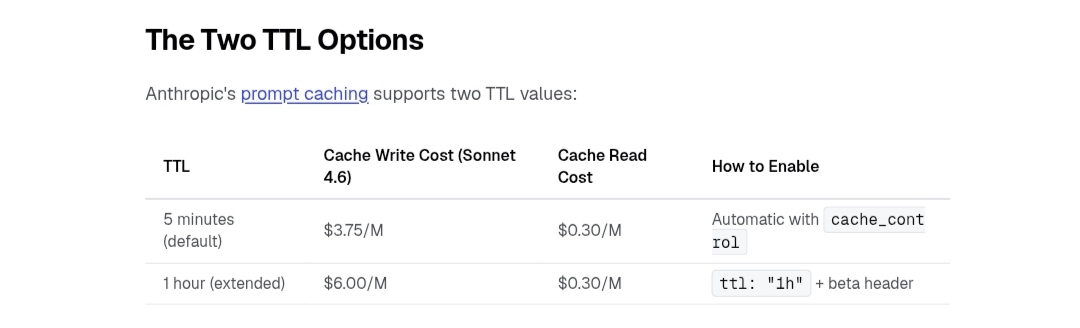
Three of those gaps exceed 5 minutes. Each time, the cache expires. The next request pays full $3/M input on the entire context — system prompt, tool definitions, conversation history — then writes a new cache at $3.75/M.
With the 1-hour TTL, those gaps don't matter. The cache survives. You pay the higher write cost once, then read at $0.30/M for the rest of the session.
Anthropic's prompt caching cuts input costs by 90%. The catch nobody mentions: the default cache expires in 5 minutes.
If your Claude Code session pauses for a coffee, a code review, or a CI run — anything longer than 5 minutes — the cache evaporates. The next request re-reads the entire context at full price. Then it writes a new cache entry. You pay for the re-read and the re-write.
There's a 1-hour alternative. It costs more to write but survives the gaps. We ran the numbers.
How does Synrouter reduce API costs?
Synrouter aligns cache lifetimes with real user sessions instead of the default 5-minute TTL, auto-injects Anthropic cache_control breakpoints, trims noisy tool outputs, and provides per-session savings metering. Users report 40-85% cost reduction depending on their agent workload.
Is Synrouter free?
Synrouter offers free credits during Early Access. You only pay for the upstream LLM API costs (Anthropic, OpenAI) at provider rates, plus a small gateway markup. The savings from caching typically exceed the markup by 5-10x.
Which agents work with Synrouter?
Any OpenAI- or Anthropic-compatible agent: Claude Code, Codex CLI, Hermes, OpenClaw, Kilo Code, and custom agents. You switch by changing only the base URL and API key — no SDK changes, no agent logic changes.
Let's Look at the Actual Numbers
Here is a relative breakdown of an 80-turn developer coding session using a premium model (e.g., Claude Opus or Sonnet):
Save-to-Earn: Transparent, Value-Aligned Pricing
Most API proxies charge a direct markup (e.g., a flat 5% or 10% fee on your usage). This creates a bad incentive loop: the more tokens you waste, the more money the proxy makes. They are financially incentivized to keep your queries bloated.
Synrouter corrects this model with our Save-to-Earn (80/20 Savings Split):
Baseline Calculation: We calculate exactly what you would have paid to execute the session raw on traditional providers.
Optimize: We apply our session caching, log compaction, and compression algorithms.
Split the Savings: Synrouter takes a 20% cut of the money we successfully save you. The remaining 80% of the savings goes directly back to your bank account.
If Synrouter doesn't save you money on your session, our service fee is exactly $0.00. Our success is mathematically tied directly to your efficiency.
Your AI agent loops for 2 hours. Your prompt cache lasts 5 minutes.
Synrouter keeps the cache alive for the whole session, so you stop paying full price for tokens you already sent.
In their 100-turn Opus example: $75.00 → $17.60.
https://t.co/qcWtLL261i
Enter Synrouter: One Line of Code to Optimize Agent Caching
Synrouter sits transparently between your AI agent and upstream LLM providers (like Anthropic, OpenAI, or self-hosted models). You don't have to rewrite your application or learn new SDKs. Just change your API configuration:
bash
# Anthropic-compatible clients:
base_url = "https://t.co/TpmFjedc5m"
# OpenAI-compatible clients:
base_url = "https://t.co/ZQF6vPxzuI"
api_key = "sk-sr-..."
By switching endpoints, Synrouter automatically activates a suite of transparent, server-side optimizations designed for stateful workflows:
🚀 Continuous Session-lifetime Caching
Synrouter intelligently manages session states on our end. We bypass fragile 5-minute timeouts by mapping caches to the actual birth-to-death lifecycle of your user session. Whether you pause for 2 minutes or 20 minutes, your warm context stays in place. Zero cold starts, zero cost spikes.
🧹 Automatic Tool Result Compaction
Standard tool outputs are full of noise — ANSI colors, duplicate log lines, progress bars, and massive file buffers that bloat context windows. Synrouter automatically sanitizes and formats these results before they hit the model. If a tool output spans between 4K and 20K tokens (like reading a large project file), our parser automatically compresses and slices it down (preserving target blocks and headers) yielding a 50% to 70% payload weight reduction without affecting the model's reasoning accuracy.
🔌 Multi-Tier Routing & Warm Prefix Sharing
When multiple users run agents with similar toolboxes, Synrouter maps their common system instructions onto shared prefix tables. In enterprise setups, our warm-prefix tier eliminates duplicate cache-write costs entirely for shared core tools.
3. Context is Your Burden (The Boilerplate Waste)
Because providers don't handle state, every single engineering team has to build their own custom "workarounds":
Writing custom state recovery and checkpointing logic.
Hand-crafting string-parsing rules to strip ANSI color escape codes, progress spinners, and giant logs from tool outputs.
Implementing fallback logic for context truncation when files are too big.
This is all non-differentiating engineering boilerplate. Instead of spending time making your product smarter or improving your user experience, your team is stuck building and maintaining complex token-management infrastructure.
AI agents are rewriting the rules of software engineering and automation. From autonomous terminal partners like Claude Code and Codex CLI to general-purpose agents like Hermes and OpenClaw, autonomous loops are becoming the primary consumers of LLM endpoints.
But there is a massive architectural misalignment: every mainstream LLM API today is fundamentally designed for single-turn, stateless chat. We explored this in depth in The 5-Minute TTL: How Anthropic's Prompt Cache Quietly Broke Long-Running Agents — the cache infrastructure itself was built for chatbots, not agents.
When you force a stateless chat API to power a continuous, stateful agent loop, things break down quickly. Developers are forced to pay a heavy "redundancy tax", manage fragile caches, and build custom plumbing just to keep their applications fast and affordable.
Today, we are launching Synrouter — a drop-in, session-aware inference gateway built specifically to bridge this gap, slashing your agent API costs by up to 85% while drastically lowering latency, with zero modifications to your agent application's code.
2. Cache TTL ≠ Session Life (The 5-Minute Timer)
"But can't we just use provider prompt caching?" Yes, in theory. But commercial prompt caching is extremely fragile.
Anthropic's native cache TTL is strictly hardcoded to 5 minutes.
Real-world development sessions don't fit into 5-minute boxes. Developers write a prompt, run tests, read documentation, discuss ideas, or take a quick coffee break. When you pause for more than 5 minutes, your upstream cache is silently evicted. Your next turn faces a slow, expensive \u201ccold start\u201d and your session cost immediately spikes by 30% or more. We show the exact math and how to fix it in How to Cut Claude Code API Costs by 85%.
The Mismatch: A natural coding session lasts 2 hours; provider caches last 5 minutes.