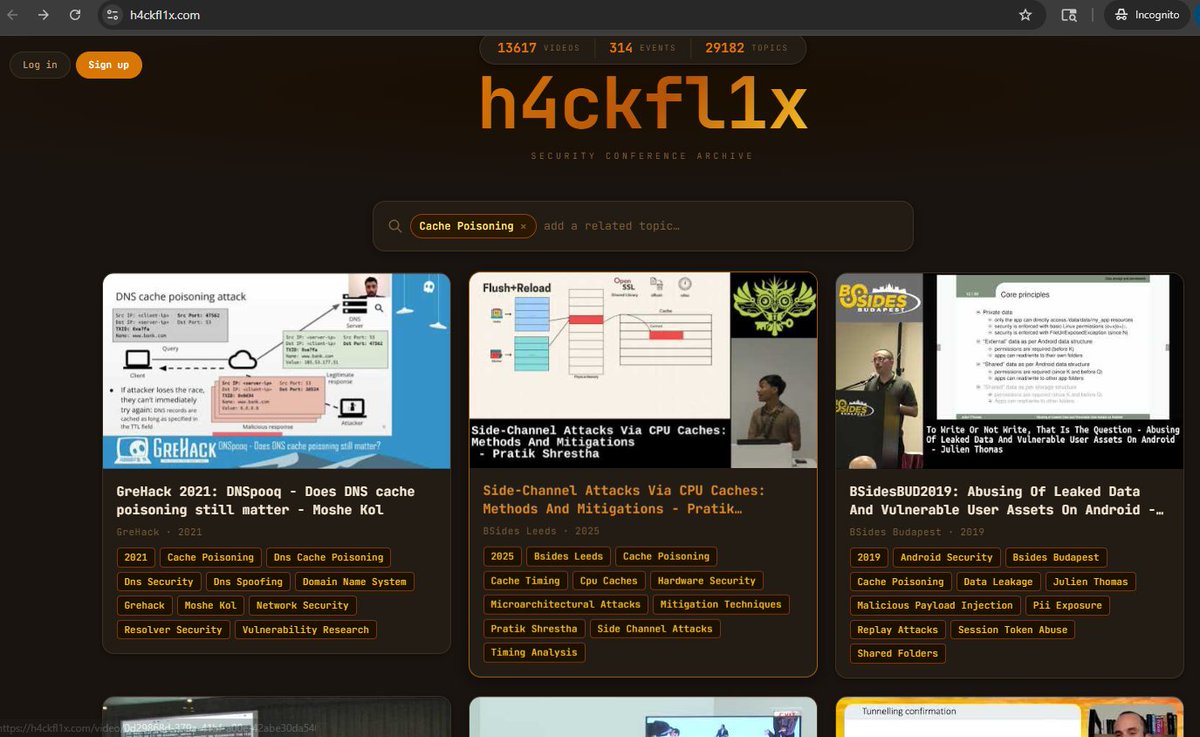
🔐 Automate BAC & IDOR Testing in Burp Suite with This Powerful Extension
TokenTwin Checker is a Burp Suite extension that automates Broken Access Control (BAC), IDOR, and horizontal privilege escalation testing across multiple authenticated users. It supports cookie and custom-header authentication, all-vs-all testing, baseline comparison, smart response filtering, risk classification, CSV export, side-by-side request comparison, and a built-in PoC viewer—making authorization testing faster and more accurate for bug bounty hunters and security researchers.
🔗 https://t.co/fFB8Nqn5Ej
#BugBounty #BurpSuite #API #IDOR #CyberSecurity
Many beginners struggle with recon in bug bounty & pentesting 🔍
So I built a simple recon pipeline to make it easier for you to get started!
Check it out 👇
https://t.co/jUWTv1IRFt
#BugBounty#Recon#CyberSecurity#Infosec#EthicalHacking
We pulled in $117,000 in Chrome bug bounties with simple tricks; on Wednesday, Quang Luong will spill his secrets at the Stanford AI Security Conference:
https://t.co/Fhq0NH13jn
Fun fact: Quang is probably the only researcher in the known universe who still uses Gemini to find bugs.
Before the end of the year, Calif researchers will be presenting at Blackhat USA, Defcon, and Hexacon. We're also hoping to make it to Unprompted AU, OffensiveCon, and Objective By The Sea.
At Black Hat USA, Dionysus Blazakis and the team will walk through the bugs and exploit chain used in the Apple MIE bypass discovered a few months ago.
https://t.co/dfeYJSzFVT
At DEF CON, we will tell the story of hacking software that helps run the Internet backbone.
At Hexacon in Paris, @brucedang and I will give the keynote. Apple announced MIE there last year, so it'll be a fun one. I suspect they only wanted Bruce, but keynotes require a certain amount of professional nonsense, and Bruce is far too honest for that, so I got invited too. My job is marketing, which is to lie without getting caught.
What's wild is that none of this existed at the beginning of the year.
We started with a simple realization: very few people have both deep security expertise and access to the best AI models.
So we went all in and never looked back.
Back in March, we called a company-wide all-hands on a Saturday. The title of the invite was: "AI Tsunami and Our Actions."
I don't want to romanticize overwork, but what we were seeing felt too urgent to wait until Monday.
Then everyone started cooking. The results have been spectacular.
Our research on defeating Apple MIE made it into The Wall Street Journal. We signed major contracts with Anthropic, OpenAI, Google DeepMind, and xAI. While others are celebrating access to the latest models, we've been using them to explore the frontiers of vulnerability research.
In the first half of 2026, we're already surpassing our entire 2025 bookings. Most importantly, we've assembled a top-tier team in record time.
I've read many strategy books, but this is the first time I've witnessed the power of the right strategy at the right time.
Focus is the name of the game. Strategy is deciding what to ignore. For one month and a half, we stopped starting new projects. I've personally shelved a lifelong passion in Vietnam, because it isn't a priority for the company. You can only move fast when you're light.
Several people were upset when we changed direction so abruptly. That's normal. If nobody complains, you probably didn't focus.
Of course, strategy isn't magic. You can make a focused bet and still be wrong. We were fortunate that this one worked out.
None of this would be possible without our partners and supporters across the frontier labs. Thank you.
Deleting a GitHub commit does NOT delete the secret.
The SHA still resolves. The credential is still live.
I built a tool to find exactly that and it earned me $$$$
https://t.co/vz6fgRuOEF
#BugBounty#InfoSec
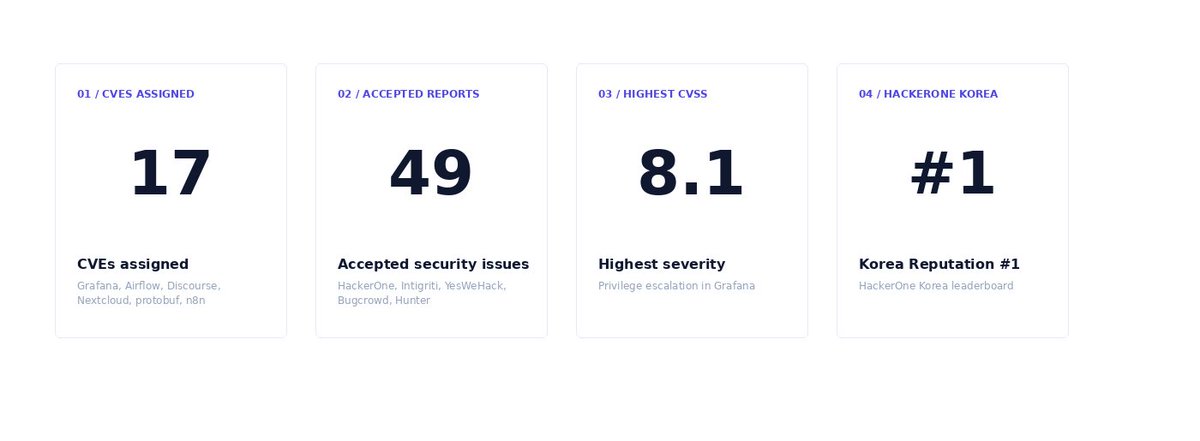
Korea’s #1-ranked hacker on HackerOne is back with a follow-up post! 👀
Hyunseo Shin (KU, 4th year) previously shared how he uncovered open-source 0-days using LLM agents.
Now, he breaks down the AI-based vulnerability detection workflow behind those findings.
Full post below 🔥
🔗 https://t.co/6UodzgY5tN
#CyKor #AI #hackerone
Authorized testing on a production API endpoint. Opus 4.7 confirmed the SQL injection was real but couldn't pull any database names. sqlmap said false positive.
I switched to DeepSeek V4 Pro inside Claude Code and it figured out a trick: make the database answer yes/no questions by crashing on purpose.
The payload wraps CASE WHEN around two XML casts. If the condition is true, it parses broken XML like <root>< and throws HTTP 500. If false, it parses clean XML like <root/> and returns HTTP 200. WAF was watching for SQL keywords, not XML errors.
Extracted 19 database names. DeepSeek V4 Pro succeeded where both Opus and sqlmap failed. Two hours. Twenty cents.
Setup: Mapped Claude Code to DeepSeek V4 Pro by creating ~/bin/claude-deep with ANTHROPIC_BASE_URL=https://t.co/RhiWu8K5Ja and ANTHROPIC_MODEL=deepseek-v4-pro[1m]. No config changes needed, original claude command stays untouched.
No cybersecurity restrictions!!!
Image 1: sqlmap output showing "false positive" / "all tested parameters do not appear to be injectable"
Image 2: Claude Code terminal showing 19 databases extracted in ~2 hours
Image 3: DeepSeek platform dashboard showing $0.20 total cost
Image 4: Why this trick is different from standard blind SQLi types and why sqlmap has no built-in vector for it
Earlier today Cloudflare's CSO shared how they tested Anthropic Mythos using an unreleased 8-stage vulnerability-discovery agent. So I asked Opus to implement the agent for me, it works via Claude SDK with a Pro or Max subscription, no API.
Enjoy https://t.co/McoZbTvTLL
Someone built 35 AI pentesting agents for Claude Code... and it's honestly insane.
AD attacks, web exploitation, cloud pentests, malware analysis, reverse engineering, C2 ops, even LLM red teaming — all inside one framework.
This is one of the most advanced offensive security AI projects I’ve seen on GitHub lately.
🔗 https://t.co/DvJVKM2hY9
#CyberSecurity #Pentesting #RedTeam #AI #OSINT
This might be what's missing from your recon workflow.
Uncover will search for hosts using Shodan, Censys, FOFA, Hunter, Quake, ZoomEye, Netlas, CriminalIP, PublicWWW, HunterHow, Google, Onyphe, Driftnet and NerdyData.
Then it drops the results straight into your terminal, ready for chaining with other tools.
https://t.co/sl9d0Ap1sY
Effective today, we are:
1) Doubling Claude Code’s 5-hour rate limits for Pro, Max, and Team plans;
2) Removing the peak hours limit reduction on Claude Code for Pro and Max plans; and
3) Substantially raising our API rate limits for Opus models.
while Anthropic quietly removed Claude Code from the $20 Pro plan (now $100+ Max only)
we just released OpenClaude v0.6.0
completely free & open-source.
🚨 Kimi 2.6 just dethroned @claudeai for coding — and we built 6 full projects in one morning to prove it.
3D worlds. Space shooters. Live data dashboards. All from single prompts.
Claude who? @Kimi_Moonshot 👀
Watch the full breakdown 👇
The Local LLM cheat sheet for your 16GB RAM device
I pulled together a lineup of small models that can run comfortably on a Mac Mini or personal laptop while still leaving room for context without melting your machine.
Models for Daily Use
Qwen3.5 9B / GGUF / Q4_K_M
Daily driver. General chat, drafting, research, translation. If you're keeping only one, keep this.
DeepSeek-R1 Distill Qwen 7B / GGUF / Q4_K_M
Reasoning engine. Math, logic, step-by-step problems. Slower, but worth it when you need actual thinking.
Models for Specialty Work
Qwen2.5 Coder 7B / GGUF / Q4_K_M
Code specialist. Completions, refactors, debugging, repo Q&A. Better than a generalist when the task is code.
Llama 3.1 8B / GGUF / Q4_K_M
Long context worker. RAG, doc chat, codebase Q and A. The output isn't top tier, but the context is strong for its size.
Phi-4 Mini Reasoning / GGUF / Q4_K_M
Compact thinker. Logic, structured answers, math, and short coding bursts. Smaller context is the catch.
Models for Efficiency
Gemma 4 E4B / GGUF / Q4_K_M
Light all-rounder. Writing, chat, light agents, structured output.
Phi-3.5 Mini / GGUF / Q5_K_M
Pocket sidekick. Summaries, extraction, background doc chat. Easy to pair with a bigger model.
Qwen3.5 2B / GGUF / Q4_K_M
Useful for summaries, tagging, rewrites, and lightweight sidekick work.
Micro Models
Qwen3.5 0.8B / GGUF / Q5_K_M
Classification, keyword routing, binary decisions, triage.
Gemma 4 E2B-it / GGUF / Q4_K_M
Lightweight chat, quick Q and A, summaries, tiny agents.
My personal choice for a single model is Qwen3.5 9B
For two models use Qwen3.5 9B + Qwen2.5 Coder 7B for code, or Qwen3.5 9B + Phi-3.5 Mini for support tasks.
Let me know in the comments your experience with these models, or any I have left out.
𝗞𝗶𝗺𝗶 𝗞𝟮.𝟲 𝗶𝘀 𝗖𝗵𝗶𝗻𝗮'𝘀 𝗻𝗲𝘄 𝗼𝗽𝗲𝗻 𝘀𝗼𝘂𝗿𝗰𝗲 𝗮𝗻𝘀𝘄𝗲𝗿 𝘁𝗼 𝗖𝗹𝗮𝘂𝗱𝗲 𝗖𝗼𝗱𝗲.
It has 1 trillion parameters but only uses 32 billion at a time.
Context window holds 256,000 tokens.
It scored 85% on Live Code Bench. Claude hit 64%.
It plugs into OpenClaw, Cursor, and Cline with no restrictions.
Kimi Claw deploys in the cloud in 2 minutes.
It's way cheaper to run than Claude day to day.
Save this. Your coding stack just got a real rival.


![Tur24Tur's tweet photo. Authorized testing on a production API endpoint. Opus 4.7 confirmed the SQL injection was real but couldn't pull any database names. sqlmap said false positive.
I switched to DeepSeek V4 Pro inside Claude Code and it figured out a trick: make the database answer yes/no questions by crashing on purpose.
The payload wraps CASE WHEN around two XML casts. If the condition is true, it parses broken XML like <root>< and throws HTTP 500. If false, it parses clean XML like <root/> and returns HTTP 200. WAF was watching for SQL keywords, not XML errors.
Extracted 19 database names. DeepSeek V4 Pro succeeded where both Opus and sqlmap failed. Two hours. Twenty cents.
Setup: Mapped Claude Code to DeepSeek V4 Pro by creating ~/bin/claude-deep with ANTHROPIC_BASE_URL=https://t.co/RhiWu8K5Ja and ANTHROPIC_MODEL=deepseek-v4-pro[1m]. No config changes needed, original claude command stays untouched.
No cybersecurity restrictions!!!
Image 1: sqlmap output showing "false positive" / "all tested parameters do not appear to be injectable"
Image 2: Claude Code terminal showing 19 databases extracted in ~2 hours
Image 3: DeepSeek platform dashboard showing $0.20 total cost
Image 4: Why this trick is different from standard blind SQLi types and why sqlmap has no built-in vector for it](https://pbs.twimg.com/media/HJGJk5OXoAEbVo8.jpg)
![Tur24Tur's tweet photo. Authorized testing on a production API endpoint. Opus 4.7 confirmed the SQL injection was real but couldn't pull any database names. sqlmap said false positive.
I switched to DeepSeek V4 Pro inside Claude Code and it figured out a trick: make the database answer yes/no questions by crashing on purpose.
The payload wraps CASE WHEN around two XML casts. If the condition is true, it parses broken XML like <root>< and throws HTTP 500. If false, it parses clean XML like <root/> and returns HTTP 200. WAF was watching for SQL keywords, not XML errors.
Extracted 19 database names. DeepSeek V4 Pro succeeded where both Opus and sqlmap failed. Two hours. Twenty cents.
Setup: Mapped Claude Code to DeepSeek V4 Pro by creating ~/bin/claude-deep with ANTHROPIC_BASE_URL=https://t.co/RhiWu8K5Ja and ANTHROPIC_MODEL=deepseek-v4-pro[1m]. No config changes needed, original claude command stays untouched.
No cybersecurity restrictions!!!
Image 1: sqlmap output showing "false positive" / "all tested parameters do not appear to be injectable"
Image 2: Claude Code terminal showing 19 databases extracted in ~2 hours
Image 3: DeepSeek platform dashboard showing $0.20 total cost
Image 4: Why this trick is different from standard blind SQLi types and why sqlmap has no built-in vector for it](https://pbs.twimg.com/media/HJGJkbDWsAATD0G.jpg)
![Tur24Tur's tweet photo. Authorized testing on a production API endpoint. Opus 4.7 confirmed the SQL injection was real but couldn't pull any database names. sqlmap said false positive.
I switched to DeepSeek V4 Pro inside Claude Code and it figured out a trick: make the database answer yes/no questions by crashing on purpose.
The payload wraps CASE WHEN around two XML casts. If the condition is true, it parses broken XML like <root>< and throws HTTP 500. If false, it parses clean XML like <root/> and returns HTTP 200. WAF was watching for SQL keywords, not XML errors.
Extracted 19 database names. DeepSeek V4 Pro succeeded where both Opus and sqlmap failed. Two hours. Twenty cents.
Setup: Mapped Claude Code to DeepSeek V4 Pro by creating ~/bin/claude-deep with ANTHROPIC_BASE_URL=https://t.co/RhiWu8K5Ja and ANTHROPIC_MODEL=deepseek-v4-pro[1m]. No config changes needed, original claude command stays untouched.
No cybersecurity restrictions!!!
Image 1: sqlmap output showing "false positive" / "all tested parameters do not appear to be injectable"
Image 2: Claude Code terminal showing 19 databases extracted in ~2 hours
Image 3: DeepSeek platform dashboard showing $0.20 total cost
Image 4: Why this trick is different from standard blind SQLi types and why sqlmap has no built-in vector for it](https://pbs.twimg.com/media/HJGJkQ2XoAAYv89.jpg)





![Tur24Tur's tweet photo. Authorized testing on a production API endpoint. Opus 4.7 confirmed the SQL injection was real but couldn't pull any database names. sqlmap said false positive.
I switched to DeepSeek V4 Pro inside Claude Code and it figured out a trick: make the database answer yes/no questions by crashing on purpose.
The payload wraps CASE WHEN around two XML casts. If the condition is true, it parses broken XML like <root>< and throws HTTP 500. If false, it parses clean XML like <root/> and returns HTTP 200. WAF was watching for SQL keywords, not XML errors.
Extracted 19 database names. DeepSeek V4 Pro succeeded where both Opus and sqlmap failed. Two hours. Twenty cents.
Setup: Mapped Claude Code to DeepSeek V4 Pro by creating ~/bin/claude-deep with ANTHROPIC_BASE_URL=https://t.co/RhiWu8K5Ja and ANTHROPIC_MODEL=deepseek-v4-pro[1m]. No config changes needed, original claude command stays untouched.
No cybersecurity restrictions!!!
Image 1: sqlmap output showing "false positive" / "all tested parameters do not appear to be injectable"
Image 2: Claude Code terminal showing 19 databases extracted in ~2 hours
Image 3: DeepSeek platform dashboard showing $0.20 total cost
Image 4: Why this trick is different from standard blind SQLi types and why sqlmap has no built-in vector for it](https://pbs.twimg.com/media/HJGJk5sWQAA7Kr5.jpg)