@Hellishnum1@GenLayer How does the contract turn three scores into one verdict? Is there a fixed threshold in the code, like fidelity above a certain number, or do the validators decide what counts as good enough?
I once asked a jury of AI models whether a translation was any good.
One of the small dApps I vibe coded on @GenLayer checks translations. Validators, each running its own AI model, score fidelity, coverage and fluency, and the contract turns those scores into a verdict.
That's how I'd explain GenLayer to someone new. It's a blockchain where a contract can judge something written in plain language, and the judgment comes from validators that have to agree. The image below shows how one verdict gets made, step by step.
I joined in May. The early testnet had its bumps and one of my first projects needed a redesign, but every time I tested the core idea, it held up.
Right now GenLayer is pointing that same jury at AI agents. Internet Court launched with 27 founding members and has since added Solana, Yellow, HOL and Blocksee. When two agents disagree about a deal, validators running different AI models read the evidence and have to agree on a verdict.
If you're arriving today, build one tiny thing. Seeing a few models agree on a sentence you wrote makes it click faster than reading about it.
What would you want a contract like that to judge first: a deadline, a delivery, or a promise? Drop your pick below
🪪 𝗚𝗘𝗡𝗟𝗔𝗬𝗘𝗥 𝗔𝗥𝗖𝗔𝗗𝗘 𝗖𝗔𝗥𝗗
👤 𝘀𝘆𝗿𝗲𝘅 - molecule
🏅 tier i - spark
▸ arcade: lvl 0 - 18 xp
▸ badges: 1/10
your turn: grab your card and drop it below 👇 https://t.co/IC8LXAtCW7
If a friend who has been in crypto since the ICO days asked me what GenLayer is, I wouldn't start with the tech.
I'd ask him who decided the last prediction market he lost.
The honest answer is usually token holders, voting. That works for choosing what a crowd wants, but a vote only tells you which answer had more tokens behind it, not which answer actually happened.
That is the one idea I'd want him to leave with: @GenLayer is a blockchain built for the questions code alone can't settle.
An Intelligent Contract can read its rules in plain language and check evidence on the live web. One validator proposes an outcome, and the others, each running a different AI model, decide independently whether it holds up. If someone disagrees, they can appeal and a larger set of validators takes another look. No whale, no single model and no single company gets the last word.
This matters more once AI agents start trading with each other, because they will have disputes too, and they won't wait around for a governance vote.
If you want in early, the GenLayer Portal is the place to start. Every contribution you make there is recorded and earns GenLayer Points, so learning how this works and helping build it turn out to be the same thing.
https://t.co/ncQl3Q1E7A
What is one bet, deal or bounty you've seen settled by whoever had the most weight instead of whoever was right?
Good Morning Quip Network
Something I find particularly important about @quipnetwork is its approach to the security of digital assets, especially when people start discussing the long-term impact of quantum computing
Most blockchains depend on cryptographic systems that were designed around the computing capabilities available today
A sufficiently powerful future quantum computer could threaten some of the cryptographic assumptions behind digital signatures, which makes preparation an important topic for the entire industry
@quipnetwork is working on post-quantum protection through hash-based signatures and additional wallet security mechanisms designed to protect assets across existing blockchain ecosystems
What I like about this approach is the focus on practical compatibility
Users and developers already have established networks, wallets and applications, so introducing stronger security without ignoring the existing ecosystem is a meaningful challenge, there is still a lot of research, testing and engineering ahead, but I would rather see projects explore these risks early than wait until quantum hardware becomes a serious threat
Security infrastructure is not always the most visible part of Web3, yet it could become one of the most important
The Pulse idea from @0xhazels is probably one of the more interesting parts to watch.
There’s already so much attention on X, but most of it is basically measured by likes, followers and impressions.
Hazels is trying to make attention itself useful inside the ecosystem, especially for creators and campaigns.
That’s a much more interesting direction than just launching another collection and hoping the community carries it.
The biggest bottleneck in Physical AI isn't hardware it's scalable, high quality training data.
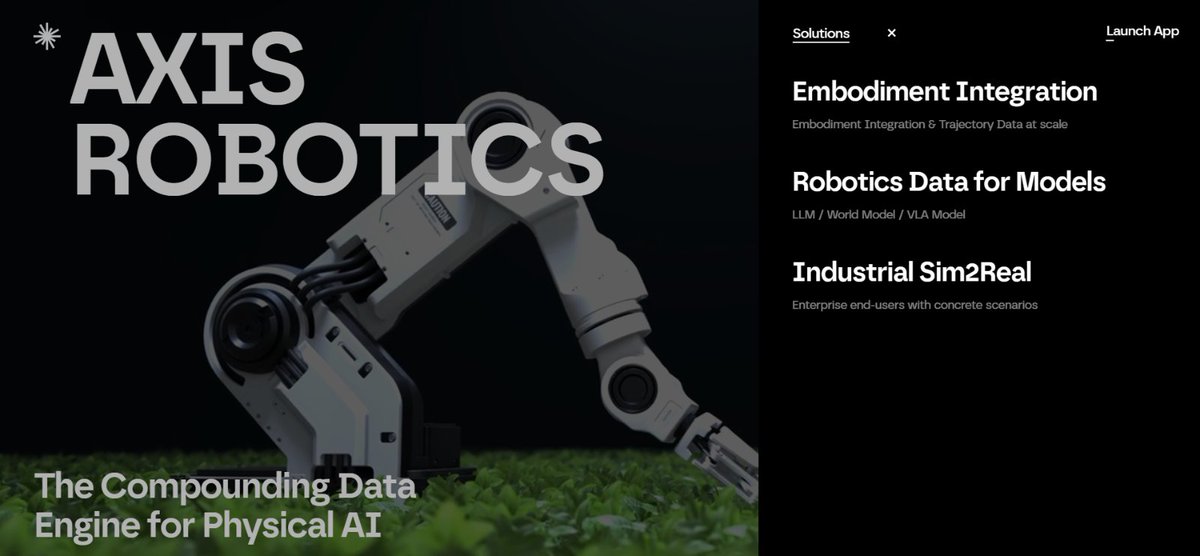
@axisrobotics is building the compounding data engine for embodied AI & robotics simulation.
Here is a breakdown of their 3 core solutions changing the game 👇
Embodiment Integration Turn any robot into a first-class simulation asset.
From scenario-based task design to community-scale trajectory generation, your hardware gets instant data pipeline coverage for rapid Sim2Real deployment.
Robotics Data for ModelsSkip the tedious data-pipeline build and jump straight into model training.
--> Off-the-shelf trajectory packages
-->Structured task bundles for VLA, World and Foundation Models
-->Joint model development and co-training partnerships
Industrial Sim2RealEnd to end automation built for the shop floor
Assess --> Simulate --> Train --> DeployBridging robotic intelligence directly with real-world manufacturing lines.
Sim-driven data is accelerating the next wave of physical intelligence.
Keep @axisrobotics on your radar.
The more 1win Token gets used, the more gets burned.
Every 1win Token spent across the platform triggers a 10% burn, connecting actual platform activity directly to supply reduction.
The flow is simple:
More usage → more burns → lower supply → more value
So if the ecosystem keeps growing, the burn mechanism keeps working in the background.
Simple mechanism but potentially a meaningful one for the long term.
Every legal system has a hidden price list.
Below a certain amount, you are not right or wrong. You are just not worth hearing.
That is the part of @GenLayer's October 1 thread that stayed with me: a million in court fees just to get started, and $14,000 left at the end.
Read that twice. The process itself ate almost everything.
Now scale it down to the economy that is coming. Agents paying agents for data, compute and deliveries, a few dollars at a time. When one of them doesn't deliver, no traditional court is going to open a case over $4.
So the side that broke the deal wins by default. Not because it was right, but because the dispute was too small to be worth deciding.
That is why a court running at internet speed matters more to me than any other piece of the agent stack.
On GenLayer, a first decision costs a fraction of a dollar and can land in minutes. Validators running different AI models judge it independently, and if someone challenges the verdict, a larger set of validators takes another look.
Justice stops being something only big disputes can afford.
What is the smallest dispute you ever walked away from, just because fighting it would cost more than it was worth?
The internet never had a judge.
AI agents are about to move $9 trillion. Nobody built the part that handles disagreement.
GenLayer did.
And now you can become part of it: https://t.co/vmIxBNIdZu
What's the hardest part of building a product when your user isn't always a human?
@iraskovsky, creator of Internet Court, puts the question to @EdgarsNemse, CPO at @GenLayerLabs, with @spacemandev from @solana in the room.
this is so interesting and His answer is worth the two minutes!
مجموعه قوانین محتوای جن لیر اینجاست 📘
این منبع برای جامعهی @GenLayer ساخته شده است و راهنمای محتوا، فرایند بررسی، سوالات متداول و بسیاری از موضوعات دیگری را که بهطور مرتب مطرح میشوند، پوشش میدهد.
اکنون هر آنچه لازم است بدانید؛ یکجا 👇
In most rooms I have sat in, disagreement is something to be managed. Someone senior steps in, the quieter view goes quiet, and the decision leaves the room looking unanimous. The disagreement was never resolved. It was absorbed.
That is how bad decisions survive. Not because nobody objected, but because the objection had nowhere to go.
This deep dive from @GenLayer inverts that, and it is the part I keep coming back to. Here disagreement is not noise the system has to smooth over. It is the trigger.
A dispute arrives and the jury is drawn at random from validators running different models, so there is nobody to lobby before the question even exists. Each one reasons through the case alone. Then the network checks whether their conclusions mean the same thing rather than whether the sentences match. That is the Equivalence Principle, and it is why agreement here counts as corroboration instead of copying.
Think a verdict is wrong? You appeal, and the jury gets larger. Every challenge widens the circle of minds that would have to be fooled at once. And because every validator has real value staked, being wrong on purpose costs money. That is Optimistic Democracy.
So finality here is not a declaration. It is what is left standing after the verdict has been shot at and did not fall.
Which is exactly what an economy of agents will need, because nobody will be awake to overrule anything at machine speed.
in your world, when two people disagree, does the disagreement actually get investigated, or does it just get outranked?
How does GenLayer actually work?
It starts from a simple conviction: you can’t trust a single AI with a final verdict.
One model can be wrong, it can be biased, and if everyone knows it holds the gavel, it can be gamed.
History already showed us this with humans - concentrated judgment, no matter how brilliant, eventually gets captured. So GenLayer was built on the opposite principle: no single AI should ever have the final word.
When a dispute arrives, the network summons a jury of validators chosen at random, each running a different model. Nobody knows who will judge until the dispute exists. That means there’s nobody to lobby and no single mind to exploit.
Once the validators reach their own conclusions, the network doesn’t check whether their answers match word for word - it checks whether they mean the same thing. Because that’s how truth has always worked between independent thinkers: agreement on meaning, not on wording.
If someone believes a verdict is wrong, they can appeal. Every round brings a larger jury. Bad verdicts don’t survive scrutiny - they get buried by it. And because every validator has real value staked behind its votes, honesty is rewarded and manipulation becomes expensive.
We call this Optimistic Democracy.
Fast, because most verdicts hold on the first round.
Fair, because fairness was never entrusted to a single mind.
The agentic economy will need millions of verdicts. This is how you make every single one of them worth trusting.