If you can build these 12 Agentic AI projects.
You're hired.
Project 1: Structured Output Agent
Enforce Pydantic JSON schemas, validate tool responses, retry on parse errors, log validation failures.
→ Shows: You can make LLMs reliable not random
Project 2: RAG Agent with Citation Grounding
Retrieve context, generate answers with sources, flag low-confidence responses, fallback to search.
→ Shows: You can prevent hallucinations at scale
Project 3: ReAct Planning Agent
Observe → think → act → reflect loop, max iteration limits, self-critique, graceful degradation.
→ Shows: You can build agents that don't infinite loop
Project 4: Multi-Tool Orchestrator Agent
Dynamic tool registry, capability-based routing, permission scoping, parallel execution, conflict resolution.
→ Shows: You can coordinate complex workflows
Project 5: Memory-Enabled Conversational Agent
Short-term buffer + long-term vector recall, context compression, relevance scoring, cross-session sync.
→ Shows: You can build agents that remember users
Project 6: Human-in-the-Loop Approval Agent
Uncertainty detection → pause → request human input → resume with validated context, full audit trail.
→ Shows: You can build safe, compliant systems
Project 7: Cost-Aware Agent Router
Token budgeting per task, model routing by complexity/cost, early exit on confidence, cost-per-decision analytics.
→ Shows: You can reduce infra costs by 40-60%
Project 8: Event-Triggered Automation Agent
Listen to webhooks/queues, execute workflows on triggers, idempotent execution, dead-letter handling, retry logic.
→ Shows: You can build production automation not demos
Project 9: Multi-Agent Debate System
Multiple agents propose solutions, critic evaluates, voting/consensus logic, aggregator synthesizes with confidence.
→ Shows: You can orchestrate swarms not single agents
Project 10: Self-Reflective Agent with Auto-Eval
Execute → evaluate via LLM-as-judge → critique reasoning → regenerate with constraints, log improvement metrics.
→ Shows: You can build systems that improve over time
Project 11: Production Agent with Observability
Deploy with LangSmith/Arize tracing, latency/cost dashboards, alerting on loops/failures, canary testing, rollback.
→ Shows: You can ship to production not just localhost
Project 12: Open Source Agent Framework Contribution
Extend LangGraph/CrewAI/AutoGen with new pattern, write docs + demo, publish benchmarks, submit PR + tutorial.
→ Shows: You're a community builder not just a consumer
(Bookmark this)
happy building...
Muslim student asks: “Can I practice gay anal sex to widen my ass for a bomb?”
Muslim teacher answers: “Normally forbidden, but for jihad? Totally allowed!”
Is it just me, or they are all repressed and gay?
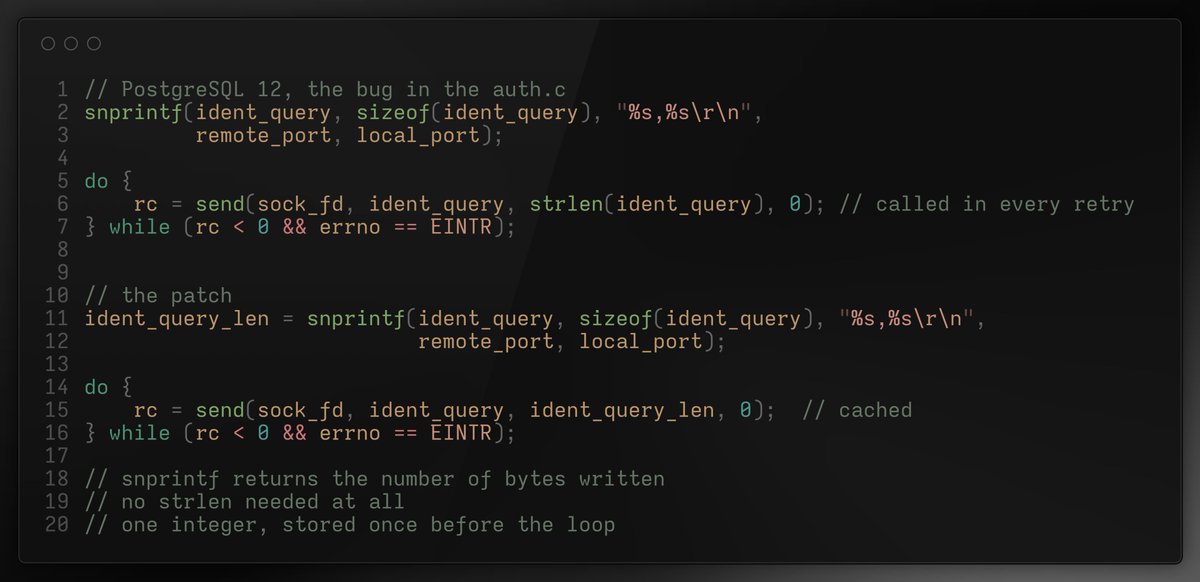
it is O(n²)
strlen has no way to know the string length without walking every byte to the null terminator
every loop iteration restarts from the beginning of the string
n iterations × n cost per strlen = n²
this is the actual patch submitted to PostgreSQL 12 in November 2019
the bug was in auth.c, the ident authentication loop
strlen was called inside the send() retry loop on every iteration
the fix is one line, cache the length before the loop
@realpreityzinta@PunjabKingsIPL@prabhsimran01@arshdeepsinghh@ShreyasIyer15@RickyPonting In all these years, how you have stood with PBKS, motivates common fans like us to not loose hopes. We had a horrific decade but we all were, you were there, for the team, by the team, waiting for our time. you made it possible. Can’t express how long we waited for this. Takk!
As a Backend engineer, learn below to move beyond CRUD APIs:
→Security
a. Authentication & Authorization
b. Cryptography
c. Encryption Algorithms
d. OWASP Top 10
e. SIEM, IDS, IPS, etc.
f. misc: OAuth 2.0, JWT, etc.
g. CORS
h. Security headers(CSP, HSTS etc.)
i. Input validation
→Performance
a. Caching strategies
b. Rate-limiting & Throttling
c. Load balancing
d. Chaos Engineering
e. Fault Tolerance
→Database Engineering
a. Query optimization
b. Indexing
c. Database trade-offs
d. Database transactions and isolation levels
e. Sharding and partitioning
→API Design
a. OpenAPI 3.0 standards
b. Restful & GraphQL API principles
c. Status codes, versioning, and pagination strategies
→Architecture & Paradigms
a. Monolith
b. Modular monolith
c. Microservices
d. Serverless vs. Native
e. Concurrency & parallelism
f. Multithreading
g. Optimistic and pessimistic locking
→Distributed systems
a. Microservices patterns
b. Event-driven approach
c. Serverless vs native approach
d. gRPC & Protobuf
e. Kafka/RabbitMQ
→ DevOps
a. CI/CD
b. Containerization
c. Understanding of SLAs
d. Incident Management
→Observability
a. Logging, monitoring, and tracing
b. Profiling & optimization
c. Alerting
→Miscellaneous Microservices topics
a. API Gateway
b. Reverse proxy
c. Circuit breaker Pattern
d. Retry/back off patterns
e. Background jobs/Scheduling
These will help you make outstanding backend systems that are secured, meet SLAs, and are highly tolerant.
Service based Interview Questions shared by a 5 year experienced Java developer :
1. What is CompletableFuture and when do we use it?
2. Difference between Future and CompletableFuture
3. Internal working of HashMap
4. HashMap vs ConcurrentHashMap
5. How Java Memory Model works?
6. What is volatile keyword?
7. How does Spring Boot Auto Configuration work?
8. How do we handle transactions in Spring Boot applications?
9. Propagation and Isolation levels in Transaction Manager
10. What is Dependency Injection?
11. An application is slow due to JPA. How do you fix it?
12. What is Dirty Checking?
13. How is JPA different from Hibernate?
14. How can we implement DTO projection in JPA. Write a query.
15. Two microservices share the same database. Is it a good approach?
16. Two microservices updating the same database row at the same time. What happens?
17. If one microservice is down, how does it impact system performance?
18. How do you improve application performance?
Programming Questions
a. Permutations of a String "abc"
b. Check if a string is balanced or not "{[()]}"
HOW MANY CAN YOU ANSWER ?