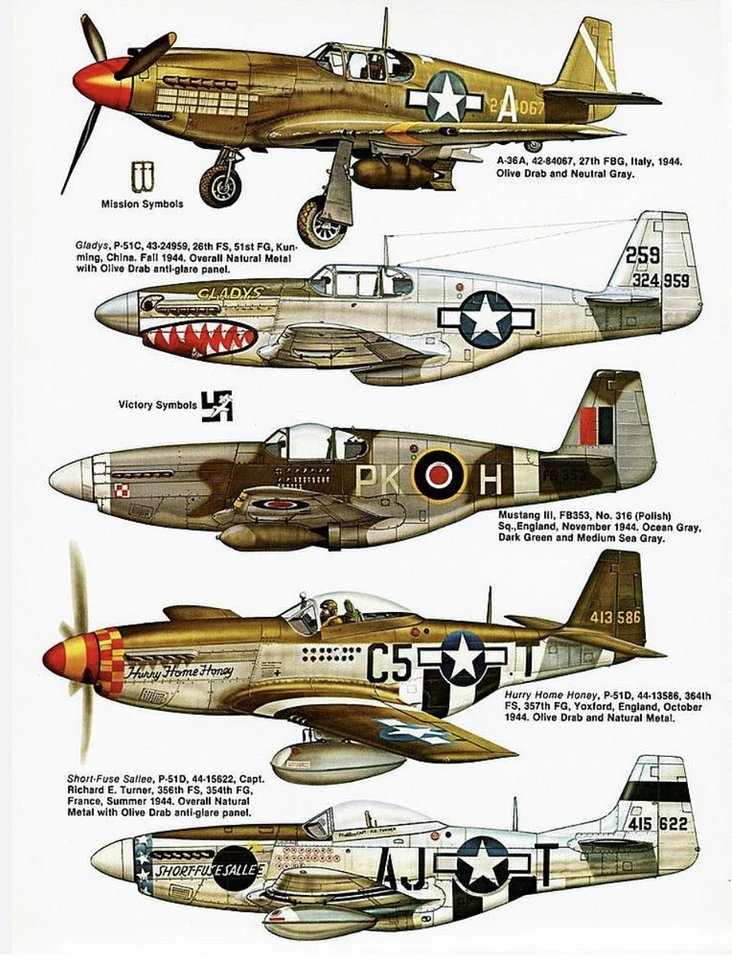
October 13, 1942. At a quiet airfield in England, a modified fighter takes off for the first time with a different engine in its nose, and the sound of that engine is the sound of the air war over Germany being won. The marriage of the American P-51 Mustang airframe to the British Rolls-Royce Merlin engine, first flown on this day, created what many consider the finest fighter of the Second World War.
The Mustang had an odd origin. It was designed and built in a matter of months by North American Aviation to a British order early in the war. The airframe was brilliant, clean, fast, with a revolutionary low-drag wing and enormous internal fuel capacity, giving it tremendous range. But it had one crippling flaw: its American Allison engine performed poorly at high altitude, where the air battles over Europe were fought. Up high, where it was needed most, the early Mustang gasped and faded, and so it was relegated to low-level reconnaissance and ground attack, a thoroughbred hobbled by the wrong heart.
Then someone had the inspired idea of putting the Rolls-Royce Merlin into it, the same superb engine that powered the Spitfire, an engine that kept its power up in the thin air at high altitude. On the 13th, the prototype of this combination, the Mustang X, made its first flight in England. The transformation was staggering. With the Merlin, the Mustang became a superb high-altitude fighter, fast, agile, climbing and fighting with the best of them up where the bombers flew, while keeping its one magic quality, its enormous range.
That combination of range and high-altitude performance was exactly, precisely what the Allies desperately needed and did not have. The American daylight bombing campaign over Germany was being slaughtered. The heavy bombers flew deep into the Reich, and the short-ranged escort fighters had to turn back at the German border, leaving the bombers to go on alone into the teeth of the German fighter defenses, which butchered them. Raids were losing crews in catastrophic numbers. Without a fighter that could escort the bombers all the way to the target and back, the whole strategy of daylight bombing was failing.
The Merlin Mustang was the answer. With its range, it could accompany the bombers all the way to Berlin and beyond, and with its performance, it could beat the German fighters that came up to meet them. When it arrived over Germany in strength in 1944, it changed everything. The Mustangs did not just protect the bombers; they were turned loose to hunt the German fighter force and destroy it in the air and on its airfields, and they broke the back of the Luftwaffe in the months before D-Day, winning the air superiority that made the invasion possible.
All of that flowed from the moment on this day in 1942 when a Mustang first flew with a Merlin in its nose. It is one of the great examples of combination in the whole war, an American airframe and a British engine coming together to make something far greater than either, the long-range escort fighter that cleared the skies over Germany. The thoroughbred had finally been given the right heart.