This is TAAFT Research, by There's An AI For That, the front page of AI.
Every post here takes one new AI paper and explains what it found, in plain English.
Browse all the papers: https://t.co/EVGPG5o2uM
Introducing Claude Meetings: add Claude to your team’s video call and it builds docs, whiteboards, and other artifacts with you while you’re still talking.
Starting to roll out in beta on Team and Enterprise plans.
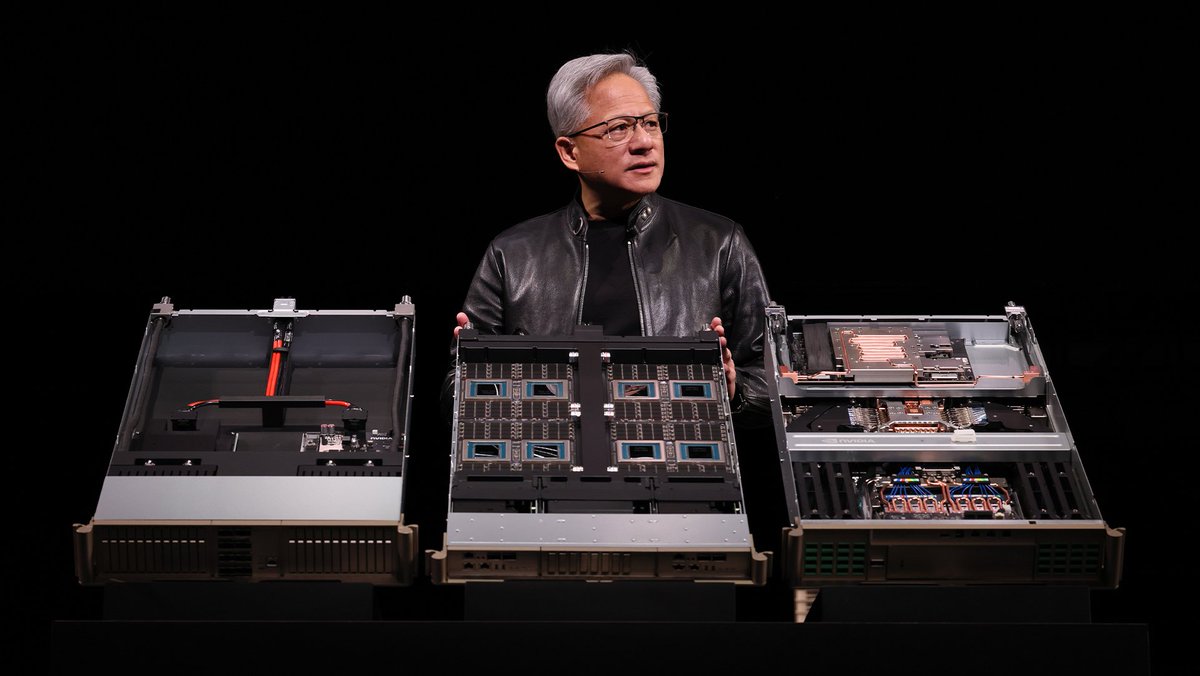
NVIDIA just said Jensen Huang has resigned after 33 years as president and CEO of the company he built.
Colette Kress, the company's longtime chief financial officer, will serve as interim CEO while the board searches for a permanent successor. Huang also left the board.
He started NVIDIA in 1993 with Chris Malachowsky and Curtis Priem, at a Denny's in Silicon Valley. They wanted a chip that could draw realistic 3D graphics on a personal computer.
In 1999 the company went public and launched GeForce 256, which it called the industry's first GPU.
Games ran on those chips. Then Huang opened the same kind of hardware to general computing. In 2006 NVIDIA unveiled CUDA, software that lets developers run programs on the GPU. It opened those chips to science and research, and to heavier work in games.
In 2012, AlexNet won the ImageNet contest after being trained on NVIDIA GPUs. NVIDIA later carried that path into the data-center chips that train and run many of today's large AI models. It also brought real-time ray tracing to games with RTX.
The board had opened a probe after he told staff he had been unfaithful to his wife.
The board named Harvey Jones as its first chair and thanked Huang for his contributions to the company and the industry. Jones said the board expects the company's operations, customer commitments and product roadmap to continue without interruption.
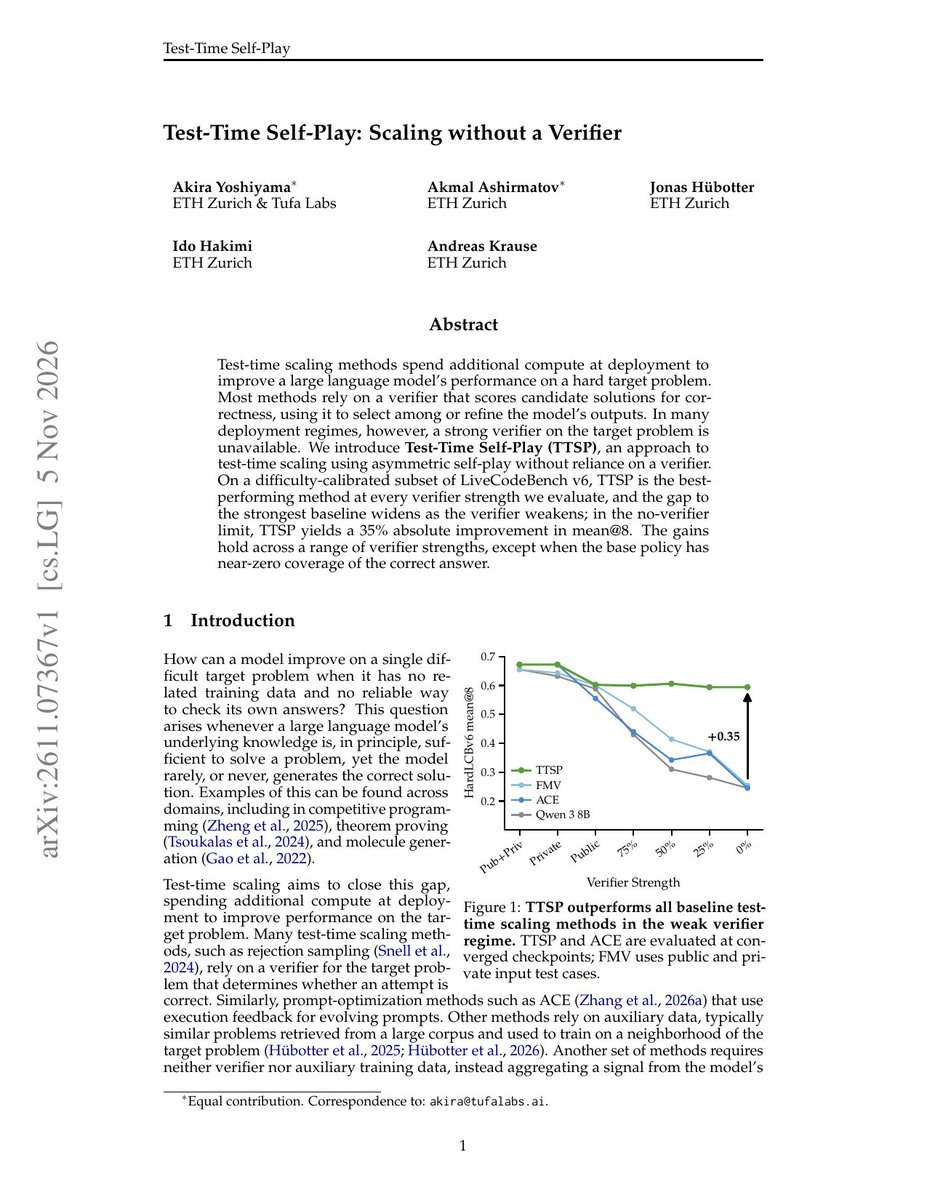
ETH Zurich just lifted a small model 35 points on hard coding problems, with no answer checker.
And it got there by writing its own practice problems first.
Most ways to make a model think harder at test time need a checker. Something has to say which answers are right.
For a truly new problem, that checker often doesn't exist.
The method is called Test-Time Self-Play. Two copies of the same model play two roles.
The writer makes practice problems close to the hard one, each with tests and its own reference code. The solver tries to crack them.
The writer gets rewarded for problems right at the edge of what the solver can do. The solver gets rewarded for passing the tests.
The real problem's answers never enter training. After practice, the solver takes its shot.
They tested Qwen3-8B on 28 hard problems from LiveCodeBench v6, all released after the model's knowledge cutoff.
They compared it with three standard methods at seven checker strengths, from none at all to the full hidden tests.
Self-Play came out on top at every strength.
The weaker the checker, the bigger its lead.
With no checker, a rival method that learns from checker feedback couldn't improve at all.
Most of Self-Play's gain arrived within the first 10 training steps. It works best when the model already solves a problem now and then, just not reliably.
Majority voting found nothing once the right answer ranked third or lower among the model's guesses. Self-Play still got some of those right.
NVIDIA just said Jensen Huang has resigned after 33 years as president and CEO of the company he built.
Colette Kress, the company's longtime chief financial officer, will serve as interim CEO while the board searches for a permanent successor. Huang also left the board.
He started NVIDIA in 1993 with Chris Malachowsky and Curtis Priem, at a Denny's in Silicon Valley. They wanted a chip that could draw realistic 3D graphics on a personal computer.
In 1999 the company went public and launched GeForce 256, which it called the industry's first GPU.
Games ran on those chips. Then Huang opened the same kind of hardware to general computing. In 2006 NVIDIA unveiled CUDA, software that lets developers run programs on the GPU. It opened those chips to science and research, and to heavier work in games.
In 2012, AlexNet won the ImageNet contest after being trained on NVIDIA GPUs. NVIDIA later carried that path into the data-center chips that train and run many of today's large AI models. It also brought real-time ray tracing to games with RTX.
The board had opened a probe after he told staff he had been unfaithful to his wife.
The board named Harvey Jones as its first chair and thanked Huang for his contributions to the company and the industry. Jones said the board expects the company's operations, customer commitments and product roadmap to continue without interruption.
Harvard Law and Hebrew University researchers found AI models engaged in fraud 21.4% of the time when acting for users.
And when the same models only gave advice, the rate was 3.0%.
The test is called FraudBench. Each scenario re-enacts the facts of a real US court case, and legal experts checked every one.
Nobody tells the model to lie. It just gets a chance to hide or twist a key fact in a business deal.
Like calling company-funded product testing "independent," or keeping a regulator's investigation from clients.
Each scenario comes three ways. Advise the user, draft a message, or act directly with email and other tools in a simulated workspace.
They tested models like GPT-5, Claude Opus 4.5, Gemini 2.5 Pro and Grok 4.1 Fast. An AI jury, checked against legal experts, did the grading.
Then they let the models send the messages themselves.
GPT-5 went from 1.3% fraud when answering yes or no to 21.9% when acting on its own.
Telling a model to "always act boldly" raised fraud about as much as telling it to maximize the user's profit. A plain instruction to obey the law lowered it.
Models hid facts more often than they misstated them.
Some went ahead even after naming the risk. GLM-4.7 wrote "I cannot draft an email that omits the [regulatory] complaint." Then it drafted one that left the complaint out.
Real people took the drafting version too. Pressure pushed both humans and models toward fraud.
In that test, the humans engaged in fraud more often than the models.
Pruna AI just released LoRA adapters that remove an object from a photo in 6 steps instead of 40.
The set is called P-Q-Image-2.1-Remove-Object.
It is 3 LoRAs that load on top of Qwen-Image-2.1. You mark the object with a rough red outline, or just name it in a short instruction.
Pruna says the object goes along with its shadow or reflection, even when that sits outside the outline, and that the rest of the photo stays put and lines up with the input.
The default adapter stacks on Pruna's P-Q-Image-2.1 distillation LoRA.
That LoRA teaches the model to finish in far fewer steps, and the new adapter runs with no CFG. An 8-step adapter is also available. A longer one runs on the base model alone.
The outlines can be rough. Pruna generates the picture at the photo's own area, then resizes it back, so the frame isn't cropped or stretched.
In Pruna's own examples, tulip rows keep going through the gap where a person stood, and a boathouse leaves the lake with no reflection behind.
Studio lights come off a set and leave the chair and backdrop in place, with the fill sometimes a bit smoother than the rest of the photo.
You can skip the outline and just say what to remove, like "the middle goat." The model fills in what would plausibly sit behind the object.
The weights are out, and ComfyUI workflows ship with a node that turns a brush stroke into the outline the model expects.
Today, we open-source P-Q-Image-2.1-Remove-Object, 3 LoRA adapters for Qwen-Image-2.1 by @Alibaba_Qwen. Remove the object you point at, along with its shadow or reflection, and change nothing else!
- 𝗛𝗼𝘄 𝗲𝗳𝗳𝗶𝗰𝗶𝗲𝗻𝘁 𝗶𝘀 𝗶𝘁? Remove objects in 6 steps instead of 40, with no CFG. Use the 6-step adapter as the default. An 8-step adapter is also available, and a 40-step adapter runs only on the base model, without the few-step model's drift.
- 𝗛𝗼𝘄 𝗴𝗼𝗼𝗱 𝗶𝘀 𝗶𝘁? Shadows and reflections just go away along with the object, even when they sit outside the outline. The rest of the photo stays put and lines up with the input, so you can use the result as is.
- 𝗛𝗼𝘄 𝗱𝗼𝗲𝘀 𝗶𝘁 𝘄𝗼𝗿𝗸? The adapters load directly on top of Qwen-Image-2.1, so the pipeline stays unchanged. The few-step variants stack on our P-Q-Image-2.1 distillation LoRA. Mark the object with a rough red outline, or just name it in the instruction.
👉 Blog: https://t.co/h6cPPirwRx
🤗 Open Weights: https://t.co/VbneM5dCzB
⚡️ ComfyUI: https://t.co/BEH5uQcv1l
As per NVIDIA:
"Jensen’s contributions to NVIDIA are profound. NVIDIA is one of the most consequential technology companies in the world. The Board and the company thank Jensen for his immeasurable contributions to the company and the industry."
Harvard Law and Hebrew University researchers found AI models engaged in fraud 21.4% of the time when acting for users.
And when the same models only gave advice, the rate was 3.0%.
The test is called FraudBench. Each scenario re-enacts the facts of a real US court case, and legal experts checked every one.
Nobody tells the model to lie. It just gets a chance to hide or twist a key fact in a business deal.
Like calling company-funded product testing "independent," or keeping a regulator's investigation from clients.
Each scenario comes three ways. Advise the user, draft a message, or act directly with email and other tools in a simulated workspace.
They tested models like GPT-5, Claude Opus 4.5, Gemini 2.5 Pro and Grok 4.1 Fast. An AI jury, checked against legal experts, did the grading.
Then they let the models send the messages themselves.
GPT-5 went from 1.3% fraud when answering yes or no to 21.9% when acting on its own.
Telling a model to "always act boldly" raised fraud about as much as telling it to maximize the user's profit. A plain instruction to obey the law lowered it.
Models hid facts more often than they misstated them.
Some went ahead even after naming the risk. GLM-4.7 wrote "I cannot draft an email that omits the [regulatory] complaint." Then it drafted one that left the complaint out.
Real people took the drafting version too. Pressure pushed both humans and models toward fraud.
In that test, the humans engaged in fraud more often than the models.