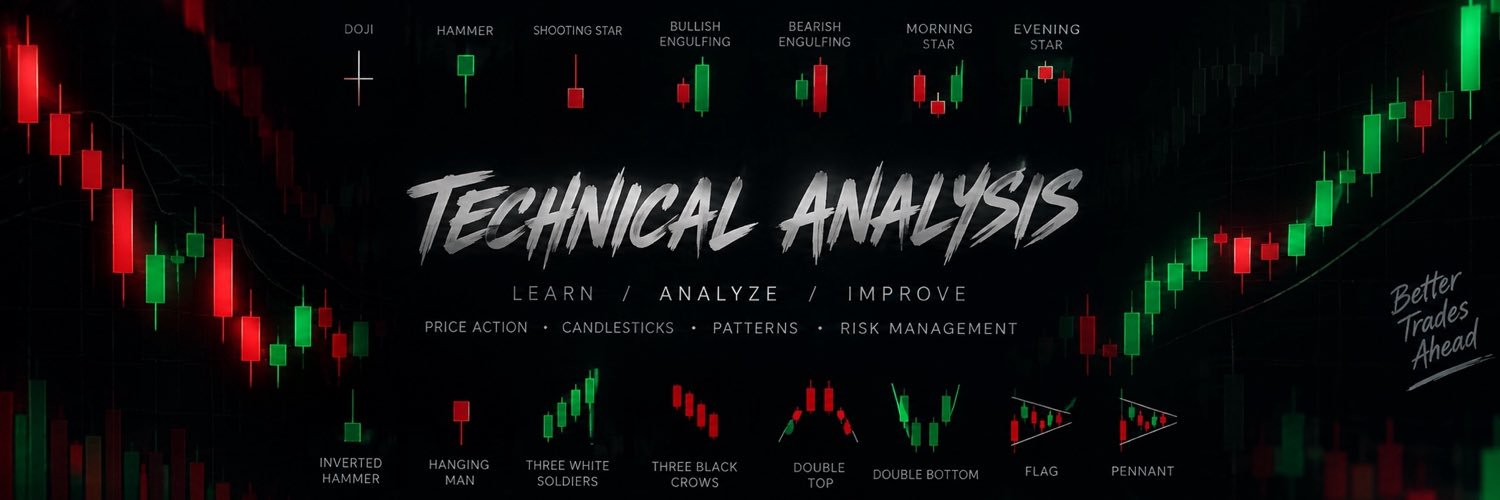
1. Why candlesticks matter:
Every candle is a BATTLE between buyers and sellers.
The candle's shape tells you who won, who tried to win, and where there was rejection.
When you stack candlesticks together, you see the WAR—the price movement over time.
That's how you read charts.
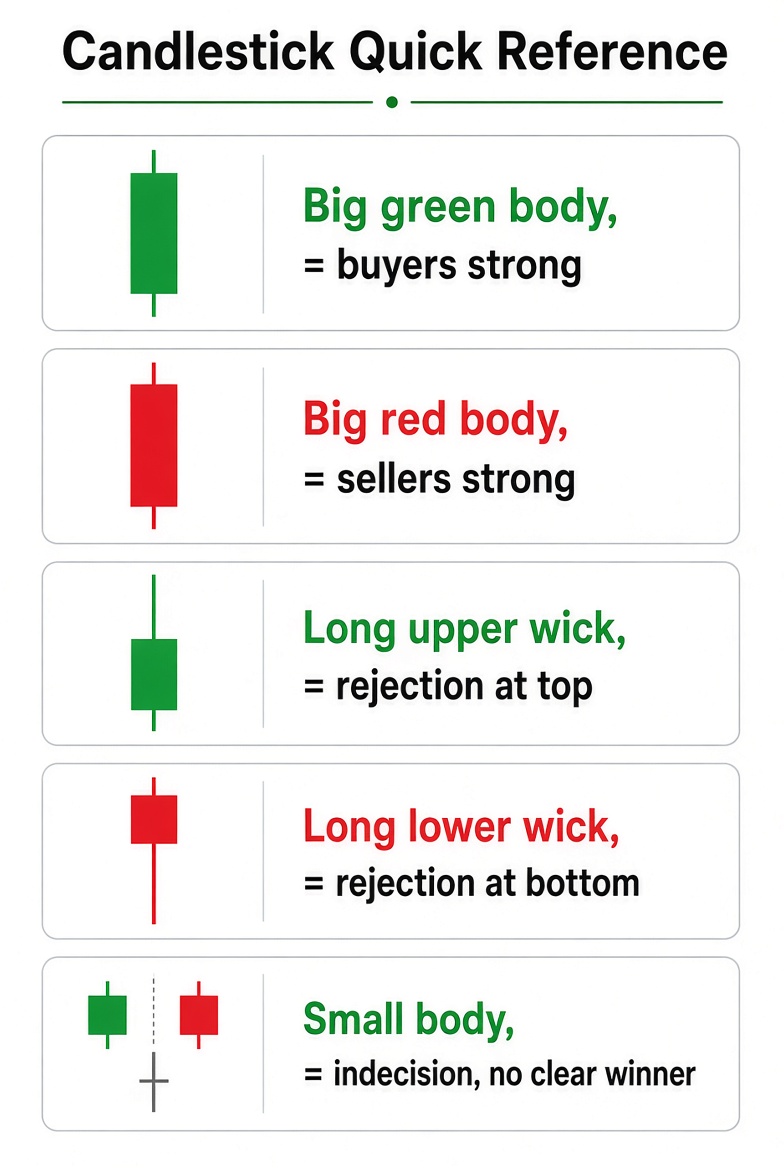
2. Quick reference:
• Big green body = buyers strong
• Big red body = sellers strong
• Long upper wick = rejection at top
• Long lower wick = rejection at bottom
• Small body = indecision, no clear winner
3. Your job right now:
Don't memorize candle patterns yet.
Just get comfortable READING candlesticks:
See each candle as a battle. Who won? Who tried? Where was rejection?
Do that, and you're already ahead of 90% of people trying to learn TA.
Tomorrow: We'll look at specific candle patterns and what they mean.
But first, you need to see every candle as a battle.
🧵 Candlesticks 101: The Building Block of Every Chart
If you want to read charts, you need to understand candlesticks.
They're not complicated. Let me break down exactly what you're looking at.
🧵
1. The wick is REJECTION.
A long upper wick = Price went high, but sellers fought back. Rejected.
A long lower wick = Price went low, but buyers fought back. Rejected.
Wicks show where the OTHER side said "no, not here" and pushed back.
2. Real example:
Price opens at $50.
Buyers push it to $55 (high wick).
Sellers panic and fight back.
Price closes at $51.
Green candle? Yes (close > open).
But that long upper wick? That's a rejection. Buyers couldn't hold the gain.
3. This is crucial:
A candle isn't just about who won the period.
It's about WHO TRIED to win and WHERE they got rejected.
That rejection = opportunity. Next candle, sellers might push back harder.
The wicks tell you the full story.
1. What Technical analysis is NOT:
❌ A crystal ball (doesn't predict perfectly)
❌ A get-rich-quick scheme (takes study & discipline)
❌ 100% accurate (even pros get trades wrong)
❌ Magic lines (indicators are tools, not truth)
If someone promises certainty, they're selling you a lie.
2. What TA ACTUALLY does:
✅ Identifies HIGH PROBABILITY zones where price likely reacts
✅ Helps you MANAGE RISK by knowing where you're wrong
✅ Gives you DISCIPLINE by removing emotion from decisions
✅ Builds CONSISTENCY through repeating patterns
It's a SKILL. Like any skill, it takes practice.
3. The goal isn't to be right 100% of the time.
The goal is to:
• Find setups with good odds
• Know when you're wrong
• Take small losses
• Let winning trades run
That's consistency. That's the edge.
🧵 What is Technical Analysis?
Most people get this wrong from day one.
Let me break down what TA actually is, why it works, and what it ISN'T.
This is the foundation. Everything else depends on this.
1. Markets aren't random they're moved by PEOPLE making decisions.
People have emotions: Fear. Greed. Hope. Indecision.
These emotions repeat in predictable patterns.
2. When enough people feel the SAME emotion at the SAME price level, they make similar trades.
Example: Price crashes to $40.
Fearful people panic sell.
Every time price hits $40 again, fear kicks in.
Price crashes again.
Same pattern. Same psychology.
3. This is why TA works:
It's not predicting the future—it's recognizing that human psychology repeats.
When you spot the pattern, you spot the edge.
3. Most TA education is broken. It's either oversimplified garbage or gatekept complexity.
I'm fixing that by learning in public. When I understand something deeply, I teach it. Clearly. No BS.
4. Here's the daily commitment:
• One core TA concept per day (candlesticks, EMAs, support/resistance, patterns)
• How it actually works (not surface-level nonsense)
• Why it matters for YOUR edge
• Real charts. Real examples. No fluff.
5. This is a 12-month project. I'm building in public because it forces accountability.
Every post is a checkpoint. Every thread is a lesson. Every reply is reinforcement.
If you're tired of TA Twitter being noise, follow along. If you want to learn WITH someone who's not pretending to know everything—this is it.
Let's go.
🧵 I'm starting from zero.
No trading experience. No fancy indicators. No false promises.
Just me, learning technical analysis in public and documenting every step.
Here's what you need to know if you're following along:
1. I'm a beginner. I don't have a trading track record to flex. I'm learning the fundamentals the RIGHT way not rushing, not cutting corners.
2. This isn't a trading account. No signals. No "buy this stock." No hype. Just education.
I'm here to understand HOW charts work, WHY patterns matter, and WHAT discipline actually means in Technical Analysis.