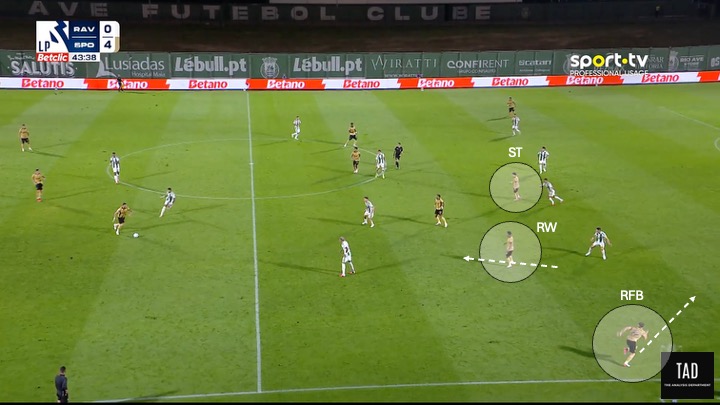
A completed pass can be a poor football action.
An incomplete pass can be a good one.
So what should an analyst actually evaluate: the outcome or the process that produced it?
One team intention doesn't mean eleven identical individual intentions.
A team might be trying to exploit the space behind the opponent's back line.
One player occupies a defender.
Another moves towards the ball.
Another runs away from it.
Another positions himself between opponents.
The player on the ball might wait.
Viewed individually, these actions can look completely different, even contradictory.
But they can all contribute to the same collective intention.
Watch the situation first before reading my analysis.
Several players are involved in what eventually looks like a relatively simple action.
But instead of only looking at what each player does, ask:
What might each player be trying to achieve?
How might those individual intentions interact?
And what can they tell us about what the team is collectively trying to achieve?
I’ve broken down the situation into several moments below ↓
Really like this. For me, shared understanding doesn’t mean predetermined solutions. Players can have different individual intentions and actions while still contributing to the same team intention. Maybe that’s where a shared football language becomes so valuable. It creates alignment without removing individual decision-making.
@coach_kevin_m D for me. The distance makes it difficult to affect the ball, the runner at the edge is already covered, and protecting the front-post space has more priority than doubling up around the penalty spot.
@ReeceEdwardsX Really like this. The execution might look simple, but everything that happens before it might not be. Recognising the situation and finding the right solution is often what allows the action to look simple.
@Keepitonthedeck What stands out to me is how simple the communication seems to be. There can be a lot of complexity behind the way a team wants to play, but the information reaching the players doesn’t necessarily have to be complex. Clear intention, simple language.
How confident can we actually be about a player's intention from video alone?
We can observe the player's positioning and movement.
We can see the ball, teammates, opponents and available space.
We can understand what the team might be trying to achieve.
But when we say:
“This player moves here to create space for his teammate.”
how do we know that was actually his intention?
From video, we observe behaviour and the situation around it. From there, we interpret how an individual might be trying to contribute to the team intention.
Where do you draw the line between observation and interpretation when analysing football?
A team intention can only be achieved collectively.
Imagine the team wants to exploit the space behind the opponent's back line.
The winger makes a run in behind.
The #9 occupies a centre-back.
The #10 positions himself to influence another defender.
The player on the ball creates the possibility to find the space.
Each player has a different individual intention.
But none of them exploits the space alone.
Their individual intentions contribute to the same team intention.
Understanding that relationship helps us see the situation as more than a collection of individual actions.
Describing a football action doesn't necessarily mean we understand it.
A centre-back breaks a line.
A winger moves inside.
A midfielder drops towards the ball.
A striker runs in behind.
We can observe and describe all of these actions.
But what are the players trying to achieve?
What is the team intention?
And how are the individual intentions contributing to it?
Understanding those intentions gives us another reference for making sense of what we see on the pitch.
What happened is only the beginning of the analysis.
Football changes. The game remains.
A 4-3-3 isn't fundamental.
Building with three isn't fundamental.
Inverting the fullback isn't fundamental.
Pressing man-to-man isn't fundamental.
They are ways teams try to solve problems within the game.
What comes first is understanding those problems:
How do we create and convert chances?
How do we prevent and neutralise the opponent's chances?
The solutions will continue to evolve.
The analyst needs to understand both: what remains and what changes.
This reminds me of something Marcelo Bielsa once said about fame and money being insignificant compared to the love for the work itself. Maybe that's something many of the very best have in common. The goals, records, money and recognition can all come with football. But they aren't necessarily the reason they fell in love with the game in the first place.
@kevinvidana Really like this. The challenge for me is helping players understand the situation without prescribing the solution. Give them clarity about what they are trying to achieve, then allow them to recognise and decide HOW.
Really interesting. I also wonder how often these scenarios are actually trained during the week. We see teams change to a back five to protect a lead all the time, but how often have the players actually experienced that situation together before being asked to solve it under pressure?