Trauma Care After Resuscitation
Leading online trauma training courses for nurses and other clinicians caring for patients across the trauma care continuum
Trauma Term Time! Transient Ischemic Attack (TIA): a temporary disruption of blood flow to the brain that causes stroke-like symptoms. In trauma patients, TIAs and strokes most often result from carotid or vertebral artery occlusion.
What’s your experience? When you’re working and need a little pick-me-up, what’s your go-to beverage? Coffee, tea, or an energy drink? Leave your answers in the comments.
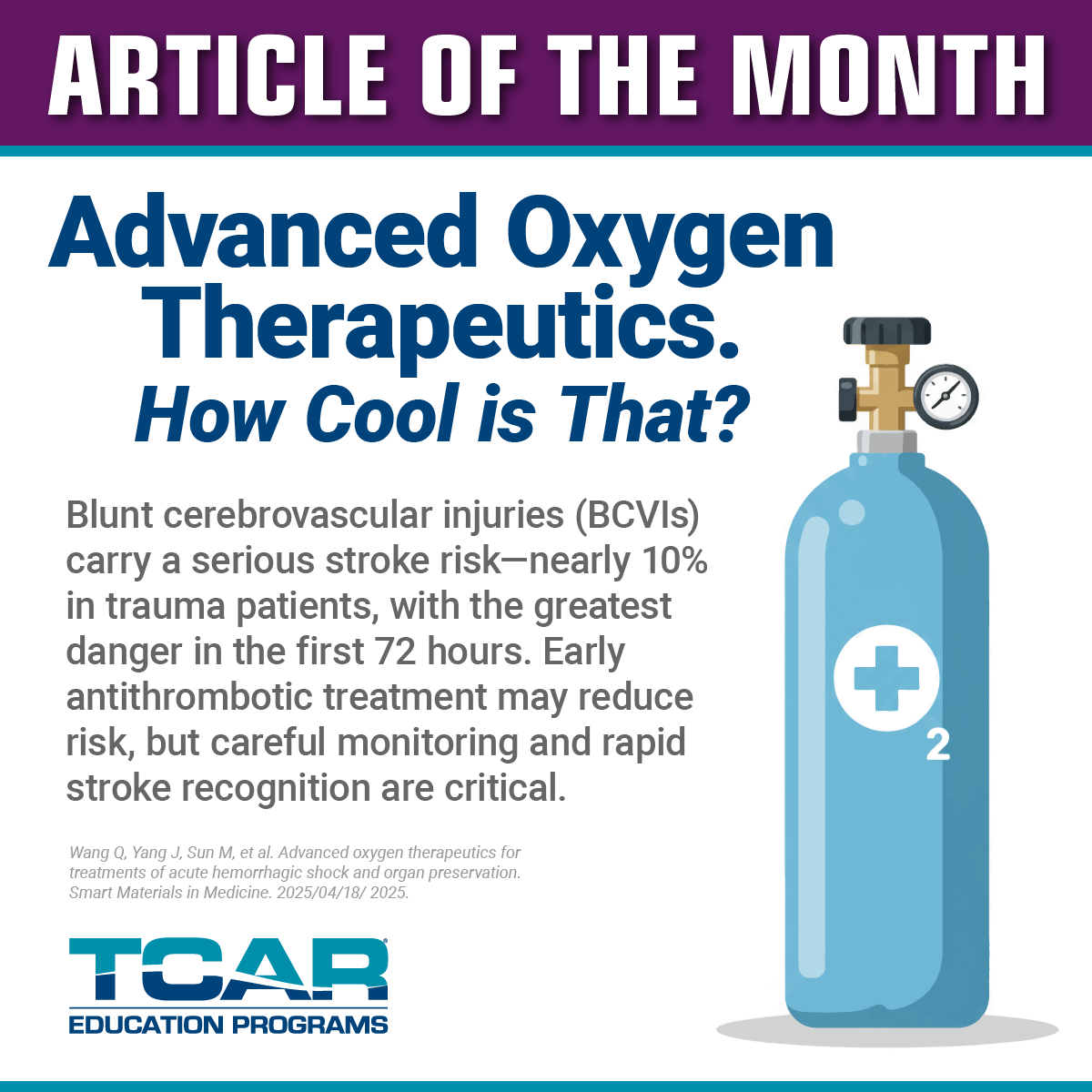
February Article of the Month. BCVIs carry a high stroke risk (~10%) in trauma patients, highest in the first 72 hrs. Early antithrombotic therapy may help, but careful assessment and rapid stroke recognition are key. https://t.co/W69y9T5DlU
Our first Fun Fact of the new year. Your brain is truly a universe of its own! With over 86 billon neurons, it would take almost 3,000 years to count them(even at one neuron per second).
Looking for course help? Stop by the Resources page on our website and explore the wide variety of tools we offer such as Thoracic Injury Comparison Chart, Intracranial Lesion Comparison Chart, the Glossary, and many more. https://t.co/n8xFOCqUQZ.
Interested in our TCAR and PCAR courses. Here’s what a past learner had to say. Talk to your administrator about signing up today. For more information check out our website at https://t.co/n8xFOCqn1r.
Have you subscribed to our weekly Trauma Tuesday newsletter? Get trauma-related medical articles, trivia, quizzes, and puzzles sent directly to your email every week. Subscribe today. https://t.co/PG9DesBXcM
Today our Historical Nurses post honors Mary Breckinridge. In 1925, she founded the Frontier Nursing Service, sending nurse-midwives on horseback to deliver lifesaving care in rural Kentucky—laying the foundation for Frontier Nursing University. Learn more https://t.co/NNIGy5GOuS
Trauma Term: Subarachnoid Hemorrhage (SAH)
Bleeding that occurs between protective layers around the brain and spinal cord—an area normally filled only with cerebrospinal fluid. Knowing the terms helps us better understand serious brain injuries. https://t.co/SY8ZO5gfpY
A 2023 study shows extremely high mortality rates in hemodynamically unstable pelvic fractures and wide variation in hemorrhage control strategies—reinforcing the need for standardized algorithms and strong nursing vigilance. https://t.co/UWfzX9Dcul
Our last fun fact of 2025 goes way back in time. In 1816, French physician René Laennec invented the stethoscope, transforming the way heart and lung sounds are examined. Want to know what inspired his breakthrough? https://t.co/NuMdeljzqi
Looking for course assistance? Check our library of free bedside resources including the Abdominal Injury Comparison Chart showing how abdominal injuries differ based on tissue characteristics. Head to our website: https://t.co/SY8ZO5gNfw or https://t.co/TbE3tp3SJf.
Curious about our PCAR and TCAR courses. Here’s what one student had to say. Talk to your administrator about signing up. For more information check out our website at https://t.co/n8xFOCqUQZ.
Are you receiving our weekly Trauma Tuesday newsletter? Sign up today to have trauma-related articles, trivia, and quizzes sent directly to your email every week. You’ll also have access to back issues. To subscribe, simply follow the link on our homepage. https://t.co/n8xFOCqn1r
Today we honor Edith Cavell, the WWI nurse who treated all wounded soldiers and helped over 200 Allied troops escape German-occupied Brussels. Learn more about her remarkable life at https://t.co/8D82vHIToa
Trauma Term of the Day: Periorbital ecchymosis, sometimes called panda eyes or raccoon eyes. This is bruising around the both eyes and is associated with anterior fossa basal skull fractures. For more Trauma Terms, visit the resource page on our website. https://t.co/Wf6hKege5y