@thmslj i'd split scoped credentials out of the sandbox into their own layer. the agents.md malware campaign https://t.co/xYFFYHNm0x flagged today went straight for github tokens and cloud creds, and the delegated token an agent holds for a user is the part i'm building around
nginx2root has a public poc and a reload alone won't swap out the vulnerable binary, so patching this one means a real restart. i'd take the http/2 boxes down today for it
https://t.co/KJgi9JqClr
‼️ BREAKING: A 10-year-old flaw in #NGINX could let attackers execute code on servers — no login required.
Dubbed #nginx2root (CVE-2026-123007), the critical HTTP/2 vulnerability scores 9.2/10.
Public PoC available. Patches released.
Full details ↓ https://t.co/kNq60Lv5zx
@matthew_d_green i'd take an honest not confident over another all clear. the vague part is what's hard to act on, even knowing whether it's primitives or implementations would change what i prioritize this week
@jachiam0 stockpiles help find bugs faster, and i'd spend the same energy on getting fixes live. i take servers down same day to patch and eat the uptime hit
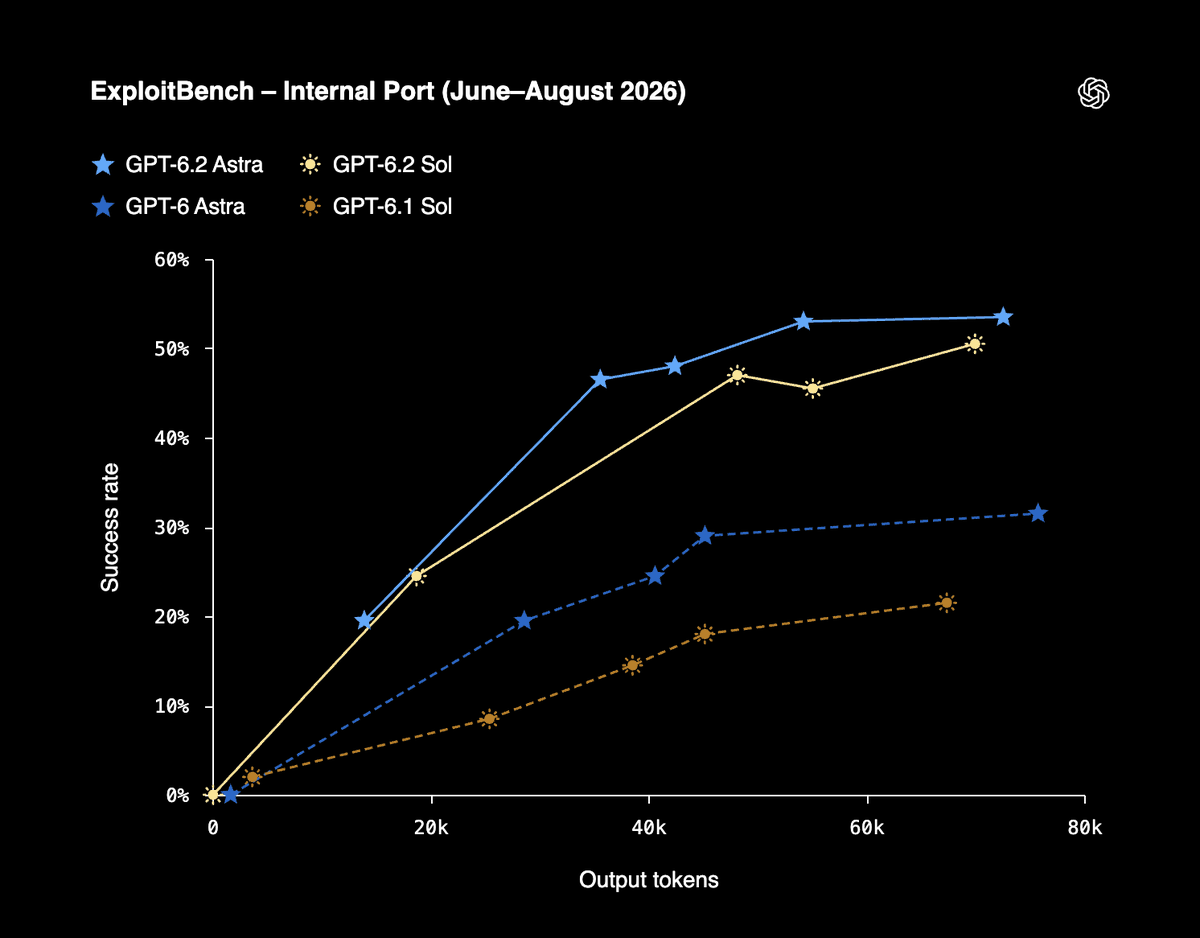
openai shipped gpt-6.2 astra today with tighter cyber safeguards, and the vetted lane for approved defenders is still on the way. until that lane opens, the public model treats attackers and defenders on the same terms
https://t.co/c3rFLkK6E2
https://t.co/c3rFLkK6E2
GPT-6.2 Astra is our most capable model ever for cyber. It jumps 22 points over GPT-6 Astra on ExploitBench Internal Port.
Due to increased capabilities, we’re launching GPT‑6.2 Astra and Sol with tighter safeguards for higher-risk cybersecurity assistance. We are working to bring these models to Daybreak so approved defenders can access them with reduced refusals.
@natolambert google's exploit_agent report yesterday has it running on frontier and locally hosted models, so revoking api access only cuts off part of the pipeline. i run 4x dgx and nobody upstream ever sees that usage
@koraykv@GeminiApp the fast tier is what ends up reading logs, tickets and tool output all day inside an orchestrator, so hydrogen will see more untrusted text than carbon or argon ever do. i'd want its prompt injection numbers in the model card right next to the fabrication ones
@darioncassel an agent reviews all my code, so the part i'd worry about is a reviewer model going easy on another model's work out of regard for it. i'd want that measured on code review and monitoring tasks specifically
once anthropic is public, stolen weights turn into an 8-k filing within days of calling it material. i'd bet the first 8-k about a stolen model gets filed by end of 2028 https://t.co/8BFmJHEEXn
https://t.co/8BFmJHEEXn
Our initial public offering: https://t.co/Ah4BkI2loD
Legal disclaimer: Anthropic has filed a registration statement (including a prospectus) with the SEC for the offering to which this communication relates. Before you invest, you should read the prospectus in that registration statement (available at: https://t.co/Z44axxzf9b) and other documents Anthropic has filed with the SEC for more complete information about Anthropic and this offering. You may get these documents for free by visiting EDGAR on the SEC Web site at https://t.co/94ojsWZTKi. Alternatively, copies of the preliminary prospectus may be obtained from: Goldman Sachs & Co. LLC, Attention: Prospectus Department, 200 West Street, New York, NY 10282, by telephone at (866) 471-2526, or by email at [email protected]; or Morgan Stanley & Co. LLC, Attention: Prospectus Department, 180 Varick Street, 2nd Floor, New York, NY 10014.
The securities may not be sold, nor may offers to buy be accepted, prior to the time the registration statement becomes effective. This post is not an offer to sell, or a solicitation of an offer to buy, the securities in any jurisdiction where the offer or sale is not permitted.
@matthew_d_green my guess is the hardware refreshes you raised. any key that was wrapped out and unwrapped into a new hsm reads CKA_LOCAL false by spec, so a lot of older roots would fail it, which is awkward when code signing already makes subscribers prove their keys were born in hardware
@AndrewLampinen memory reads like a delegated credential nobody scoped, one benign session ends up steering what the agent does in a later task. i'm building against this kind of agent access problem, more on it soon, and curious whether expiring old memories cuts the effect
an agent does my code review now, so a proof that covers the code actually running on devices is the first check i'd trust in that loop without reading anything. by end of 2028 the big crypto libraries ship with proofs like this, and open sourcing the specs is what gets them there
@alexandr_wang first job i'd give ember is a monitor that reads every tool call before an agent executes it. at this price the security team doesn't have to fight for that budget anymore
@iamtrask if these curves hold, the security story starts in research infra, since that's what a self improving loop touches first and it rarely gets audited like prod. i'd date the first public incident traced to an automated research loop to end of 2027
@giffmana an agent reviews my code and i only judge the output. i still treat that as a one time speedup until the next review is better because of what the last one learned
@patopet putting services behind auth stops the anonymous agent. the one i worry about more shows up holding a user's delegated token and walks straight through it, which is what i'm building against, more on it soon
@francoisfleuret ml phd and my bet lands on better final loss when the recovery is clean. a spike the optimizer absorbs usually means it found a sharper basin