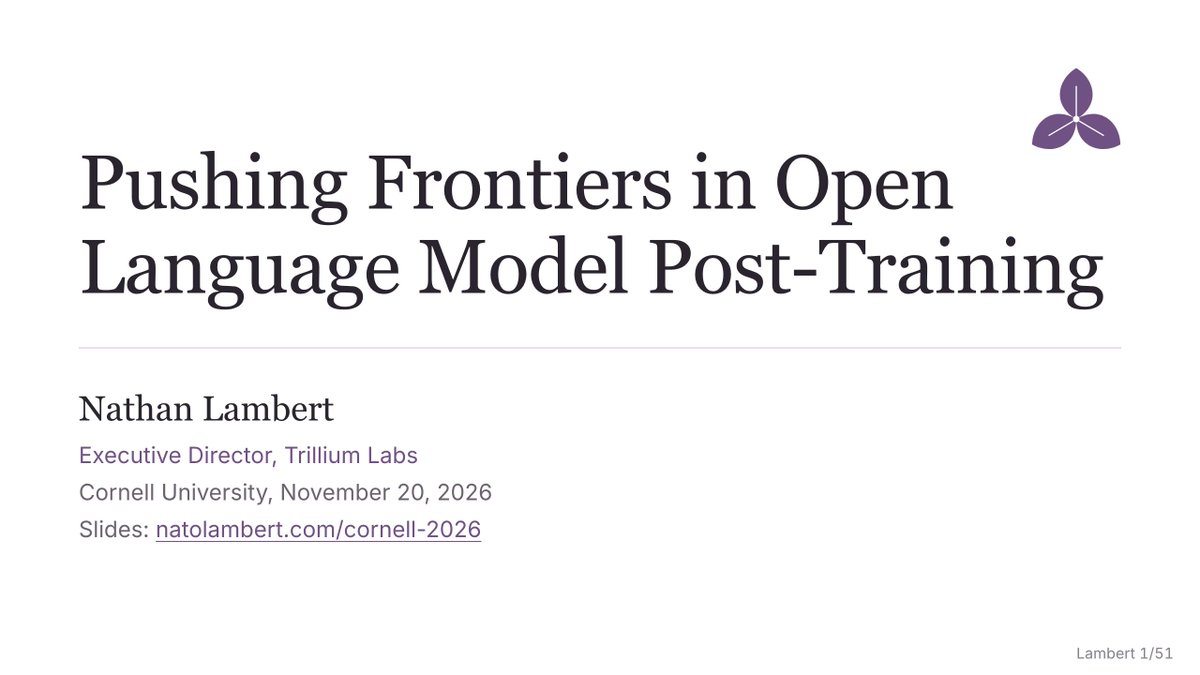
New slide deck on the biggest open problems in post-training and how the field got to where it is today. Largely, this is a statement of my goals with Trillium Labs (not that we can do every project at once). Stay in touch if you're working on any of these in the open!
Opens with the evolution of post-training and ends with a debate on how RSI is changing this type of research.
The research areas on my mind:
1. Harness specialization and design – How do we design environments for context management that enable new paradigms of using LLMs?
2. Character training – How do we create the personality of models and how does this impact safety, trust, and diffusion of LLMs?
3. Open-source RL environments – How do we create scalable, open data methods?
4. Reasoning efficiency in RL – How do we control and manipulate the reasoning efficiency of LLMs?
5. Scaling laws for RL – How do we design principled experimentation methodology for large-scale post-training?
6. Multi-agent scaling laws – What are the main axes of inquiry into multi-LLM systems and collaborations?
Re-recording video soon :) was from a recent visit to Cornell
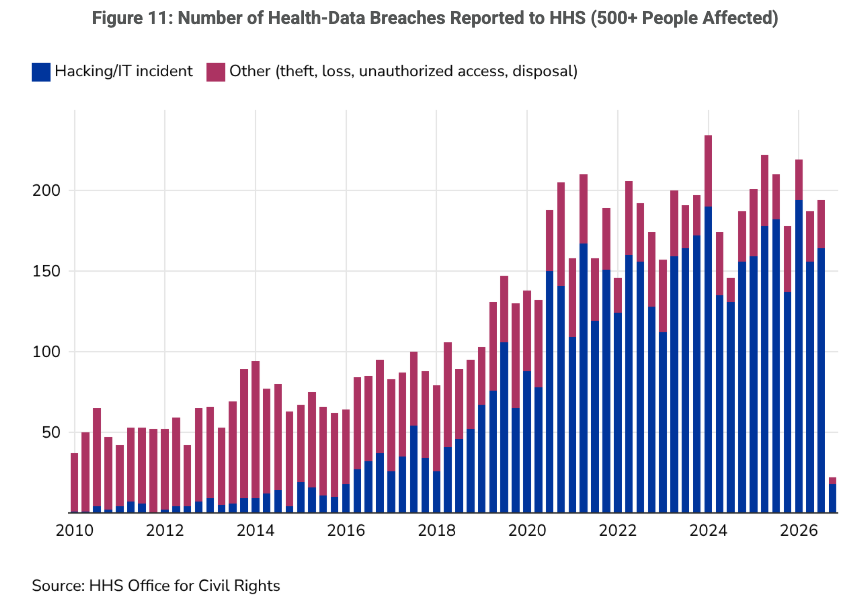
This is not very vibe compliant, but we have a new post out today looking at what data on *impacts* of cyber attacks tells us about whether the cyber-pocalypse is here.
TLDR: not yet?
May just be lagging data, or slow adoption of AI tools by cyber attackers. But another possibility is that a significant factor here is that attackers' incentives matter at least as much as their technical capabilities, and their incentives (to avoid retaliation/prison/etc) have not changed all that much.
If so, one implication is that attribution matters a lot in this new era - does AI make anonymity easier, and if so can we do anything about that?
Some data below; more charts and more recommendations in the full piece.
https://t.co/QL7b9Kxlvb
Happy to be a part of this open intelligence mini-doc by Modal. Very happy to get work on this mission with great friends in the space. https://t.co/BtR6WF889t
It is an inevitable path of optimization that interpretable chain of thought goes away. It being intelligible is an inefficiency brought about how we first discovered inference time reasoning (related to in-context learning). Looped architectures are the first step there.
This squashes intelligence a bit too much into one quantity, where intelligence is jagged in whatever form you make it. The Riemann Hypothesis is showing math is the peak, and the question is how close behind all other valuable domains are.
Reading the comments of this is very interesting. There's a whole other open models community, which feels closer in vibes to the crypto community past, and I feel like I barely know most of them.
i am so so so so so so so so so so excited about local models, open weights, private inference, etc.
it reminds me of the early days of Bitcoin when the focus was on sovereignty and censorship resistance.
where are the philosophers of this movement? must follow!
@Melt_Dem Have been writing interconnects partially to chronicle the formation of the open ecosystem & economy. Will soon cross 100K readers :) https://t.co/DNSgULmpHs
We decided to provide more transparency into pretraining progress at OpenAI for the sake of moving toward shared safety bars. In “Perplexity and Intelligence” I argue for common limits based on perplexity and other measurements, with progress beyond them gated on our ability to understand AI behavior.
https://t.co/XX35m5vq89