We've raised $1.1B to build AI that is owned and shaped by each of us. Check out the article published by the The New York Times that explains River AI's mission and where we're going next.
Our first product is the River API which allows anyone to build custom agents and LLMs based on open weight models: https://t.co/kDIR8zRZwG
Congrats to the team and thank you to all of our supporters. Stay tuned for more updates soon.
Today, we're sharing that River AI has raised $1.1 billion, led by @generalcatalyst and @amppublic with strategic investment from @nvidia and @AMD. Additional investors include @ycombinator and @Temasek.
We imagine a future where your AI works entirely for you and deeply aligns with your values. Compared to the corporate chatbots of today, it will feel completely different: responsible, curious, and truly yours. Most importantly, you'll own everything: the hardware it runs on, the data it learns from, and the intelligence itself.
Our training API is already live and powering incredible work today. This new funding accelerates our push to bring the full personal AI stack to life.
Read River AI CEO Igor Babuschkin’s (@ibab) conversation with the New York Times to learn more: https://t.co/DK66aKkF31
We just shipped something pretty unique among post-training API providers: end-to-end custom losses.
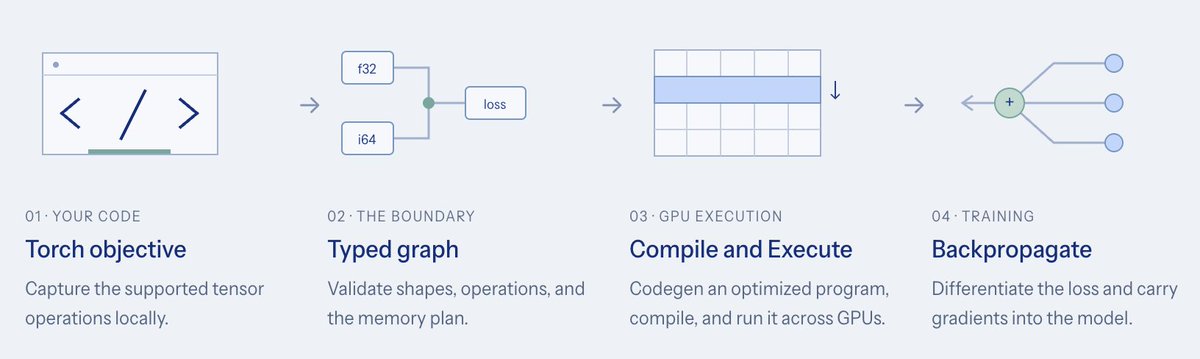
The objective you define locally gets traced into a graph, compiled and executed efficiently on our GPUs.
Read more about the engineering behind it in our latest blog post.
The River API now supports training LLMs with any loss function. You define a custom loss in PyTorch on your laptop and we efficiently execute it at scale on our remote GPU cluster with zero overhead.
The blog explains how it works: the loss function is traced on your machine, sent to the API as a graph, and the computation gets parallelized and streamed for memory efficiency.
Custom losses are now live on the River API.
Write your objective in PyTorch. Our Symbolic Engine compiles and runs it end-to-end across GPUs, handling efficient execution and memory usage.
Learn more and see it in action with decision models and score centering: https://t.co/YCV6SbAEVB
No one changes the world alone
Introducing Ampersand - the first model built for us. Ampersand is a collaborator trained to help people achieve their individual and collective goals. In multi-month simulations, users collaborating with Ampersand accomplished more than with Fable and other frontier models
Available to everyone through our API
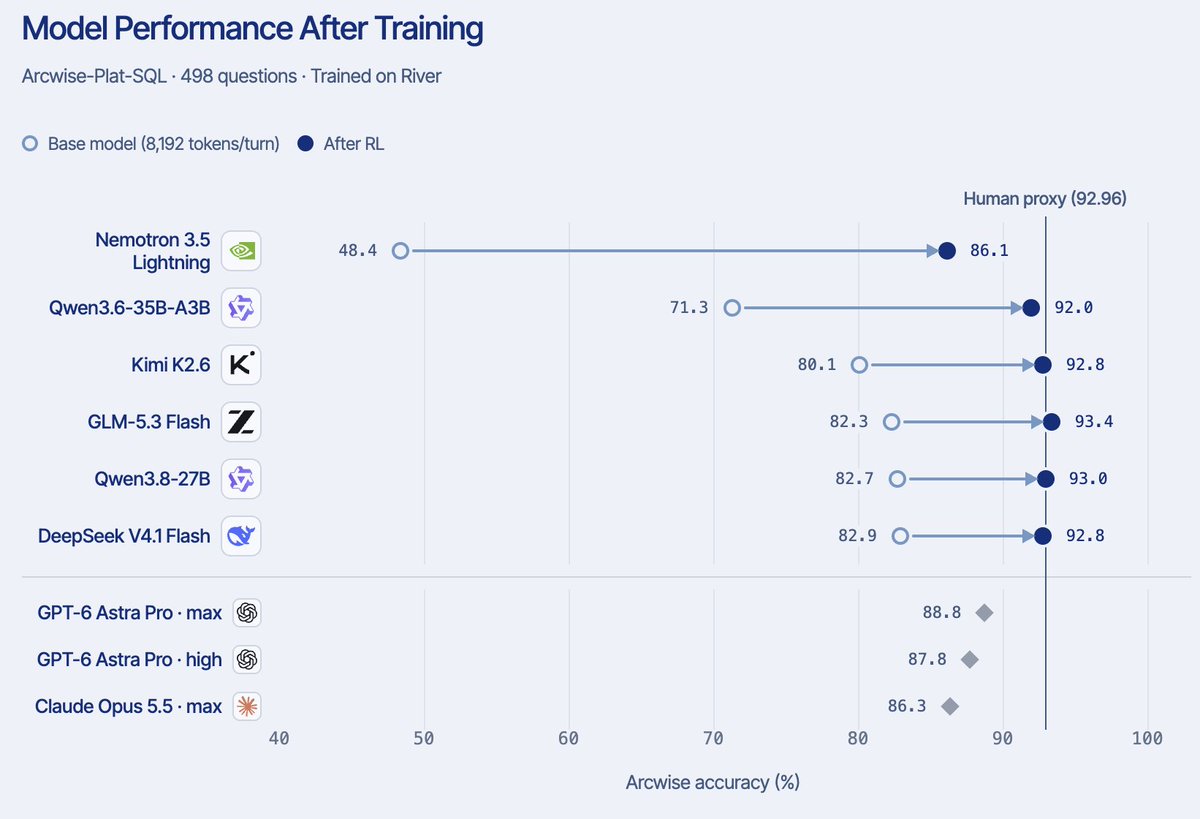
Nemotron 3.5 Super VL is now available on the River API for inference, finetuning and RL. We show how it can be trained to beat Astra and Opus 5.5 on SQL generation.
We've partnered with @NVIDIAAI to make Nemotron 3.5 Super VL available on the River API from day zero.
Even before training, Super VL outperforms Kimi K2.6 on our text-to-SQL evaluation, despite being a fraction of its size. After training with our text-to-SQL recipe on River, it outperformed every proprietary model we evaluated.
These results show what's possible with River: frontier-level performance on a specialized task, using a model small enough to deploy on your own hardware.
@PavanKatta1998@finitetape@JayaGup10 Not at all, the reason we added prod inference is that our customers keep asking us for a way to deploy their custom models to users (public facing or internal). They can deploy their models with one click now, quantized and optimized.
@KyrelleBuckley@river_ai_inc It depends on how general the task is. We’ve seen just a few hundred RL tasks can be enough. Often these can be built synthetically by agents, or from existing data at the company.
Over the last few months at @river_ai_inc we’ve developed what we believe is the best system in the world for building your own internal custom models, driven by 10 years of experience training top models at DeepMind, OpenAI and xAI.
In order to best support our customers, we’ve decided to do something radical: We also deploy our API on-prem on your compute cluster, and if you don’t have compute we will help you find it.
Again and again we’ve seen that custom models designed for your own internal workflows outperform top frontier models on performance, at a fraction of the cost (1 percent or less).
We’re just at the beginning of the custom model era, but its already clear that in the future more than 99% of LLM tokens will be generated on efficient custom models. The economics of it are just too powerful, and it’s far easier than people think once you have the right tools in place.
The reason why small models will dominate is due to the physics of deep learning: A general model that can do everything needs more capacity and training it on the whole distribution of all tasks is more challenging, so the model will be larger and more expensive, and wont perform perfectly on every task. A small model trained on a targeted domain usually outperforms it.
We were able to fine tune an open weight model (Qwen3.5-9B) on proprietary internal data at @coinbase, and it out performed frontier models, at much lower cost and speed, for a specialized task (fraud prevention in this case).
I think we'll see more of this pattern inside companies. The frontier models are amazing generalists. But increasingly you'll see specialist models out perform on more narrow tasks, either working on teams, or by themselves.
We're making it easy to fine tune models internally for our employees. We even have a skill for it in our internal harness that makes it easy to spin these up and start training them:
"/fine-tune-and-serve-llm I want to fine-tune Qwen for payments risk review. help me get started"
I imagine we'll have some backend services that could be replaced entirely by this new architecture.
We’ve launched fast production inference for open-weight models! Anyone who signs up right now gets $25 in free credits to spend on the platform.
DeepSeek v4.1 Flash and GLM-5.3 Flash are 20% cheaper than the offerings from DeepSeek and ZAI.
At River AI we’ve written our own training and inference stack from scratch in Rust, which unlocked much higher efficiency. We’re passing the savings on to our customers. Enjoy!
We show how you can use the River API to fine-tune open weight models to beat GPT-6 Astra and Claude Opus 5.5 on tasks you care about, with less than 1% of the cost!
A few years from now most of the LLM usage in the world will run on customized open weight models. Building your own custom models is getting easier and more affordable. Our mission is to help everyone own their own intelligence and be independent of big AI labs.
Introducing River Recipes: our open-source initiative for turning promising research into vetted, reproducible training recipes.
Our first recipe tackles text-to-SQL, where our trained open models beat GPT-6 Astra Pro and Claude Opus 5.5 on Arcwise-Plat for less than 1% of the cost.
Read the full breakdown and explore the recipe ↓
https://t.co/MNcTas9TOf