Tenshin-ryu Training Method: Candle-Flame Cutting
This is Tenshin-ryu’s candle-cutting training method.
You can clearly see the moment when the flame is cleanly split straight down the middle.
Thank you very much for helping the Tenshinryu International Facebook page surpass 450,000 total followers.
Your support and amplification make a real difference. Thank you for standing with us.
https://t.co/cu1v3SEnfl
You do not rely only on the arms, but use the whole body to create the sword's cutting angle. By using your footwork as much as possible, you cultivate strong legs and hips, agile movement, and Kenkitai-ichigan, the unity of sword, mind, and body.
11.12 TENSHINRYU ONLINE KEIKO
https://t.co/hKENjwZmzd
19:30-20:00(JST)
Instruction:10th Shike Kuwami Masakumo Sensei
We will give private Online Lesson exclusively for the Tenshinryu family (students, Tenshinryu online members, YouTube membership)
20:00-21:00(JST)
Hone-chan’s Chochin-yaburi 提灯破 challenge from Tachiai Battojutsu.
This isn’t a traditional method, but in Tenshinryu we often train by placing obstacles on the wall or overhead.
When something presses in on you, the body moves on its own.
#Samurai
Tenshinryu Hyoho — Tachi-ai Battojutsu: Chochin-yaburi 提灯破 performed as Madoi-nuki 円居抜(in a circle).
A method in which, the instant the opponent moves to draw, you drop your body low and sweep-cut the shin.
For this Chōchin-yaburi, keep your body as low as possible.
As training, we also tried a tsuri-tenjō (suspended-ceiling trap) setup—improvised with a furoshiki.
Chōchin-yaburi 提灯破(Lantern-Breaker) Challenge.
In Tenshinryu Hyoho, our techniques often come with the adverb dekiru dake—“as much as possible.”
Setting real combat aside, in kata practice we do things as much as possible to forge the body and polish the technique.
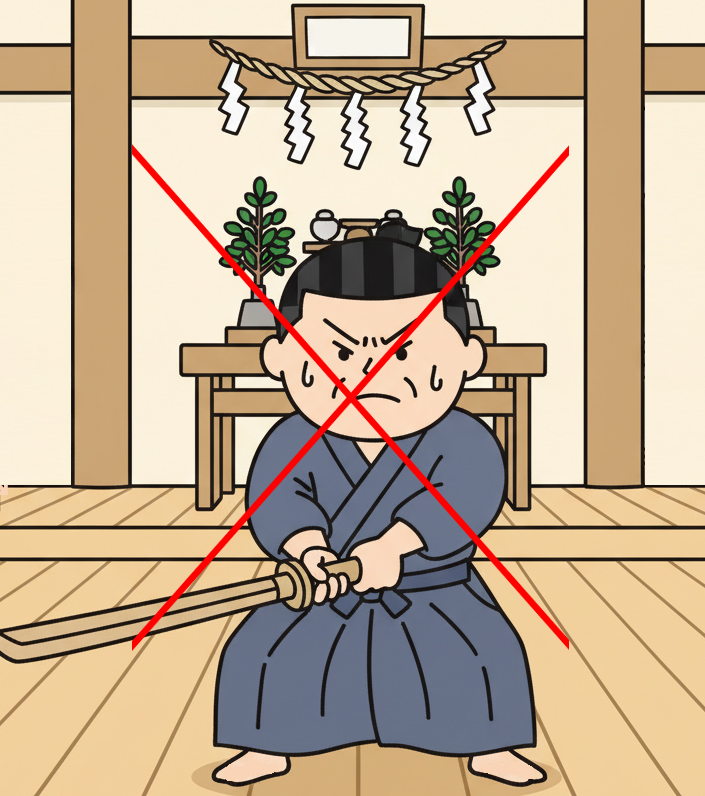
As a general rule in Japanese culture, it is taboo to turn one’s back (or backside) toward the shinza (the deity’s seat). In a dojo or home this means the kamidana (household shrine), and in a Shinto shrine it means the honden or sanctuary—the place where the kami are enshrined.
Of course, in the natural flow of actual training, instruction, or demonstrations, there will be moments when one’s back—or the sword tip—ends up facing the shinza. This is why the above is a guiding principle: it is an expression of respect for the kami.