On a cold New Year’s Eve, one glow changed everything.
After years of obsession, thousands of failed experiments, and more late nights than anyone could count, Thomas Edison finally invited the public into his lab in Menlo Park to see something the world had never seen before.
A practical incandescent light.
Not a theory. Not a sketch. Not a promise.
A working bulb that could stay lit, safely, long enough to matter.
And this was the bulb he used.
The original carbon-filament lamp that powered that first public demonstration and proved electric light was ready for real life.
On this day in history, Edison didn’t just flip a switch.
He showed the world what persistence looks like when it finally pays off.
#OnThisDayInHistory #ThomasEdison #InnovationInAction #PersistencePays #HistoryThatMatters
Edison saved thousands of papers. This one might be the strangest. 🦃
Tucked in the archives is a Thanksgiving telegram from 1924, wishing him well and referencing a Rhode Island turkey.
Edison read it, grabbed a pencil, and wrote his reply right across the bottom: “Thanks for the gigantic turkey you sent. Edison.”
In a sea of serious paperwork, this light Thanksgiving note hits differently.
Maybe it was the size of the bird.
Maybe it was the rare break in a year packed with experiments.
Or maybe it was just a moment that made him laugh.
Here's to that!
Most people walk past the old punch clock at the entrance of the West Orange labs without thinking twice. Edison treated it like everyone else did. He clocked in, he clocked out, and he broke the rule of “going home on time” more often than his wife would have liked.
During the Diamond Disc years, his time cards show weeks that hit eighty five, sometimes ninety five hours. Long nights. Early mornings. A man who kept forgetting to live a normal rhythm because he was chasing something he couldn’t quite let go of.
It tells you a lot about him. He wasn’t only a husband and a father. He was someone who felt pulled toward the work that lived in his head, even when the rest of his life was calling him back. Most of us know that tension in our own way, even if it looks different now.
The clock is still frozen at the last moment he walked out. Not as a monument to overwork, but as a reminder of one stubborn truth. A good life is rarely just one thing. And Edison spent his trying to figure out how to honor both.
Edison once looked at slow, expensive homebuilding and thought, there has to be a better way. His answer was bold for the early 1900s, a single-pour concrete house made from one giant mold. The trials didn’t reshape the industry then, but the thinking behind them feels familiar to anyone watching the rise of 3D-printing today.
Here are 6 things Edison’s concrete experiments share with modern 3D-printing techniques:
✅ Build the whole structure in one continuous process.
✅ Reduce extra materials and cut down on waste.
✅ Move construction from days or weeks to hours.
✅ Make durable, safe housing more affordable.
✅ Create custom shapes without extra labor or parts.
✅ Use new methods to rethink how entire neighborhoods could be built.
Thomas Edison didn’t invent the first light bulb. So what happened on October 21, 1879?
On this night, Edison and his Menlo Park team tested a cotton thread filament in a near vacuum. This time the bulb glowed for 13.5 hours straight. It was the breakthrough the world had been waiting for and proof that electric light could actually work in everyday life.
Edison’s design could also be produced for about $1.00 a bulb at the time (roughly $30 today). Still costly, but dramatically cheaper and longer-lasting than earlier versions. Within a few years, improvements (including carbonized bamboo filaments that lasted over 1,000 hours) brought the price down enough to wire homes, streets, and eventually entire cities.
That night in October wasn’t the birth of the light bulb. It was the moment it became practical.
#OnThisDayinHistory #ThomasEdison #Light #LightTheWay
9 nations honored Edison with medals. 22 universities awarded him degrees. In 1928, the United States added the highest honor of all.
That year, Congress awarded Thomas Edison the Congressional Gold Medal — the top civilian recognition of its time. Treasury Secretary Andrew Mellon presented it in Edison’s West Orange lab, while President Calvin Coolidge’s words were broadcast nationwide on nearly 50 radio stations:
"In his invention of the incandescent lamp and in the perfection of means for developing and distributing electrical energy he literally brought light to the dark places of the earth.
Although Edison belongs to the world, the United States takes pride in the thought that his rise from humble beginnings and his unceasing struggle to overcome the obstacles on the road to success well illustrate the spirit of our country. "
A proud tribute from his country to the man who lit up the modern world. 🇺🇸💡
#ThomasEdison #CongressionalGoldMedal #History #OnThisDayInHistory
On the morning of October 18, 1931, the front page of the New York Times carried the news that stunned the world: Thomas Edison had passed away at his home in West Orange at 84 years old.
In the days that followed, visitors began arriving at his laboratory. By the thousands, they filed past Edison’s casket in the library where he once worked late into the night. Pope Pius XI, President Hoover, Henry Ford, and everyday citizens alike shared their grief for a man whose inventions had lit their homes, entertained their families and powered their cities.
Four days later, the mourning turned into a national ritual. At 10 PM, Americans across the country switched off their lights for one full minute, honoring the man who had once turned darkness into light.
The moment said more than words ever could: Edison’s genius had touched every life, and the world would never be the same without him.
#ThomasEdison #NYTimes #OnThisDayInHistory #LightInTheDarkness
Every September 11, the sky over New York glows with the Tribute in Light. Two powerful beams stretch upward, standing in for what was lost, and reminding us of what endures.
Thomas Edison once said he wanted his light to be “for the people.” More than a century later, light still carries meaning far greater than he could have imagined.
As those beams shine tonight, we remember. ♥️
#NeverForget #September11 #TributeInLight #WeRemember #DayOfRemembrance
Then and now: Mina Edison’s greenhouse is still growing.
More than a century ago, Mina Edison filled this glass house with orchids, ferns, palms, and seasonal blooms. She was a devoted gardener and early conservationist who believed in protecting nature and educating others to do the same.
She supported local garden clubs, championed civic causes, and promoted community gardens long before they were common.
Today, Glenmont’s greenhouse still stands...and some of the plants inside are descendants of the ones she cared for.
It’s one of the many reasons Glenmont is now recognized as part of New Jersey’s Women’s Heritage Trail, honoring Mina’s leadership in the home, the community, and beyond.
Weekend tours include the greenhouse and grounds. Plan your visit + download our free guide:
👉 https://t.co/jpwTzVQoqI
The day Mark Twain traded his pen for Edison’s phonograph, he became the first author to dictate a book.
In the late 1880s, Twain had a plan. He wanted to finish A Connecticut Yankee in King Arthur’s Court by speaking it into Edison’s brand-new phonograph, then having someone type it up from the recordings.
But the machines weren’t ready. Twain had to finish the book the old way, pen in hand.
Fast-forward to 1891. Twain’s shoulder ached, his hand was worn out… and Edison’s improved phonograph was finally on the market.
This time, he got two of them. Sitting in his study, Twain spoke the words of his new novel, The American Claimant, into wax cylinders, becoming the first author to use a recording device to write a book.
It wasn’t everything he’d hoped. He joked it was “good enough for letters, but not for literature,” and said it lacked the “gift for elaboration” his pen gave him.
Still, for a brief moment, two of America’s most inventive minds had collided — one chasing a story, the other chasing the future.
Even Edison looked up to someone.
In between experiments, he read about people who challenged the norm. Here are a few of the minds that inspired him:
🔹 Benjamin Franklin – Inventor, printer, diplomat, scientist. Edison called him “the first great American engineer.”
🔹 Thomas Paine – Revolutionary writer and radical thinker. Edison read and reread him often and praising him for being far ahead of his time.
🔹 Michael Faraday – The scientist behind electromagnetism. Edison kept Faraday’s work close at hand his notebooks were a regular presence in Edison’s lab.
🔹 James Watt – The steam engine pioneer. Edison once said Watt had done “more for humanity than all the kings who ever lived.”
They were builders, disruptors, and relentless minds who saw what the world could be—and made it happen.
#ThomasEdison #StudyTheGreats #BuiltOnIdeas #GritOverGlory
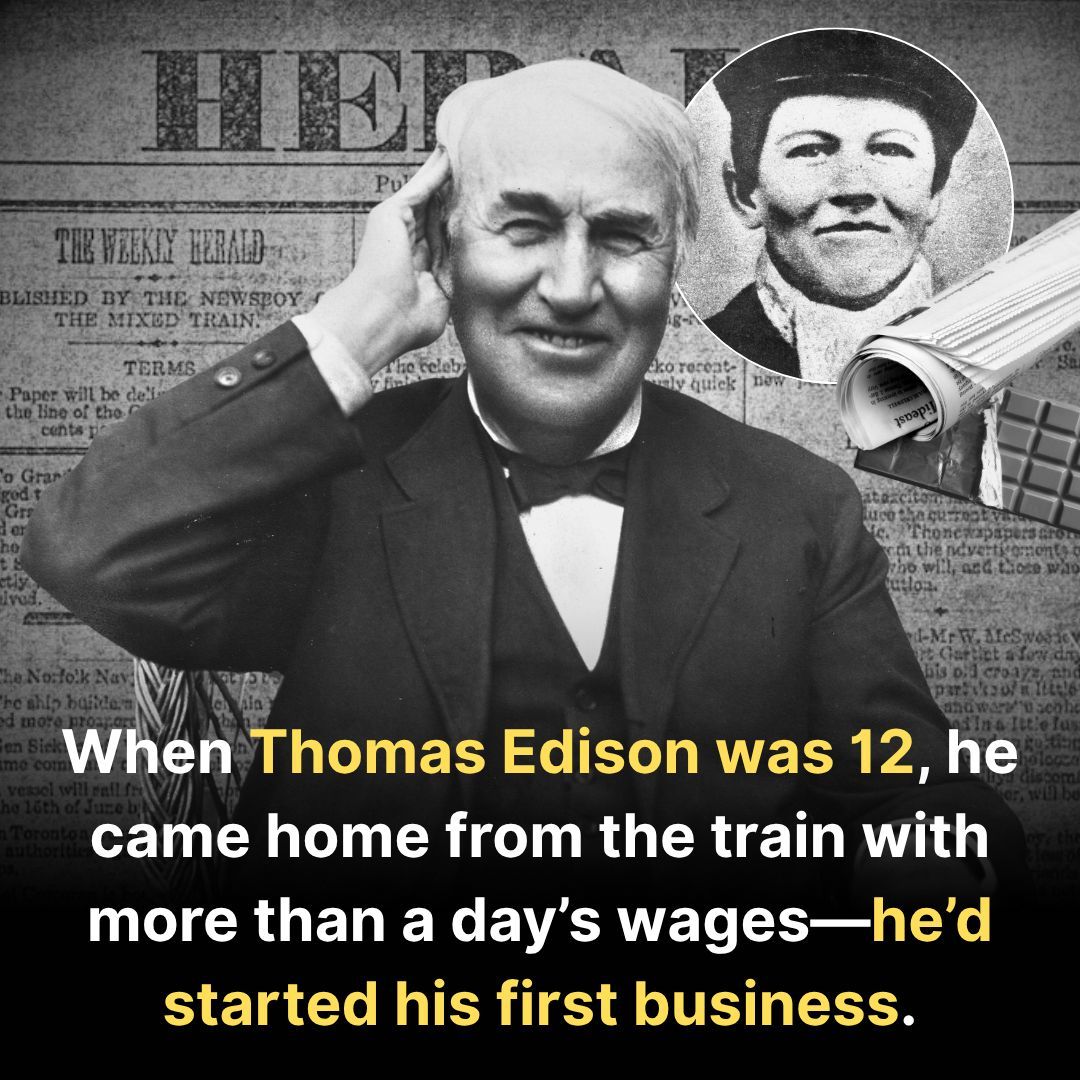
The story is told that when Thomas Edison was just 12 years old, he boarded the Grand Trunk Railroad each morning with a box of candy and a stack of newspapers to sell. But unlike most boys his age, he wasn’t satisfied with just making change and calling out headlines.
One day, he noticed the passengers weren’t just hungry for snacks. They were hungry for news. Not the big city headlines, but the small stories: what was happening in the towns along the line, which packages had gone missing, what gossip was making the rounds.
So, in the back of a baggage car, this young boy set up a tiny printing press and started producing The Grand Trunk Herald - a two-page newspaper written, printed and sold entirely on the moving train. He charged 3 cents a copy, and around 300 railroad workers became regular readers.
The paper was so unusual that a London publication wrote about it calling it the only newspaper in the world printed aboard a train.
The boy didn’t know it then, but he had just launched his first business, learned how to spot a need and fill it, and discovered that ideas are only as powerful as the work you put behind them.
That boy went on to hold over a thousand patents. But in a way, it all started there in the rattling carriage of a train, with ink on his fingers and a head full of ideas.
#ThomasEdison #YoungEntrepreneur #BusinessStories #GrandTrunkHerald #HistoryThatBuiltUs
Edison is buried in the backyard of his home.
At Glenmont, behind the greenhouse and past the trees, there’s a small family cemetery where Thomas and Mina Edison are laid to rest.
It’s quiet and unassuming...easy to walk past if you aren’t looking for it. But it’s part of what makes Glenmont feel less like a museum and more like a real home, frozen in time.
You can visit the gravesite on a weekend tour, along with the house and grounds.
Summer Tours are held only on weekends. Plan your visit + get our free guide:
👉 https://t.co/jpwTzVQoqI
#ThomasEdison #Glenmont #EdisonGravesite #HistoricHomes #WestOrangeNJ #EdisonHistory #LlewellynPark #EdisonLegacy #STEMHistory
Thomas Edison didn’t get his best ideas at a desk...
He got them while almost asleep. 😴
He used a technique called hypnagogia, the brief state between being awake and asleep, because he believed that’s when the brain was most creative.
To access it, he’d sit in a chair holding steel ball bearings over a metal tray. As soon as he started to doze, they’d fall and wake him. Just enough to hold onto whatever idea surfaced!
It might sound odd, but if you’ve ever had a great idea in the shower, you’ve actually been in that same state. When your body’s on autopilot and your mind starts to wander, your brain starts making unexpected connections.
Today, researchers call it the default mode network, and it’s linked to creativity, memory, and problem-solving. It can happen when you're lying in bed before falling asleep, driving a familiar route, folding laundry, or just staring out a window.
Some of your best ideas don’t show up when you try harder. They show up when you’re not trying at all.