Stay informed on the tax policies impacting you with Tax Foundation Europe, Europe's leading voice on tax policy:
📚 Principled Research
📊 Insightful Analysis
🔌 Engaged Experts
https://t.co/l2hAu3MpMP
Capital gains taxes create a bias against saving, leading to a lower level of national income by encouraging present consumption over investment.
Denmark levies the highest top capital gains tax of all countries covered, at a rate of 42 percent. Norway levies the second-highest top capital gains tax at 37.8 percent. The Netherlands follow at 36 percent.
Explore the latest data: https://t.co/uYAPXl0l9T
The European Commission has plans to generate more tax revenue to fund the forthcoming MFF, the long-term budget running from 2028 to 2034. But the truth is, without serious reform, the EU isn’t ready for new taxation.
Read more: https://t.co/acB6R4ic6l
Poland is currently moving forward with legislation aimed at introducing a windfall profits tax. In doing so, it is following a broader European trend of renewed interest in such taxes in response to rising fuel prices triggered by the conflict in the Middle East.
Read more: https://t.co/qkUhjPH7wW
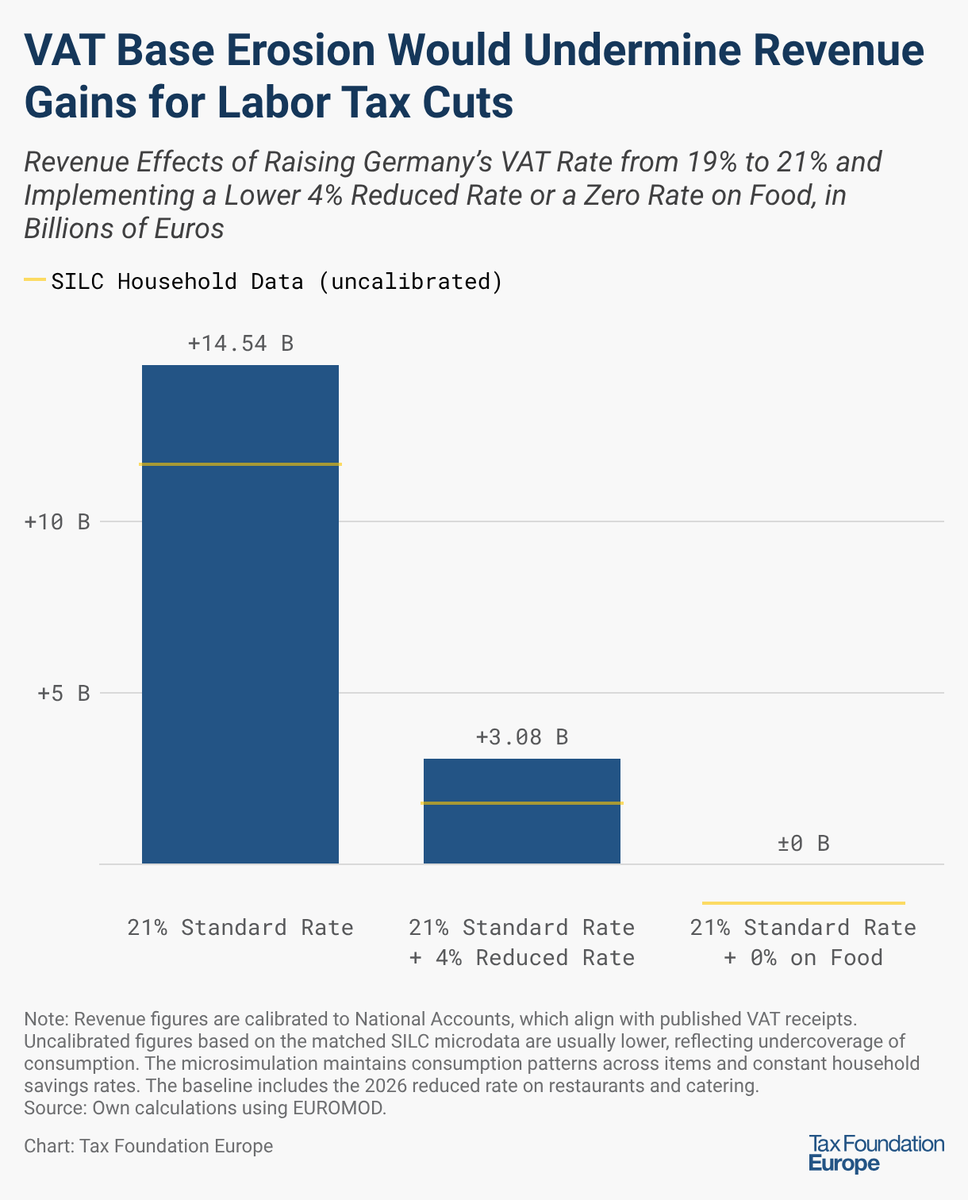
Shifting the tax burden from labor to consumption can improve incentives to work and expand the labor supply. However, combining a higher VAT rate with base-narrowing measures would likely eliminate any additional revenue. As a result, the reform would fail to create additional fiscal space for labor tax cuts.
Read more: https://t.co/iS9ciCB35w
Who really pays for European welfare states? Many assume the answer is obvious: high-income earners contribute while low-income earners benefit. However, that assumption is only partly true, and often misleading.
Read more: https://t.co/xhGQFO356Q
Since digital services taxes generate little revenue, place the cost on European consumers and not on large digital companies as intended, and risk escalating trade disputes, policymakers should rethink their strategy. Read more: https://t.co/Gj0mejpnPP
In recent years, several countries have taken measures to reduce carbon emissions, including instituting environmental regulations, emissions trading systems (ETSs), and carbon taxes. In 1990, Finland was the world’s first country to introduce a carbon tax.
Since then, 24 European countries have implemented carbon taxes, ranging from less than €1 per metric ton of carbon emissions in Ukraine and Poland to more than €125 in Norway, Sweden, Switzerland, and Liechtenstein.
Explore the data: https://t.co/sTsILX7Zv1
Debates over tax fairness and anti-avoidance rules have dominated European tax policy circles for over a decade. However, as geoeconomic pressures increase around the world, policymakers are looking for ways to boost European competitiveness and economic growth.
This new analysis examines how the design of a country’s tax system affects economic growth, and what role European-level harmonization should play: https://t.co/ayGvSKpsfV
EU businesses increasingly operate under complex, outdated, or overlapping tax rules that are applied unevenly across Member States, raising compliance costs and weakening the Single Market.
The European Commission’s Tax Omnibus proposal would amend six directives on direct taxation to simplify the framework, reduce administrative burdens, and strengthen competitiveness.
Read more: https://t.co/a5kdaIpXF8
Closing the EU’s value-added tax (VAT) actionable policy gap could yield €773 billion in government revenue—four times the EU’s 2026 budget.
Read more: https://t.co/8crNvUInhg
In recent years, European Union countries have experienced high inflation—driven by supply factors, demand, and imported inflation—that has significantly altered the economic landscape. This shift from low to high prices has profound implications, especially from a fiscal perspective.
Our research focuses on the inflationary environment’s fiscal consequences. Read more: https://t.co/C6iomlfkwH #inflation #europe
Digital services taxes generate limited tax revenue, increase complexity and compliance costs, negatively impact innovation and competitiveness, risk escalating trade disputes, and are often passed on to consumers.
Our latest testimony: https://t.co/3vDHgiJpe8 @crisberechet
Digital services taxes generate limited tax revenue, increase complexity and compliance costs, negatively impact innovation and competitiveness, risk escalating trade disputes, and are often passed on to consumers.
Our latest testimony: https://t.co/3vDHgiJpe8 @crisberechet
Digital services taxes generate limited tax revenue, increase complexity and compliance costs, negatively impact innovation and competitiveness, risk escalating trade disputes, and are often passed on to consumers.
Our latest testimony: https://t.co/3vDHgiJpe8 @crisberechet
Digital services taxes generate limited tax revenue, increase complexity and compliance costs, negatively impact innovation and competitiveness, risk escalating trade disputes, and are often passed on to consumers.
Our latest testimony: https://t.co/3vDHgiJpe8 @crisberechet
Digital services taxes generate limited tax revenue, increase complexity and compliance costs, negatively impact innovation and competitiveness, risk escalating trade disputes, and are often passed on to consumers.
Our latest testimony: https://t.co/3vDHgiJpe8 @crisberechet
Digital services taxes generate limited tax revenue, increase complexity and compliance costs, negatively impact innovation and competitiveness, risk escalating trade disputes, and are often passed on to consumers.
Our latest testimony: https://t.co/3vDHgiJpe8 @crisberechet
Digital services taxes generate limited tax revenue, increase complexity and compliance costs, negatively impact innovation and competitiveness, risk escalating trade disputes, and are often passed on to consumers.
Our latest testimony: https://t.co/3vDHgiJpe8 @crisberechet
Capital gains taxes create a bias against saving, leading to a lower level of national income by encouraging present consumption over investment.
Denmark levies the highest top capital gains tax of all countries covered, at a rate of 42 percent. Norway levies the second-highest top capital gains tax at 37.8 percent. The Netherlands follow at 36 percent.
Explore the latest data: https://t.co/hr2uQtqPwr
The European Commission has plans to generate more tax revenue to fund the forthcoming MFF, the long-term budget running from 2028 to 2034. But the truth is, without serious reform, the EU isn’t ready for new taxation.
Read more: https://t.co/vwuEg0pn0f