Bringing native forests back to life. Tools, training, and funding for local restoration teams. Follow for forest science, field stories, and climate solutions.
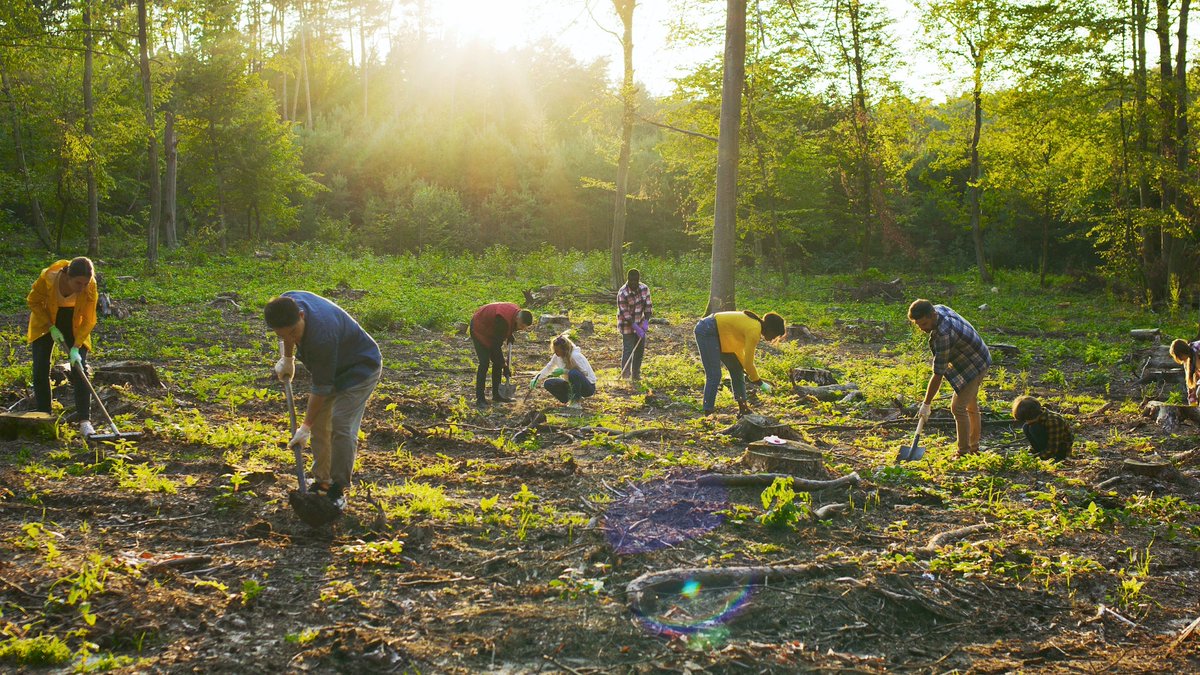
Where cattle once grazed, native forests are taking root again.
In Colombia’s Andes, home to extraordinary cloud forests, we’re working with local communities and our partners at @Grupo_Argos to restore degraded pasture into thriving ecosystems.
As forests return, they draw carbon from the air, rebuild wildlife habitat, and support local livelihoods.
Meet the people bringing them back to life.
#forestrestoration #climatesolutions #nature
A forest cleaned the water in your glass.
Think about rain falling on a hill. If the hill is bare, the water runs right off. It picks up dirt and anything else lying around. It hits the river brown, fast, and all at once.
If the hill is covered in forest, the rain lands on leaves first. Then on dead leaves on the ground. Then it sinks into soil full of roots. The water slows way down. It can spend weeks underground. While it is down there, the soil pulls out the dirt and the roots and microbes soak up the rest. By the time it reaches a stream, it is clear and cool, and it keeps coming even when it hasn't rained in a while.
Three out of every four glasses of fresh water on Earth come from a forest this way.
Back in the 1990s, New York City had a choice. It could build a giant plant to filter its water. That would cost six to eight billion dollars to build, plus a lot more every year to run. Or it could spend less and protect the forests in the mountains where the water came from.
New York picked the forest. About thirty years and two billion dollars later, nine million people still drink water that never went through a filter plant. The plant was never built. The forest is the plant.
Cities in Ecuador and Colombia now pay farmers upstream to keep their trees. It costs less than cleaning the water after the fact.
Here is what happens when the trees get cut down. The water gets dirtier, but that's not the worst part. It also floods in the rainy season. Almost nothing in the dry season. The reservoir fills up with mud years early. The water bill goes up. One study looked at 300 big cities around the world. About one in three had seen their water get measurably dirtier over the last hundred years, and the cause was what had happened to the land upstream.
So the next time you fill a glass, picture the whole trip. A cloud. A treetop. A few weeks in the dirt. A stream. A tank. A pipe. The forest is the one part of that trip you can lose without noticing, until the bill shows up.
#nature #forests #water #science
As of this week, a radio signal from Earth takes a full day to reach Voyager 1. It launched on September 5, 1977. Here is what happened to the planet's forests while it was on its way to a light-day from civilization.
In the 49 years since, the world has cleared more than half a billion hectares of forest. Stack FAO's own assessments end to end, about 11 million hectares a year around 1980, 15 million through the 80s, 17 million through the 90s, 13 million through the 2000s, 11 million since, and the total comes to roughly 690 million. The early years count only the tropics, so the true figure is higher. Half a billion is the conservative floor. That is an area larger than the European Union, cut down during one spacecraft's flight.
Some of it grew back, as young secondary forest and plantation. What did not grow back is the primary forest: at least 81 million hectares of it since 1990 alone, the kind that had never been cleared and does not return on any human timescale.
Now run it the other way. Suppose, on the morning Voyager lifted off from Cape Canaveral, someone had planted a hectare of native tropical forest on degraded pasture. What would it look like today, 49 years on?
The research on secondary tropical forest recovery is consistent enough to answer. Canopy would have closed in the first decade. By year 20, above-ground biomass would be roughly half of old-growth levels; by now, closer to 80 to 90 percent. Tree species richness in a connected landscape would have recovered most of the way by year 30 and would now be near old-growth counts, with the slow-recruiting specialists still filling in. Soil carbon, the last thing to come back, would be most of the way home. The forest floor would be dark, the understory cool and stable, and the microclimate buffering that protects the animals living there would have switched on somewhere past 76 percent canopy closure, which this stand would have crossed a quarter century ago. Birds, bats, and the seed rain they carry would have been arriving on their own since the first decade.
It would not be old growth. Old growth is a process, and this stand would be about a third of the way through its first cycle. But it would be a forest by every functional measure, pulling water into the sky, holding its soil, running its own weather, and sequestering carbon at a rate that peaks right around now.
That is the arithmetic that should sit beside the mission. A probe launched in 1977 is now a light-day out. A forest planted the same morning would be nearly whole.
We can explore the frontiers of science while simultaneously restoring our home.
#science #Voyager1 #lightday #NASA #forests
Who would you gift a native tree to this holiday season? 🌱🎁
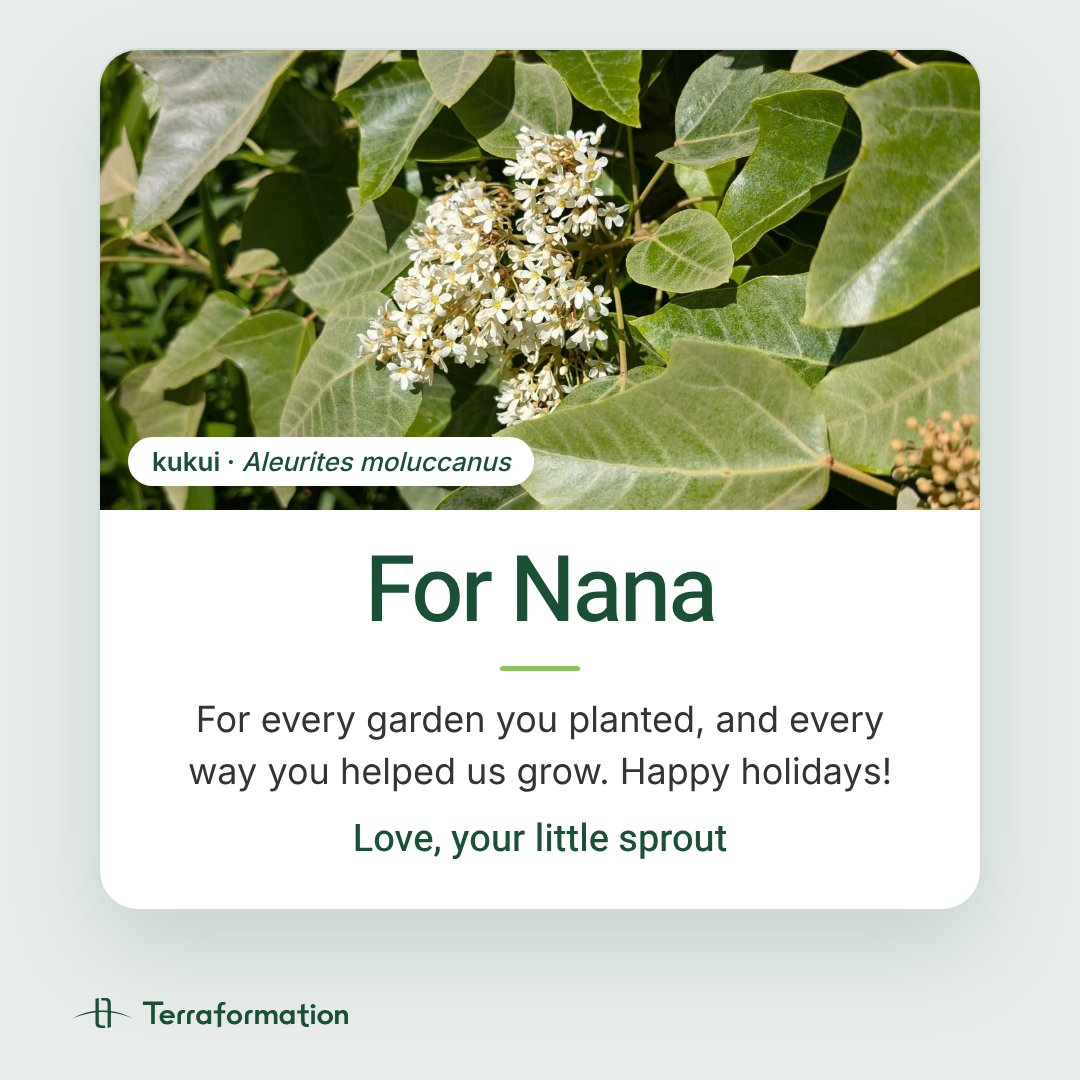
Introducing holiday tree gifts: a native tree planted in their name on Hawaiʻi Island, with photos and updates as it grows within a future biodiverse forest. 🌳
Start gifting: https://t.co/leomuF2g2E
You probably haven’t thought about a forest today, but they have been quietly working to better your life.
When you turned on your faucet, forest roots and soils were helping keep sediment out of rivers and reservoirs.
When you poured your coffee, you were enjoying crops whose pollinators rely on forests for food and shelter.
When you had your breakfast, your foods benefited from rains generated by forests.
When you stepped outside, trees were shading the ground and releasing water vapor that helps cool the air.
And through it all, healthy forest ecosystems were pulling carbon from the air and providing habitats for thousands and thousands of species.
Clean water. Food. Rain. Cooling. Carbon Storage.
We call these ‘ecosystem services.’ That makes them sound like a side benefit.
Try getting through your day without them.
Every native forest we protect, and ever one we bring back to life, helps keep your world spinning.
#nature #forests #treeshugback
As anyone who has stepped inside a rainforest knows, the forest floor is significantly cooler than the air above the canopy. Until recently, nobody had measured exactly how much canopy you can lose before things heat up again.
A study published last November in iScience did just that in Borneo. Thermal cameras pointed at the forest floor across sites ranging from old-growth forests at 90 percent canopy cover down to heavily-logged forests at around 60-percent canopy cover.
They found that for every 5 percent of canopy cover lost, mean surface temperature rose around 1°C, with peaks up to 4°C. Air temperature barely moved, while ground and leaf surfaces heated significantly.
The team also inventoried over 5,000 invertebrate species to find their temperature sensitivity based on the heat point that stopped their movement. By overlaying these datasets, they found that below 76 percent canopy cover, surface temperatures began exceeding the thermal limits of every species they observed.
With 3°C of simulated warming, roughly what Borneo’s end-of-century projections would be under a high-emission scenario, up to half of the forest floor was inhospitable.
This study makes it clear that forest degradation can still disrupt biodiversity, and that for true forest restoration a healthy canopy is crucial.
#science #rainforests #biodiversity #climatechange
A rainforest replaces itself every fifty to a hundred years, but it's almost impossible to see from above.
In every square kilometer of forest, a canopy tree is dying. When it falls it opens a tennis-court-sized hole, letting sunlight flood into the forest floor that typically only receives 1 percent of that energy. This activates dormant seeds that germinate within days, suppressed saplings that accelerate growth to meters per year, and pioneer species that quickly close the canopy hole in less than a decade. Slow hardwoods then take back their positions within 60 years, until another tree falls.
If you zoom out, the entire forest is a mosaic of these patches in different phases of restoration a few decades out of step with the others. This landscape-scale turnover happens at about 1 percent of the canopy every year, and this cycle is the engine for renewal and resilience.
Late last year, Nature published a thirty-year census of Amazon plots that shows this cycle is speeding up as the climate changes. Hot droughts, like the one today's record El Niño is causing, are pushiing mortality rates 55 percent above baseline once soil moisture crosses a critical threshold, which is happening more and more frequently. This is disrupting the rhythm of the forest and over time is changing the makeup and carbon store of one of the world's most important ecosystems.
'Old growth' doesn't mean the trees themselves are old. It means that the process of forest renewal has been going on for millennia. As a warming world forces changes to that tempo, these sensitive cycles are pushing forests into uncharted territory.
#nature #climatechange #forests #Amazon
The ocean fertilizes forests, and forests return the favor.
Salmon runs along rivers in Alaska, British Columbia, and the Pacific Northwest of the United States bring a quarter of the nitrogen found in trees up to hundreds of meters from the streamside. Bears, eagles, wolves, and dozens of other species haul salmon carcasses into the woods, which then decompose into the soil. This marine nitrogen can be traced by scientists as it has a heavier isotope signature than anything made on land. Trees beside salmon rivers can grow up to three times faster than ones without.
Forests send nutrients back downstream as well. Forest soil is rich in iron, which is one of the key nutrients ocean ecosystems are starved of. Phytoplankton, the microscopic plants that underpin every marine food chain, can’t grow without it. Decaying leaves and wood leach humic acids full of iron that rain carries into streams, then rivers, and eventually into ocean waters that circulate this vital nutrient into the deep.
Modern science is refining this macro-scale mutual support between ecosystems, but many cultures have already observed this phenomenon. Japanese fishing villages made a point to replant forested hillsides near their fishing grounds, and called them uotsuki-rin – fish-breeding forests.
Conservation and restoration of these forest landscapes not only benefit the climate, the wildlife, and the communities that live among them, but also neighboring ocean ecosystems as well. Life in the biosphere is more interconnected than you can imagine.
#nature #forests #conservation #restoration
Overshooting the international target of 1.5 degrees Celsius of warming is now unavoidable.
The good news? There is still a way back.
@UNEP's new Limiting Overshoot report makes it clear that the path to peak warming and decline back to safe levels passes through future forests.
Native forest restoration is a powerful climate solution ready to scale, and is now a critical step in returning the world to a safe climate.
Reforestation, done right, can help stabilize the atmospheric chemistry that underpins modern civilization, all while anchoring local economies and rebuilding habitats for wildlife around the world.
Our window on climate action is closing, but it is still open. Let’s #ReforestTheFuture, together.
#forests #climate #biodiversity #development
Every forest on Earth relies on the mighty yet minuscule biological technology of a seed.
If you crack one open, here’s what you’ll find:
- The embryo. This near-complete miniature plant has a root end and shoot end already formed, and sometimes even has the first two leaves folded up inside.
- The food store. This nutrient base of starch, oil, and protein is packed around the embryo, with enough power to run the first days or weeks before its nutrient engine can spin up.
- And the coat. Around the seed, a sealed, waterproof case closes it off from the outside world with a built-in lock for just-right conditions to germinate.
But how does something that small become something that big?
A redwood seed weighs about five milligrams, and is about 3 millimeters long, yet the tree it becomes can weigh over a thousand tonnes and tower 350 feet high. That mass doesn’t come from the seed, but out of the sky. A tree builds itself from carbon dioxide that is pulled in through the leaves, which is first made into sugar with sunlight and then into cellulose and lignin. The surrounding soil supplies water and minerals through its roots.
But the seed itself runs the instruction program, and contains just enough fuel to get the first leaf into the sunlight. After that, the tree constructs itself out of thin air.
First, the seed waits.
A date palm seed from Herod's palace at Masada sat in a storeroom for roughly 2,000 years, when a botanist planted it. It sprouted. They named the tree Methuselah. It has since fathered fruit.
How is this possible? A dry seed isn’t really alive or dead. Its water content has fallen so low that the inside stops being a liquid and becomes a kind of glass, the same physical state as a window pane. Molecules can barely move, so almost nothing can go wrong. Vitrification is how many seeds survive until the time is just right.
While seeds wait, they measure.
Timing is everything for a seed to germinate. To help it sprout at the right moment, a seed has sophisticated sensing abilities and the evolutionary intelligence to pinpoint itself in seasonal cycles.
First, it senses and counts the cold. An oak or maple seed won't germinate until it has logged enough hours near freezing. That's how it knows winter actually happened and not just paused.
Second, it reads light through the soil. Not brightness, but the ratio of red to far-red light, which says whether there's a canopy overhead or open sky.
Finally, it measures depth. Surface soil swings warm and cold every day; ten centimeters down it barely moves. The seed feels the size of the swing and knows how far it has to climb to break through the surface.
Yet, most rainforest seeds can't wait long. Their seeds never dry, never go glassy, and die within weeks if they can’t germinate. The forests that need rebuilding most are the ones whose seeds are hardest to keep.
Take some time to wonder at the small but mighty power of the humble seed. Every forest you've ever walked through, and every forest yet to grow, passes through these remarkable engines of life.
#nature #science #forests #seeds
In Borneo, the largest trees in the forest only reproduce every few years, all at once. Dipterocarps are 60-meter giants that release enormous crops of seeds at a time that only have days to germinate.
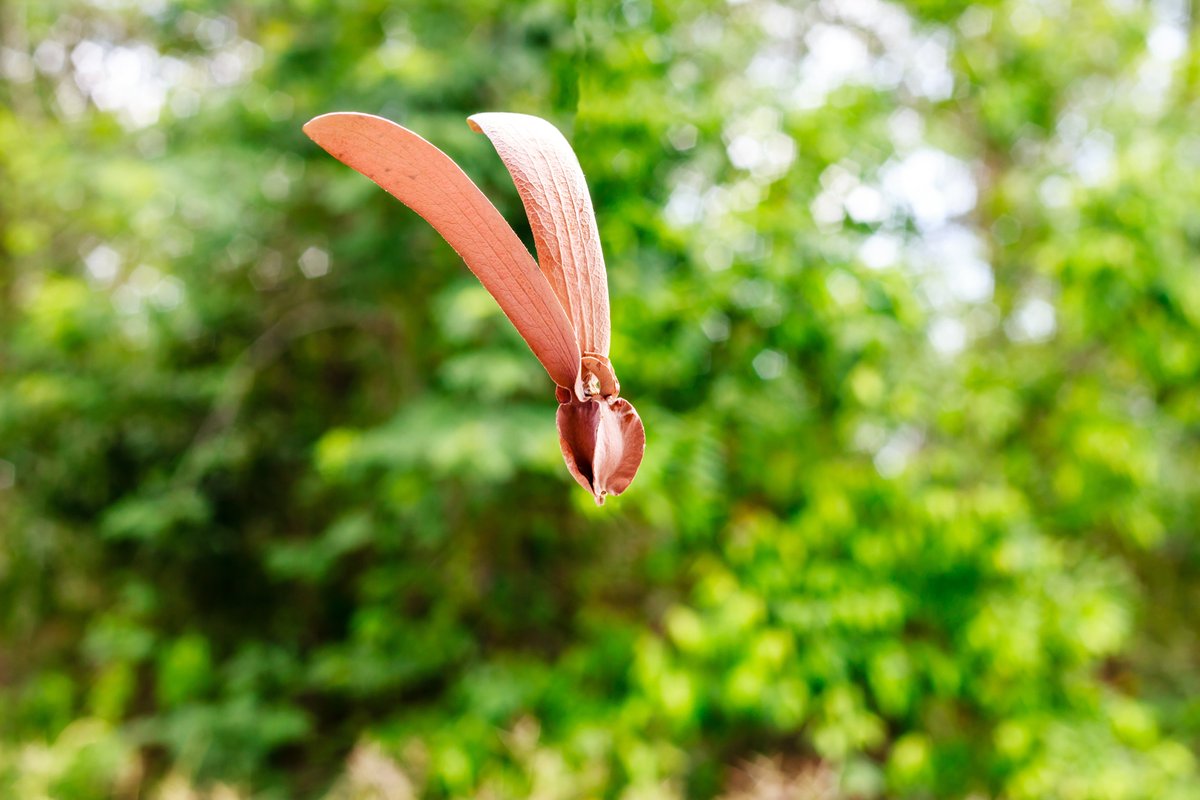
For the teams working to collect these seeds for native forest restoration, this collection window is unpredictable and extremely short. Dry spells, sometimes combined with cooler temperatures, can cue a wave of flowering across many species. Winged seeds cover the forest floor ankle-deep until the germination window closes and they return to the soil.
This is more the rule in tropical forests than the exception. A large percentage of rainforest trees produce seeds that are sensitive to moisture levels. If they dry out, they die. Botanists call these recalcitrant seeds, and they present a real challenge for tropical forest restoration in that traditional preservation techniques don’t work. These seeds need to be caught in season, cleaned, and sown within days or weeks.
That work requires skilled teams on the ground who have a deep understanding of local ecosystems. It also requires infrastructure like nurseries where these seeds can be planted and hardened, and the water supply to keep everything growing. In the places that need forest restoration the most, seed supply chains like this are rarely in place.
The path to bringing the world’s degraded lands back to life passes through these tiny seeds, collected and planted with care. To grow a forest, you have to start small.
#forestrestoration #nature #nativeseeds
Zay Harding from The Visioneers on CBS WKND visited our headquarters to see how we’re restoring native forests in Hawaiʻi. 🌱
Johannes Seidel, our Director of Hawaiʻi Forestry Operations, guides Zay through the full journey of one of our native plants, the ʻukiʻuki, from seed to out-planting.
In this short documentary, you can step inside our nursery where our team cares for 35 species of native plants, and see how seedlings are prepared for life beyond the nursery. Then, head out to our ʻŌhiʻa Lani at Waikoekoe restoration site, where Zay gets his hands in the soil and plants an ʻukiʻuki that will grow alongside other native plants as the forest returns. 🌿
Reforesting the future can bring back critical native forests ecosystems, and all the benefits they bring: a stable climate, fresh water, cleaner air, a home for wildlife, and an engine for local economies.
Check out the full episode here: https://t.co/YedJnqsh78
Two scientists found a tree stump in New Zealand with no leaves that appeared dead, yet the surrounding forest was keeping it alive.
On the North Island, a kauri stump was all that was left of a tree that was cut decades ago. By every visible sign, it shouldn't have been alive. But one of the researchers noticed fresh bark growing over the cut, and decided to investigate.
First, they clipped sap-flow sensors to the stump and to the living kauri trees beside and found water moving through the stump. This doesn’t happen in dead wood.
They also discovered something even stranger. The stump was moving water at night, and going quiet in the daytime. Living trees move water during the daytime, when transpiration through the leaves pulls water columns up through the xylem. The stump has no leaves, and was on an opposite schedule.
The researchers discovered that the roots of the stump had grafted onto the roots of the trees beside it, a common find among the kauri species. During the daytime, the stump was on the losing end of the water suction of its neighboring trees, but at night transpiration stopped and the pressure in the shared root system rose, pushing waters and sugars into the stump itself.
The insight here is that forests are deeply interconnected systems, with individual trees supporting one another through nutrient sharing and shared stability underground. This is why deforestation and degradation can harm the forest system more than what’s merely visible above the soil, and why plantation-style ‘forests’ can’t reach the resilience of native ecosystems.
#forests #nature #science
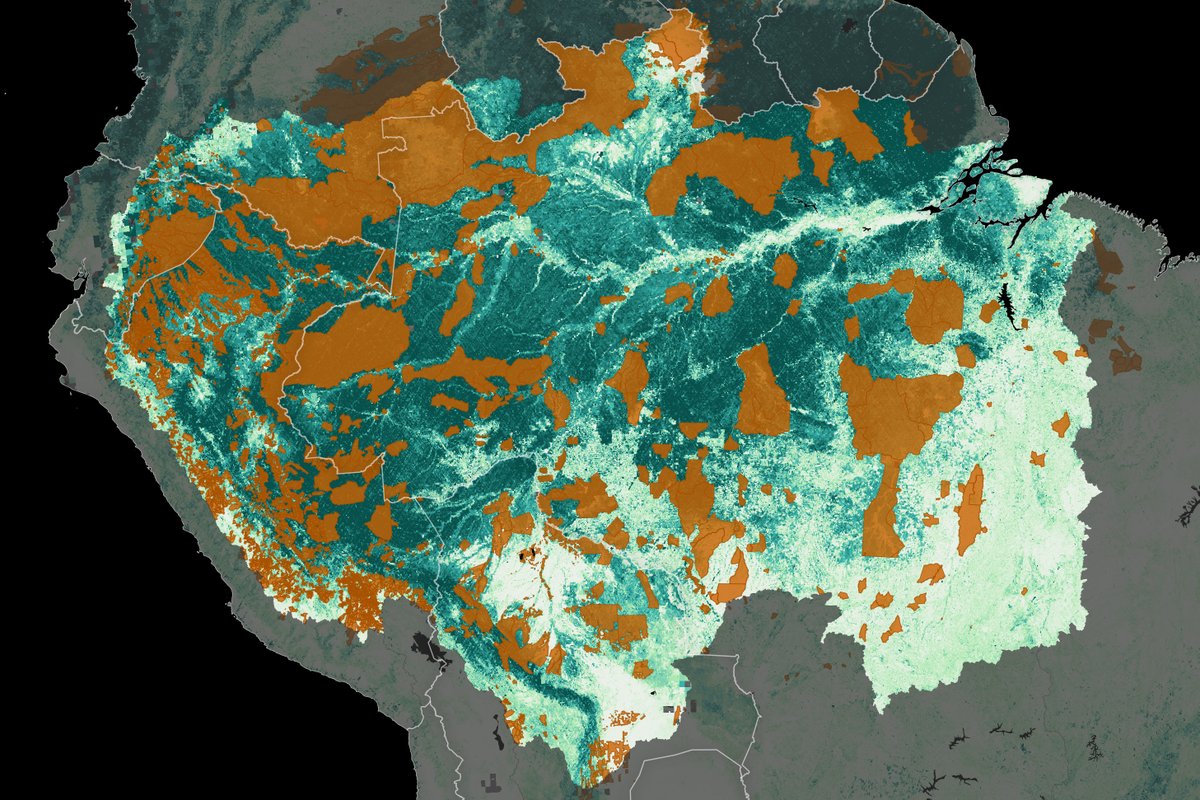
This is the Amazon rainforest from space. The orange regions represent territories managed by the 1.5 million Indigenous people who call this forest home across Bolivia, Brazil, Colombia, Ecuador, French Guiana, Guyana, Peru, Suriname, and Venezuela.
Look closely, and you’ll see a pattern. These areas often coincide with the healthiest forested areas that remain in the Amazon basin.
Inside these Indigenous regions of the Amazon, deforestation rates fall by more than half. People who live inside a forest and depend on it for food, water, medicine, and culture, understand the true value of these ecosystems, and have watched over them for generations.
Forests pull significant amounts of carbon dioxide from the air, making them critical carbon sinks that help stabilize our planet’s climate. They are also biodiversity hotspots. Yet here, in the largest tropical rainforest in the world, deforestation is threatening to turn the Amazon into a net carbon source as fire and logging return CO2 to the atmosphere, and is disappearing some of the richest and diverse habitats of wildlife we have left.
Globally, Indigenous people hold tenure over roughly 36% of the forests that are still intact. Their stewardship is critical to slowing climate change, protecting biodiversity, and preserving ancient forests that humanity has called home for millennia.
Image source: NASA
#Indigenous #Amazon #forests #conservation #nature
No part of an ecosystem exists in isolation.
On the Hawaiian island of Kauaʻi, native birds like the ʻakikiki, ʻanianiau, and Kauaʻi ʻamakihi face growing threats as temperatures rise. Mosquitoes carrying avian malaria are moving into higher elevations that once provided refuge for Hawaiʻi’s vulnerable native birds. As that safe zone shrinks, so does the habitat where these species can survive.
Restoring Kauaʻi’s native forests is one important piece of protecting these birds, by creating a habitat where they can find food, shelter, and space to recover. Birds, in turn, help forests thrive through pollination, seed dispersal, and unique relationships that have evolved over thousands of years.
Healthy forests need native birds, and native birds need healthy forests.
Watch our interview with @hawaiiaudubon to learn how the future of Kauaʻi’s forests can still be filled with native birdsong: https://t.co/j1jJ2j0CIV
Help grow a native forest in Hawaiʻi: https://t.co/FPfIUWtCxZ
#EcosystemRestoration #Biodiversity #Wildlife
Half the world’s forests are gone or degraded. Here’s what happens when you bring one back to life:
Day 0: Picture a former pasture landscape with compacted soil under a scorching sun. A forest restoration team plants a diverse mix of seedlings that have been hardened in a nearby nursery, grown from a stock of native seeds meticulously collected from nearby forests. Months of work, including land agreements and community co-design, go into each planted sapling.
Day 1: Hundreds of seedlings provide small areas of shade and are already absorbing carbon dioxide while releasing water vapor into the air.
Month 1: Roots begin exploring the surrounding soil. Many seedlings establish or expand partnerships with fungi that help them access nutrients.
Year 1: As the trees begin to significantly grow, they begin to offer perches, shelter, and eventually food to birds and other wildlife, which can carry additional seeds to other parts of the landscape. 40 maturing tree species are beginning to have a measurable influence on ground temperature and moisture levels.
The first dry season: Some young trees die, while others struggle. The restoration team monitors survival, controls competing vegetation, and replaces losses where needed.
Year 3: Fast-growing trees begin closing the canopy to create shaded areas that let other species flourish. Strong roots begin to protect the soil from erosion.
Year 10: The ecosystem becomes more complex, and growing trees store more and more carbon. Independently verified removals generate credits that help finance continued restoration and protection. Landscape restoration begins to influence rainfall.
Year 30: A remarkable amount of life returns to the forest, up to 90% of old-growth levels. The forest is now resilient to threats from climate-induced wildfire and drought. The boundaries of the restoration area are spreading far beyond the project scope. Local communities now depend on the many ecosystem services the new forest provides.
Year 100: Large, fully-mature trees and old-growth structures now dominate the landscape, helping stabilize the climate, creating a haven for biodiversity, and anchoring community well-being for its generational stewards.
A forest doesn’t wait until it is “finished” to start helping. Its benefits build as it grows.
#forestrestoration #nature #regeneration
Have you ever stood under a California Redwood and wondered how something that massive stays alive? The mechanism was only proved in the 1990s, and broke physics as we knew it.
Redwoods are giants that can stand over 300 feet tall. However, their root systems are shockingly shallow. Most of the root mass is found within the first few feet of topsoil. Here, fine root hairs absorb water through osmosis, and the droplets begin their long journey to the top.
For context, our best artificial suction pumps can’t lift water more than about 30 feet. So, how does a Redwood raise water 10x higher? Inside the tree’s xylem, a bundle of dead and hollow cells, water forms a thin unbroken thread stretching from root to needle. At the top of the tree hundreds of feet in the air, water evaporates through tiny pores, pulling the next water molecule up behind it and moving the whole column like pulling a rope.
Inside the tree, pressures reach up to minus 20 bar, meaning the water itself should boil away. However, this razor-thin thread of water molecules is so clean that there’s nowhere for a bubble to form.
This process, called cohesion-tension, was first proposed in 1894 to much controversy. It was believed that water under this much tension is metastable, meaning just one disturbance would snap the chain and reset the process. It wasn’t until the 1990s that direct measurements made inside a living tree helped settle the debate.
But redwoods have another way to stay hydrated in their California climate. They drink directly from the sky. Researchers from UC Berkeley have shown these trees absorb water from fog through their needles. This process, called foliar uptake, provides extra moisture and helps ease water stress and tension within the xylem.
Incredibly, all of these thin columns of water quietly gliding upward can lift up to 500 gallons of water a day to the top of a giant California Redwood every single day. This is one of the most efficient and powerful "water pumps" known to science, and it’s been operating for over 100 million years.
#redwoods #California #forests #science #nature
🌳 🧠 Forest ecosystems are astounding examples of natural intelligence (NI). Here’s a list of what they can do, ranked by how much they sound like a lie.
1. They can count. Trees in temperate forests won’t grow their leaves until they’ve experienced enough hours below 5 degrees Celsius. This is called a chilling requirement, and buds won’t open no matter how warm spring gets until this requirement is met.
2. They can tell the time. Phytochrome proteins in tree leaves precisely measure the length of the day to the minute.
3. They remember, and adapt. English oak trees that were damaged by caterpillars one year will open their leaves 3 days later the next spring to miss the hatch.
4. They share warnings with each other. Bruised acacia trees pump tannin into its leaves that releases ethylene, which triggers trees downwind to do the same within minutes to keep animals from eating them.
5. They share food, too. Expansive underground mycorrhizal networks move carbon from well-lit trees to shaded ones, and from dying trees to living ones. Even stumps can be kept alive for decades through this communal process.
6. They create their own weather. Evapo-transpiration lifts trillions of tonnes of water into the air around the world, condensing into rains that sustain ecosystems thousands of miles away.
7. They use lightning as a weapon. The almendro tree in Panama conducts lightning strikes through its trunk and into the soil of its surrounding neighbors, killing competitors and even stripping off vines that choke its growth, boosting seed output by roughly 14 times.
8. They record the sun’s activity. Scientists used trees alive in 774 to validate a monster solar storm that spiked tree rings from Japan to Newfoundland.
9. They stabilize the climate: Since 1990, global forests have taken in nearly 3.5 billion tonnes of carbon dioxide from the atmosphere per year. That’s almost 30% of human emissions over the same period. Healthy forests are critical for a livable climate.
10. They enable wildlife intelligence. Forests are home to more than 80% of land-based species. A single hectare of tropical forest holds more tree species than all of Europe, and that diversity allows countless niche species to thrive.
Natural intelligence is the true super intelligence. Let’s treat it with respect, and care. 🌱
#nature #AI #forests #wildlife