Somewhere in a remote village, a child with a disability is learning the world in silence. He grasps concepts quickly, asks sharp questions, and dreams beyond his surroundings.
But the school is far. The classroom is inaccessible. No teacher knows how to reach him.
Intelligence alone cannot overcome closed doors. To become a great mind, every child, disabled or not needs education at the same starting line, a place where learning is possible, visible, and fair.
How many potential geniuses have we already left behind?
#TGMM
#Inclusion
#DisabilityRights
When Disaster Strikes: The Invisible Risk Faced by Persons with Disabilities
When societies plan for emergencies such as fires, floods, earthquakes, or war, the focus is usually on infrastructure, logistics, and rescue operations. Evacuation routes are mapped, alarms installed, and shelters prepared.
Yet an essential question is often overlooked:
How safe are persons with disabilities when disaster strikes?
For many people with disabilities, especially those living with severe conditions such as chronic spinal cord injury (SCI), emergencies are not just dangerous, they can become immediately life threatening.
A person who cannot walk cannot run from a burning building.
A wheelchair user cannot descend broken staircases when elevators stop working.
Someone who relies on medical equipment, medication, or daily assistance cannot survive long without those supports.
In moments of crisis when electricity fails, communication breaks down, and transport becomes chaotic, dependency becomes a profound vulnerability.
Most emergency plans quietly assume that people can move quickly, hear alarms, follow instructions, and physically reach safety.
But what happens when someone cannot move without assistance?
What happens when a person with severe disability is trapped on the third floor with no accessible evacuation route?
Without deliberate planning, persons with disabilities can become invisible casualties of poor preparedness, not because disasters are unavoidable, but because systems were never designed with them in mind.
Consider someone living with chronic spinal cord injury. Daily survival may depend on a wheelchair, caregiver support, medication, bladder and bowel management, and protection from pressure injuries.
These are not conveniences, they are life sustaining systems.
During sudden evacuations caused by fire, conflict, or flooding, these supports can disappear instantly. Emergency shelters are rarely designed for complex medical needs or accessibility.
For many, survival becomes uncertain long before the disaster itself reaches them.
In war, these risks multiply.
When cities collapse into chaos and families flee overnight, survival often depends on speed and mobility. Refugee journeys may involve long travel on foot and unstable transportation.
For someone who cannot walk or who depends entirely on caregivers, escape may be impossible.
History shows that in conflict zones, persons with disabilities are disproportionately left behind, not by cruelty, but by the brutal mathematics of survival during chaos.
A truly intelligent society measures preparedness not by how well the strongest survive, but by how well it protects the most vulnerable.
Inclusive emergency planning, accessible evacuation routes, trained rescue teams, accessible shelters, and backup systems for medical support is not charity.
It is simply good governance.
Disasters reveal the moral architecture of societies. They show whether communities were designed only for the strong, or for everyone.
Because the real test of preparedness is not how quickly we escape danger ourselves.
It is whether everyone has a chance to escape with us.
Intellect is not measured by how fast a body moves, but by how deeply a mind understands the world.
History’s greatest advancements were born from people who sat still long enough to question everything — power, truth, identity, and what it means to be human.
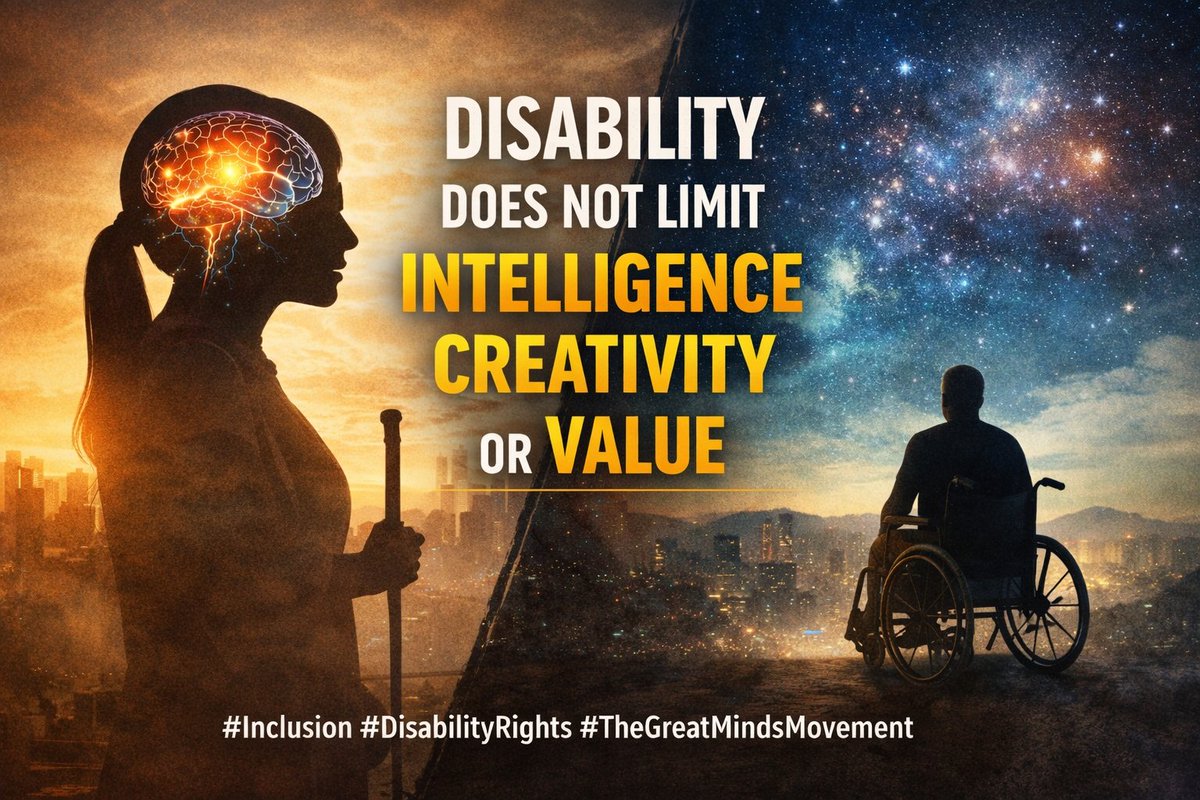
Disability does not diminish thought.
It refines perspective.
It forces philosophy to become lived experience.
A civilized society is not one where everyone walks the same path, but one where every mind is allowed to shape the journey.
#TheGreatMindsMovement #DisabilityAndDignity #PhilosophyOfHumanity
#Inclusion
Progress does not come from excluding difference.
It comes from learning how to work with it.
When systems fail to accommodate diverse bodies and minds, they don’t preserve standards, they lower their own intelligence.
#Inclusion#Zimbabwe
Monday Morning Message
Somewhere in Zimbabwe today, a person with a disability is solving complex problems in their head with no platform, no tools, no audience.
Talent does not need sympathy.
It needs access.
In the body that cannot walk, there may live a brilliant strategist.
In the eyes that do not see, a powerful thinker.
In the ears that do not hear, an extraordinary innovator.
In the mouth that does not speak, a mind capable of reshaping nations.
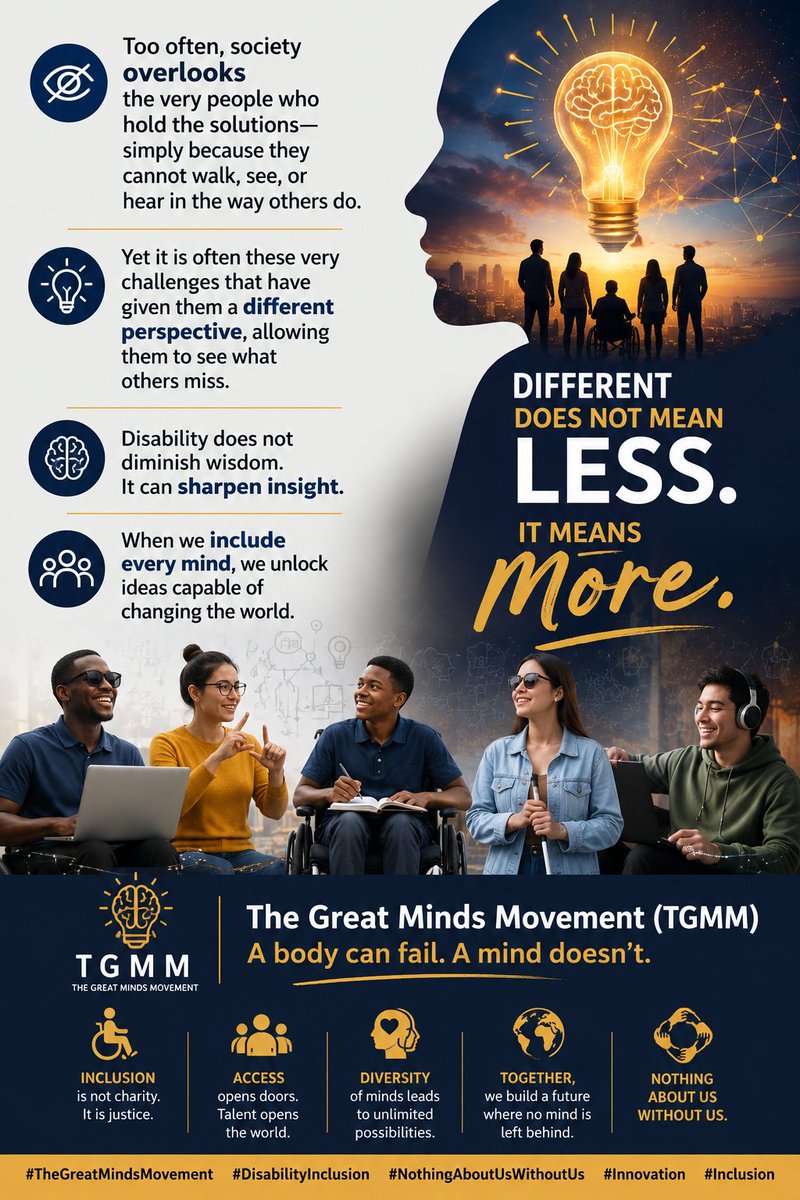
We have been trained to measure human worth by physical output, by hands that lift, legs that move, mouths that speak loudly. In doing so, we quietly discard intelligence, creativity, wisdom and problem solving simply because they arrive in a different body.
Disability is not the absence of ability. It is the presence of a mind society has failed to accommodate.
#TheGreatMindsMovement #DisabilityRights #Inclusion #Zimbabwe
The Mental Potential of PWDs
For far too long, society has measured human potential by physical ability. Strength, speed, sight, hearing, and mobility have been wrongly treated as indicators of intelligence, creativity, and leadership. This misconception has cost the world immeasurable talent.
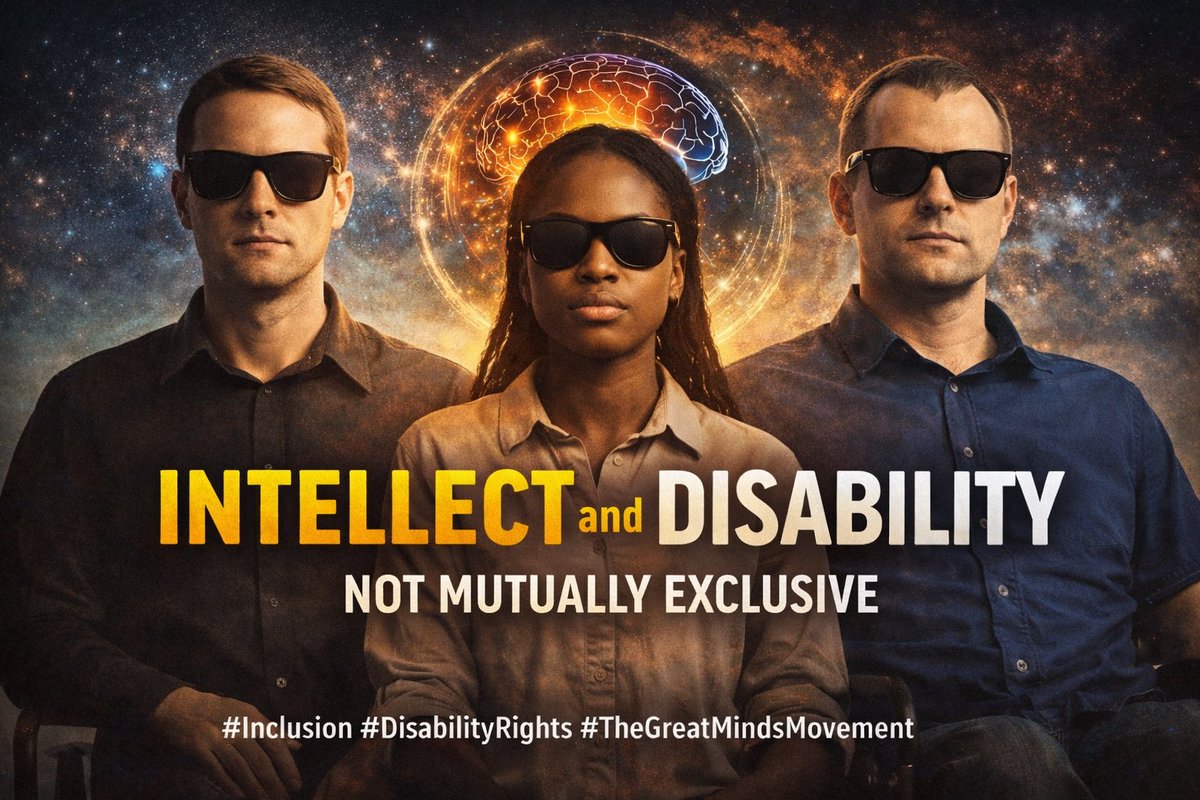
Persons With Disabilities (PWDs) are not defined by what their bodies cannot do. Their minds remain capable of reasoning, innovation, strategy, empathy, and leadership. When PWDs are included, supported, and given equal opportunity, they consistently demonstrate that mental potential is not diminished by physical limitation.
One of the clearest examples is Professor Stephen Hawking, one of the most brilliant theoretical physicists in human history. Despite living most of his adult life with amyotrophic lateral sclerosis (ALS), which progressively paralyzed his body and left him unable to speak, Hawking reshaped our understanding of the universe. His work on black holes, cosmology, and time changed modern physics forever. His condition did not weaken his mind; if anything, it exposed how powerful the human intellect can be when barriers are removed and support is provided.
Another powerful example is Helen Keller, a visually and hearing-impaired American woman who became a globally respected author, political activist, and lecturer. Losing her sight and hearing at a very young age did not silence her intellect. With access to education and the right support, she mastered language, earned a university degree, and advocated tirelessly for disability rights, education, and social justice. Helen Keller’s life stands as undeniable proof that disability does not equate to inability.
These stories are not exceptions meant to inspire pity. They are evidence of a broader truth: when systems are inclusive, minds thrive.
Across the world today, PWDs are innovators, researchers, entrepreneurs, artists, policymakers, engineers, teachers, and leaders. Many possess heightened problem solving skills, resilience, emotional intelligence, and creativity, qualities forged through navigating environments that were never designed for them. Yet, these strengths often go unnoticed because exclusion remains deeply embedded in education systems, workplaces, and public policy.
The real limitation is not disability. The real limitation is lack of access.
Physical ability is not a measure of human potential.
A body may fail. A limb may weaken. A sense may be lost. But a supported mind can still shape nations, invent solutions, lead movements, and redefine what is possible.
MONDAY MOTIVATION 🍀
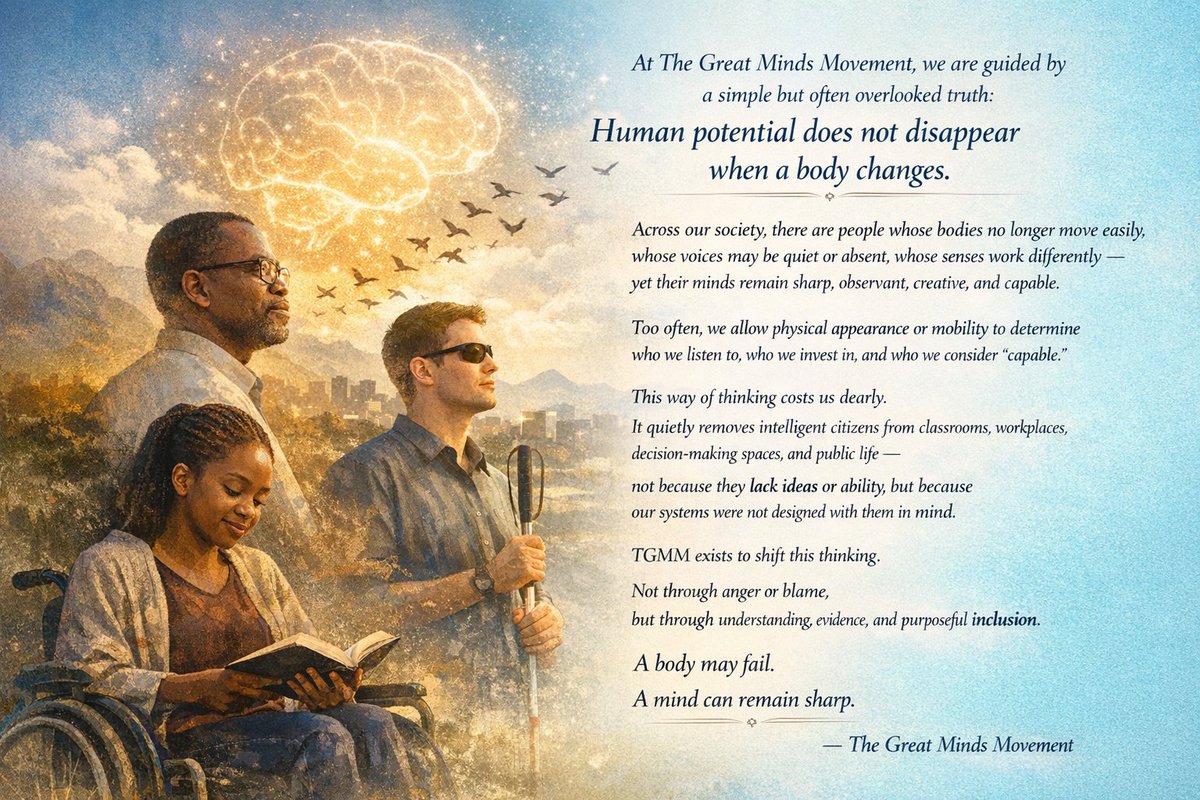
At The Great Minds Movement, we are guided by a simple but often overlooked truth: human potential does not disappear when a body changes.
Across our society, there are people whose bodies no longer move easily, whose voices may be quiet or absent, whose senses work differently, yet their minds remain sharp, observant, creative, and capable. Too often, we allow physical appearance or mobility to determine who we listen to, who we invest in, and who we consider “capable.”
This way of thinking costs us dearly. It quietly removes intelligent citizens from classrooms, workplaces, decision-making spaces, and public life, not because they lack ideas or ability, but because our systems were not designed with them in mind.
TGMM exists to shift this thinking. Not through anger or blame, but through understanding, evidence, and purposeful inclusion. We believe a nation grows stronger when it measures worth by insight, contribution, and character, not by physical form.
A body may fail. A mind can remain sharp.
And when we include every mind, we all move forward.
— The Great Minds Movement
Persons with disabilities are not a burden waiting to be carried.
Many are professionals, thinkers, creators locked out by systems that only see wheelchairs, not minds.
#Inclusion#DisabilityRights#Zimbabwe