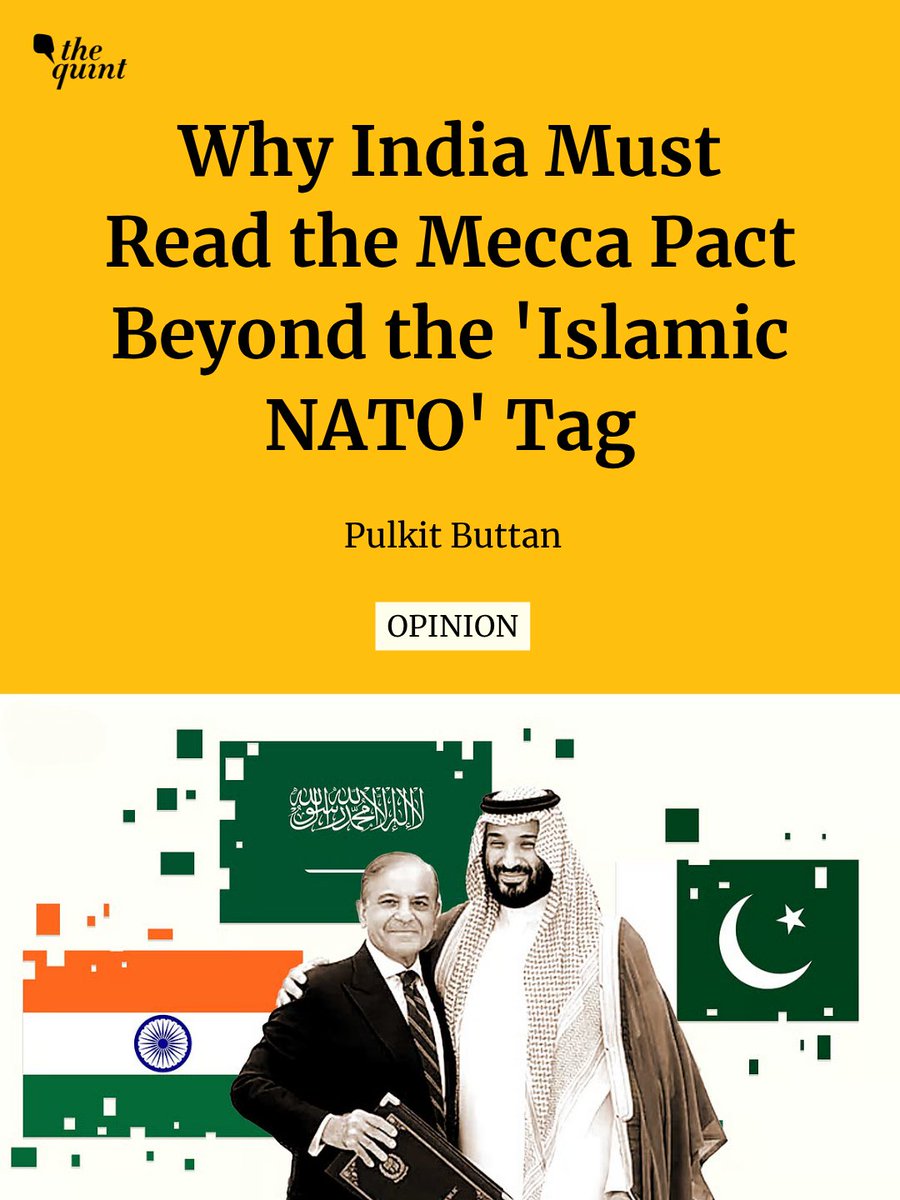
If one calls it an “Islamic NATO”, then it would imply that Ankara is helping build an alternative to the Western Alliance system; however, Turkiye is already a NATO member and has little interest in building a rival architecture that forces it to make a choice between the existing alliances and its relationships across the Muslim world. Turkiye currently wants both.
NATO belonged to an age of blocs; the Mecca Pact may belong to an age of networks. @PulkitButtan writes.
Read here: https://t.co/ZZ3dHNCsAM
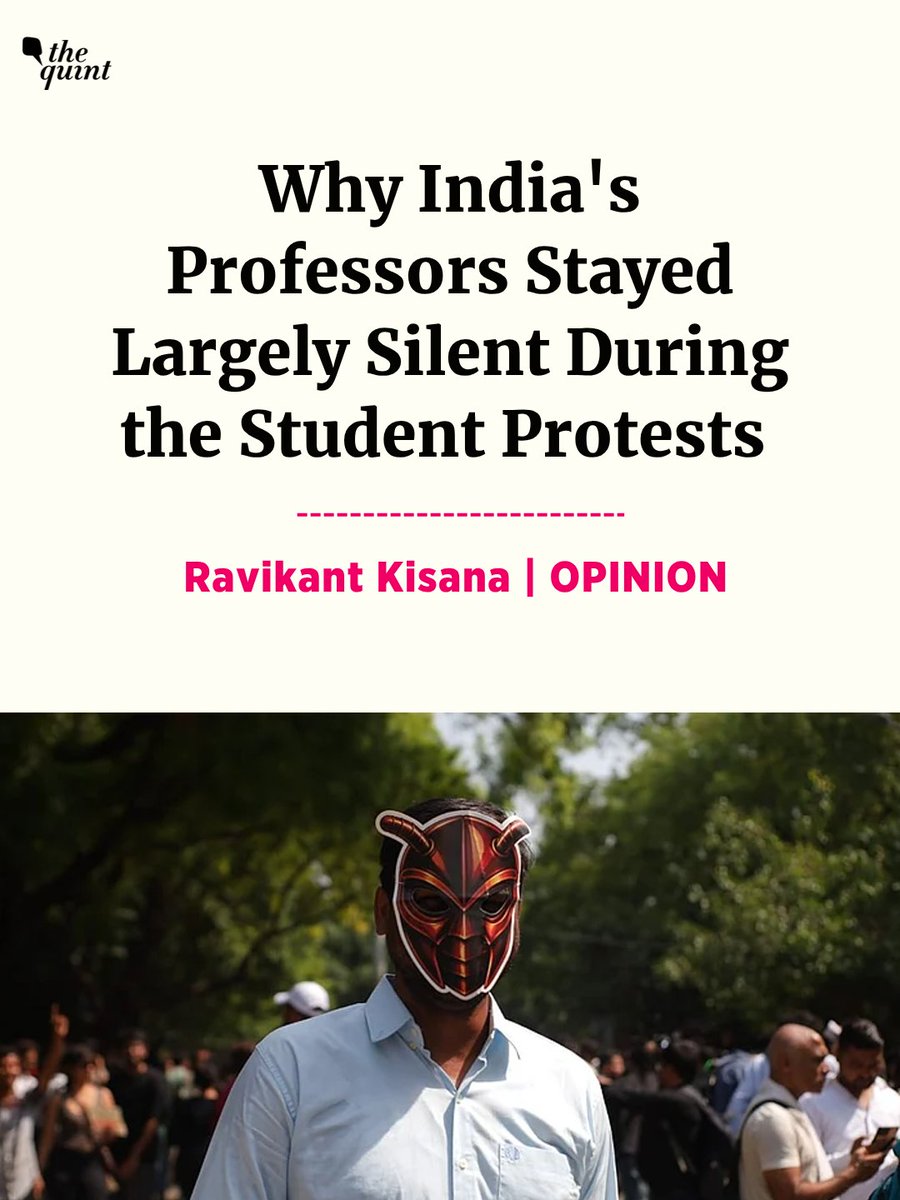
Rationality and critical thought are not sought after, instead are seen with suspicion. The administrative leadership of most institutions prioritise ‘good relations’ with the regime and often share its agenda, transforming the campus as a laboratory of ideological reproduction. Individual faculty who try to resist or non-participate are marked out, isolated and harassed. This is particularly intense for younger assistant professors who are new to the role, as well as PhD scholars who depend often on the institution for stipend, network and their degree. Any deviation brings punitive action. @ProfRavikantK writes.
Read the complete analysis: https://t.co/VeFn6rksG9
How did the GoI finances do in Q1? Was there a serious under-performance in tax revenues? Why did the GoI transfer less than normal tax share to the states? Is there something to worry about? @Subhashgarg1960 analyses.
Read: https://t.co/Jt7Ggb9ekG
This focus has only intensified as Democrats seek to win back the Christian conservative middle class in key battleground states. For the Republicans, a vast majority of their base and financial contribution comes from the traditional Christian and evangelical base. Therefore, any actions in India that impact the interests of these organisations, as in the case of FCRA, have the potential to worsen India-US ties.
Amid growing influence of Christian groups in US politics, the issue could become another flashpoint for India. Abhishek Kadiyala writes.
Read the complete analysis: https://t.co/mmkM5iQ02u
In the current milieu of Hindi films, Batwara 1947 ranks as an outright oddity of an enterprise. The soul of Wajahat’s play, a rendering based in the partition era, is one of religious tolerance and explores themes of compassion, humanity and brotherhood.
https://t.co/99FoK17ZyM
#WebQoof | A video from Maharashtra is being shared to falsely claim that it shows the CJP's Abhijeet Dipke meeting Jharkhand's Congress president amid the ongoing protests in the state. Read our fact-check here.
https://t.co/Zbnq22oVtF
We talk of quality education to students on equitable basis but before quality comes the question of drawing up the merit lists of eligible students, writes Hemant Verma.
Read: https://t.co/IW05jH3TVn
A crowd of roughly 8,000 protesters eventually managed to reach the Assembly – but not without violent clashes, lathi-charges on protesting students, the use of water cannons and tear gas. @hey_eshwar reports.
Read the ground report: https://t.co/YxWg9kTiWN
#UmarKhalid shows that reality is often more complicated and nuanced than this simplistic reduction. It is no surprise that Ramachandra Guha called his doctoral dissertation "one of the most accomplished doctoral dissertations by an Indian" he had read.
The cancellation of discussion on Umar’s book is a rung on the same #Hindutva ladder of producing docile subjects. Harsh Mamnani writes.
Read the full article: https://t.co/j9tknLTGHW
Karnataka’s new policy is a welcome move, however, the programme as currently designed is based on an assumption not supported by national data. Karan Babbar writes.
Read: https://t.co/aaggKYcgOG
#WebQoof | An old video of a CRPF jawan getting beaten by Kanwariyas at the Mirzapur railway station was falsely shared as a recent one. Read our fact-check here.
https://t.co/EkvpviJoxt
#WebQoof | A video is being shared on the internet, falsely claiming to show a Muslim man trying to disguise himself by wearing a bhagwa cloth and stealing a mobile from a Hindu girl. Read our fact-check here.
https://t.co/T8VzUmHeuJ
#WebQoof | A BTS video from a short film's shoot is being shared to falsely claim that it shows a baby girl who was abandoned by her parents in Nashik, Maharashtra. Read our fact-check here.
https://t.co/duWkHwfVIw
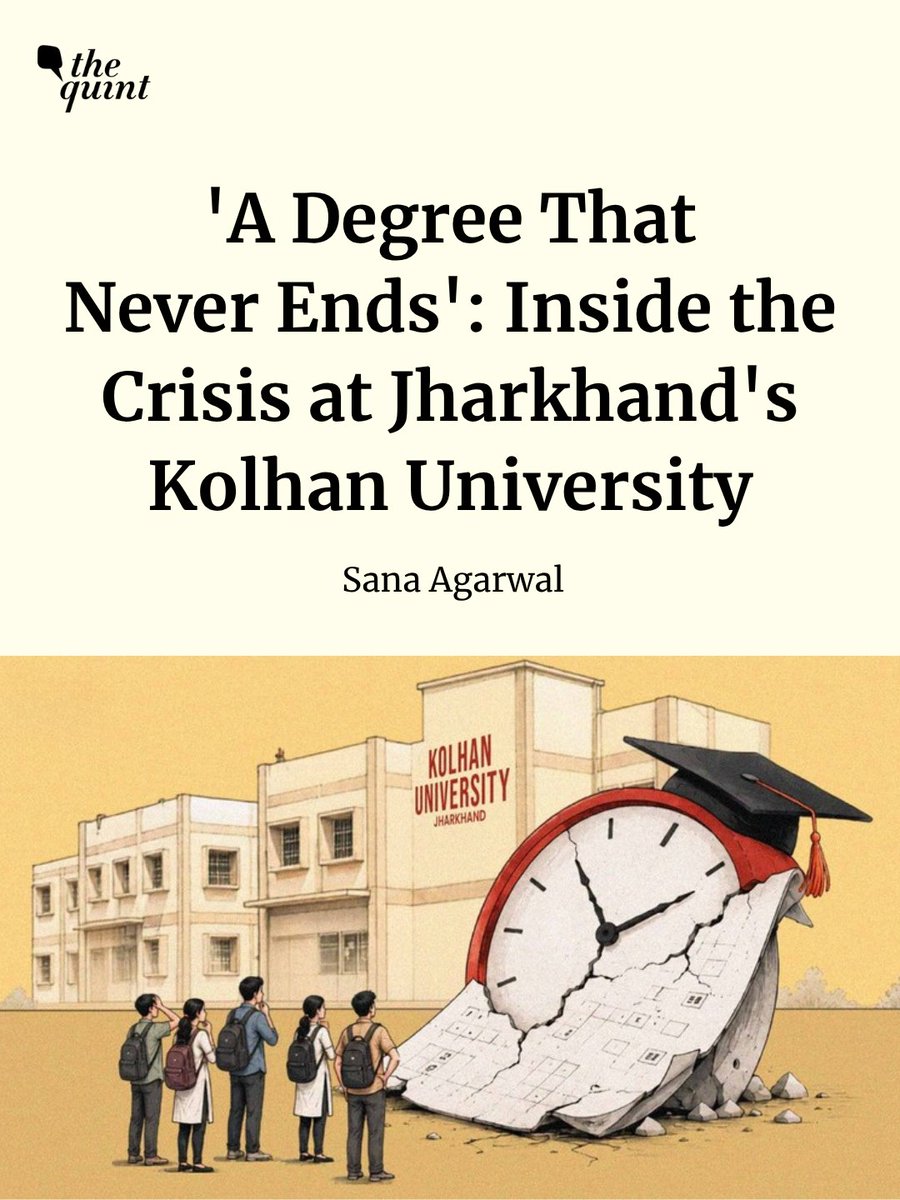
As of August 2026, the university's 2022-admitted batch, which was suppose to complete eight semesters by now, has only just attempted its sixth semester exams, a full graduating class behind schedule, a delay students attribute squarely to administrative failure.
#Students at #Jharkhand's Kolhan University protest against exam delays which caused loss of an entire academic year. Sana Agarwal reports.
Read the full report: https://t.co/ygMmqAscK2
It is more like a minilateral arrangement with a small group of states cooperating at the points where their interests and capabilities converge. @PulkitButtan writes.
Read: https://t.co/6hF4WYaViS
The protests breathed life back into India’s comatose democracy. What happens now? Does history foretell next steps? @Raghav_Bahl writes.
Read the latest Raghav's Take: https://t.co/5XIYi16nOn
Six layers of barricading. Barbed wire. Water cannons. Lathi-charges. Tear gas.
All of this stood between thousands of protesting students and the #Jharkhand Vidhan Sabha – on a march that was barely five kilometres long.
But every barricade was eventually breached.
What began as a Vidhan Sabha gherao march by students protesting alleged irregularities in Jharkhand’s #JPSC and #JSSC recruitment examinations turned into a day-long confrontation with the police. Students crossed multiple layers of barricading as police repeatedly used water cannons, lathi-charges and tear gas to stop them.
By evening, hundreds of protesters had made it to the Assembly. Some chose to sit in and refused to leave, demanding that the government agree to a CBI probe into the examinations.
Even after they reached the Vidhan Sabha, the confrontation continued, with protesters facing another round of lathi-charge at night.
@hey_eshwar reports.
After successfully gheraoing the Jharkhand Vidhan Sabha following a day-long confrontation with the police, a group of protesting students refused to leave the Assembly premises, demanding that the government order a CBI probe into alleged irregularities in JPSC and JSSC recruitment examinations.
Around 7–7:30 pm, police began forcibly removing the protesters from the Assembly premises. The students were lathi-charged as they were being taken out.
The confrontation had begun earlier in the day as thousands of students marched towards the Vidhan Sabha, crossing multiple layers of police barricading. Police used water cannons, lathi-charges and multiple rounds of tear gas to stop them from advancing. Despite the crackdown, hundreds eventually reached the Assembly and staged a gherao, refusing to leave until their demand for a CBI probe was addressed.
I have spent the day with Ranchi protesters while getting injured in Lathi charge, facing water canons, and witnessing tear gas shelling. All this, after thousands of students crossed barricades with barbed wires to reach the Vidhan Sabha.
In the next two minutes you'll see the number of layers of barricades that failed to stop the protesters.
First, they were stopped merely 50 Metres after the march began. After an hour of face off, they were allowed to move ahead. They marched, they ran.
Then came the second spot of barricades. That collapsed too.
Then came the biggest layer near the xx temple where tear gas truck and water canons were spotted for the first time. But they weren't used. This massive layer of barricades failed too..
Then came the 4th spot where the barricades had barbed wires. Protesters climbed the hill next to this spot to cross over.
Then came the fifth spot where the barricades had barbed wires again. Here the police used water canons for the first time. After they ran out of water, the protesters broke this layer too, to arrive at the final set of barricades. From this point on, the face off between two sides lasted several hours.
Two rounds of lathi charge, several rounds of tear gas shelling happened here. There were several altercations and heated tempers after the first Lathi charge. However, people found a way to reach the Vidhan Sabha. They took alternate routes, crossed fields, and hopped walls.
They reached the Vidhan Sabha gate raised slogans,and some of them declared that they won't leave until the government agrees for a CBI probe in the examinations.
After the crowd thinned and the sun set, another Lathi charge happened in which many were injured.
The biggest demand right now is one - a CBI probe in the examinations, until which the protest won't end.
The sentiment on the ground? - Hemant Soren has promised that this won't be like Delhi. Then why does it feel exactly like it?
The big question: If RBI can save so much money and has loads of cash on its hands, where is the need for someone downstream to pay for UPI? Like a toll-free highway, UPI oils India’s economic growth and its tab may as well be picked up by the RBI. That’s the suggestion from opposition parties like the Congress. @madversity writes.
Read the complete analysis: https://t.co/ZJZbURhS0L