@realEstateTrent They’ll lose major foot traffic.
IMO, huge reason for decreased sales was they removed all comfortable seating which made their locations a place to gather. Now folks don’t gather there. This pol will exacerbate attrition.
If you ever want to turn off your employment income (permanently or otherwise), you need to be able to answer 7 questions to set yourself up for life:
I spent the first 7 years of my career serving dozens of multi-millionaires approaching retirement or in retirement
Whatever you're striving for, the common thread is that the goal is to not be reliant on steady income from a traditional employer or "day job" and have complete control of your time
Fat FIRE, FIRE, CoastFIRE, Barista FIRE, Lean FIRE
^^Just open Reddit and you'll find any number of communities focused on how to achieve these goals
Very few people I work with are focused on a classic "retirement" (i.e. stop working completely at age 65 and sale off to a warm climate state to collect a pension i)
More often it's now focused on work optionality, financial independence, and ability to do whatever for “work” and not care about having a regular W-2 gig
After all, almost fully gone are the days of guaranteed pension streams, retiree medical plans, etc...
Social Security is a different story (for a different day), but for many folks it will be real money (think up to $4k+ per month with annual inflation adjustments)
Here are the 7 critical questions:
1) How will I spend my time?
Ask yourself: what do you want "retirement" to look like?
→ Golf at the country club 3-5x per week?
→ Traveling to as many countries as possible?
→ Volunteering?
→ Starting a coaching/mentoring business?
→ Hanging out on the beach and enjoying some well-deserved R&R?
→ Starting a formal charitable giving program?
^^All of these things will impact the way we craft a financial plan for someone
2) How will I manage cash flow?
I often like to take a "stair step" approach to planning for expenses in retirmement (with a few caveats)
Rather than planning for a flat annual spend (with COLA adjustments upward for inflation), we build in higher expenses in the beginning (research has shown differing trends here, but all else equal)
→ "Go-Go" Years:
This phase typically occurs right after "retirement", when retirees are usually in good health and have a desire to enjoy life to its fullest
They are often more active, traveling, pursuing hobbies, and engaging in social activities
This is a period of high activity and spending, as people often want to make the most of their newfound freedom
→ "Slow-Go" Years:
As you age, you may start to slow down due to age-related health issues or reduced energy levels
During this phase, there's often a noticeable decrease in the level of physical activity and travel
→ "No-Go" Years:
This is the later stage of life, often marked by significant health challenges and a much quieter lifestyle
Mobility might be limited, and you may require assistance with daily living
Financial resources are often directed more towards healthcare and assisted living than discretionary spending
3) How will I have enough $$$ to meet my lifestyle spending needs after my regular income goes away?
Most people are terrified of "shutting off" their income, and for good reason
You spend your entire life in accumulation mode and watching your net worth increase -- now it's time to draw down
That's why we work to replace people's income via all available sources
We might even try to replicate their paycheck when they leave their job so it's not a shock to their month to month
If they were used to getting $7k semi-monthly net pay, we simply send them $14k on the 1st of the month from the portfolio (if that's what they prefer)
There's a lot of debate about a sustainable withdrawal rate, which we won't get into here -- most planners are comfortable with a withdrawal rate between 4-6%
This is highly variable and subject to sequence of withdrawal risk with market volatility
There are a number of ways to build your way up to this monthly nut:
→ Pension/SS Income (if applicable)
There are some employers that still offer a pension plan
When you retire, you sometimes get the choice of taking a Lump Sum vs Annuity stream
The annuity stream might have different options (Single Life Annuity, Joint & Survivor, 10 Year Certain, etc)
→ Social Security
The Social Security Administration uses a formula to calculate the monthly benefit amount, based on a person's 35 highest-earning years
To receive the maximum benefit, a person needs to earn at least the maximum taxable amount for Social Security taxes for at least 35 years
This maximum taxable amount changes each year with changes in the national average wage index
🔹Collecting at Age 62:
This is the earliest age at which one can start receiving Social Security retirement benefits, but it comes with a reduction in the monthly benefit amount
The reduction is about 30% less than the full retirement age (FRA) benefit
🔹Collecting at Full Retirement Age (FRA):
The FRA varies depending on the year of birth
For people born in 1960 or later, the FRA is 67
If one starts collecting Social Security at their FRA, they receive 100% of their calculated benefit
🔹Collecting at Age 70:
If a person delays taking Social Security benefits past their FRA, their benefit increases via "delayed retirement credits"
I have an Aunt who decided to collect SS at 62 instead of waiting until Full Retirement Age
She knew she was leaving money on the table by not waiting until FRA or age 70 (your SS benefit increases by 8% every year you wait from FRA to Age 70)
She now uses that $$ to host her kids and grandkids in FL every year, and she covers the rental
This is how financial planning should be -- personal
→ Portfolio withdrawals
I call this the "liquidity funnel"
Your balance sheet should be constructed according to your goals, risk tolerance, capital needs, and time horizon
Regardless of accumulation phase or withdrawal phase, your account structure and portfolio mix should be calibrated accordingly
→ Passive income streams
🔹rental income
🔹higher yielding private investments
🔹dividends from the portfolio
🔹and many others...
One of the biggest mistakes I see is people focusing ONLY on creating passive income (dividends & interest) rather than accumulating assets and positioning their portfolio for total return
4) How will I manage my balance sheet and taxes?
Everyone talks about being "diversified", but what does it really mean?
I think about it in 3 ways:
→ Balance Sheet
(cash, after-tax investments, pre-tax retirement, Roth, real estate, etc.)
→ Asset Allocation
(stocks vs. bonds, US vs. Int'l, growth vs. value, etc.)
→ Liquid vs. Illiquid
(marketable securities vs. illiquid private investments & hard assets)
Managing taxes in withdrawal mode is CRITICAL
This is especially important when you have large, pre-tax retirement balances (401k, IRA, Defined Benefit plan, etc)
We run multi-decade tax projections to see where it might make sense to accelerate income and take advantage of lower tax brackets
Typically when you stop working full-time, your taxable income falls off a cliff:
This is before Social Security kicks in at 67/70 and Required Minimum Distributions (RMD's) kick in in your early 70's
I call this the post-retirement tax "valley"
If you're not soaking up low brackets during these years, it's a BIG missed opportunity (IRA withdrawals, Roth conversion, capital gain harvesting, etc)
Withdrawing from qualified retirement assets is an ordinary tax event
This means withdrawing $40k for a new car can really end up costing you $60k or more after taxes (!)
5) How will I solve for health insurance?
Health insurance for early retirees (those retiring before the age of 65, which is when Medicare eligibility begins in the United States) is often a significant issue
→ Lack of Employer-Sponsored Coverage:
Many individuals rely on their employer for health insurance
When they retire early, they lose this coverage and must find alternatives, which can be expensive and less comprehensive
→ High Cost of Private Insurance:
Private health insurance can be prohibitively expensive, especially for those in their 50s and early 60s
This age group is generally more likely to have health issues than younger people, leading to higher premiums
→ Medicare Ineligibility:
Medicare is the Federal health insurance program, is generally not available until age 65
Early retirees need to bridge the gap between their retirement age and Medicare eligibility with alternative coverage
6) What happens if I run out of money?
One thing that we haven't talked about is gauranteed income vehicles like annuities
I'm not a huge fan of the products, but they've gotten a lot better over the years
Annuities can be an important part of *certain* people's plans if there is a strong need/desire for guaranteed income for the rest of their lives
Do you have a backup plan? Living with children? Selling your house? Moving to a lower COL area?
What happens if you have a long-term care event?
7) What happens to my family if I'm not here?
I always recommend developing a comprehensive estate plan that addresses your wishes for wealth transfer, reduces estate taxes, and provides for the efficient management of assets in the event of incapacity or death
If you were hit by the proverbial bus tomorrow -- would spouse know how to access your money?
If not, you should strongly consider a detailed estate plan exercise
🔹Proper beneficiary designations
🔹Revocable living trust
🔹Last will & testament
🔹HIPAA authorizations
🔹Advanced medical directive
🔹Powers of attorney
🔹Irrevocable trusts (If necessary/desired while living)
🔹Charitable Bequests at death
Beyond the basics:
—Who should your family call when you pass?
—Where are the passwords saved?
—Who carries your life insurance?
—Who is the estate attorney
—Where are the bank accounts and investments?
Bottom line -- there's a LOT to consider when planning for financial independence and long-term wealth planning
Each person's situation is completely unique, and there are a lot of ways to approach things
A trusted partner in evaluating all of these areas can make or break your long-term plan for financial independence
If you enjoyed this...
1. Repost to share with your audience
2. Follow me on X for more personal finance content
3. Visit the Linktree in my bio for more information
4. DM me to connect
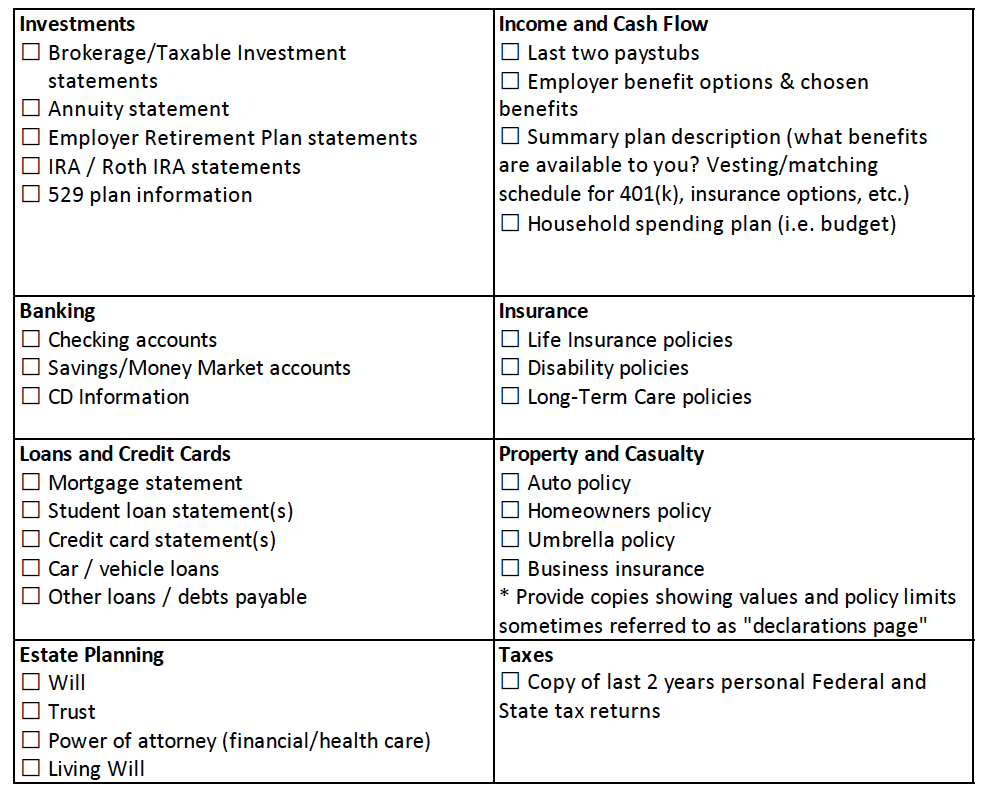
If I was going deep on a full financial plan exercise for a client, I would request the following documentation
Even just going through the exercise of *gathering* all of this information can be invaluable for financial housekeeping
2/n. This is huge in that people can buy the #Bitcoin ETF in their retirement accounts (401k, 453b, 457, IRA, etc.), pension funds can buy it, corporations can buy it, endowments, family offices, basically anyone and everyone.
A pro-privacy🧵...
1/x Just listened to another CLE event on the #CTA (Corporate "Transparency" Act) & new rules taking effect 1/1/24. This new law is a DRAMATIC overreach & acute infringement on privacy. EVERY existing US LLC created for private or small business is impacted...
@DDrolapas Actually, telling me I can’t message you. I have a great referral who can get mortgages for 3-4 units in SF. DM if interested in contact info.
@KrissBergTweets Not think about THIS: Is there a way to add electric car chargers where car is washed while it charges? Have a coffee shop/snack bar? Other entertainment/things while people wait for car charge/wash? Lots of other revenue streams possible.