Building the grid platforms the digital age needs - BESS + data centres + ultra-fast charging on Australia's constrained NEM. Foundation sites in NSW & SA.
Grid Capacity is the Scarce Asset.
Australia is building the wrong thing in the wrong places.
Grid connection queues are years long. AI compute needs power now. EVs need charging on freight corridors that have none.
We're building the platform that solves all three from one site. 🧵
1/ The bottleneck isn't generation. It's the grid. Connection queues, augmentation costs and constraint zones mean new demand can't just plug in. The wait is measured in years. That constraint is the opportunity.
2/ Our model: regional high-voltage platforms that stack three businesses on one connection:
Battery Energy Storage (grid-forming LFP)
Data Centres (battery-backed compute)
Ultra-fast transport charging (350kW+)
One site. One connection. Three revenue layers.
3/ Why that matters economically - three uncorrelated revenue layers:
i/ NEM Merchant - energy arbitrage + grid services (FCAS).
ii/ EV Charging Lease - capacity leased to operators.
iii/ Compute-as-a-service - AI inference & HPC workloads.
Merchant risk on one layer is cushioned by contracted income on the others.
4/ Why regional?
Because that's where land, grid headroom and freight corridors intersect - and where the constraints that block others become our moat.
Foundation portfolio secured in NSW and SA, expanding across the NEM in waves.
5/ The digital age runs on electricity.
AI data centres, electrified transport, an increasingly renewable grid that needs firming - all of it is a demand story for dispatchable, battery-backed power in the right locations.
We're building for that curve, not the last one.
6/ The roadmap is deliberately staged:
Months 1-6: foundation site's connections secured and engineering designs implemented --> build, energise, connect in waves.
Month 36: 100MW dispatchable, across multiple NEM regions.
7/ Why us: we sit at the intersection of energy, real assets and digital infrastructure - with a delivery-first mindset in a market where execution, not ideas, is the constraint.
8/ We're partnering with investors, infrastructure operators, charge-point operators and compute-intensive businesses to build this out.
If that's you --> [email protected].
Follow along as we build the network the digital age needs.
#DataCentres #DataCenters #EnergyTransition #NEM #BatteryStorage #EVCharging #AIInfrastructure #PrivateEquity #AI #DigitalInfrastructure
Australia's tax regime vs the US on entrepreneurship & VC
Australia says it wants an innovation economy. Our tax system says otherwise.
Compare how the two countries treat the people who take the risk:
🇺🇸 In the US, Qualified Small Business Stock (Section 1202) lets founders, early employees and investors pay ZERO federal capital gains tax on up to US$15M of gains per company. Congress just expanded it — the holding period dropped from 5 years to 3, and eligibility now covers companies with up to US$75M in assets. That's not a loophole. It's deliberate policy: back a startup early, hold on, keep the upside.
🇦🇺 In Australia, the same founder pays capital gains at marginal rates — up to 47% — softened only by the 50% CGT discount. And the May Budget proposes scrapping even that for assets acquired after July 2027, replacing it with indexation and a 30% minimum rate. The carve-out for "innovative startups"? A maze of eligibility tests, a 5-year holding requirement and a $10M lifetime cap — and your accountant gets to argue with the ATO about whether you're "innovative" enough.
Meanwhile, employee equity here is still taxed as income before there's any liquidity to pay the bill. In the US, an 83(b) election fixes that on day one.
The results follow the incentives. US VC investment runs at roughly 50x ours in absolute terms — and multiples of ours per capita.
Capital and talent are mobile. Founders don't need Australia. Australia needs founders.
We don't have a shortage of ideas. We have a tax system that treats a successful exit as a problem to be solved.
#startups #venturecapital #tax #australia #innovation
Electric heavy trucks will arrive in waves. The charging infrastructure on major freight routes needs to be there first.
Grid connection timelines are measured in years, not months. If we wait for the trucks to show up before we energise the sites, the transition stalls.
Build the high-power capacity on the corridors now — before the fleet arrives — and the economics and operations both work.
That’s the sequence that actually scales.
--> https://t.co/KLNoGojuhS
#ElectricTrucks #EnergyInfrastructure #RegionalAustralia
@blockspace@AnthropicAI The cost difference to build and operate a data centre in the US compared to other countries is staggering.
https://t.co/4V5cdWhq6x
@SawyerMerritt A country as big as Australia will need a huge buildout of ultra-fast charging stations to support the inevitable arrival of electric heavy vehicles.
Luckily, it's already underway.
https://t.co/mTAkPuf5LV
Electric heavy trucks will arrive in waves. The charging infrastructure on major freight routes needs to be there first.
Grid connection timelines are measured in years, not months. If we wait for the trucks to show up before we energise the sites, the transition stalls.
Build the high-power capacity on the corridors now — before the fleet arrives — and the economics and operations both work.
That’s the sequence that actually scales.
--> https://t.co/KLNoGojuhS
#ElectricTrucks #EnergyInfrastructure #RegionalAustralia
@wallstengine There is actually adequate grid capacity in Australia for AI compute demand. The real bottleneck will be the grid connection point.
That's why we are pursuing a distributed compute model.
https://t.co/FOw2yA0Rtl
https://t.co/4tLPvNnjaJ
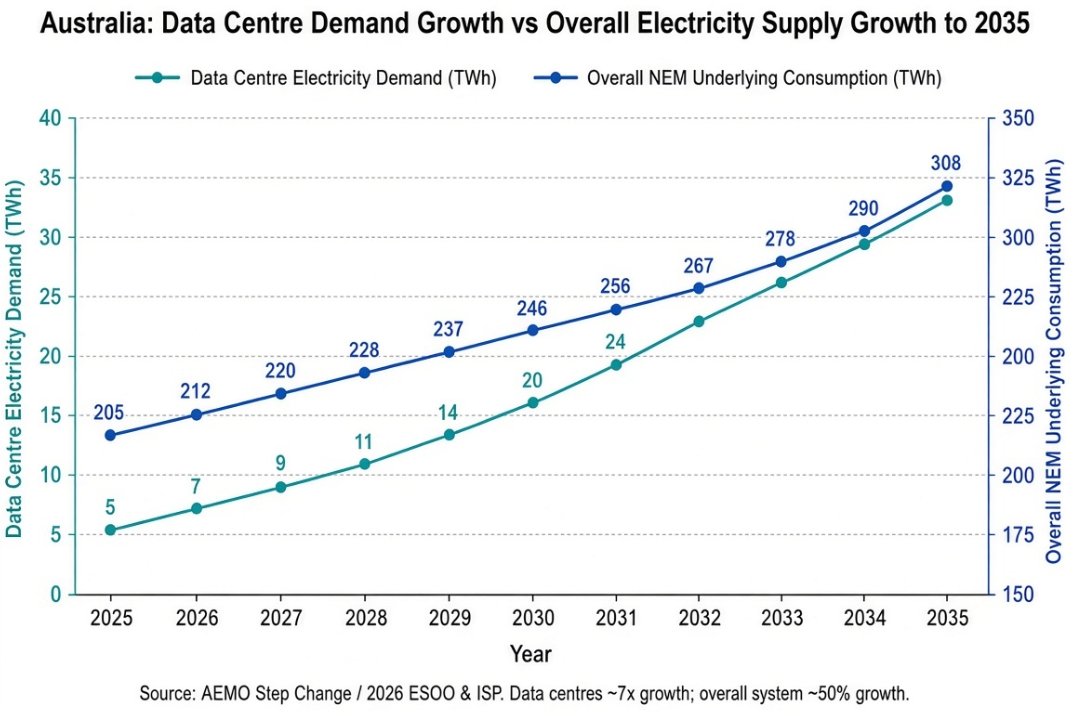
In Australia, data centre electricity demand is growing far faster than overall generation and consumption.
Under AEMO’s Step Change outlook:
1. Data centres: from ~5 TWh today to ~34 TWh by 2035-36 — roughly a 7× increase
2. Overall NEM underlying consumption: from ~205 TWh to ~308 TWh — about a 50% increase over the same period
Generation is being added at pace, but the rate of growth in data-centre load is several times higher than the growth rate of the system as a whole.
That differential is why connection queues, local augmentation costs and firm capacity in the right locations are becoming the binding constraints — not the absolute volume of new renewable generation.
The sites that can deliver firm, battery-backed capacity quickly will capture a disproportionate share of the next decade’s demand.
In Australia, data centre electricity demand is growing far faster than overall generation and consumption.
Under AEMO’s Step Change outlook:
1. Data centres: from ~5 TWh today to ~34 TWh by 2035-36 — roughly a 7× increase
2. Overall NEM underlying consumption: from ~205 TWh to ~308 TWh — about a 50% increase over the same period
Generation is being added at pace, but the rate of growth in data-centre load is several times higher than the growth rate of the system as a whole.
That differential is why connection queues, local augmentation costs and firm capacity in the right locations are becoming the binding constraints — not the absolute volume of new renewable generation.
The sites that can deliver firm, battery-backed capacity quickly will capture a disproportionate share of the next decade’s demand.
In Australia, data centre electricity demand is growing far faster than overall generation and consumption.
Under AEMO’s Step Change outlook:
1. Data centres: from ~5 TWh today to ~34 TWh by 2035-36 — roughly a 7× increase
2. Overall NEM underlying consumption: from ~205 TWh to ~308 TWh — about a 50% increase over the same period
Generation is being added at pace, but the rate of growth in data-centre load is several times higher than the growth rate of the system as a whole.
That differential is why connection queues, local augmentation costs and firm capacity in the right locations are becoming the binding constraints — not the absolute volume of new renewable generation.
The sites that can deliver firm, battery-backed capacity quickly will capture a disproportionate share of the next decade’s demand.
@wallstengine There is actually adequate grid capacity in Australia for AI compute demand. The real bottleneck will be the grid connection point.
That's why we are pursuing a distributed compute model.
https://t.co/FOw2yA0Rtl
https://t.co/4tLPvNnjaJ
The cost gap is real. Chinese models are delivering strong results for a fraction of the US price.
Sovereign AI doesn’t require reinventing every model. It requires the ability to run the best available open models — including Chinese ones — on infrastructure you control.
Distributed compute in Australia gives you that option: firm power, faster energisation, and capacity that stays local as you scale.
--> https://t.co/KLNoGojuhS
Performance is converging. Cost is not.
The countries that can run high-quality open models (including Chinese ones) on their own distributed infrastructure will have a durable advantage — lower cost, faster iteration, and genuine sovereignty.
That’s the layer that actually matters next.
--> https://t.co/KLNoGojuhS