The older website is still maintained, but I'll try to migrate everything on the new website while maintaining a clear structure. Definitively not an easy task.
Die shots and new articles will be posted on the new website.
Will need some cleaning, but was trying an objective I got some time ago (Nikon PlanApo 10x/0.45) with UV386nm and got a nice surprise with these colors.
High res map linked on this page: https://t.co/CfxJcTWQgR
Next I'll have to fix this leveling issue by moving the Z axis along the scanlines. Manual leveling at this numerical aperture is sadly too hard to perfectly focus a single layer.
Another continuous scan with the global shutter monochrome camera.
Texas Instrument 343S1147-3 PCI-Interface from the QuickDraw 3D accelerator graphics add-in card developed by Apple.
8x8mm, 7min30 using Olympus MPlanApo 20x/0.60 objective.
@qpostintel Some things are valid but yeah it's a mix of hallucination and trivial information from the datasheet.
If you want to learn anything the best is really to look at the datasheet. This one is very complete.
@whenihadoralsex@phratzke Second cool thing is I now have a PlanApo 60x/1.40 that have more resolving power than the 100x/1.25 I was using. So bigger field of view, faster captures.
But to compare apples with apples I'll try again with the 100x before. Very curious to see the new capture time.
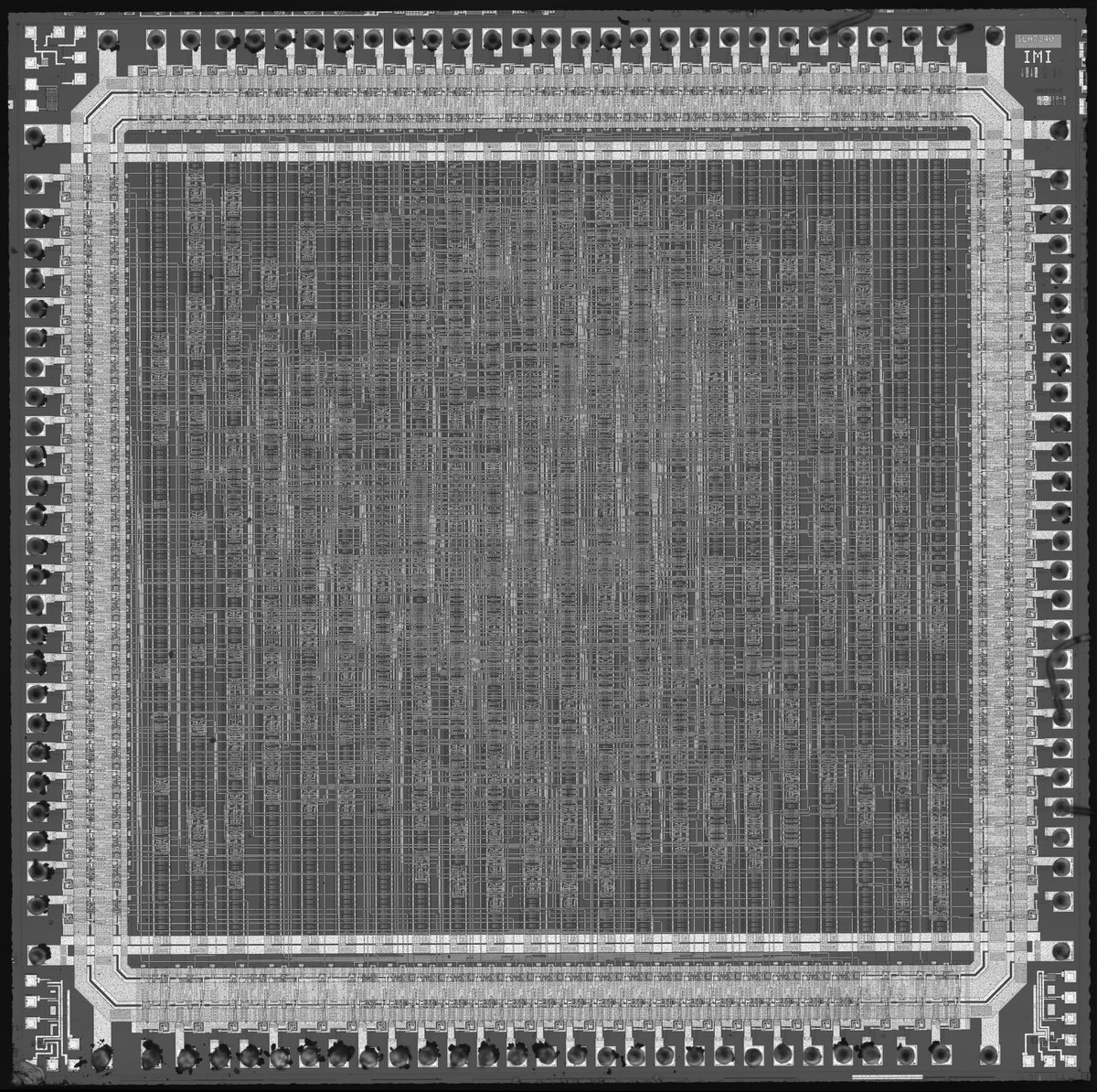
Experimenting continuous scanning with my global shutter camera. Took this 6x6mm die with a 20x/0.60 objective in 5 minutes instead of hours.
Main issue obviously is this is a monochrome camera. Now I want to strobe multiplexed R/G/B LEDs to get color images on the fly.
@whenihadoralsex@phratzke When I'm done with the colors, I'll try again.
Or at worse I'll work in monochrome.
But this time in theory I don't have to do a full 2.5d capture (40 focus stack), because fast captures => no focus drift. So I can take the layer I want in one go instead of capturing all focuses.
@smokee2es So the easy solution to multiplex to beam is just to add a beam splitter (90 deg) in the way, and to place a second led at 90 deg. This way you can combined two LEDs, but the tradeoff is that you lose 50% light of each LED.
@smokee2es By combining two dichroic of the right wavelengths you can get your very efficient multiplexed RGB light.
On mine I have the red light passing through 2 dichroic.
One dichroic is reflecting green and let red pass.
Second one reflect blue and let pass red and green.
@smokee2es A better solution is to replace this beam splitter by a dichroic that can let pass the wavelength of one led, and fully reflect the other LED. This way you only lose a few percent of light instead of 50% per LED.
@smokee2es Yes.
But there is also the fact that even if you manage to get some light (low magnification objectives) darkfield images looks very, very different.
Here you can see the silicon is bright. On darkfield images the silicon is basically black.
Darkfield is not good for RE.
@smokee2es Sadly multiplexing multiple wavelengths is very hard. Even with good dichroic mirrors you have some losses, and the more wavelengths you want to fit, the lower the light throughput. Also custom dichroic mirrors are just super expensive, so this is out of my budget.
@smokee2es This is why when you want to use light from the "sides" you want the light coming from all sides at the same time.
For that you either have a light ring (for low magnification) or darkfield objectives, like NeoSPlan or BD objectives.