One idea. Four formats.
Post the cheapest version with one clear claim.
Wait 48 hours. If it hits, expand into long-form with the mechanism + an example.
Cut that into a carousel (one idea per card).
Then strip it into a one-page follow-up sales can send after a call.
Spend 20% creating, 80% repackaging what worked. Invert it and you make more, land less.
Owned distribution is a boring idea that takes about eighteen months to pay and then never stops.
Rented:
• ads
• referrals
• a marketplace
• someone else's newsletter.
Access you pay for per unit and lose the day you stop paying.
Owned:
• your list
• your CRM
• your handles
• the relationships your team built and wrote down.
Most teams find out which one they have during the quarter they can least afford to find out.
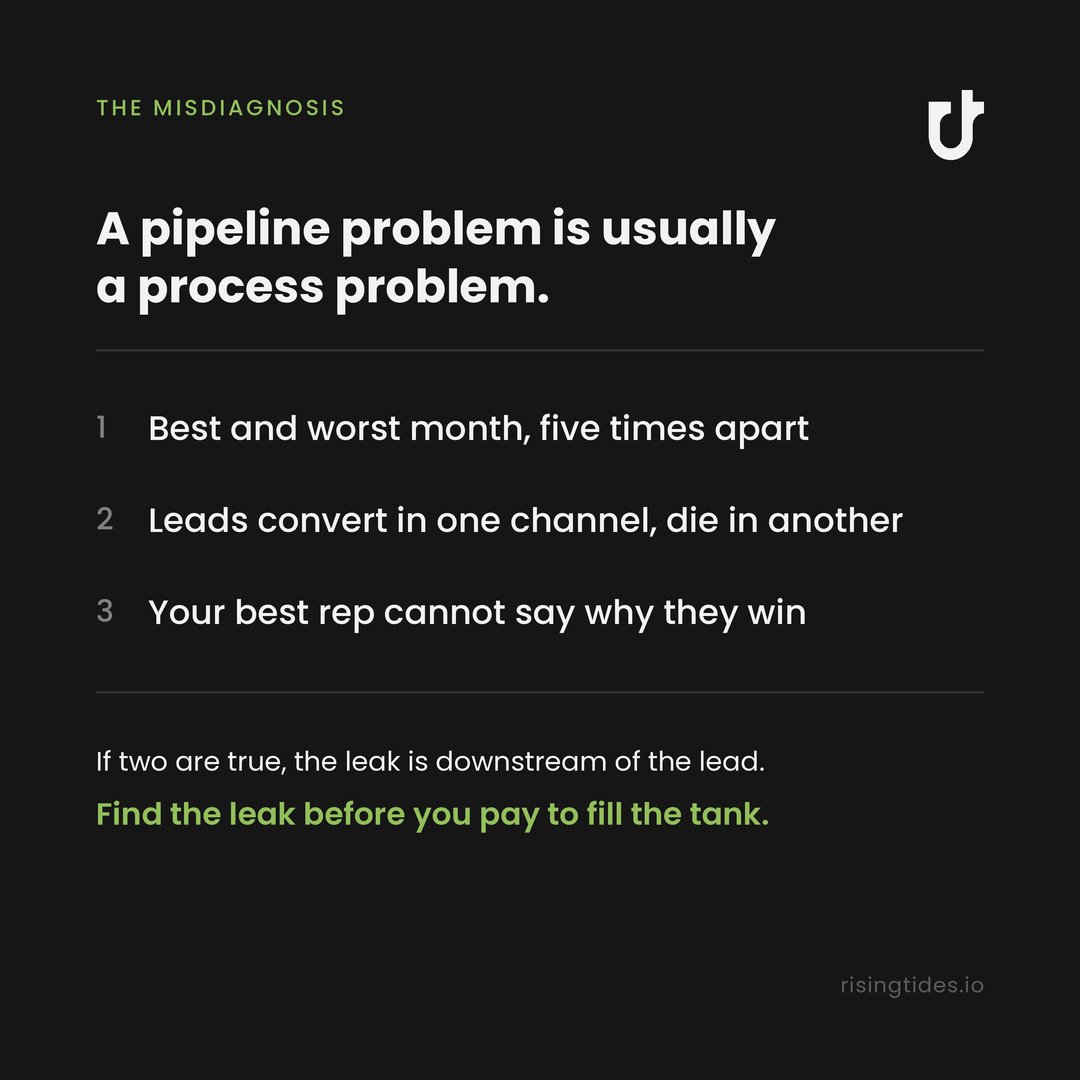
"We have a pipeline problem" is usually a misdiagnosis.
Three tells you are looking at a process problem instead:
1. Your best month and your worst month are five times apart, and nobody can explain why.
2. Leads convert in one channel and die in another, behind the same offer.
3. Your strongest rep cannot tell you why they win. They just do.
If two of those are true, the leak is downstream of the lead. More leads poured into a leaky system drain out faster.
Find the leak before you pay to fill the tank.
Execute, Analyze, Iterate, Document.
Three feel like progress. The fourth gets skipped and it’s the one that makes the others matter.
Documentation turns month-four ramp into week-one execution. It turns “our best rep is great” into “here’s the playbook.” It’s what buyers are really buying.
Skip it and you don’t have a system you have someone’s memory.
Write the stage definitions, routing rules, and follow-up sequence. That’s the D in E.A.I.D., and it’s how you build a machine.
"they built systems, not campaigns"
is the line in here doing all the work.
Every founder reading this has the same feed
the same algorithm
the same $0 to post.
Most accounts still go quiet by week six
because there is no documented process underneath the posting.
> One sequence per ICP, so the message matches the reader
> Every reply routed into the CRM with context attached
> Follow up owned by a name, not a shared inbox
Rising Tides is stacked for exactly this.
Owned distribution is the only real moat. The channel is just where it lives.
The typical cold email sender earns one reply per 135 contacts.
One client sent 36,814 emails at 40% open, and 28.86% of the replies came back positive.
Same market. The difference was the system. We map it on a 30-min audit: https://t.co/w5V9UF0b9b
We have run outbound for 275+ B2B companies.
The pipeline problems look different on the surface and run identical underneath: a dirty list, a slow handoff, or a funnel that leaks.
Fix the system and the numbers follow. They always have.
64% of cold email replies land within the first hour. The typical reply comes in about 10 minutes.
Follow-ups sent days later mostly reach people who already decided no.
Speed into the inbox, and speed on the reply, is most of the game.
The 2026 cold email benchmark confirmed what we see across 275+ campaigns.
The gap between the top 5% and the typical sender is not talent or luck. It is verified sending, a clean list, a short first email, and fast follow-up.
A system, repeated.